
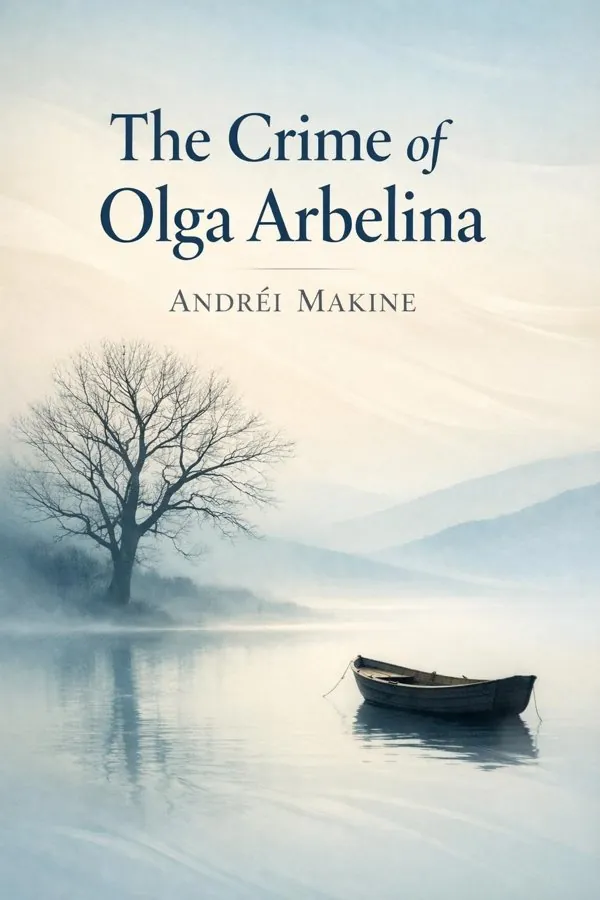
The Crime of Olga Arbelina: Summary & Key Insights
 10 min9 chaptersAudio available
Key Takeaways from The Crime of Olga Arbelina
A person can lose a country long before losing a home.
Love is not always liberating; sometimes it becomes the heaviest chain.
What we refuse to say does not disappear; it ferments.
Places are never neutral in Makine’s fiction; they absorb emotion and reflect inner states.
To confess is not always to be forgiven; sometimes it is only to stop hiding.
What Is The Crime of Olga Arbelina About?
The Crime of Olga Arbelina by Andreï Makine is a classics book spanning 5 pages. Andreï Makine’s The Crime of Olga Arbelina is a haunting literary novel about exile, memory, maternal devotion, and the unbearable pressure of a secret that can no longer remain buried. Set in a quiet French provincial town, the story follows Olga Arbelina, a former Russian aristocrat who has survived revolution, displacement, and social ruin, only to find herself trapped in a smaller, more intimate tragedy. Her life revolves around her fragile son, and as the novel unfolds, what first appears to be a portrait of lonely émigré existence becomes something darker and more morally unsettling. Makine transforms Olga’s private suffering into a meditation on guilt, love, and the strange ways the past continues to shape the present. The novel matters because it refuses easy judgments: it asks readers to confront how trauma distorts moral boundaries and how compassion can coexist with horror. Makine is uniquely suited to this subject. A Franco-Russian writer deeply concerned with memory, identity, and displacement, he brings both emotional intimacy and historical depth to Olga’s story, writing with lyrical precision and psychological insight.
This FizzRead summary covers all 9 key chapters of The Crime of Olga Arbelina in approximately 10 minutes, distilling the most important ideas, arguments, and takeaways from Andreï Makine's work. Also available as an audio summary and Key Quotes Podcast.
The Crime of Olga Arbelina
Andreï Makine’s The Crime of Olga Arbelina is a haunting literary novel about exile, memory, maternal devotion, and the unbearable pressure of a secret that can no longer remain buried. Set in a quiet French provincial town, the story follows Olga Arbelina, a former Russian aristocrat who has survived revolution, displacement, and social ruin, only to find herself trapped in a smaller, more intimate tragedy. Her life revolves around her fragile son, and as the novel unfolds, what first appears to be a portrait of lonely émigré existence becomes something darker and more morally unsettling. Makine transforms Olga’s private suffering into a meditation on guilt, love, and the strange ways the past continues to shape the present. The novel matters because it refuses easy judgments: it asks readers to confront how trauma distorts moral boundaries and how compassion can coexist with horror. Makine is uniquely suited to this subject. A Franco-Russian writer deeply concerned with memory, identity, and displacement, he brings both emotional intimacy and historical depth to Olga’s story, writing with lyrical precision and psychological insight.
Who Should Read The Crime of Olga Arbelina?
This book is perfect for anyone interested in classics and looking to gain actionable insights in a short read. Whether you're a student, professional, or lifelong learner, the key ideas from The Crime of Olga Arbelina by Andreï Makine will help you think differently.
- ✓Readers who enjoy classics and want practical takeaways
- ✓Professionals looking to apply new ideas to their work and life
- ✓Anyone who wants the core insights of The Crime of Olga Arbelina in just 10 minutes
Want the full summary?
Get instant access to this book summary and 100K+ more with Fizz Moment.
Get Free SummaryAvailable on App Store • Free to download
Key Chapters
A person can lose a country long before losing a home. That is the emotional foundation of Olga Arbelina’s life. Makine places her in a quiet French village not simply to show that she lives far from Russia, but to reveal what exile does to the self. Olga is not merely an immigrant adjusting to a new place; she is a survivor of a vanished world. The Russian aristocratic culture that once gave her language, ritual, and social meaning has been swept away by history, leaving her suspended between memory and irrelevance.
In practical terms, Makine shows exile as a daily erosion. Olga’s surroundings are stable, even dull, yet within her, old loyalties, habits, and grief continue to burn. She cannot fully belong to France, but the Russia she carries inside her no longer exists except as memory. This split identity creates a profound loneliness. She is visible in the village, yet unreadable to those around her. Her silence is not mystery for its own sake; it is the consequence of having no audience that can understand the full weight of what she has lost.
This idea reaches beyond the novel. Many people experience softer forms of exile: moving to a new country, changing class, losing a profession, or leaving a family system that once defined them. In each case, the old self lingers even when the external world has moved on. Makine reminds us that adaptation is not always healing; sometimes it is a mask worn over an unassimilated past.
Actionable takeaway: Reflect on one identity you have outgrown or been forced to leave behind, and ask what part of it still silently shapes your present life.
Love is not always liberating; sometimes it becomes the heaviest chain. In Olga’s life, motherhood is both her last reason to go on and the source of her deepest torment. Her son is not simply a child she cares for; he is the center of her existence, the final thread connecting her to purpose, tenderness, and obligation. Yet because he is mentally disabled and deeply dependent, this bond is marked by exhaustion, pity, protectiveness, and despair.
Makine refuses sentimental simplifications. He does not portray maternal love as pure, effortless sacrifice. Instead, he shows how caregiving can become emotionally consuming, especially when the mother is isolated, financially precarious, and haunted by an irretrievable past. Olga’s devotion to her son contains genuine love, but also loneliness, grief, and a suffocating sense of destiny. She cannot imagine abandoning him, yet she also cannot imagine a future in which either of them is truly free.
The power of this theme lies in its moral complexity. Parents, caregivers, and even adult children caring for elders may recognize parts of Olga’s condition: the confusion of love with duty, the guilt of resenting what one faithfully serves, and the fear of being judged for feelings that are more human than noble. Makine invites readers to see caregiving not as a simple virtue but as a terrain where compassion and collapse can coexist.
Actionable takeaway: If you are responsible for someone vulnerable, honestly name both the love and the strain involved, and seek support before silence turns devotion into despair.
What we refuse to say does not disappear; it ferments. One of the most important dimensions of The Crime of Olga Arbelina is the way memory operates through silence. Olga’s life is built around what remains unspoken: the traumas of revolution, the humiliations of exile, and the intimate secret at the center of the novel. Makine suggests that silence can begin as a survival mechanism. Some experiences are too painful, too shameful, or too incomprehensible to articulate. But over time, that silence becomes a prison.
Olga’s memories are not organized into a clear narrative she can explain to others. They return in fragments, atmospheres, and emotional reactions. This is psychologically true to trauma: the past often survives less as orderly recollection than as recurring pressure. The result is that Olga does not simply remember; she inhabits remembrance. Her present is filtered through what she cannot stop reliving and cannot bring herself to confess.
This pattern has real-world resonance. Families often carry generational silences around war, abuse, loss, migration, addiction, or mental illness. Such silence may preserve dignity on the surface, but it often transmits confusion and pain beneath it. Makine does not argue that every truth should be publicly exposed, yet he does show that secrecy extracts a cost. The unspoken shapes relationships, distorts identity, and narrows the possibility of peace.
Actionable takeaway: Notice one recurring pain in your life that remains unnamed, and consider whether putting it into words, privately or with a trusted listener, might lessen its power.
Places are never neutral in Makine’s fiction; they absorb emotion and reflect inner states. In this novel, the calm French landscape is not merely a backdrop to Olga’s life. Its stillness, routine, and provincial modesty intensify the drama of what she carries inside. The village appears orderly and quiet, but that calm only sharpens the contrast with Olga’s inner wreckage. The physical world becomes a mirror in which the hidden life of exile, loss, and dread is made more visible.
Makine’s use of setting also reveals the slow violence of time. The great historical convulsions that uprooted Olga are over, yet their consequences continue in small, ordinary spaces: rooms, roads, gardens, seasonal changes. This is part of the novel’s brilliance. Instead of staging trauma in moments of public spectacle, Makine lets it settle into daily life. The passing of time does not erase the past; it layers it. Every quiet scene contains the echo of another world now gone.
Readers can apply this insight beyond literature. We often assume that healing comes automatically with distance, routine, or a change of scenery. But new surroundings may simply provide a sharper frame for old pain. A peaceful environment can expose rather than soothe what remains unresolved. Likewise, familiar places in our own lives can become containers for memory, carrying emotional significance far beyond their practical use.
Actionable takeaway: Pay attention to one place that reliably changes your emotional state, and ask what memories or unresolved experiences that setting may be silently holding for you.
To confess is not always to be forgiven; sometimes it is only to stop hiding. The title of the novel points toward wrongdoing, but Makine is less interested in legal judgment than in the psychological and spiritual meaning of confession. Olga’s burden is not only that she has committed an act that violates moral boundaries, but that she has had to live afterward in a world where no explanation can fully excuse it. Her crime is bound up with love, pity, desperation, and fate, making it resistant to simple condemnation or defense.
This complexity is what gives the novel its force. Makine does not offer redemption as a neat narrative reward. Instead, he explores whether speaking the truth about oneself can restore a measure of dignity even when innocence is impossible. Confession in this sense is not transactional. It does not guarantee absolution from society, religion, or the self. Rather, it is an attempt to move from mute suffering to moral recognition.
In ordinary life, people often avoid confession because they imagine it must produce immediate reconciliation. But many truths do not resolve so cleanly. Admitting harm, dependency, betrayal, or failure may not repair the damage. Even so, honest acknowledgment can mark the beginning of responsibility. Makine’s insight is that redemption is less about being declared pure than about refusing to live inside total self-deception.
Actionable takeaway: If there is a truth you keep postponing, ask not whether confession will fix everything, but whether continuing to hide it is costing you more than facing it.
Extreme suffering does not erase morality, but it can alter the conditions under which moral choices are made. This is one of the most unsettling truths in The Crime of Olga Arbelina. Makine asks readers to confront the possibility that under the pressure of isolation, grief, dependency, and long-term trauma, people may cross lines they once believed absolute. Olga’s story is disturbing precisely because her actions cannot be separated from the emotional and historical wreckage that formed her.
Makine does not excuse wrongdoing through psychology, yet he insists that judgment without context is shallow. Olga is neither monster nor martyr. She is a person shaped by revolution, exile, loneliness, and a caregiving burden that has consumed her sense of self. This moral ambiguity is central to the novel’s power. The reader is pushed into an uncomfortable position: to understand without fully acquitting, to feel compassion without denying harm.
This matters outside fiction because modern life often encourages instant verdicts. We like clear categories, especially when faced with disturbing behavior. But literature can train moral attention by slowing us down. It reminds us that explanation is not the same as justification, and that human beings often act from tangled motives rather than pure intentions. Such complexity does not weaken ethics; it deepens it.
Actionable takeaway: The next time you encounter a troubling action, pause before making a final judgment and ask what history, pressure, or hidden suffering may have shaped it without denying responsibility.
History is not only remembered in stories; it is stored in posture, ritual, taste, and reflex. Makine is especially sensitive to the way Olga’s vanished aristocratic world persists in her manner of living. Even in diminished circumstances, traces of breeding, etiquette, aesthetic memory, and emotional discipline remain. These remnants do not restore her former life, but they show how deeply identity can be embodied.
This is an important insight because it expands the novel beyond plot. Olga does not merely think about the past; she performs it in fragments, sometimes consciously, sometimes not. A gesture, a way of speaking, a response to vulgarity, a relationship to objects or clothing: all of these become carriers of a lost civilization. At the same time, such habits intensify her estrangement. What once signaled belonging now marks difference. Her refinement offers dignity, but also isolates her further from the pragmatic world around her.
Many readers will recognize this dynamic in less dramatic forms. Class background, family culture, religious upbringing, or national origin often survive in small embodied habits long after outward circumstances change. These patterns can be sources of strength, embarrassment, nostalgia, or alienation. Makine shows that such details matter because they reveal the layers of selfhood that reason alone cannot reorganize.
Actionable takeaway: Identify one habit or reflex that comes from your past rather than your current life, and consider whether it is helping you preserve meaning or keeping you trapped in an identity you no longer need.
Some of the saddest books are also the most beautiful, because beauty can make suffering more visible rather than less. Makine’s prose is lyrical, restrained, and atmospheric, and that style is not ornamental. It performs one of the novel’s deepest ideas: human pain does not cancel the world’s beauty, and beauty does not redeem pain. The two often exist side by side, creating a tension that makes Olga’s story even more piercing.
This matters because readers might expect a novel about guilt, disability, exile, and moral transgression to be relentlessly bleak. Instead, Makine offers moments of sensory richness and emotional subtlety. The changing seasons, remembered elegance, fleeting tenderness, and delicate observations of place do not soften the tragedy. They intensify it by showing what remains perceptible even in a broken life. Olga is not deadened. She still notices beauty, and that capacity makes her suffering more, not less, human.
In practical terms, the novel suggests that aesthetic attention can be a form of witness. To describe pain beautifully is not to prettify it, but to resist reducing life to damage alone. This has relevance far beyond literature. People enduring grief or hardship are not served only by analysis and problem-solving; they also need language, art, and forms of attention that preserve complexity.
Actionable takeaway: When facing a painful period, deliberately record one beautiful detail each day, not to deny the hardship, but to keep your inner world from being flattened by it.
The hardest compassion is not tenderness toward the innocent, but attention to the morally compromised. The Crime of Olga Arbelina ultimately challenges readers to practice a more demanding kind of understanding. Olga’s circumstances invite sympathy, yet her actions disturb that sympathy. Makine structures the novel so that readers must live inside contradiction: pity and alarm, intimacy and repulsion, sorrow and judgment.
This is not a trick. It is the ethical achievement of the book. Rather than asking us to excuse Olga, Makine asks whether we can remain attentive to her humanity without simplifying what she has done. Such reading becomes a moral exercise. We learn that compassion is not agreement, and that condemnation alone can be a way of protecting ourselves from difficult truths about vulnerability, dependency, and the fragility of moral certainty.
Applied to everyday life, this idea is deeply useful. In families, workplaces, and public life, we often choose between two inadequate responses: sentimental absolution or total denunciation. Makine models a third approach. We can acknowledge harm, maintain boundaries, and still remain curious about the suffering that produced a person’s distortions. That kind of compassion is not weakness. It is disciplined moral seriousness.
Actionable takeaway: In your next conflict, try describing the other person’s pain or fear as accurately as possible before deciding what judgment or boundary is necessary.
All Chapters in The Crime of Olga Arbelina
About the Author
Andreï Makine is a Franco-Russian writer born in 1957 in Krasnoyarsk, Siberia. Raised within Russian culture and later established in France, he has built a distinctive literary career by writing in French while drawing deeply on Russian history, memory, and sensibility. His work often explores exile, identity, nostalgia, and the emotional consequences of political upheaval. Makine achieved international acclaim with Le Testament français, published in English as Dreams of My Russian Summers, which won both the Prix Goncourt and the Prix Médicis. He is celebrated for his lyrical prose, psychological subtlety, and ability to unite intimate personal stories with larger historical forces. In novels such as The Crime of Olga Arbelina, Makine examines how displacement and memory shape moral life, making him one of the most compelling voices in contemporary literary fiction.
Get This Summary in Your Preferred Format
Read or listen to the The Crime of Olga Arbelina summary by Andreï Makine anytime, anywhere. FizzRead offers multiple formats so you can learn on your terms — all free.
Available formats: App · Audio · PDF · EPUB — All included free with FizzRead
Download The Crime of Olga Arbelina PDF and EPUB Summary
Key Quotes from The Crime of Olga Arbelina
“A person can lose a country long before losing a home.”
“Love is not always liberating; sometimes it becomes the heaviest chain.”
“What we refuse to say does not disappear; it ferments.”
“Places are never neutral in Makine’s fiction; they absorb emotion and reflect inner states.”
“To confess is not always to be forgiven; sometimes it is only to stop hiding.”
Frequently Asked Questions about The Crime of Olga Arbelina
The Crime of Olga Arbelina by Andreï Makine is a classics book that explores key ideas across 9 chapters. Andreï Makine’s The Crime of Olga Arbelina is a haunting literary novel about exile, memory, maternal devotion, and the unbearable pressure of a secret that can no longer remain buried. Set in a quiet French provincial town, the story follows Olga Arbelina, a former Russian aristocrat who has survived revolution, displacement, and social ruin, only to find herself trapped in a smaller, more intimate tragedy. Her life revolves around her fragile son, and as the novel unfolds, what first appears to be a portrait of lonely émigré existence becomes something darker and more morally unsettling. Makine transforms Olga’s private suffering into a meditation on guilt, love, and the strange ways the past continues to shape the present. The novel matters because it refuses easy judgments: it asks readers to confront how trauma distorts moral boundaries and how compassion can coexist with horror. Makine is uniquely suited to this subject. A Franco-Russian writer deeply concerned with memory, identity, and displacement, he brings both emotional intimacy and historical depth to Olga’s story, writing with lyrical precision and psychological insight.
More by Andreï Makine


You Might Also Like





Browse by Category
Ready to read The Crime of Olga Arbelina?
Get the full summary and 100K+ more books with Fizz Moment.