
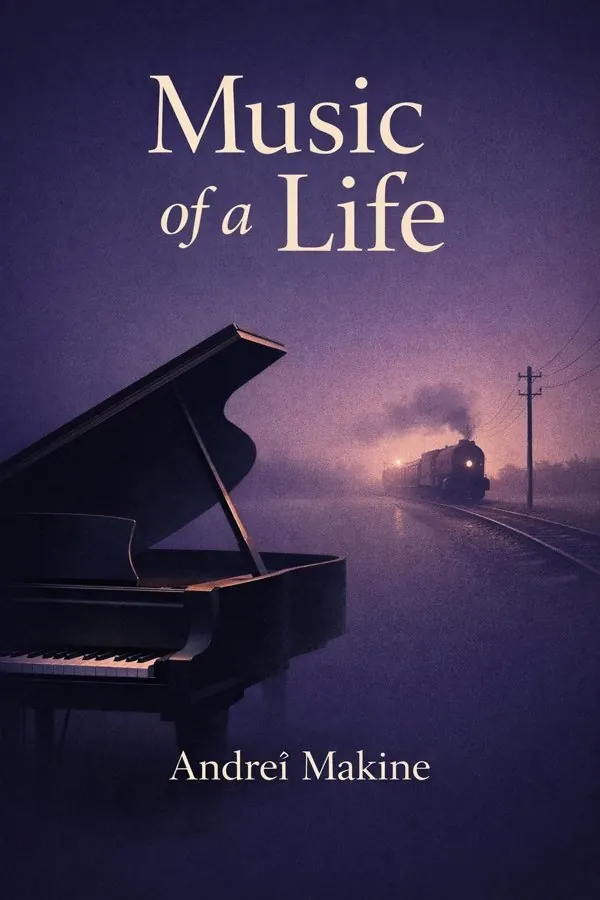
Music of a Life: Summary & Key Insights
 10 min9 chaptersAudio available
Key Takeaways from Music of a Life
Sometimes the most important stories arrive disguised as accidents.
Talent can feel like destiny—until history interrupts.
One of the novel’s harshest truths is that large political events do not remain abstract; they invade individual lives with brutal intimacy.
When reality becomes unbearable, anonymity can feel like salvation.
Silence is not always emptiness; sometimes it is a life sentence.
What Is Music of a Life About?
Music of a Life by Andreï Makine is a classics book spanning 6 pages. Some novels tell a story; others preserve a vanished world. Music of a Life by Andreï Makine does both with remarkable grace. This short, haunting work begins with a chance meeting in a remote Russian train station, where a narrator encounters an elderly man whose quiet dignity conceals a life shattered by war, Stalinist repression, exile, and long silence. As the old man recounts his past, we discover that he was once a gifted pianist, a young artist destined for greatness before history intervened and redirected his life into obscurity. What follows is not only a personal tragedy but a meditation on how political violence enters the most intimate parts of existence, breaking vocations, identities, and dreams. Yet Makine also shows that art can survive where institutions and ambitions fail. A musician may lose the stage, the audience, even the instrument, and still carry music within. Makine, a Franco-Russian writer celebrated for his lyrical prose and deep engagement with memory, identity, and displacement, brings unusual authority to this story. The result is a classic of compressed emotional power: tender, devastating, and unforgettable.
This FizzRead summary covers all 9 key chapters of Music of a Life in approximately 10 minutes, distilling the most important ideas, arguments, and takeaways from Andreï Makine's work. Also available as an audio summary and Key Quotes Podcast.
Music of a Life
Some novels tell a story; others preserve a vanished world. Music of a Life by Andreï Makine does both with remarkable grace. This short, haunting work begins with a chance meeting in a remote Russian train station, where a narrator encounters an elderly man whose quiet dignity conceals a life shattered by war, Stalinist repression, exile, and long silence. As the old man recounts his past, we discover that he was once a gifted pianist, a young artist destined for greatness before history intervened and redirected his life into obscurity. What follows is not only a personal tragedy but a meditation on how political violence enters the most intimate parts of existence, breaking vocations, identities, and dreams. Yet Makine also shows that art can survive where institutions and ambitions fail. A musician may lose the stage, the audience, even the instrument, and still carry music within. Makine, a Franco-Russian writer celebrated for his lyrical prose and deep engagement with memory, identity, and displacement, brings unusual authority to this story. The result is a classic of compressed emotional power: tender, devastating, and unforgettable.
Who Should Read Music of a Life?
This book is perfect for anyone interested in classics and looking to gain actionable insights in a short read. Whether you're a student, professional, or lifelong learner, the key ideas from Music of a Life by Andreï Makine will help you think differently.
- ✓Readers who enjoy classics and want practical takeaways
- ✓Professionals looking to apply new ideas to their work and life
- ✓Anyone who wants the core insights of Music of a Life in just 10 minutes
Want the full summary?
Get instant access to this book summary and 100K+ more with Fizz Moment.
Get Free SummaryAvailable on App Store • Free to download
Key Chapters
Sometimes the most important stories arrive disguised as accidents. Music of a Life opens in a bleak railway station, submerged in snow, fatigue, and the anonymous movement of travelers. In this setting of delay and discomfort, the narrator meets an elderly man whose composure stands apart from the surrounding disorder. He is not dramatic, not eager to impress, and not obviously remarkable. Yet his silence has weight. Makine uses this encounter to introduce one of the book’s central ideas: every ordinary face may conceal an epic of survival.
The station matters because it is a place of transition. People pass through without truly seeing one another, just as history often moves on without remembering those it has damaged. The narrator’s willingness to remain, listen, and attend transforms the scene. A conversation that might have remained trivial becomes an act of witness. The old man’s story emerges gradually, not as confession but as something earned through patience. This structure reminds us that truth is often fragile. People shaped by trauma rarely announce themselves; they reveal themselves only when met with respect.
In practical terms, the novel invites readers to reconsider their own encounters with others. A co-worker who seems reserved, an older relative who repeats certain memories, or a stranger whose bearing suggests untold experience may be carrying a history far richer than appearances suggest. Deep listening, rather than quick interpretation, becomes a moral skill.
Makine’s opening also prepares us for the contrast between public insignificance and private grandeur. The old man appears to be merely another traveler, but he once stood on the threshold of artistic brilliance. The distance between those two realities is the very subject of the novel.
Actionable takeaway: practice deliberate attention in everyday conversations; ask one sincere question and listen long enough for the real story to begin.
Talent can feel like destiny—until history interrupts. In the old man’s recollections, we encounter a youth shaped by culture, discipline, and belief in the future. As a young pianist, he is not simply skilled; he is formed within a world that still trusts refinement, education, and artistic achievement. Conservatory training, family support, and the social prestige surrounding classical music all suggest a life moving toward recognition. Makine portrays this period with tenderness because it represents more than personal promise. It is a fragile civilization of manners, aspiration, and beauty before catastrophe descends.
The novel does not romanticize talent as effortless genius. Music here is work, repetition, sensitivity, and devotion. The young pianist’s identity is inseparable from his craft. To play is not a hobby but a way of inhabiting the world. This matters because when later events destroy his musical path, they do not merely alter his career; they rupture his sense of self. Makine therefore explores how vocations become entwined with dignity, memory, and meaning.
Modern readers can recognize the pattern even outside the arts. A student preparing for medicine, an athlete training for elite competition, or an entrepreneur building a company may also invest so much of themselves in one path that disruption feels existential. The book does not advise emotional detachment, but it does caution us against assuming that promise guarantees fulfillment.
At the same time, youth in Music of a Life is not presented as naive. It is luminous precisely because we know how vulnerable it is. The old man’s remembered early life gives emotional force to everything that follows. We mourn not only what happened but what might have been.
Actionable takeaway: honor your gifts fully, but build an identity rooted in values and inner life, not only in the future you expect to achieve.
One of the novel’s harshest truths is that large political events do not remain abstract; they invade individual lives with brutal intimacy. War, repression, forced displacement, and suspicion enter the pianist’s life not as distant headlines but as forces that alter where he can go, whom he can trust, and whether his art has any place in the world. Makine shows that twentieth-century Russian history did not merely create ideological conflict; it reordered personal destiny at the deepest level.
The pianist’s story illustrates how systems of power destroy in indirect as well as direct ways. Not every victim is imprisoned or executed. Some are rendered invisible, diverted from their vocation, cut off from institutions, or forced into survival roles that make their former identity seem impossible. In this sense, the old man becomes emblematic of countless lives deformed by history without entering official records. His ruined musical career represents all the unrealized books, discoveries, friendships, and loves that oppressive systems extinguish before they can fully exist.
This idea remains relevant far beyond the Soviet context. Political instability, war, censorship, migration, and economic collapse continue to interrupt lives across the world. A gifted teacher may become a refugee. A scientist may become a laborer. An artist may abandon creation to protect family. Makine urges us to understand biography not as pure individual choice but as something vulnerable to historical violence.
The novel also counters comforting narratives about resilience. Yes, people survive. But survival often carries loss that cannot be repaired. To acknowledge that is not pessimism; it is moral clarity.
Actionable takeaway: when judging your own path or that of others, account for the historical forces shaping opportunity, and cultivate compassion for lives that look unfinished from the outside.
When reality becomes unbearable, anonymity can feel like salvation. As war and repression close around him, the pianist is pushed into a state where survival requires erasure. The promising young artist does not simply suffer misfortune; he is driven away from the world in which his talent had meaning. In place of performance, acclaim, and disciplined artistic growth comes concealment, improvisation, and the constant need to adapt. Makine captures how trauma does not always produce dramatic breakdown. Often it produces disappearance.
The phrase “flight into oblivion” captures more than physical movement. It suggests a retreat from recognition, from biography, even from one’s own former name. For someone whose life was built around public interpretation of music, this retreat is particularly cruel. Art asks for expression; repression rewards invisibility. The pianist’s escape is therefore double-edged: it saves his body while burying the self he had been becoming.
This tension appears in many lives. People leaving abusive homes, political dissidents changing countries, or workers accepting far lesser roles after crisis often know that safety may require letting go of cherished ambitions. Such decisions can look passive from the outside, but Makine shows their cost. To survive is an achievement, yet survival may demand forms of self-betrayal forced by circumstance.
Importantly, the novel does not frame oblivion as weakness. It is an adaptation to terror. But Makine also makes clear that what is buried does not vanish. Memory remains active underground, preserving pain and possibility alike.
Readers can apply this insight by recognizing that periods of retreat, silence, or apparent stagnation may mask intense inner struggle. People may not be lazy or defeated; they may be preserving themselves.
Actionable takeaway: if life forces you into a season of survival, do not confuse temporary concealment with permanent failure; protect what matters inwardly until conditions allow it to reemerge.
Silence is not always emptiness; sometimes it is a life sentence. After the rupture of his early promise, the pianist enters a long period defined by obscurity, distance, and the inability to live openly as the person he once was. Makine treats exile not only as geographic displacement but as spiritual estrangement. A man can remain within his country and still be exiled from his own life if the conditions that gave it meaning have been destroyed.
The old man’s silence is especially moving because it accumulates over years. He does not simply stop speaking of music; he lives in a world where speaking of it would change nothing. This is one of the novel’s deepest insights: grief often becomes quiet not because it is healed, but because it has outlived the expectation of being understood. Silence hardens into habit. Identity retreats inward. The self survives in fragments of memory rather than in public action.
Many readers will recognize lesser versions of this experience. Someone who once wanted to be a writer may stop mentioning it after years in unrelated work. An immigrant may stop telling stories from home because no one around them grasps their significance. A widow may cease speaking her partner’s name not from forgetfulness but from exhaustion. In each case, silence can hide loyalty, pain, and unresolved love.
Makine’s portrayal also challenges modern cultures that prize constant self-expression. Not every truth can be narrated on demand. Some experiences require trust, time, and an attentive listener before they can be spoken.
By giving the old man a witness at last, the novel turns narration into restoration. He cannot recover his lost years, but he can resist total erasure by telling them.
Actionable takeaway: revisit one silent part of your life—a neglected dream, grief, or forgotten identity—and give it expression in conversation, writing, or reflection before it disappears into habit.
What is most deeply ours may sleep for decades without dying. One of the most powerful movements in Music of a Life is the reawakening of music within a man long separated from the artistic life he once embodied. This return is not a triumphant comeback in the conventional sense. There is no simple restoration of career, youth, or lost opportunity. Instead, Makine offers something subtler and more profound: the rediscovery that art can remain alive in a person even after the world has denied them the conditions to practice it openly.
This matters because the book refuses a purely external definition of success. The pianist may no longer possess a public identity as a musician, but the inner architecture shaped by music—its discipline, emotional depth, memory, and capacity for order—still exists. When music returns, it does so as recognition: he remembers who he is beneath history’s damage. The experience is painful because it reveals all that was lost, yet it is also liberating because it proves that repression never fully possessed his inner life.
Readers can find here a broader lesson about dormant capacities. A retired teacher may rediscover the joy of explaining ideas. A parent who abandoned painting may begin sketching again. A former athlete may reconnect with movement through coaching or daily exercise. Revival need not replicate the original dream exactly. It may arrive in altered, humbler form while still restoring meaning.
Makine suggests that memory, when joined to art, can become not merely nostalgic but regenerative. To hear, play, or recall music is to reenter a dimension of selfhood larger than survival.
Actionable takeaway: return to one neglected art or vocation from your past this week, not to recover lost status, but to test whether it still carries a living part of your identity.
Power can police bodies, institutions, and careers, but it struggles to extinguish inner form. Throughout the novel, music functions as more than aesthetic pleasure. It becomes a repository of freedom, memory, and human continuity. Even when the pianist is cut off from the concert hall and from public recognition, the musical world he has absorbed remains a private territory beyond complete political capture. This is why art matters so intensely in the book: not because it guarantees escape from suffering, but because it preserves dimensions of the self that tyranny cannot fully rewrite.
Makine is careful not to sentimentalize this claim. Art does not save the protagonist from loss. It does not reverse history. Yet it prevents total reduction. The old man is never only a victim, a displaced person, or an anonymous traveler. He is also someone who has inhabited Mozart, Chopin, and the discipline of musical interpretation. That interior inheritance gives his life a hidden grandeur invisible to official history.
This insight has practical relevance in ordinary life. People under pressure often stop reading, listening, creating, or reflecting because such activities seem nonessential compared with work or crisis management. The novel argues the opposite. Art is essential precisely when life becomes harsh, because it protects interior complexity. A song, poem, or piece of music can carry memory, tenderness, and moral perspective through years that would otherwise flatten the soul.
For educators, parents, and readers, the implication is strong: exposing people to art is not a luxury project but a human one. The culture we internalize becomes part of our resilience.
Actionable takeaway: build a small personal archive of sustaining art—music, books, images, poems—that you return to in difficult times to preserve inner freedom.
We often imagine memory as either comforting nostalgia or painful recollection, but Makine shows it is almost always both. The old man’s memories of youth, music, love, and interrupted promise are sources of suffering because they measure the distance between what was possible and what became real. Yet those same memories are also his refuge. Without them, history would have succeeded in reducing him to mere survival. Remembering hurts, but forgetting would be a deeper form of loss.
The novel treats memory as a moral act. To remember is to refuse the simplifications imposed by time and political systems. It keeps alive vanished people, erased worlds, and the truth of one’s own inner development. At the same time, memory is unstable. It returns in fragments, moods, and sensory impressions rather than tidy chronology. This gives the book its lyrical quality: the past is not archived data but a living emotional landscape.
Readers can connect this to personal experience. A melody from childhood may evoke both tenderness and grief. Returning to a hometown can bring warmth mixed with disorientation. Looking at old photographs may awaken not just what happened, but the person one once was. In all these cases, memory becomes a site of identity work.
Makine’s genius lies in showing that the old man’s story matters not because it reaches closure, but because it is spoken at all. Articulated memory creates relation between generations. The narrator receives not just information but inheritance.
To live well, the book suggests, we must neither dwell destructively in the past nor sever ourselves from it. We need forms of remembrance that honor loss while sustaining continuity.
Actionable takeaway: choose one meaningful memory and record it in detail—what was seen, heard, and felt—so that it becomes a source of understanding rather than a blur of regret.
The modern world often equates a meaningful life with visibility, achievement, and public recognition. Music of a Life quietly dismantles that assumption. The old man did not become the celebrated pianist he once seemed destined to be. Much of his life unfolded in obscurity, marked by silence and compromised circumstances. Yet Makine insists that dignity does not depend on applause. A life may be historically defeated and still retain moral and emotional nobility.
This is one of the novel’s most consoling and demanding insights. It consoles because it honors all those whose talents went unrealized through forces beyond their control. It demands because it asks readers to revise their criteria for success. The protagonist’s worth lies not in renown but in what he carries: discipline without an audience, memory without recognition, sensitivity without reward, and a capacity to endure without becoming spiritually coarse.
In practical terms, this has broad application. Many people inhabit lives far from their youthful ambitions. They may work in ordinary jobs, care for family, or live with unrecognized sacrifice. Their value cannot be measured by status. Likewise, our own sense of self should not depend entirely on outcomes. Makine reminds us that character is forged not only in triumph but in how one bears dispossession.
The narrator’s act of listening is crucial here. Dignity often requires witness. When we take others seriously—especially those society overlooks—we participate in restoring their full humanity. The novel itself becomes such an act of restoration.
Actionable takeaway: measure your life and the lives around you not only by visible accomplishments, but by endurance, integrity, and the quiet forms of beauty people preserve under pressure.
All Chapters in Music of a Life
About the Author
Andreï Makine is a Franco-Russian novelist born in 1957 in Krasnoyarsk, Siberia. Raised in the Soviet Union and later settled in France, he began writing in French and became widely admired for the musicality, clarity, and emotional depth of his prose. His work often explores themes of memory, exile, identity, history, and the fragile persistence of beauty under political oppression. Makine achieved major international recognition with Dreams of My Russian Summers, which won both the Prix Goncourt and the Prix Médicis. Across his fiction, he frequently returns to the tension between personal destiny and historical violence, especially in relation to Russia’s twentieth century. Music of a Life reflects many of his defining strengths: lyrical compression, moral seriousness, and a profound sensitivity to displaced lives.
Get This Summary in Your Preferred Format
Read or listen to the Music of a Life summary by Andreï Makine anytime, anywhere. FizzRead offers multiple formats so you can learn on your terms — all free.
Available formats: App · Audio · PDF · EPUB — All included free with FizzRead
Download Music of a Life PDF and EPUB Summary
Key Quotes from Music of a Life
“Sometimes the most important stories arrive disguised as accidents.”
“Talent can feel like destiny—until history interrupts.”
“One of the novel’s harshest truths is that large political events do not remain abstract; they invade individual lives with brutal intimacy.”
“When reality becomes unbearable, anonymity can feel like salvation.”
“Silence is not always emptiness; sometimes it is a life sentence.”
Frequently Asked Questions about Music of a Life
Music of a Life by Andreï Makine is a classics book that explores key ideas across 9 chapters. Some novels tell a story; others preserve a vanished world. Music of a Life by Andreï Makine does both with remarkable grace. This short, haunting work begins with a chance meeting in a remote Russian train station, where a narrator encounters an elderly man whose quiet dignity conceals a life shattered by war, Stalinist repression, exile, and long silence. As the old man recounts his past, we discover that he was once a gifted pianist, a young artist destined for greatness before history intervened and redirected his life into obscurity. What follows is not only a personal tragedy but a meditation on how political violence enters the most intimate parts of existence, breaking vocations, identities, and dreams. Yet Makine also shows that art can survive where institutions and ambitions fail. A musician may lose the stage, the audience, even the instrument, and still carry music within. Makine, a Franco-Russian writer celebrated for his lyrical prose and deep engagement with memory, identity, and displacement, brings unusual authority to this story. The result is a classic of compressed emotional power: tender, devastating, and unforgettable.
More by Andreï Makine
You Might Also Like




Browse by Category
Ready to read Music of a Life?
Get the full summary and 100K+ more books with Fizz Moment.