
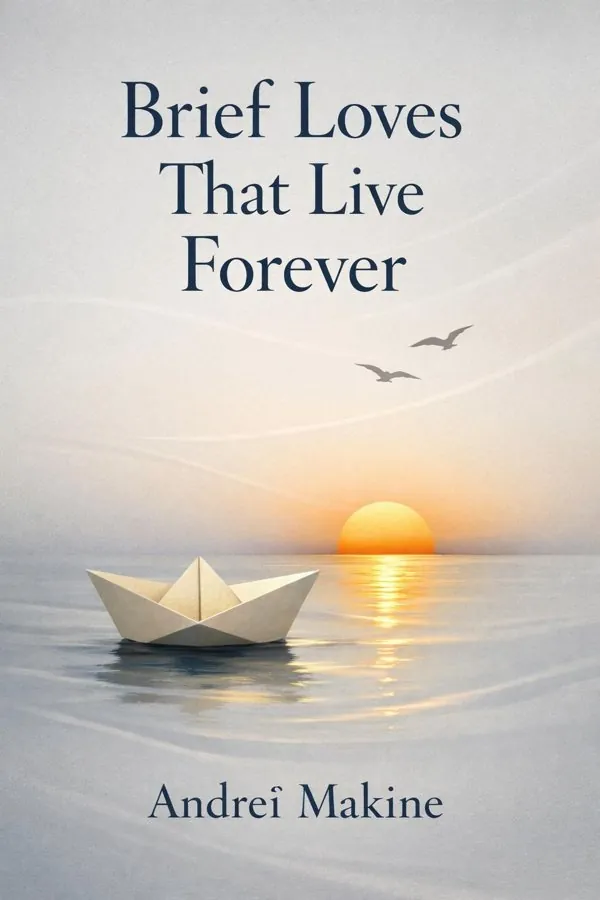
Brief Loves That Live Forever: Summary & Key Insights
 10 min9 chaptersAudio available
Key Takeaways from Brief Loves That Live Forever
We do not remember youth simply because it came first; we remember it because it taught us how to feel.
Some of the most important connections in life happen between strangers who know they may never meet again.
Nothing reveals the human soul more starkly than a world organized around violence.
Love does not disappear under repression; it becomes coded, cautious, and inwardly intense.
We are taught to measure love by what it secures, but Makine suggests that love may be most enduring where it was never fully possessed.
What Is Brief Loves That Live Forever About?
Brief Loves That Live Forever by Andreï Makine is a classics book spanning 9 pages. Andreï Makine’s Brief Loves That Live Forever is a luminous meditation on how brief moments of tenderness can outlast political systems, personal disappointments, and even death itself. Set against the emotional and moral landscape of the Soviet world, the novel gathers memories, encounters, and half-vanished passions into a single question: what remains when history strips life down to its essentials? Makine answers not with ideology, but with atmosphere, longing, and the unforgettable persistence of feeling. Rather than telling a conventional love story, Makine offers interwoven reflections on youth, desire, war, exile, memory, and the strange durability of fleeting human bonds. A glance, a train conversation, a wartime act of tenderness, or a love constrained by fear can become more lasting than entire official narratives. That is what gives the book its quiet force. Makine writes with unusual authority. Born in Siberia and later becoming one of France’s most celebrated novelists, he has long explored the intersections of memory, identity, and historical upheaval. Here, his poetic style and moral precision make private emotion feel inseparable from the fate of a century. The result is a deeply human classic about love as the one form of resistance time never fully defeats.
This FizzRead summary covers all 9 key chapters of Brief Loves That Live Forever in approximately 10 minutes, distilling the most important ideas, arguments, and takeaways from Andreï Makine's work. Also available as an audio summary and Key Quotes Podcast.
Brief Loves That Live Forever
Andreï Makine’s Brief Loves That Live Forever is a luminous meditation on how brief moments of tenderness can outlast political systems, personal disappointments, and even death itself. Set against the emotional and moral landscape of the Soviet world, the novel gathers memories, encounters, and half-vanished passions into a single question: what remains when history strips life down to its essentials? Makine answers not with ideology, but with atmosphere, longing, and the unforgettable persistence of feeling.
Rather than telling a conventional love story, Makine offers interwoven reflections on youth, desire, war, exile, memory, and the strange durability of fleeting human bonds. A glance, a train conversation, a wartime act of tenderness, or a love constrained by fear can become more lasting than entire official narratives. That is what gives the book its quiet force.
Makine writes with unusual authority. Born in Siberia and later becoming one of France’s most celebrated novelists, he has long explored the intersections of memory, identity, and historical upheaval. Here, his poetic style and moral precision make private emotion feel inseparable from the fate of a century. The result is a deeply human classic about love as the one form of resistance time never fully defeats.
Who Should Read Brief Loves That Live Forever?
This book is perfect for anyone interested in classics and looking to gain actionable insights in a short read. Whether you're a student, professional, or lifelong learner, the key ideas from Brief Loves That Live Forever by Andreï Makine will help you think differently.
- ✓Readers who enjoy classics and want practical takeaways
- ✓Professionals looking to apply new ideas to their work and life
- ✓Anyone who wants the core insights of Brief Loves That Live Forever in just 10 minutes
Want the full summary?
Get instant access to this book summary and 100K+ more with Fizz Moment.
Get Free SummaryAvailable on App Store • Free to download
Key Chapters
We do not remember youth simply because it came first; we remember it because it taught us how to feel. In Brief Loves That Live Forever, Makine begins in the Soviet world of his childhood, where public life was saturated with official slogans, rigid expectations, and collective myths. Yet beneath that ideological surface, private experience quietly formed a counter-history. The young learn early that reality has two layers: the one announced loudly by institutions and the one lived intimately in kitchens, courtyards, train stations, and secret conversations. This is where memory begins.
Makine shows that childhood and adolescence are not innocent so much as intensely absorptive. A young person notices tones of voice, fragments of beauty, and emotional tensions long before he has the language to interpret them. The result is that memory stores not only events but textures: the cold of a station platform, the theatrical stiffness of public speeches, the sudden warmth of an unscripted human gesture. These details later become the true archive of a life.
This idea matters because it reframes the past. We often think our lives are shaped by major public events, but Makine suggests that identity is formed just as much by brief private impressions. A reader can apply this insight by asking: what early scenes still govern the way I understand love, truth, power, or belonging? Often the answer lies in a minor incident, not a dramatic turning point.
Makine’s deeper point is that memory resists propaganda by preserving what power cannot organize: feeling. Empires can dictate language, but they cannot fully control what a child notices and carries forward.
Actionable takeaway: revisit one vivid memory from your youth and ask what emotional lesson it taught you; that forgotten lesson may still shape your life today.
Nothing reveals the human soul more starkly than a world organized around violence. In Makine’s vision, war is not only destruction on a massive scale; it is also the condition that strips away illusion and reveals what remains essential in people. Against brutality, the smallest gesture of tenderness acquires enormous moral significance. A look of care, an act of restraint, or a moment of shared vulnerability can become more memorable than any military triumph.
Makine refuses to present war as a stage for heroics alone. Instead, he shows how conflict intensifies emotional truth. Under pressure, individuals discover whether they will harden completely or preserve some capacity for compassion. This is central to the novel’s moral landscape: tenderness is not weakness but a form of inner resistance. It affirms that another way of being human remains possible even when history seems determined to erase it.
This idea has broad relevance beyond literal warfare. In any harsh environment—political repression, family crisis, institutional cruelty, social breakdown—small acts of gentleness become magnified. A person who listens carefully, protects another’s dignity, or offers comfort in dangerous circumstances does more than provide relief. That person keeps alive a standard of humanity that systems of force cannot generate.
Makine also implies that memory itself is shaped by this contrast. We do not remember violence only because it wounds us; we remember tenderness within violence because it proves that the world was never entirely conquered by brutality. Those moments become sacred evidence.
Readers can apply this insight in everyday life. During periods of stress, urgency, or conflict, kindness may seem secondary. Makine argues the opposite: under pressure, kindness becomes most meaningful.
Actionable takeaway: in any difficult environment, deliberately perform one concrete act of tenderness; in harsh times, small mercies often become the moments people remember forever.
Love does not disappear under repression; it becomes coded, cautious, and inwardly intense. One of Makine’s most powerful themes is the way political, social, and emotional constraints reshape affection. In the Soviet setting, surveillance, conformity, and fear do not merely limit public speech. They alter courtship, self-expression, trust, and even fantasy. People learn to conceal feeling, to speak indirectly, and to protect what matters by making it less visible.
This pressure gives love a paradoxical quality. On one hand, constraint can deform relationships by filling them with secrecy, hesitation, and missed chances. On the other, what is forbidden or fragile may become more concentrated in significance. A glance can carry the force of a confession. A short meeting can feel larger than a full relationship lived in comfort. Makine captures this emotional compression with great subtlety.
The lesson is not that repression makes love better. Rather, it shows that human feeling adapts to circumstance while preserving its essential hunger for connection. Readers may recognize this dynamic in many forms: families that do not openly discuss emotion, workplaces where sincerity feels risky, cultures where desire must be disguised, or personal histories in which vulnerability was never safe. In all such cases, love survives by changing language.
Makine invites us to notice the hidden labor this requires. To love under constraint means reading silences, sensing fear, and distinguishing between emotional truth and social performance. It demands patience and a fine sensitivity to nuance.
This idea also offers a practical challenge. If your environment discourages honesty, what forms of indirectness have you mistaken for emotional absence? Sometimes care is present, but encoded.
Actionable takeaway: look for the concealed forms affection takes in your life and, where possible, create one safer space in which feeling can be expressed more openly and without fear.
We are taught to measure love by what it secures, but Makine suggests that love may be most enduring where it was never fully possessed. In Brief Loves That Live Forever, moments of passion are often linked to loss, incompletion, or impossibility. Rather than diminishing their significance, this lack gives them a haunting permanence. What could not be stabilized in life continues to unfold in memory.
Makine is deeply interested in the illusion of happiness as something durable and complete. He distrusts the idea that fulfillment means closure. Many of the loves in the novel are intense precisely because they resist neat endings. They are interrupted by circumstance, history, fear, distance, or mortality. Yet their emotional resonance survives. In some cases, what is remembered is not the factual relationship itself but the inner awakening it produced.
This is not a romantic glorification of suffering. Makine is too lucid for that. Instead, he shows that human beings often continue living through emotional afterimages. A brief encounter can alter standards of beauty, possibility, or self-understanding for years. We carry not only people but versions of ourselves that emerged in loving them.
In practical terms, this idea can help readers reinterpret their own losses. A relationship that ended quickly or failed to become permanent need not be dismissed as meaningless. Its value may lie in what it revealed, intensified, or transformed. The insistence that only lasting arrangements count can make us blind to the real work of emotion.
Makine’s contribution here is subtle but liberating: happiness is not always what stays; sometimes it is what flashes and leaves a durable light behind.
Actionable takeaway: reconsider one past love or attachment not by asking why it failed, but by asking what lasting perception, strength, or tenderness it awakened in you.
When a public dream collapses, private lives do not simply continue unchanged. Makine portrays a generation formed by the promises of Soviet ideology and then marked by its exhaustion, falsity, and disintegration. The great collective future that was supposed to give meaning to existence begins to ring hollow, leaving individuals to confront a difficult vacuum. If history no longer tells you who you are, you must assemble meaning from fragments.
This generational disillusionment is not only political. It is emotional and existential. People who were educated to believe in grand narratives discover that institutions cannot answer their deepest needs. Careers, slogans, patriotic myths, and official language begin to feel stale. What remains are private memories, personal loyalties, and the search for moments of authenticity. In this sense, Makine’s love stories are not separate from history; they are what become visible after history’s public script has lost credibility.
The insight applies broadly to any era of cultural disappointment. A generation may inherit failed economic promises, broken political ideals, or decaying social institutions. In such moments, cynicism becomes tempting. Makine warns against that temptation without denying reality. He suggests that after disillusionment, one can still recover seriousness through intimate truth: friendship, love, memory, and aesthetic attention.
For modern readers, this is particularly relevant. Many people feel detached from large systems and skeptical of collective narratives. Makine offers no easy optimism, but he does offer an alternative source of orientation. Meaning need not come from believing the official story. It can come from honoring what was genuinely lived.
Disillusionment, then, is not the end of meaning. It is the beginning of a more demanding, less naive search for it.
Actionable takeaway: identify one inherited belief about success, identity, or history that no longer feels true, and replace it with a value grounded in direct experience rather than social expectation.
Time does not organize life into meaning; memory does. One of Makine’s deepest concerns is how scattered moments—especially moments of love—are gathered into a pattern only in retrospect. Lived experience is often chaotic, interrupted, and unfinished. But memory revisits, selects, arranges, and illuminates. It does not simply preserve the past; it interprets it.
This makes memory both powerful and fragile. On one hand, it rescues life from disappearance by giving emotional continuity to isolated events. A brief encounter from decades earlier can suddenly appear as a central truth, while seemingly important public events fade into abstraction. On the other hand, memory is subjective, selective, and shaped by desire. Makine embraces this ambiguity. He does not treat recollection as a courtroom record but as a deeply human art of meaning-making.
In practical life, we do this constantly. We tell ourselves stories about who we have been, what mattered, and why certain losses remain active. The danger is that we either romanticize the past or dismiss it as irrelevant. Makine suggests a more fruitful approach: treat memory as a source of understanding rather than a prison. Ask not whether every detail is exact, but what emotional truth the remembered scene still carries.
This perspective can help readers navigate regret and nostalgia. Instead of seeing memory as an obstacle to the present, we can use it to identify enduring values. Which moments remain vivid, and why? What pattern emerges from what we cannot forget? Often the answer reveals the true shape of a life more clearly than external achievement does.
Makine’s novel itself models this process, turning remembrance into a moral act.
Actionable takeaway: write down three memories that return to you often, then look for the shared theme; that theme may reveal what your life has been trying to teach you.
No love ends neatly at the moment of separation; it continues as an echo in perception, longing, and self-knowledge. Makine explores how former loves remain active long after the relationship, encounter, or possibility has passed. These echoes are not always dramatic. They may survive as a sensitivity to a certain kind of beauty, a reaction to a voice, an instinctive melancholy, or a sudden awareness that some part of oneself was formed in relation to another person.
What makes these echoes powerful is that they blur the boundary between memory and presence. The loved person may be absent, dead, distant, or scarcely known, yet the emotional imprint remains. Makine suggests that we are inhabited by our past attachments. They become part of our interior climate. This is why a brief love can live forever—not as ongoing romance, but as a permanent modulation of consciousness.
This idea helps explain why moving on is rarely a matter of erasure. Healthy emotional life does not require forgetting; it requires integrating. A past love can remain meaningful without dominating the present. Readers can apply this insight by shifting from a language of elimination to one of incorporation. Instead of asking, “How do I stop feeling this?” ask, “How has this experience become part of who I am?”
Makine’s treatment is especially valuable because it avoids both sentimentality and denial. He does not claim every old passion should be preserved unchanged. Rather, he shows that the traces of love become material for identity. We are partly composed of remembered tenderness.
Acknowledging these echoes can also deepen empathy. Others are never just who they seem now; they too carry invisible histories of attachment.
Actionable takeaway: when an old memory of love resurfaces, resist the urge to suppress it immediately; instead, ask what enduring human need or truth it is reminding you to honor.
Political systems promise permanence, but they vanish; a fleeting act of love can endure in memory for a lifetime. This contrast stands at the heart of Makine’s novel. The Soviet Union presented itself as historical destiny, something vast and irreversible. Yet its slogans, ceremonies, and certainties prove less lasting than private moments of tenderness. In the end, what survives is not the official story but the felt one.
Makine’s argument is not merely historical. He is asking what deserves to outlast us. Institutions seek monuments, records, and power. Love leaves little material trace, yet it persists through memory, influence, and transformed perception. A person may forget speeches, doctrines, and collective rituals, but remember exactly how someone looked at them once in a moment of recognition. This suggests a radical reordering of value: what is most fragile may also be what is most enduring.
The practical application is profound. Many people devote enormous energy to visible accomplishment while neglecting the emotional quality of their relationships. Makine reminds us that what will be remembered—by us and by others—may not be our public success but the humanity we offered in passing moments. This does not diminish achievement; it places it in proportion.
The novel also implies that love’s resistance to oblivion is a form of moral survival. To remember tenderness is to refuse complete submission to violence, bureaucracy, or despair. Even in ruined times, love testifies that human life contained more than domination and fear.
For readers, this can reshape priorities. Ask what in your life would remain meaningful if every title, role, and system around you disappeared. The answer likely has to do with the bonds you formed and the grace you gave.
Actionable takeaway: invest today in one small act of lasting human significance—a message, reconciliation, or moment of real presence—because emotional traces often outlive every public structure.
All Chapters in Brief Loves That Live Forever
About the Author
Andreï Makine is a Franco-Russian novelist born in 1957 in Krasnoyarsk, Siberia. Raised in the Soviet Union and later settled in France, he became one of the most distinctive literary voices writing in French about memory, exile, and identity. Makine gained international acclaim with Le Testament français, published in English as Dreams of My Russian Summers, which won both the Prix Goncourt and the Prix Médicis. His fiction is known for its lyrical prose, emotional precision, and deep interest in how private lives are shaped by historical upheaval. Across his novels, he returns to themes of longing, displacement, tenderness, and the survival of inner truth in politically damaged worlds. Brief Loves That Live Forever exemplifies his gift for turning fleeting moments into lasting meditations on human meaning.
Get This Summary in Your Preferred Format
Read or listen to the Brief Loves That Live Forever summary by Andreï Makine anytime, anywhere. FizzRead offers multiple formats so you can learn on your terms — all free.
Available formats: App · Audio · PDF · EPUB — All included free with FizzRead
Download Brief Loves That Live Forever PDF and EPUB Summary
Key Quotes from Brief Loves That Live Forever
“We do not remember youth simply because it came first; we remember it because it taught us how to feel.”
“Some of the most important connections in life happen between strangers who know they may never meet again.”
“Nothing reveals the human soul more starkly than a world organized around violence.”
“Love does not disappear under repression; it becomes coded, cautious, and inwardly intense.”
“We are taught to measure love by what it secures, but Makine suggests that love may be most enduring where it was never fully possessed.”
Frequently Asked Questions about Brief Loves That Live Forever
Brief Loves That Live Forever by Andreï Makine is a classics book that explores key ideas across 9 chapters. Andreï Makine’s Brief Loves That Live Forever is a luminous meditation on how brief moments of tenderness can outlast political systems, personal disappointments, and even death itself. Set against the emotional and moral landscape of the Soviet world, the novel gathers memories, encounters, and half-vanished passions into a single question: what remains when history strips life down to its essentials? Makine answers not with ideology, but with atmosphere, longing, and the unforgettable persistence of feeling. Rather than telling a conventional love story, Makine offers interwoven reflections on youth, desire, war, exile, memory, and the strange durability of fleeting human bonds. A glance, a train conversation, a wartime act of tenderness, or a love constrained by fear can become more lasting than entire official narratives. That is what gives the book its quiet force. Makine writes with unusual authority. Born in Siberia and later becoming one of France’s most celebrated novelists, he has long explored the intersections of memory, identity, and historical upheaval. Here, his poetic style and moral precision make private emotion feel inseparable from the fate of a century. The result is a deeply human classic about love as the one form of resistance time never fully defeats.
More by Andreï Makine

You Might Also Like



Browse by Category
Ready to read Brief Loves That Live Forever?
Get the full summary and 100K+ more books with Fizz Moment.