
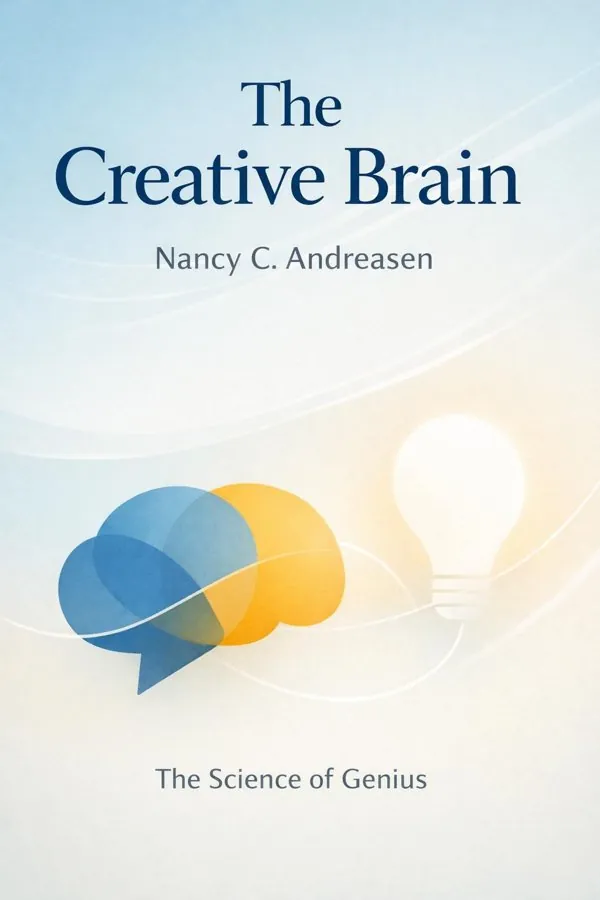
The Creative Brain: The Science of Genius: Summary & Key Insights
 10 min9 chaptersAudio available
Key Takeaways from The Creative Brain: The Science of Genius
For most of human history, creativity was explained as something that arrived from outside the self.
One of the most important scientific insights in the book is deceptively simple: creativity does not happen in one tiny “genius center” of the brain.
A high IQ can open doors, but Andreasen makes clear that intelligence alone does not produce creativity.
Creative breakthroughs often begin not with certainty but with wandering.
Few topics in the science of genius attract more fascination than the apparent overlap between creativity and mental illness.
What Is The Creative Brain: The Science of Genius About?
The Creative Brain: The Science of Genius by Nancy C. Andreasen is a neuroscience book spanning 11 pages. What makes a mind capable of producing ideas that reshape art, science, and culture? In The Creative Brain: The Science of Genius, psychiatrist and neuroscientist Nancy C. Andreasen tackles that question with unusual authority. Drawing on decades of clinical work, brain-imaging research, and interviews with distinguished writers, scientists, and thinkers, she explores creativity not as a mystical gift but as a deeply human capacity rooted in the brain. Andreasen examines how original thought emerges from memory, imagination, intelligence, personality, and environment, while also confronting one of the most controversial topics in the field: the link between creativity and mental illness. What makes this book especially valuable is its balance. It respects the mystery of genius without surrendering to myth, and it embraces scientific rigor without reducing creativity to a single brain scan or formula. For readers interested in neuroscience, psychology, education, innovation, or the nature of human potential, this book offers a compelling framework for understanding how creative minds work—and how creativity can be cultivated, protected, and better understood.
This FizzRead summary covers all 9 key chapters of The Creative Brain: The Science of Genius in approximately 10 minutes, distilling the most important ideas, arguments, and takeaways from Nancy C. Andreasen's work. Also available as an audio summary and Key Quotes Podcast.
The Creative Brain: The Science of Genius
What makes a mind capable of producing ideas that reshape art, science, and culture? In The Creative Brain: The Science of Genius, psychiatrist and neuroscientist Nancy C. Andreasen tackles that question with unusual authority. Drawing on decades of clinical work, brain-imaging research, and interviews with distinguished writers, scientists, and thinkers, she explores creativity not as a mystical gift but as a deeply human capacity rooted in the brain. Andreasen examines how original thought emerges from memory, imagination, intelligence, personality, and environment, while also confronting one of the most controversial topics in the field: the link between creativity and mental illness. What makes this book especially valuable is its balance. It respects the mystery of genius without surrendering to myth, and it embraces scientific rigor without reducing creativity to a single brain scan or formula. For readers interested in neuroscience, psychology, education, innovation, or the nature of human potential, this book offers a compelling framework for understanding how creative minds work—and how creativity can be cultivated, protected, and better understood.
Who Should Read The Creative Brain: The Science of Genius?
This book is perfect for anyone interested in neuroscience and looking to gain actionable insights in a short read. Whether you're a student, professional, or lifelong learner, the key ideas from The Creative Brain: The Science of Genius by Nancy C. Andreasen will help you think differently.
- ✓Readers who enjoy neuroscience and want practical takeaways
- ✓Professionals looking to apply new ideas to their work and life
- ✓Anyone who wants the core insights of The Creative Brain: The Science of Genius in just 10 minutes
Want the full summary?
Get instant access to this book summary and 100K+ more with Fizz Moment.
Get Free SummaryAvailable on App Store • Free to download
Key Chapters
For most of human history, creativity was explained as something that arrived from outside the self. Ancient philosophers described inspiration as divine possession, poets invoked muses, and later thinkers often associated genius with eccentricity or madness. Andreasen begins by showing that our fascination with extraordinary minds is ancient, but she also argues that inherited myths can obscure real understanding. The romantic image of the tormented genius is powerful because it captures something emotionally true about intensity, sensitivity, and originality. Yet it can also turn creativity into a mystical trait that seems unreachable and unteachable.
By tracing historical ideas about genius, Andreasen shows how the concept gradually moved from religion and philosophy into psychology and neuroscience. This shift matters. Once creativity is treated as a human capacity rather than supernatural intervention, it becomes possible to study the habits, environments, mental processes, and biological systems that support it. We can ask better questions: How do novel ideas arise? Why are some people more productive than others? What role do memory, emotion, and social context play?
A practical implication is that modern readers should resist simplistic labels. Calling someone a genius tells us very little about how they think, work, or struggle. In schools, workplaces, and creative fields, it is more useful to focus on specific ingredients such as curiosity, persistence, breadth of knowledge, and tolerance for ambiguity. Historical myths may inspire us, but they should not define our expectations.
Actionable takeaway: Replace the idea of creativity as magic with the idea of creativity as a trainable, observable human process—and start paying attention to the conditions that help original thinking grow.
One of the most important scientific insights in the book is deceptively simple: creativity does not happen in one tiny “genius center” of the brain. Andreasen’s research suggests that creative thought emerges from cooperation across multiple brain systems. Rather than assigning originality to a single region, the brain recruits networks involved in memory, association, emotion, language, planning, and self-reflection. This helps explain why creativity feels both spontaneous and effortful, both dreamy and disciplined.
Andreasen was among the pioneers using brain imaging to explore how highly creative individuals think. Her findings challenged the common temptation to localize complex abilities too narrowly. When a novelist imagines a character, a scientist reframes a problem, or a composer hears an unheard melody, the brain is integrating stored knowledge with flexible association and evaluative judgment. In other words, creativity depends on communication among systems rather than isolated activity.
This network view has practical consequences. If creativity is distributed, then strengthening it means developing multiple capacities: deep knowledge in a field, openness to unusual connections, emotional engagement, and the executive ability to shape raw ideas into finished work. For example, a designer may improve creativity not only by brainstorming but also by studying history, exposing herself to other disciplines, and building habits of revision.
The network model also supports interdisciplinary work. Many breakthroughs occur when people connect ideas from different domains because the brain itself thrives on integration.
Actionable takeaway: Don’t look for a single trick to become more creative. Build a richer mental network by combining focused expertise, broad curiosity, and regular time for reflection.
A high IQ can open doors, but Andreasen makes clear that intelligence alone does not produce creativity. Many highly intelligent people are excellent at solving defined problems, learning quickly, and performing well in academic settings, yet they may never generate truly original work. Creativity requires something more than analytical power: the ability to reframe, imagine alternatives, tolerate uncertainty, and produce ideas that are both novel and meaningful.
This distinction matters because societies often confuse achievement with originality. Standardized testing, grades, and conventional markers of brilliance tend to reward convergent thinking—finding the correct answer efficiently. Creative work often relies on divergent thinking—producing multiple possible answers, unexpected combinations, or new questions altogether. A scientist who challenges a dominant theory, a filmmaker who invents a new visual language, or an entrepreneur who sees an overlooked need is doing more than displaying intelligence. They are using imagination, risk tolerance, and independent judgment.
Andreasen does not argue that intelligence is irrelevant. A certain baseline of cognitive ability is often necessary, especially in demanding fields. But beyond that threshold, personality, motivation, and environment become crucial. Persistence matters. So does the willingness to spend long periods exploring ideas that may fail.
In practical terms, this insight should change how talent is identified and developed. Teachers and managers should not assume the most creative person is the one with the fastest or most correct answers. Someone slower, more questioning, or less conventional may be the one generating the most original possibilities.
Actionable takeaway: If you want to cultivate creativity, stop measuring yourself only by correctness or speed. Practice asking unusual questions and generating multiple possibilities before choosing the best one.
Creative breakthroughs often begin not with certainty but with wandering. Andreasen emphasizes that imagination and divergent thinking are central to original thought because they allow the mind to move beyond standard categories and expected associations. Divergent thinking is the capacity to generate many possible ideas, interpretations, or solutions rather than narrowing immediately to one. It is especially important in the early stages of creative work, when exploration matters more than evaluation.
This kind of thinking depends heavily on memory and association. The brain draws from stored experiences, fragments of knowledge, emotional impressions, and sensory details, then recombines them in surprising ways. A poet may connect a childhood image to a political crisis. A physicist may solve a technical problem by visualizing a pattern borrowed from nature. Imagination is not random fantasy; it is structured freedom built from what the mind already contains.
Andreasen’s account helps explain why boredom, daydreaming, and solitude can sometimes be productive. When the mind is not locked into immediate demands, it can roam through remote associations. This is one reason many people get ideas while walking, showering, or doing repetitive tasks. The brain is still working, but in a looser mode.
To apply this, individuals and organizations need to protect exploratory time. Brainstorming can help, but only if judgment is temporarily suspended. Writers can freewrite. Scientists can keep idea journals. Teams can ask, “What else might be true?” before deciding.
Actionable takeaway: Create regular low-pressure space for idea generation—walk without your phone, freewrite for ten minutes, or list ten alternative solutions before evaluating any of them.
Few topics in the science of genius attract more fascination than the apparent overlap between creativity and mental illness. Andreasen approaches this question with both scientific caution and clinical experience. She does not romanticize psychiatric suffering, nor does she dismiss the patterns observed in highly creative populations. Her research suggests that certain mood disorders, especially bipolar tendencies and depression, may appear more often in some creative individuals and their families. But the relationship is subtle, varied, and easily distorted by myth.
The key point is that vulnerability is not the same as causation. Mental illness does not automatically produce creative brilliance, and severe episodes can destroy concentration, relationships, and productivity. At the same time, traits that sometimes accompany psychiatric risk—intensity, emotional depth, unusual associations, high energy, and cognitive flexibility—may overlap with qualities useful for creative work. This may help explain why some artists and writers report periods of elevated productivity alongside psychological instability.
Andreasen’s balanced view is especially important today, when people may either glamorize suffering or fear that treatment will eliminate originality. In reality, many creative people do their best work when symptoms are managed and functioning is protected. Support, therapy, medication when needed, stable routines, and meaningful relationships can preserve the person while allowing creativity to flourish.
The practical lesson is compassionate realism. Creative excellence does not require breakdown, and untreated illness is not a badge of authenticity. Families, educators, and creative professionals should take mental health seriously without turning it into a stigma or a mythology.
Actionable takeaway: If emotional intensity fuels your work, protect it with healthy structure—seek support early, maintain sleep and routine, and never confuse untreated suffering with creative necessity.
Andreasen enriches her scientific arguments with case studies of highly creative individuals, showing that genius becomes visible not only in laboratory findings but in lived patterns. When she interviewed accomplished writers, scientists, and artists, she found recurring themes: deep curiosity, strong intrinsic motivation, tolerance for isolation, unusual persistence, and a lifelong habit of engaging complex ideas. These people were not merely talented in bursts. They built sustained creative lives.
Case studies matter because they reveal what numbers alone cannot. A brain scan may show activation patterns, but a life story shows how creative potential is shaped by family influences, early opportunities, setbacks, mentors, and work habits. Some individuals displayed broad intellectual interests that fed their originality. Others benefited from periods of solitude. Many combined imagination with relentless revision, proving that inspiration is only one stage of the process.
These portraits also challenge the stereotype that creative people are chaotic improvisers. While some are unconventional, many are highly disciplined. A novelist may write every morning for decades. A researcher may pursue one problem obsessively through repeated failures. Creative achievement usually reflects a long marriage between freedom and structure.
Readers can apply this insight by studying biographies not to imitate surface quirks but to identify enduring principles. What environments nurtured curiosity? How did these people recover from criticism? What routines protected deep work? Creative growth becomes more realistic when we focus on patterns rather than myths.
Actionable takeaway: Learn from the life designs of creative people—build a routine, seek meaningful mentors, and commit to long-term practice rather than waiting for dramatic flashes of inspiration.
One of Andreasen’s most nuanced arguments is that creativity arises from an interaction between biology and experience. Some people may inherit temperaments or cognitive tendencies that support originality—openness to experience, unusual associative thinking, energetic drive, or emotional intensity. But genes do not produce finished creators. They create possibilities that must be developed through education, exposure, relationships, culture, and sustained work.
This interaction explains why creative ability often appears to run in families without being mechanically predictable. A child may inherit curiosity and verbal fluency, but whether those traits mature into significant creative achievement depends on context. Did the child have access to books, instruments, tools, or stimulating conversation? Were questions encouraged or punished? Was experimentation rewarded? The environment can either nourish or suppress innate potential.
Andreasen’s view discourages both fatalism and naïve optimism. It is false to say creativity is purely inborn and cannot be changed. It is equally false to assume anyone can become exceptional in any field without the right fit of aptitude, effort, and opportunity. The more accurate position is developmental: potential unfolds through interaction.
For parents, teachers, and leaders, this means creating conditions in which latent originality can surface. Encourage exploration across domains. Allow mistakes. Offer challenging material early. Expose people to accomplished work that raises their standards. For individuals, it means choosing environments that energize and stretch your best abilities.
Actionable takeaway: Treat creativity as a seed that needs the right ecosystem—seek or build environments rich in challenge, encouragement, resources, and freedom to experiment.
Creative people do not produce in a vacuum. Andreasen shows that culture and society shape not only what kinds of creativity are valued, but whether creative work can emerge at all. Every act of genius depends on a larger context: institutions that preserve knowledge, audiences that recognize innovation, mentors who transmit craft, and communities that either support or resist deviation from the norm. A brilliant idea may die in an environment that punishes originality, while moderate talent may flourish where experimentation is encouraged.
Education plays a particularly important role. Too often, schools reward obedience, memorization, and single-answer thinking at the expense of curiosity and invention. Andreasen argues that fostering creativity requires different habits: encouraging students to ask questions, connect disciplines, pursue independent interests, and engage uncertainty without fear of failure. This does not mean abandoning standards. On the contrary, creativity thrives when freedom is paired with strong knowledge and serious practice.
The same principle applies in adulthood. Artists refine craft through repetition. Scientists become innovative by mastering the existing literature before challenging it. Teams become more inventive when they create psychological safety, allowing unusual ideas to be voiced before being judged. Practice is not the enemy of originality; it is the medium through which originality becomes usable.
This perspective is empowering because it moves creativity out of the realm of rare destiny and into the realm of design. Families, schools, companies, and communities can all do more to cultivate it.
Actionable takeaway: Build a creativity-friendly environment by rewarding questions, allowing intelligent risk, exposing yourself to multiple disciplines, and treating disciplined practice as the foundation of innovation.
Andreasen ends with a forward-looking view of what the science of creativity can and cannot accomplish. Neuroscience is giving us increasingly sophisticated tools to study the brain, from imaging technologies to genetic research and cognitive testing. These advances can help clarify how creative thought unfolds, why some minds are especially generative, and how disorders or environmental pressures interfere with innovation. But Andreasen warns against reductionism. No scan, score, or formula will fully capture the richness of genius.
This is because creativity is both biological and deeply human. It involves personal meaning, cultural context, emotional life, moral values, and historical timing. A scientific account can explain mechanisms, but it cannot replace interpretation. Knowing which brain networks are active when a composer writes music does not tell us why the music moves us or changes a tradition. Science helps us understand conditions and processes; it does not eliminate mystery.
That balanced perspective is one of the book’s greatest strengths. It invites optimism without exaggeration. We may one day become better at identifying creative potential, protecting mental health in high-risk populations, and designing schools or workplaces that support innovation. Yet we should remain humble. Human originality is not just a technical puzzle but one of civilization’s most precious capacities.
For readers, the final lesson is both practical and philosophical: creativity deserves care. It should be studied rigorously, nurtured deliberately, and valued broadly—not only in famous geniuses but in everyday problem-solving, art, teaching, leadership, and discovery.
Actionable takeaway: Use science to support creativity, not shrink it—combine evidence-based habits with respect for the complexity, individuality, and humanity behind original work.
All Chapters in The Creative Brain: The Science of Genius
About the Author
Nancy C. Andreasen is an American psychiatrist, neuroscientist, and writer recognized for groundbreaking work at the intersection of brain science, mental illness, and creativity. A longtime professor at the University of Iowa, she became one of the leading figures in biological psychiatry and was an early pioneer in using neuroimaging to study the brain. Her research has focused especially on schizophrenia, mood disorders, and the neurological basis of creative thought. Andreasen is also known for her rare ability to bridge scientific rigor with humanistic insight, drawing connections between medicine, psychology, literature, and the arts. A member of the National Academy of Medicine, she has earned wide respect for making complex scientific ideas accessible while addressing some of the most profound questions about genius, imagination, and the human mind.
Get This Summary in Your Preferred Format
Read or listen to the The Creative Brain: The Science of Genius summary by Nancy C. Andreasen anytime, anywhere. FizzRead offers multiple formats so you can learn on your terms — all free.
Available formats: App · Audio · PDF · EPUB — All included free with FizzRead
Download The Creative Brain: The Science of Genius PDF and EPUB Summary
Key Quotes from The Creative Brain: The Science of Genius
“For most of human history, creativity was explained as something that arrived from outside the self.”
“One of the most important scientific insights in the book is deceptively simple: creativity does not happen in one tiny “genius center” of the brain.”
“A high IQ can open doors, but Andreasen makes clear that intelligence alone does not produce creativity.”
“Creative breakthroughs often begin not with certainty but with wandering.”
“Few topics in the science of genius attract more fascination than the apparent overlap between creativity and mental illness.”
Frequently Asked Questions about The Creative Brain: The Science of Genius
The Creative Brain: The Science of Genius by Nancy C. Andreasen is a neuroscience book that explores key ideas across 9 chapters. What makes a mind capable of producing ideas that reshape art, science, and culture? In The Creative Brain: The Science of Genius, psychiatrist and neuroscientist Nancy C. Andreasen tackles that question with unusual authority. Drawing on decades of clinical work, brain-imaging research, and interviews with distinguished writers, scientists, and thinkers, she explores creativity not as a mystical gift but as a deeply human capacity rooted in the brain. Andreasen examines how original thought emerges from memory, imagination, intelligence, personality, and environment, while also confronting one of the most controversial topics in the field: the link between creativity and mental illness. What makes this book especially valuable is its balance. It respects the mystery of genius without surrendering to myth, and it embraces scientific rigor without reducing creativity to a single brain scan or formula. For readers interested in neuroscience, psychology, education, innovation, or the nature of human potential, this book offers a compelling framework for understanding how creative minds work—and how creativity can be cultivated, protected, and better understood.
You Might Also Like
Anxious
Joseph LeDoux
10 min
Hallucinations
Oliver Sacks
10 min
The Biological Mind: How Brain, Body, and Environment Collaborate to Make Us Who We Are
Alan Jasanoff
10 min
The Feeling of Life Itself: Why Consciousness Is Widespread but Can't Be Computed
Christof Koch
10 min
The No-Nonsense Meditation Book
Steven Laureys
10 min
A General Theory of Love
Thomas Lewis, Fari Amini, Richard Lannon
10 minBrowse by Category
Ready to read The Creative Brain: The Science of Genius?
Get the full summary and 100K+ more books with Fizz Moment.