
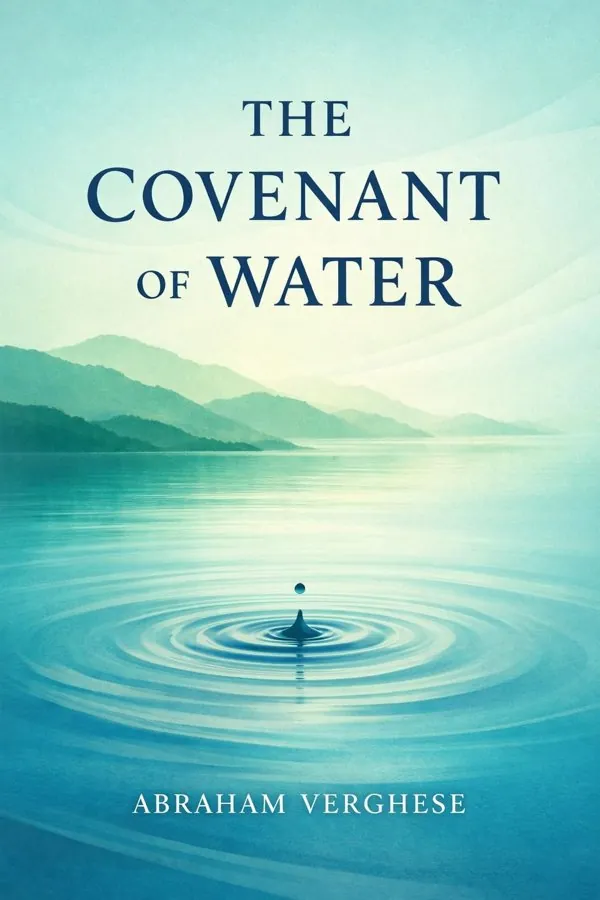
The Covenant Of Water: Summary & Key Insights
 10 min9 chaptersAudio available
Key Takeaways from The Covenant Of Water
Some families inherit land, recipes, or stories; this family inherits fear.
Great families are often held together not by power, but by quiet stamina.
A generation raised by tradition must still learn how to live in history.
Illness is never only biological; it is also social, emotional, and spiritual.
The most powerful symbols endure because they contain opposites.
What Is The Covenant Of Water About?
The Covenant Of Water by Abraham Verghese is a bestsellers book spanning 4 pages. Set on India’s Malabar Coast and stretching across much of the twentieth century, The Covenant Of Water is a vast, intimate family saga about inheritance, memory, love, medicine, and survival. At its center is a Christian family in Kerala haunted by a bewildering condition: in every generation, at least one member dies by drowning, even though water is everywhere around them and woven into the fabric of daily life. The novel begins with a twelve-year-old girl sent by boat to marry a much older widower, and from that moment unfolds into a richly layered story of kinship, grief, faith, political change, and scientific discovery. What makes this novel matter is not only its sweeping plot, but its understanding of how private suffering intersects with larger historical forces—colonialism, caste, migration, modern medicine, and India’s transformation into a new nation. Abraham Verghese brings unusual authority to this world. A celebrated physician and novelist, he writes with both clinical precision and deep compassion, illuminating the body’s mysteries while honoring the emotional and spiritual lives of his characters. The result is a rare novel: epic in scale, but profoundly human in feeling.
This FizzRead summary covers all 9 key chapters of The Covenant Of Water in approximately 10 minutes, distilling the most important ideas, arguments, and takeaways from Abraham Verghese's work. Also available as an audio summary and Key Quotes Podcast.
The Covenant Of Water
Set on India’s Malabar Coast and stretching across much of the twentieth century, The Covenant Of Water is a vast, intimate family saga about inheritance, memory, love, medicine, and survival. At its center is a Christian family in Kerala haunted by a bewildering condition: in every generation, at least one member dies by drowning, even though water is everywhere around them and woven into the fabric of daily life. The novel begins with a twelve-year-old girl sent by boat to marry a much older widower, and from that moment unfolds into a richly layered story of kinship, grief, faith, political change, and scientific discovery.
What makes this novel matter is not only its sweeping plot, but its understanding of how private suffering intersects with larger historical forces—colonialism, caste, migration, modern medicine, and India’s transformation into a new nation. Abraham Verghese brings unusual authority to this world. A celebrated physician and novelist, he writes with both clinical precision and deep compassion, illuminating the body’s mysteries while honoring the emotional and spiritual lives of his characters. The result is a rare novel: epic in scale, but profoundly human in feeling.
Who Should Read The Covenant Of Water?
This book is perfect for anyone interested in bestsellers and looking to gain actionable insights in a short read. Whether you're a student, professional, or lifelong learner, the key ideas from The Covenant Of Water by Abraham Verghese will help you think differently.
- ✓Readers who enjoy bestsellers and want practical takeaways
- ✓Professionals looking to apply new ideas to their work and life
- ✓Anyone who wants the core insights of The Covenant Of Water in just 10 minutes
Want the full summary?
Get instant access to this book summary and 100K+ more with Fizz Moment.
Get Free SummaryAvailable on App Store • Free to download
Key Chapters
Some families inherit land, recipes, or stories; this family inherits fear. One of the central forces in The Covenant Of Water is the strange and persistent pattern of drowning deaths that shadows generations of a Syrian Christian family in Kerala. Water, which should represent fertility, livelihood, cleansing, and connection in this lush region, becomes something more complicated: a source of beauty, necessity, and mortal danger. This tension gives the novel its emotional and symbolic core.
Verghese uses the so-called curse not as a simple superstition, but as a way of exploring how families build identity around recurring trauma. When a mysterious pattern appears often enough, people start organizing life around it. They become cautious, secretive, and ritualistic. The affliction shapes marriage choices, household rules, and the stories elders pass down to children. It creates a culture of vigilance, where love often expresses itself through protection and control.
In practical terms, the novel shows how unresolved family history can act like an inheritance. A household marked by grief may become overprotective. A family that has suffered repeated loss may avoid risk, hide important truths, or mistake fear for wisdom. Many readers will recognize versions of this in real life: addictions repeated across generations, silence around illness, patterns of emotional withdrawal, or anxieties that seem to predate any one individual.
The novel asks an important question: when does a family story preserve memory, and when does it imprison the living? The answer develops slowly, through observation, compassion, and eventually knowledge. Actionable takeaway: examine the “curse stories” in your own family—the repeated fears, assumptions, and warnings—and ask whether they still protect you or simply keep old pain alive.
Great families are often held together not by power, but by quiet stamina. The young girl who enters her husband’s household at the beginning of the novel grows into Big Ammachi, one of the book’s moral and emotional anchors. Married at twelve to an older widower, she arrives in an unfamiliar world with little control over her fate. Yet over time she becomes the organizing intelligence of the household—observant, practical, loving, and resilient in ways that are never sentimental.
Her strength is not loud heroism. It appears in how she learns the rhythms of the home, nurtures children, absorbs loss, and keeps the family functioning through uncertainty. Verghese portrays her growth with extraordinary care, showing how women in constrained social systems often exercise influence through memory, discipline, hospitality, and emotional endurance. She becomes a keeper of continuity in a world changing around her.
This idea matters because the novel resists narrow definitions of leadership. Big Ammachi does not conquer through status or rhetoric; she steadies through presence. In many families and communities, the most important figures are those who maintain relationships, preserve stories, and hold others through grief. Their labor can be invisible because it is domestic, repetitive, and expected.
Readers can apply this insight by reconsidering what counts as authority in their own lives. The person with the title is not always the person sustaining the group. A grandmother who remembers everyone’s burdens, a parent who absorbs conflict, or a caregiver who notices what others miss may be the true center.
Actionable takeaway: identify the “Big Ammachi” figures in your life or workplace, and acknowledge their stabilizing labor before crisis makes their importance obvious.
A generation raised by tradition must still learn how to live in history. Philipose, Big Ammachi’s son, embodies this challenge. He inherits a family shaped by faith, land, and the old rhythms of Kerala, but he must also navigate a world transformed by technology, social mobility, and India’s movement toward independence and modern nationhood. Through him, the novel explores what it means to stand between worlds.
Philipose is not simply a representative of change; he is a man formed by contradictions. He is drawn toward progress but tethered to inherited fear. He benefits from family continuity yet suffers under its burdens. His life reflects a broader reality: modernity does not erase tradition overnight. Instead, people carry old beliefs into new institutions, new economies, and new political realities. The result is often tension rather than clean transition.
Verghese uses Philipose to show how historical change enters ordinary life. National independence is not only a political event; it alters aspiration, education, work, and self-understanding. Families begin imagining different futures for their children. Medicine becomes more scientific. Travel expands possibility. But these shifts also unsettle established identities. What do you keep? What do you discard? What does progress cost?
In everyday life, many readers face similar dilemmas. A first-generation college student may feel split between family expectations and personal ambition. A business adopting new systems may struggle to preserve its culture. Communities undergoing migration or rapid development often wrestle with both nostalgia and necessity.
The novel suggests that change is most humane when it is accompanied by humility and memory. Progress without rootedness becomes arrogance; tradition without adaptation becomes stagnation. Actionable takeaway: when facing major change, ask not only “What is new?” but also “What is worth carrying forward with care?”
Illness is never only biological; it is also social, emotional, and spiritual. One of the most compelling dimensions of The Covenant Of Water is the way it brings medicine into conversation with mystery. Verghese, himself a physician, writes about the body with technical confidence, but he never reduces people to symptoms. Instead, he shows how diagnosis, suffering, and healing are bound up with family, shame, love, and belief.
As the novel unfolds, medical understanding gradually offers a way to interpret what earlier generations experienced as curse or fate. Yet the movement from superstition to science is not handled triumphantly, as if knowledge cancels mystery. Rather, Verghese shows that medicine can clarify causes while still leaving room for awe, grief, and moral complexity. A clinical explanation may solve a puzzle, but it cannot erase the years of fear that shaped a family’s life.
This is one of the novel’s deepest achievements. It presents medicine not as detached expertise, but as a human practice requiring attention, listening, and imagination. A good doctor must read bodies, but also stories. Symptoms often arrive wrapped in silence, stigma, or inherited misunderstanding. That insight has practical relevance far beyond hospitals. Teachers, managers, and parents also make better decisions when they look beneath surface behavior to the hidden narrative beneath it.
For readers, the book offers a powerful model of integrated thinking: honor empirical truth, but do not dismiss the meanings people attach to their suffering. In real life, someone may resist treatment because of fear, family history, or faith. Effective care begins by understanding the whole person.
Actionable takeaway: when confronting a problem—medical or otherwise—seek both the factual diagnosis and the human story, because solutions fail when they address only one of the two.
The most powerful symbols endure because they contain opposites. In this novel, water is not merely setting; it is the governing metaphor. Kerala’s rivers, backwaters, rains, wells, and seas nourish crops, shape travel, structure labor, and lend the landscape its sensual beauty. Yet for this family, water also carries dread. It is the source of death, the element that mocks confidence, and the reminder that what sustains life can also take it.
Verghese uses water to dramatize a broader truth about existence: our greatest dependencies often carry our deepest vulnerabilities. Love can heal and wound. Family can shelter and confine. Faith can console and blind. Progress can liberate and uproot. By centering water, the novel keeps returning readers to this paradox. The same force that makes Kerala fertile also keeps the family alert to danger.
This layered symbolism enriches the novel’s emotional impact because it prevents easy interpretation. Water is not evil, and the family’s affliction is not a moral punishment. Instead, water becomes a reminder that human life unfolds within powers larger than individual intention. We do not control all risk; we live alongside it. Maturity lies not in eliminating uncertainty, but in learning how to inhabit it.
In practical terms, this idea resonates with modern life. The internet connects and isolates. Ambition motivates and exhausts. Financial security offers freedom but can fuel anxiety. The things we rely on are rarely simple. Wise living requires both gratitude and caution.
The novel invites readers to stop dividing experience into neat categories of blessing or curse. Often the same reality is both. Actionable takeaway: identify one “water” in your life—a force that both sustains and unsettles you—and develop a more conscious, balanced relationship to it.
Belief is most interesting when it coexists with uncertainty. The Covenant Of Water is deeply attentive to religion, especially the Syrian Christian traditions of Kerala, but it is not a narrow religious novel. Instead, it explores faith as lived practice: prayer, ritual, community, moral instruction, and the search for meaning in suffering. The characters do not inhabit a world where belief answers every question. They inhabit one where faith must survive grief, contradiction, and silence.
This makes the novel far richer than a simple affirmation of piety. Some characters find strength in devotion; others experience doubt, incomprehension, or spiritual loneliness. Verghese treats these responses with tenderness rather than judgment. He suggests that faith is not valuable because it removes mystery, but because it gives people a language for love, endurance, and responsibility when certainty is impossible.
The novel’s moral imagination emerges from this tension. Characters must act without full understanding. They care for the vulnerable, maintain households, forgive imperfectly, and continue despite loss. In that sense, faith becomes less about doctrinal precision and more about sustained attention to others. To believe, the novel implies, is partly to remain answerable—to God, to memory, to family, to the suffering person in front of you.
Readers of any worldview can apply this insight. Even secular life depends on forms of trust and meaning that cannot be fully proven in advance: trust in relationships, in vocation, in the worth of caring for others. Moral life often begins before certainty arrives.
Actionable takeaway: when facing a question you cannot fully resolve, choose one small act of responsibility or compassion instead of waiting for perfect clarity.
The largest historical changes are finally measured in kitchens, schoolrooms, and sickbeds. One of the novel’s quiet strengths is the way it situates personal lives within major social transformations—late colonial India, independence, changing class mobility, the growth of modern institutions, and evolving understandings of education and medicine. Yet Verghese never turns history into background decoration. He shows how public events shape the private textures of life.
This approach matters because it corrects a common misconception: that history happens somewhere else, to politicians and armies, while ordinary people simply continue living. In reality, historical change alters marriage expectations, work opportunities, language, status, and the horizons people imagine for themselves. A family’s decisions about schooling, profession, migration, or social alliances are all historical decisions, whether or not they feel dramatic at the time.
In The Covenant Of Water, this interplay gives the saga much of its richness. The family is not sealed off from the world. New ideas arrive. Institutions evolve. Social boundaries shift, even when slowly. Some characters adapt; others resist or suffer dislocation. Through these changes, the novel reveals that personal identity is always partly historical. We are born not just into families, but into moments.
This is highly relevant to modern readers navigating economic disruption, technological change, or demographic shifts. What feels like a private struggle—career uncertainty, generational disagreement, identity conflict—may also be a response to larger transitions in society.
Actionable takeaway: when you feel trapped in a personal problem, step back and ask what wider social or historical forces may be shaping it; that broader perspective often creates compassion and new options.
What remains unspoken in one generation often becomes confusion in the next. Throughout The Covenant Of Water, secrecy functions almost like another inheritance. Families conceal painful truths for many reasons: to protect children, to preserve dignity, to avoid shame, or simply because language fails in the face of trauma. But the novel carefully shows the cost of that silence. Hidden histories do not disappear; they continue shaping relationships from underneath.
This dynamic is especially important in a story built around a mysterious affliction. When people cannot explain suffering, they often narrate around it. They substitute warning for understanding, ritual for explanation, and obedience for insight. Such strategies may help a family survive in the short term, but they can also create fear, misinformation, and emotional distance. Children sense that something is wrong long before they know what it is.
Verghese does not treat revelation as easy or painless. Learning the truth may bring relief, but it can also expose years of avoidable suffering. Still, the novel argues that healing requires some form of naming. Whether through medicine, confession, storytelling, or compassionate witnessing, what is hidden must eventually be brought into relation with the light.
This idea has broad practical relevance. Families often avoid discussing mental illness, financial collapse, infertility, abuse, or addiction. Organizations hide mistakes to preserve reputation. Communities bury uncomfortable histories. Yet silence rarely protects as well as people imagine. It usually transfers the burden to those with the least context.
The novel does not demand brutal honesty without care; it asks for truthful compassion. Actionable takeaway: identify one important silence in your life and consider how to address it responsibly—with timing, empathy, and support—rather than allowing uncertainty to deepen harm.
If fate imposes a pattern, love is the force that keeps human beings from becoming only that pattern. For all its grief, The Covenant Of Water is not governed by doom. It is governed by attachment: marriages that deepen over time, parental care, friendships, acts of protection, and moments when one person’s attention changes another person’s life. These bonds do not eliminate suffering, but they prevent suffering from being the whole story.
This is the novel’s redemptive center. The family may be marked by repeated loss, but they are not reducible to their affliction. Their lives are filled with cooking, work, desire, discipline, humor, study, quarrels, and tenderness. Verghese insists that even under the shadow of death, people continue to make meaning through love. In that sense, the book resists fatalism. It acknowledges inherited burdens while preserving human agency.
Love also appears here as a form of perception. To love someone is to look closely, to notice patterns, to remember details, to remain present long enough for understanding to emerge. This connects the emotional and medical strands of the novel: both good caregiving and good diagnosis require attention. Care is not abstract feeling; it is disciplined regard.
In everyday life, this insight is surprisingly practical. When facing a recurring family problem, many people focus only on fixing the pattern. The novel reminds us that strengthening bonds may be equally important. Trust makes truth easier to bear. Affection creates room for change.
Actionable takeaway: when confronting something painful that feels “fated” in your life, invest in one concrete act of loving attention—a conversation, a visit, a question sincerely asked—because connection often opens the path that explanation alone cannot.
All Chapters in The Covenant Of Water
About the Author
Abraham Verghese is an Indian-American physician, professor, and bestselling author celebrated for bringing medicine and literature into powerful conversation. Born in Addis Ababa, Ethiopia, to parents from Kerala, India, he later studied medicine in India before continuing his training in the United States. His clinical work, especially in internal medicine, has deeply shaped his writing, which is known for its compassion, observational precision, and attention to the emotional lives of patients and families. Verghese is also a prominent voice on the importance of bedside medicine and the human connection between doctor and patient. He earned wide acclaim for My Own Country, The Tennis Partner, and the novel Cutting for Stone. With The Covenant Of Water, he further established himself as a major literary storyteller of history, healing, migration, and belonging.
Get This Summary in Your Preferred Format
Read or listen to the The Covenant Of Water summary by Abraham Verghese anytime, anywhere. FizzRead offers multiple formats so you can learn on your terms — all free.
Available formats: App · Audio · PDF · EPUB — All included free with FizzRead
Download The Covenant Of Water PDF and EPUB Summary
Key Quotes from The Covenant Of Water
“Some families inherit land, recipes, or stories; this family inherits fear.”
“Great families are often held together not by power, but by quiet stamina.”
“A generation raised by tradition must still learn how to live in history.”
“Illness is never only biological; it is also social, emotional, and spiritual.”
“The most powerful symbols endure because they contain opposites.”
Frequently Asked Questions about The Covenant Of Water
The Covenant Of Water by Abraham Verghese is a bestsellers book that explores key ideas across 9 chapters. Set on India’s Malabar Coast and stretching across much of the twentieth century, The Covenant Of Water is a vast, intimate family saga about inheritance, memory, love, medicine, and survival. At its center is a Christian family in Kerala haunted by a bewildering condition: in every generation, at least one member dies by drowning, even though water is everywhere around them and woven into the fabric of daily life. The novel begins with a twelve-year-old girl sent by boat to marry a much older widower, and from that moment unfolds into a richly layered story of kinship, grief, faith, political change, and scientific discovery. What makes this novel matter is not only its sweeping plot, but its understanding of how private suffering intersects with larger historical forces—colonialism, caste, migration, modern medicine, and India’s transformation into a new nation. Abraham Verghese brings unusual authority to this world. A celebrated physician and novelist, he writes with both clinical precision and deep compassion, illuminating the body’s mysteries while honoring the emotional and spiritual lives of his characters. The result is a rare novel: epic in scale, but profoundly human in feeling.
You Might Also Like

The Godfather
Mario Puzo
10 min
The Handmaid's Tale
Margaret Atwood
10 min
The Hunger Games
Suzanne Collins
10 min
The Nightingale
Kristin Hannah
10 min
The Seven Husbands of Evelyn Hugo
Taylor Jenkins Reid
10 min
Backwater Justice
Fern Michaels
10 minBrowse by Category
Ready to read The Covenant Of Water?
Get the full summary and 100K+ more books with Fizz Moment.