
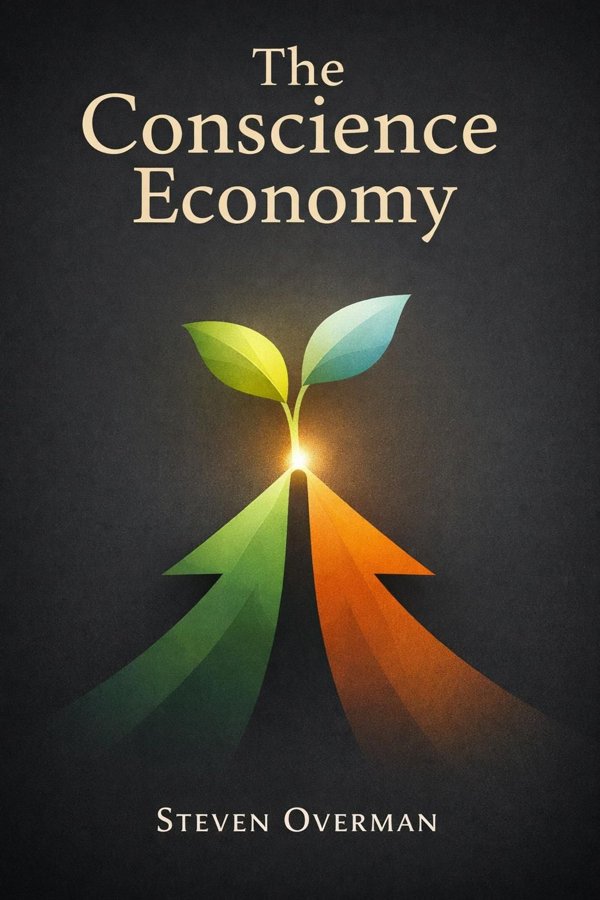
The Conscience Economy: How a Mass Movement for Good Is Great for Business: Summary & Key Insights
 10 min10 chaptersAudio available
What Is The Conscience Economy: How a Mass Movement for Good Is Great for Business About?
The Conscience Economy: How a Mass Movement for Good Is Great for Business by Steven Overman is a economics book spanning 10 pages. The Conscience Economy explores how a new generation of consumers, employees, and citizens are reshaping business and society by demanding that organizations act with purpose, transparency, and social responsibility. Steven Overman argues that companies that align profit with positive impact will thrive in this new era, while those that ignore conscience-driven values will struggle to survive.
This FizzRead summary covers all 10 key chapters of The Conscience Economy: How a Mass Movement for Good Is Great for Business in approximately 10 minutes, distilling the most important ideas, arguments, and takeaways from Steven Overman's work. Also available as an audio summary and Key Quotes Podcast.
The Conscience Economy: How a Mass Movement for Good Is Great for Business
The Conscience Economy explores how a new generation of consumers, employees, and citizens are reshaping business and society by demanding that organizations act with purpose, transparency, and social responsibility. Steven Overman argues that companies that align profit with positive impact will thrive in this new era, while those that ignore conscience-driven values will struggle to survive.
Who Should Read The Conscience Economy: How a Mass Movement for Good Is Great for Business?
This book is perfect for anyone interested in economics and looking to gain actionable insights in a short read. Whether you're a student, professional, or lifelong learner, the key ideas from The Conscience Economy: How a Mass Movement for Good Is Great for Business by Steven Overman will help you think differently.
- ✓Readers who enjoy economics and want practical takeaways
- ✓Professionals looking to apply new ideas to their work and life
- ✓Anyone who wants the core insights of The Conscience Economy: How a Mass Movement for Good Is Great for Business in just 10 minutes
Want the full summary?
Get instant access to this book summary and 100K+ more with Fizz Moment.
Get Free SummaryAvailable on App Store • Free to download
Key Chapters
To understand the Conscience Economy, we must trace its lineage. The Industrial Age taught society how to produce at scale; efficiency and mechanization reigned supreme. The Information Age connected the world, enabling communication and knowledge-sharing at unprecedented speeds. Yet both these economic epochs prioritized profit, scale, and innovation largely detached from moral consequence. The externalities—pollution, inequality, exploitation—were accepted as the necessary costs of progress.
But as technological networks matured, people grew more aware of those costs. Information empowered transparency, and transparency, in turn, awakened conscience. Consumers began to see behind the facades of brands. Employees glimpsed the true impact of their organizations’ decisions. The public could now hold institutions to account, shaping markets through collective will. The economy began to pivot—not away from profit, but toward purpose.
What we see now is a natural evolution: the Conscience Economy as the successor to the Information Economy. In this new phase, trust and authenticity are assets just as vital as capital or intellectual property. Every brand, every enterprise, now operates in plain sight. The question is no longer whether we can produce, but whether we should—and how responsibly we can do it. Those who navigate this turning point with integrity will lead the next era of growth.
Social media and digital communication have utterly redefined the boundaries of organizational behavior. In the past, corporations controlled the narrative about their brands. They could curate a public image unchallenged by the consumer’s voice. That monopoly has vanished. Today, the conversation is two-way—and often led from the outside.
Through open platforms, even a single act of dishonesty or indifference can spiral into a global crisis. Conversely, a single act of courage, transparency, or compassion can generate enormous goodwill. Digital tools have democratized accountability: consumers, employees, and citizens collaborate to demand and reward ethical conduct.
This transformation has also given rise to movements—grassroots, collective, and deeply human—that shape the choices of consumers and the direction of markets. Think of how rapidly awareness spreads around issues like fair labor, environmental sustainability, or diversity. These are not mere trends; they are cultural shifts expressing a universal demand that organizations reflect shared human values.
In the Conscience Economy, technology is not merely a tool of efficiency but a medium of connection. It allows humanity to see itself reflected in its own creations and forces companies to answer the moral question at the heart of modern commerce: 'What is our true impact on the world?'
+ 8 more chapters — available in the FizzRead app
All Chapters in The Conscience Economy: How a Mass Movement for Good Is Great for Business
About the Author
Steven Overman is an author, entrepreneur, and marketing executive known for his work on brand purpose and social innovation. He has held leadership roles at Nokia and Kodak and writes extensively on the intersection of technology, culture, and ethics in business.
Get This Summary in Your Preferred Format
Read or listen to the The Conscience Economy: How a Mass Movement for Good Is Great for Business summary by Steven Overman anytime, anywhere. FizzRead offers multiple formats so you can learn on your terms — all free.
Available formats: App · Audio · PDF · EPUB — All included free with FizzRead
Download The Conscience Economy: How a Mass Movement for Good Is Great for Business PDF and EPUB Summary
Key Quotes from The Conscience Economy: How a Mass Movement for Good Is Great for Business
“To understand the Conscience Economy, we must trace its lineage.”
“Social media and digital communication have utterly redefined the boundaries of organizational behavior.”
Frequently Asked Questions about The Conscience Economy: How a Mass Movement for Good Is Great for Business
The Conscience Economy: How a Mass Movement for Good Is Great for Business by Steven Overman is a economics book that explores key ideas across 10 chapters. The Conscience Economy explores how a new generation of consumers, employees, and citizens are reshaping business and society by demanding that organizations act with purpose, transparency, and social responsibility. Steven Overman argues that companies that align profit with positive impact will thrive in this new era, while those that ignore conscience-driven values will struggle to survive.
You Might Also Like
Business Adventures
John Brooks
10 min
Nudge
Richard H. Thaler, Cass R. Sunstein
10 min
The Hitchhiker"s Guide to the Galaxy
Douglas Adams
10 minThe Muqaddimah
Ibn Khaldun
10 minThe Outsiders
William N. Thorndike
10 min
A Little History of Economics
Niall Kishtainy
10 minBrowse by Category
Ready to read The Conscience Economy: How a Mass Movement for Good Is Great for Business?
Get the full summary and 100K+ more books with Fizz Moment.