
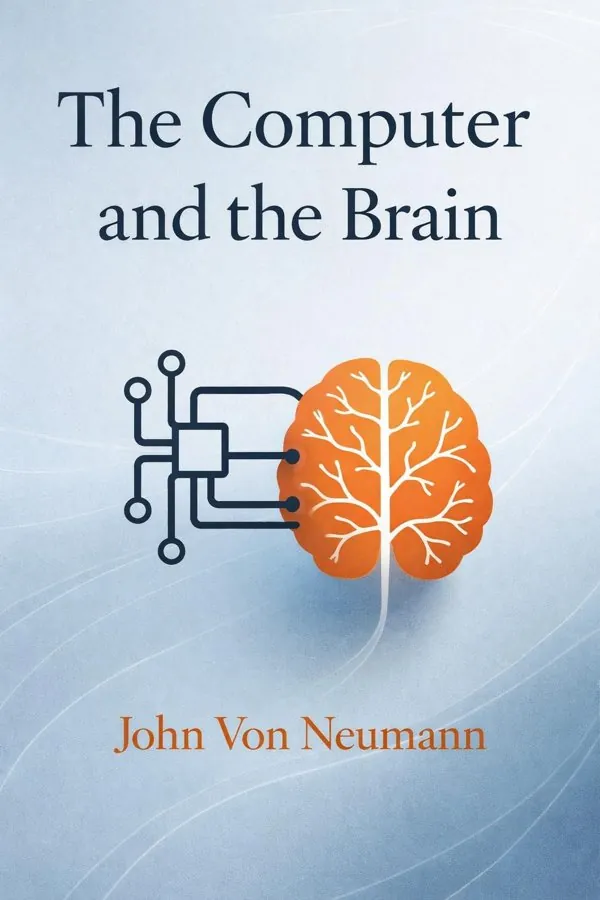
The Computer and the Brain: Summary & Key Insights
 10 min8 chaptersAudio available
What Is The Computer and the Brain About?
The Computer and the Brain by John Von Neumann is a neuroscience book spanning 8 pages. In this unfinished work, John von Neumann explores the parallels between computing machines and the human brain. Written shortly before his death, the book examines how the logical structure and functioning of computers can illuminate the mechanisms of thought and neural activity. It remains a foundational text in the study of computational neuroscience and artificial intelligence.
This FizzRead summary covers all 8 key chapters of The Computer and the Brain in approximately 10 minutes, distilling the most important ideas, arguments, and takeaways from John Von Neumann's work. Also available as an audio summary and Key Quotes Podcast.
The Computer and the Brain
In this unfinished work, John von Neumann explores the parallels between computing machines and the human brain. Written shortly before his death, the book examines how the logical structure and functioning of computers can illuminate the mechanisms of thought and neural activity. It remains a foundational text in the study of computational neuroscience and artificial intelligence.
Who Should Read The Computer and the Brain?
This book is perfect for anyone interested in neuroscience and looking to gain actionable insights in a short read. Whether you're a student, professional, or lifelong learner, the key ideas from The Computer and the Brain by John Von Neumann will help you think differently.
- ✓Readers who enjoy neuroscience and want practical takeaways
- ✓Professionals looking to apply new ideas to their work and life
- ✓Anyone who wants the core insights of The Computer and the Brain in just 10 minutes
Want the full summary?
Get instant access to this book summary and 100K+ more with Fizz Moment.
Get Free SummaryAvailable on App Store • Free to download
Key Chapters
Before we can draw meaningful parallels, we must recall what early computing machines truly are. A computer, as I defined it, consists of three principal components: the memory, the arithmetic unit, and the control unit. Memory stores instructions and data; the arithmetic unit executes operations; the control unit regulates order and timing. This logical separation reflects a fundamental principle: computation is achieved through discrete, deterministic steps governed by formal logic.
In my architectural studies, particularly in designing what became known as the von Neumann architecture, I emphasized that the stored-program concept represents a major breakthrough. The instructions that govern computation are themselves data—subject to manipulation by the machine. This circularity allows immense flexibility and has shaped all subsequent computing systems.
Yet, electronic computers of the mid-twentieth century remained crude physical embodiments. They relied on vacuum tubes—fragile, energy-hungry, and subject to failure. Their speed was impressive by human standards, yet their operation was entirely externally prescribed. Nothing in the computer ‘learned’ in any organic sense. It followed what was hard-coded by the programmer.
Why is this structure significant? Because it reveals the contrast with nature. The computer operates through precise binary distinctions: yes or no, one or zero. The brain, in contrast, functions through continuously variable states among vast assemblies of interacting elements. In the computer, each component can be perfectly described and predicted; in the brain, the component properties shift, adapt, and self-regulate.
Through examining the artificial machine, we expose the boundaries of logic itself. Logic allows construction of complex thought processes from simple elements. But does it suffice to emulate the spontaneity of the biological mind? The answer, as I propose, depends on whether we regard the brain as merely a vast logical network, or as something whose organization transcends the formal algorithmic domain.
Let us now turn to the brain—not as a mystical entity, but as a computing system in its own right. Here, each neuron acts as a fundamental unit of information processing. A neuron receives signals through its dendrites, integrates them, and emits a response through its axon. In abstract terms, this resembles a threshold logic unit: a summation followed by a decision. Neurons fire when inputs exceed certain conditions, thus forming binary-like operations. However, unlike electronic circuits, neurons exhibit variability, temporal independence, and probabilistic behavior.
In my analysis, I considered whether this neuronal activity could be mapped to the formal logic of a computing machine. The resemblance is enticing: both systems employ numerous interconnected elements exchanging signals within definable pathways. But a crucial difference emerges—the brain’s toleration, even utilization, of noise. Rather than regarding errors as destructive, nature integrates them into the robustness of function.
The logical structure of the brain is hierarchical yet massively parallel. While computers of my era processed one instruction at a time, the brain conducts innumerable operations simultaneously, each modulating the others. This parallelism establishes a form of holistic computation that cannot be easily reduced to serial logic. Where a computer’s path is predetermined, the brain’s is emergent.
Nevertheless, we may still learn from this analogy. By viewing neurons as logic elements, we glimpse how complexity can arise from repetition and interconnection. In mathematics, we know that sufficiently large networks of simple units can perform extraordinarily complex functions. The brain demonstrates that nature reached this principle long before human engineering did. But unlike our machines, it realizes complexity through adaptability rather than replication.
+ 6 more chapters — available in the FizzRead app
All Chapters in The Computer and the Brain
About the Author
John von Neumann (1903–1957) was a Hungarian-American mathematician, physicist, and computer scientist. He made pioneering contributions to quantum mechanics, game theory, computer architecture, and the foundations of mathematics. His work laid the groundwork for modern computing and theoretical economics.
Get This Summary in Your Preferred Format
Read or listen to the The Computer and the Brain summary by John Von Neumann anytime, anywhere. FizzRead offers multiple formats so you can learn on your terms — all free.
Available formats: App · Audio · PDF · EPUB — All included free with FizzRead
Download The Computer and the Brain PDF and EPUB Summary
Key Quotes from The Computer and the Brain
“Before we can draw meaningful parallels, we must recall what early computing machines truly are.”
“Let us now turn to the brain—not as a mystical entity, but as a computing system in its own right.”
Frequently Asked Questions about The Computer and the Brain
The Computer and the Brain by John Von Neumann is a neuroscience book that explores key ideas across 8 chapters. In this unfinished work, John von Neumann explores the parallels between computing machines and the human brain. Written shortly before his death, the book examines how the logical structure and functioning of computers can illuminate the mechanisms of thought and neural activity. It remains a foundational text in the study of computational neuroscience and artificial intelligence.
You Might Also Like
Anxious
Joseph LeDoux
10 min
Hallucinations
Oliver Sacks
10 min
The Biological Mind: How Brain, Body, and Environment Collaborate to Make Us Who We Are
Alan Jasanoff
10 min
The Feeling of Life Itself: Why Consciousness Is Widespread but Can't Be Computed
Christof Koch
10 min
The No-Nonsense Meditation Book
Steven Laureys
10 min
A General Theory of Love
Thomas Lewis, Fari Amini, Richard Lannon
10 minBrowse by Category
Ready to read The Computer and the Brain?
Get the full summary and 100K+ more books with Fizz Moment.