
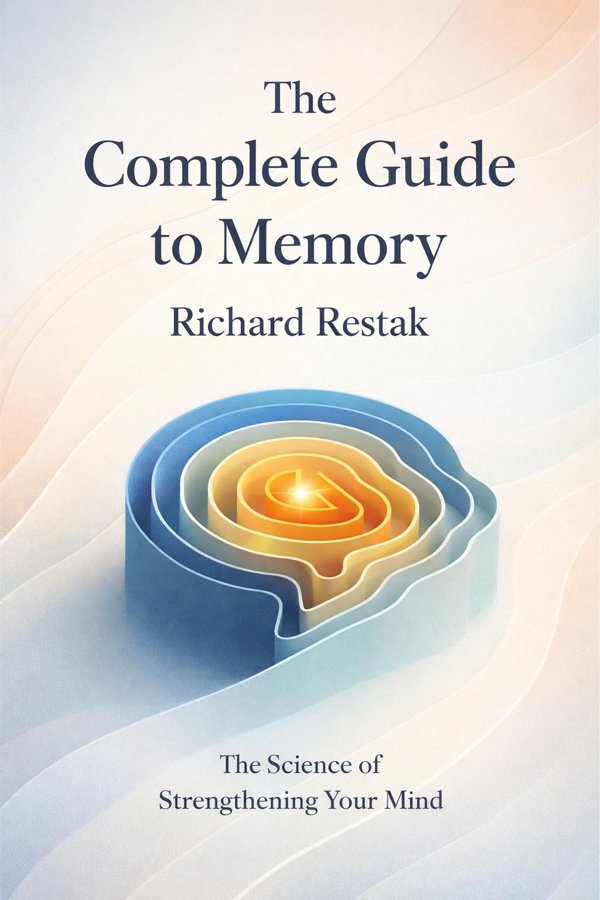
The Complete Guide to Memory: The Science of Strengthening Your Mind: Summary & Key Insights
 10 min6 chaptersAudio available
What Is The Complete Guide to Memory: The Science of Strengthening Your Mind About?
The Complete Guide to Memory: The Science of Strengthening Your Mind by Richard Restak is a neuroscience book spanning 6 pages. In this comprehensive exploration of memory, neurologist Richard Restak explains how memory works, why it sometimes fails, and how to strengthen it through scientifically grounded techniques. Drawing on decades of clinical experience and neuroscience research, Restak offers practical advice for improving recall, attention, and cognitive resilience at any age.
This FizzRead summary covers all 6 key chapters of The Complete Guide to Memory: The Science of Strengthening Your Mind in approximately 10 minutes, distilling the most important ideas, arguments, and takeaways from Richard Restak's work. Also available as an audio summary and Key Quotes Podcast.
The Complete Guide to Memory: The Science of Strengthening Your Mind
In this comprehensive exploration of memory, neurologist Richard Restak explains how memory works, why it sometimes fails, and how to strengthen it through scientifically grounded techniques. Drawing on decades of clinical experience and neuroscience research, Restak offers practical advice for improving recall, attention, and cognitive resilience at any age.
Who Should Read The Complete Guide to Memory: The Science of Strengthening Your Mind?
This book is perfect for anyone interested in neuroscience and looking to gain actionable insights in a short read. Whether you're a student, professional, or lifelong learner, the key ideas from The Complete Guide to Memory: The Science of Strengthening Your Mind by Richard Restak will help you think differently.
- ✓Readers who enjoy neuroscience and want practical takeaways
- ✓Professionals looking to apply new ideas to their work and life
- ✓Anyone who wants the core insights of The Complete Guide to Memory: The Science of Strengthening Your Mind in just 10 minutes
Want the full summary?
Get instant access to this book summary and 100K+ more with Fizz Moment.
Get Free SummaryAvailable on App Store • Free to download
Key Chapters
Memory is not housed in a single location but distributed across a network of brain structures. In my clinical work, I have often likened the hippocampus to a librarian—a structure that indexes experiences and places them within a mental map so they can be retrieved later. When patients suffer damage to the hippocampus, they may retain older memories yet lose the ability to form new ones, illustrating how central this structure is to ongoing experience.
Complementing the hippocampus is the prefrontal cortex, which manages working memory—the capacity to hold and manipulate information in mind. It allows us to plan the next move in a chess game or follow the thread of a conversation. The amygdala, meanwhile, imbues memories with emotion, ensuring that what moves us deeply remains vividly imprinted. These interactions show that remembering is not passive storage but a coordinated symphony of encoding, consolidation, and recall.
Understanding this biological choreography helps us work with, rather than against, the brain’s natural rhythms. Consolidation occurs primarily during sleep, when neural circuits replay the day’s experiences. Practice and repetition strengthen synaptic pathways, while attention determines which impressions are tagged as important. Nothing in this system is fixed; it evolves through our choices and habits. That is the empowering truth neuroscience offers today: your brain remains plastic, capable of change and renewal at any age.
In daily life, we often treat memory as a single faculty, but it is composed of many interacting systems. Short-term memory is a fleeting buffer—it holds a phone number for a few seconds before it fades. Working memory is more active; it allows us to reason, calculate, and solve problems by juggling mental data. Long-term memory, by contrast, is our cognitive archive, encompassing everything from childhood stories to professional expertise. Then there is procedural memory, which governs skills like typing or cycling, operating reliably even when we do not consciously recall each step.
Each type of memory is sustained by distinct neural circuits, yet they cooperate seamlessly. Take learning to play the piano: procedural memory automates finger movements, while long-term memory stores music theory and specific compositions. Working memory enables you to stay on tempo as your brain anticipates the notes ahead. The beauty of this system is its adaptability; the more we engage these faculties, the stronger their interconnections become.
Understanding these distinctions allows us to adopt targeted strategies for improvement. Enhancing working memory may involve mental arithmetic or language practice, while long-term retention benefits from elaborative rehearsal—connecting new material to existing knowledge. Even procedural memory thrives on consistent, mindful repetition. The purpose is not to segregate these systems but to integrate them consciously into a richer life of thought and skill.
+ 4 more chapters — available in the FizzRead app
All Chapters in The Complete Guide to Memory: The Science of Strengthening Your Mind
About the Author
Richard Restak, M.D., is a neurologist and neuropsychiatrist based in Washington, D.C. He has written numerous books on the human brain and has served as a clinical professor of neurology at George Washington University School of Medicine and Health Sciences.
Get This Summary in Your Preferred Format
Read or listen to the The Complete Guide to Memory: The Science of Strengthening Your Mind summary by Richard Restak anytime, anywhere. FizzRead offers multiple formats so you can learn on your terms — all free.
Available formats: App · Audio · PDF · EPUB — All included free with FizzRead
Download The Complete Guide to Memory: The Science of Strengthening Your Mind PDF and EPUB Summary
Key Quotes from The Complete Guide to Memory: The Science of Strengthening Your Mind
“Memory is not housed in a single location but distributed across a network of brain structures.”
“In daily life, we often treat memory as a single faculty, but it is composed of many interacting systems.”
Frequently Asked Questions about The Complete Guide to Memory: The Science of Strengthening Your Mind
The Complete Guide to Memory: The Science of Strengthening Your Mind by Richard Restak is a neuroscience book that explores key ideas across 6 chapters. In this comprehensive exploration of memory, neurologist Richard Restak explains how memory works, why it sometimes fails, and how to strengthen it through scientifically grounded techniques. Drawing on decades of clinical experience and neuroscience research, Restak offers practical advice for improving recall, attention, and cognitive resilience at any age.
You Might Also Like
Anxious
Joseph LeDoux
10 min
Hallucinations
Oliver Sacks
10 min
The Biological Mind: How Brain, Body, and Environment Collaborate to Make Us Who We Are
Alan Jasanoff
10 min
The Feeling of Life Itself: Why Consciousness Is Widespread but Can't Be Computed
Christof Koch
10 min
The No-Nonsense Meditation Book
Steven Laureys
10 min
A General Theory of Love
Thomas Lewis, Fari Amini, Richard Lannon
10 minBrowse by Category
Ready to read The Complete Guide to Memory: The Science of Strengthening Your Mind?
Get the full summary and 100K+ more books with Fizz Moment.