
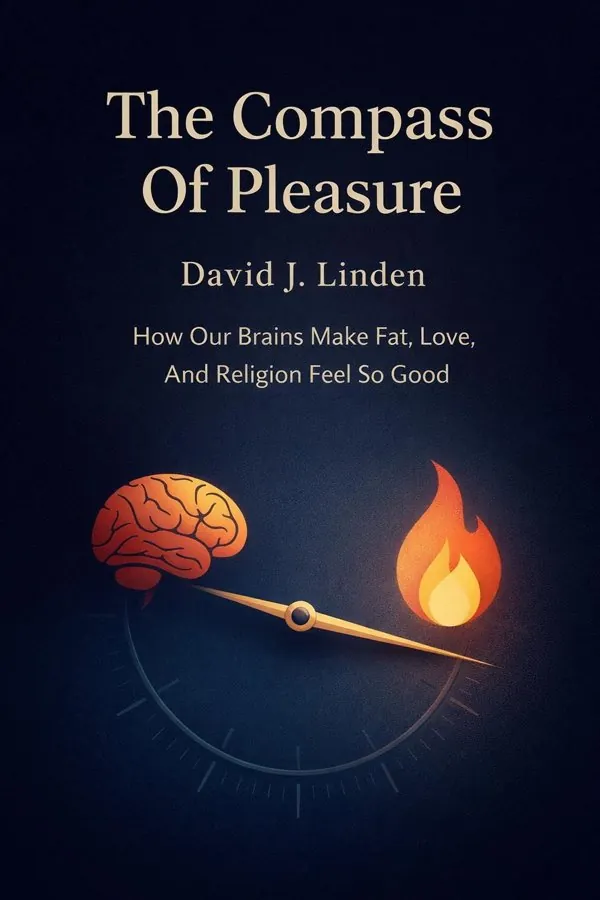
The Compass Of Pleasure: How Our Brains Make Fat, Love, And Religion Feel So Good: Summary & Key Insights
 10 min10 chaptersAudio available
What Is The Compass Of Pleasure: How Our Brains Make Fat, Love, And Religion Feel So Good About?
The Compass Of Pleasure: How Our Brains Make Fat, Love, And Religion Feel So Good by David J. Linden is a neuroscience book spanning 10 pages. In this engaging exploration of neuroscience, David J. Linden explains how the brain’s pleasure circuitry drives behaviors ranging from eating and sex to drug use and spiritual experience. Drawing on cutting-edge research, he reveals how pleasure and addiction share common neural pathways and how evolution has shaped our pursuit of reward.
This FizzRead summary covers all 10 key chapters of The Compass Of Pleasure: How Our Brains Make Fat, Love, And Religion Feel So Good in approximately 10 minutes, distilling the most important ideas, arguments, and takeaways from David J. Linden's work. Also available as an audio summary and Key Quotes Podcast.
The Compass Of Pleasure: How Our Brains Make Fat, Love, And Religion Feel So Good
In this engaging exploration of neuroscience, David J. Linden explains how the brain’s pleasure circuitry drives behaviors ranging from eating and sex to drug use and spiritual experience. Drawing on cutting-edge research, he reveals how pleasure and addiction share common neural pathways and how evolution has shaped our pursuit of reward.
Who Should Read The Compass Of Pleasure: How Our Brains Make Fat, Love, And Religion Feel So Good?
This book is perfect for anyone interested in neuroscience and looking to gain actionable insights in a short read. Whether you're a student, professional, or lifelong learner, the key ideas from The Compass Of Pleasure: How Our Brains Make Fat, Love, And Religion Feel So Good by David J. Linden will help you think differently.
- ✓Readers who enjoy neuroscience and want practical takeaways
- ✓Professionals looking to apply new ideas to their work and life
- ✓Anyone who wants the core insights of The Compass Of Pleasure: How Our Brains Make Fat, Love, And Religion Feel So Good in just 10 minutes
Want the full summary?
Get instant access to this book summary and 100K+ more with Fizz Moment.
Get Free SummaryAvailable on App Store • Free to download
Key Chapters
When neuroscientists speak of pleasure, we often begin with dopamine—but that story is more intricate than the popular image of dopamine as a 'happiness molecule.' In the brain, dopamine acts less as a direct signal of bliss and more as a ledger of prediction and learning. It surges not when we feel pleasure itself, but when we anticipate or receive an unexpected reward. This insight, born from decades of research, shifts our understanding from simple stimulus-response to cognitive expectation.
At the heart of this system lies the nucleus accumbens, a small cluster of neurons deep beneath the cerebral cortex. This structure, linked with the ventral tegmental area (VTA), forms the brain’s reward pathway. Whenever you experience something rewarding—a delicious meal, a flirtatious glance, or even the allure of risk—neurons in the VTA release dopamine that floods the nucleus accumbens. That flood engages other networks: the prefrontal cortex evaluates consequences, the amygdala stores emotional associations, and the hippocampus keeps a record of context. Together, they weave the memory of pleasure into the tapestry of motivation.
To truly grasp this circuit’s meaning, imagine a hunter-gatherer ancestor discovering ripe fruit. The sweetness triggers a surge of dopamine, encoding the experience as 'good.' That memory drives the hunter to seek similar fruits again, ensuring survival. In contrast, modern versions of the same circuitry respond not only to calories but to substances like cocaine, which artificially inflate dopamine levels far above natural bounds. The result isn’t simply 'more pleasure'; it’s distorted learning—an overpowering belief that the stimulus is essential.
Understanding that pleasure is physical yet shaped by context allows us to see why no sensation exists in isolation. Our brains evolved to assign value to behaviors that preserve life. The circuits that once guided survival now respond to cultural inventions, sometimes without discrimination. The dopamine surge is simply the messenger, persuading the brain to repeat what feels rewarding, regardless of consequence.
When we talk about pleasure, the boundary between natural and artificial quickly blurs. From the standpoint of the brain, eating a slice of cake and inhaling cocaine trigger overlapping networks. Both elevate dopamine in the nucleus accumbens. Yet the magnitude and persistence differ—natural rewards are moderate, transient, and tied to adaptive behaviors; artificial rewards hijack the system, producing exaggerated and prolonged signals.
Food represents the most ancient pleasure. Sugar and fat, scarce in our ancestral diets, were evolution’s way of ensuring energy intake. The brain encoded these flavors as gratifying. The same neural chemistry applies to sexual activity; mutual touch and orgasm activate the same nodal points of the pleasure circuit. Nature designed these experiences to reinforce behavior that sustains the species.
Artificial stimuli exploit these pathways. Drugs like heroin, nicotine, and alcohol act as pharmacological shortcuts, delivering intense rewards without the adaptive activity. Cocaine, for instance, blocks dopamine reuptake—keeping the molecule in the synaptic cleft longer and amplifying its effect. The brain eventually recalibrates, reducing receptor sensitivity or dopamine production. The consequence is the paradox of addiction: pleasure diminishes even as desire increases.
This distinction illuminates how artificial pleasures rewire the compass entirely. Unlike natural rewards, they persuade the brain that the path to satisfaction no longer requires effort or context. Eating, mating, bonding—all encoded as part of complex behavioral chains—are replaced by isolated chemical experiences. Pleasure, stripped from meaning, becomes compulsion.
+ 8 more chapters — available in the FizzRead app
All Chapters in The Compass Of Pleasure: How Our Brains Make Fat, Love, And Religion Feel So Good
About the Author
David J. Linden is a professor of neuroscience at the Johns Hopkins University School of Medicine. He is known for his accessible writing on brain science and is also the author of 'The Accidental Mind' and 'Touch: The Science of Hand, Heart, and Mind.'
Get This Summary in Your Preferred Format
Read or listen to the The Compass Of Pleasure: How Our Brains Make Fat, Love, And Religion Feel So Good summary by David J. Linden anytime, anywhere. FizzRead offers multiple formats so you can learn on your terms — all free.
Available formats: App · Audio · PDF · EPUB — All included free with FizzRead
Download The Compass Of Pleasure: How Our Brains Make Fat, Love, And Religion Feel So Good PDF and EPUB Summary
Key Quotes from The Compass Of Pleasure: How Our Brains Make Fat, Love, And Religion Feel So Good
“When neuroscientists speak of pleasure, we often begin with dopamine—but that story is more intricate than the popular image of dopamine as a 'happiness molecule.”
“When we talk about pleasure, the boundary between natural and artificial quickly blurs.”
Frequently Asked Questions about The Compass Of Pleasure: How Our Brains Make Fat, Love, And Religion Feel So Good
The Compass Of Pleasure: How Our Brains Make Fat, Love, And Religion Feel So Good by David J. Linden is a neuroscience book that explores key ideas across 10 chapters. In this engaging exploration of neuroscience, David J. Linden explains how the brain’s pleasure circuitry drives behaviors ranging from eating and sex to drug use and spiritual experience. Drawing on cutting-edge research, he reveals how pleasure and addiction share common neural pathways and how evolution has shaped our pursuit of reward.
You Might Also Like
Anxious
Joseph LeDoux
10 min
Hallucinations
Oliver Sacks
10 min
The Biological Mind: How Brain, Body, and Environment Collaborate to Make Us Who We Are
Alan Jasanoff
10 min
The Feeling of Life Itself: Why Consciousness Is Widespread but Can't Be Computed
Christof Koch
10 min
The No-Nonsense Meditation Book
Steven Laureys
10 min
A General Theory of Love
Thomas Lewis, Fari Amini, Richard Lannon
10 minBrowse by Category
Ready to read The Compass Of Pleasure: How Our Brains Make Fat, Love, And Religion Feel So Good?
Get the full summary and 100K+ more books with Fizz Moment.