
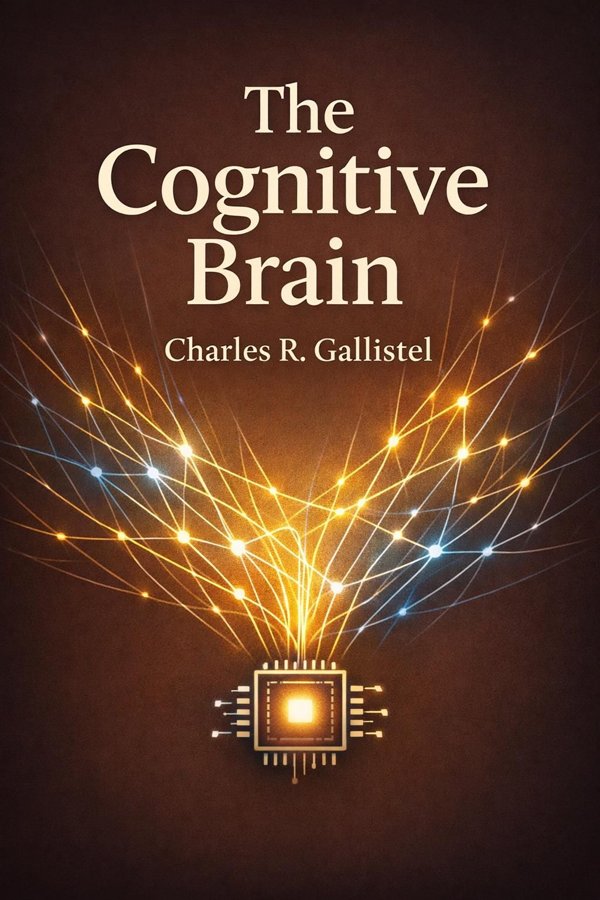
The Cognitive Brain: The Biological Basis of Learning, Thinking, and Imagining: Summary & Key Insights
 10 min11 chaptersAudio available
What Is The Cognitive Brain: The Biological Basis of Learning, Thinking, and Imagining About?
The Cognitive Brain: The Biological Basis of Learning, Thinking, and Imagining by Charles R. Gallistel is a neuroscience book spanning 11 pages. This book presents a comprehensive theory of how the brain represents, stores, and processes information. Gallistel integrates findings from neuroscience, psychology, and cognitive science to argue that the brain functions as an information-processing system, emphasizing the computational and representational nature of cognition.
This FizzRead summary covers all 11 key chapters of The Cognitive Brain: The Biological Basis of Learning, Thinking, and Imagining in approximately 10 minutes, distilling the most important ideas, arguments, and takeaways from Charles R. Gallistel's work. Also available as an audio summary and Key Quotes Podcast.
The Cognitive Brain: The Biological Basis of Learning, Thinking, and Imagining
This book presents a comprehensive theory of how the brain represents, stores, and processes information. Gallistel integrates findings from neuroscience, psychology, and cognitive science to argue that the brain functions as an information-processing system, emphasizing the computational and representational nature of cognition.
Who Should Read The Cognitive Brain: The Biological Basis of Learning, Thinking, and Imagining?
This book is perfect for anyone interested in neuroscience and looking to gain actionable insights in a short read. Whether you're a student, professional, or lifelong learner, the key ideas from The Cognitive Brain: The Biological Basis of Learning, Thinking, and Imagining by Charles R. Gallistel will help you think differently.
- ✓Readers who enjoy neuroscience and want practical takeaways
- ✓Professionals looking to apply new ideas to their work and life
- ✓Anyone who wants the core insights of The Cognitive Brain: The Biological Basis of Learning, Thinking, and Imagining in just 10 minutes
Want the full summary?
Get instant access to this book summary and 100K+ more with Fizz Moment.
Get Free SummaryAvailable on App Store • Free to download
Key Chapters
To understand the cognitive brain, we must begin with the convergence of psychology, neuroscience, and information theory. Historically, these fields evolved separately — psychology as a study of behavior, neuroscience as a study of biological structure, and information theory as a branch of mathematics concerned with the organization and transmission of signals.
In the early twentieth century, psychology was dominated by behaviorism, a movement that deliberately avoided internal mental mechanisms. Learning was seen as a product of stimulus-response chains, with memory viewed as a passive recording device. But as experiments accumulated — from Tolman's rat navigation studies to Lashley’s search for the memory engram — cracks began to form in this purely behavioral view. The mind was not a black box after all; something computational was occurring within.
At the same time, neuroscience was revealing that the brain’s architecture was far from a homogeneous tangle. Neurons communicated through discrete pulses, and these signals obeyed rules of timing and connectivity. When Shannon introduced information theory, and McCulloch and Pitts demonstrated that neural networks could carry out logical operations, it became clear that brain activity could be interpreted as information processing.
Cognitive neuroscience emerged from this synthesis. The question shifted from 'How do organisms behave?' to 'How is information represented and used in the brain?' In this context, the idea of representation became crucial. Learning and memory could no longer be understood simply as strengthening of responses, but as the encoding of relations and structures.
From my perspective, the foundations of cognitive neuroscience are built upon recognizing that biological systems can perform symbolic operations. The nervous system, while physical, operates according to rules that enable it to construct internal models of reality. The brain does not merely respond to stimuli — it predicts, generalizes, and manipulates possibilities. This realization laid the groundwork for everything else in the book.
Representation is the beating heart of cognition. When an animal perceives the world, it does not copy its environment. It constructs a neural model — an internal encoding that captures spatial, temporal, and qualitative properties of events. To think is to operate upon these representations.
Neuroscience provides abundant evidence for the representational nature of neural activity. A neuron’s firing pattern corresponds not directly to a stimulus but to an encoded feature — orientation, frequency, location, or expected reward. Populations of neurons collectively form a 'code' that represents abstract attributes of the world. In this view, the brain functions as a complex representational system, continuously mapping external events onto internal states.
I argue that these representations are symbolic in nature. They stand for things rather than being those things. This symbolic property enables computation: a neuron can manipulate signals referring to distance or time without having to physically traverse distance or time. The power of cognition lies precisely in this ability to operate on representations rather than raw sensory data.
Consider spatial navigation. When a rat navigates a maze, it uses internal representations of position and direction. These are not vague impressions but measurable codings within hippocampal cells — the now-famous 'place cells' and 'grid cells'. Such findings confirm that the brain does indeed encode the structure of space as a system of information.
Representation extends beyond perception to memory and thought. When we imagine, we reactivate representational systems, allowing us to manipulate hypothetical experiences. This reactivation forms the biological basis of imagination and planning. In essence, representation transforms neurons from mere responders into modelers of reality.
+ 9 more chapters — available in the FizzRead app
All Chapters in The Cognitive Brain: The Biological Basis of Learning, Thinking, and Imagining
About the Author
Charles R. Gallistel is an American psychologist and neuroscientist known for his research on learning, memory, and the neural mechanisms of cognition. He has contributed significantly to the understanding of how the brain encodes and manipulates information.
Get This Summary in Your Preferred Format
Read or listen to the The Cognitive Brain: The Biological Basis of Learning, Thinking, and Imagining summary by Charles R. Gallistel anytime, anywhere. FizzRead offers multiple formats so you can learn on your terms — all free.
Available formats: App · Audio · PDF · EPUB — All included free with FizzRead
Download The Cognitive Brain: The Biological Basis of Learning, Thinking, and Imagining PDF and EPUB Summary
Key Quotes from The Cognitive Brain: The Biological Basis of Learning, Thinking, and Imagining
“To understand the cognitive brain, we must begin with the convergence of psychology, neuroscience, and information theory.”
“Representation is the beating heart of cognition.”
Frequently Asked Questions about The Cognitive Brain: The Biological Basis of Learning, Thinking, and Imagining
The Cognitive Brain: The Biological Basis of Learning, Thinking, and Imagining by Charles R. Gallistel is a neuroscience book that explores key ideas across 11 chapters. This book presents a comprehensive theory of how the brain represents, stores, and processes information. Gallistel integrates findings from neuroscience, psychology, and cognitive science to argue that the brain functions as an information-processing system, emphasizing the computational and representational nature of cognition.
You Might Also Like
Anxious
Joseph LeDoux
10 min
Hallucinations
Oliver Sacks
10 min
The Biological Mind: How Brain, Body, and Environment Collaborate to Make Us Who We Are
Alan Jasanoff
10 min
The Feeling of Life Itself: Why Consciousness Is Widespread but Can't Be Computed
Christof Koch
10 min
The No-Nonsense Meditation Book
Steven Laureys
10 min
A General Theory of Love
Thomas Lewis, Fari Amini, Richard Lannon
10 minBrowse by Category
Ready to read The Cognitive Brain: The Biological Basis of Learning, Thinking, and Imagining?
Get the full summary and 100K+ more books with Fizz Moment.