
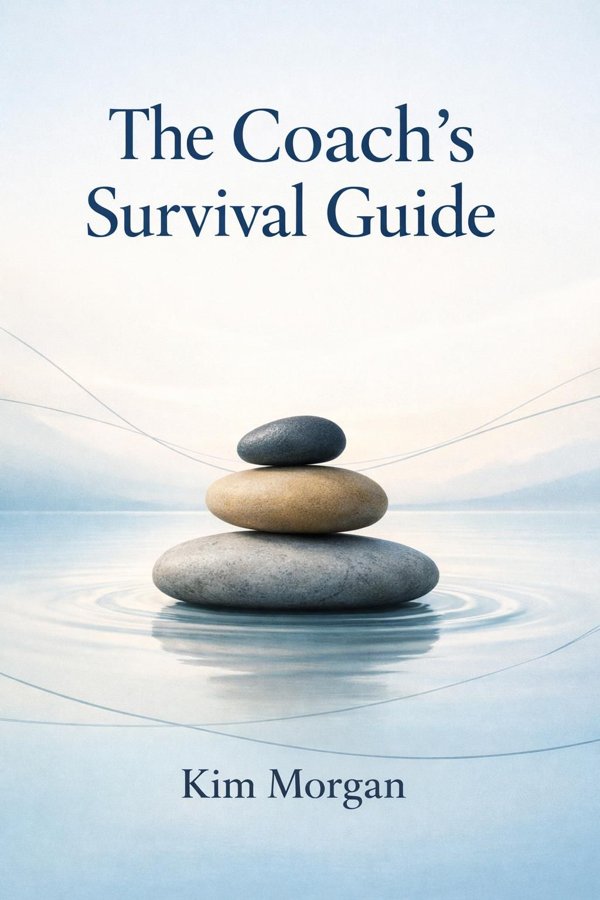
The Coach's Survival Guide: Practical Techniques and Tools for Coaching Success: Summary & Key Insights
by Kim Morgan
 10 min9 chaptersAudio available
Key Takeaways from The Coach's Survival Guide: Practical Techniques and Tools for Coaching Success
The quality of coaching is often determined before the first deep question is ever asked.
Clients rarely change because a coach sounds impressive; they change because they feel genuinely seen.
A difficult client is often not difficult by nature, but difficult for the coach’s current level of skill, patience, or clarity.
Coaches are often trained to attend carefully to others while ignoring the strain within themselves.
Experience alone does not make a better coach; reflected-on experience does.
What Is The Coach's Survival Guide: Practical Techniques and Tools for Coaching Success About?
The Coach's Survival Guide: Practical Techniques and Tools for Coaching Success by Kim Morgan is a leadership book spanning 6 pages. Coaching often looks elegant from the outside: powerful questions, breakthrough moments, and clients leaving sessions with renewed clarity. Kim Morgan’s The Coach's Survival Guide reveals what lies beneath that polished surface—the emotional labor, ethical complexity, boundary management, and business discipline that make great coaching possible. This is not a book of abstract theory alone. It is a grounded, practical handbook for coaches who want to do their work well while staying effective, professional, and resilient. Morgan draws on deep experience as a coach, trainer, and founder of Barefoot Coaching, one of the UK’s most respected coach-training organizations. Her authority comes not just from expertise, but from a clear understanding of what coaches actually face: difficult clients, self-doubt, supervision needs, blurred expectations, and the pressure to sustain a practice over time. The book matters because it treats coaching as a craft that requires both skill and stamina. For new coaches, it offers orientation and confidence. For experienced practitioners, it provides a valuable reset. Above all, it reminds readers that lasting coaching success depends not only on helping clients thrive, but on building a healthy, reflective, ethically grounded practice.
This FizzRead summary covers all 9 key chapters of The Coach's Survival Guide: Practical Techniques and Tools for Coaching Success in approximately 10 minutes, distilling the most important ideas, arguments, and takeaways from Kim Morgan's work. Also available as an audio summary and Key Quotes Podcast.
The Coach's Survival Guide: Practical Techniques and Tools for Coaching Success
Coaching often looks elegant from the outside: powerful questions, breakthrough moments, and clients leaving sessions with renewed clarity. Kim Morgan’s The Coach's Survival Guide reveals what lies beneath that polished surface—the emotional labor, ethical complexity, boundary management, and business discipline that make great coaching possible. This is not a book of abstract theory alone. It is a grounded, practical handbook for coaches who want to do their work well while staying effective, professional, and resilient.
Morgan draws on deep experience as a coach, trainer, and founder of Barefoot Coaching, one of the UK’s most respected coach-training organizations. Her authority comes not just from expertise, but from a clear understanding of what coaches actually face: difficult clients, self-doubt, supervision needs, blurred expectations, and the pressure to sustain a practice over time. The book matters because it treats coaching as a craft that requires both skill and stamina. For new coaches, it offers orientation and confidence. For experienced practitioners, it provides a valuable reset. Above all, it reminds readers that lasting coaching success depends not only on helping clients thrive, but on building a healthy, reflective, ethically grounded practice.
Who Should Read The Coach's Survival Guide: Practical Techniques and Tools for Coaching Success?
This book is perfect for anyone interested in leadership and looking to gain actionable insights in a short read. Whether you're a student, professional, or lifelong learner, the key ideas from The Coach's Survival Guide: Practical Techniques and Tools for Coaching Success by Kim Morgan will help you think differently.
- ✓Readers who enjoy leadership and want practical takeaways
- ✓Professionals looking to apply new ideas to their work and life
- ✓Anyone who wants the core insights of The Coach's Survival Guide: Practical Techniques and Tools for Coaching Success in just 10 minutes
Want the full summary?
Get instant access to this book summary and 100K+ more with Fizz Moment.
Get Free SummaryAvailable on App Store • Free to download
Key Chapters
The quality of coaching is often determined before the first deep question is ever asked. At the heart of effective coaching sits trust, and trust is built not through warmth alone but through ethical clarity, reliability, and transparent expectations. Morgan emphasizes that coaches work in a space that is both supportive and professionally bounded. Clients may disclose fears, failures, ambitions, and private struggles, which makes the coach’s ethical responsibilities central rather than optional.
A strong coaching relationship begins with a clear contract. This includes practical matters such as confidentiality, goals, session structure, boundaries, cancellation policies, and what coaching can and cannot provide. For example, a client might expect advice, therapy, or friendship unless the coach clearly defines the role from the outset. Without this clarity, misunderstanding grows and trust erodes. Ethical coaching also involves recognizing limits. If a client presents issues better suited to counseling, therapy, or another specialist, the responsible coach refers rather than overreaches.
Morgan also highlights the subtle ethical challenges that arise in real practice: dual relationships, unspoken power dynamics, dependency, and the temptation to rescue clients. Good intentions are not enough. Coaches need consistent decision-making frameworks and the humility to seek supervision when situations become unclear.
In practice, this might mean reviewing the coaching agreement when goals shift, checking how confidentiality applies in organizational coaching, or pausing when a client begins leaning on the coach in ways that compromise the work. Professionalism is not coldness; it is the structure that makes meaningful coaching safe.
Actionable takeaway: Audit your coaching agreements and boundaries today. Make sure every client understands the purpose, limits, and expectations of the relationship before deeper work begins.
Clients rarely change because a coach sounds impressive; they change because they feel genuinely seen. Morgan argues that effective client relationships are not built on performance but on presence. Rapport is the invisible force that allows challenge to be heard, reflection to deepen, and commitment to emerge. Without it, even technically sound coaching can feel mechanical.
Building rapport starts with attention. Coaches need to listen beyond words to tone, pacing, hesitation, energy shifts, and what remains unsaid. A client who says, “Everything is fine at work,” while sounding tense and guarded may be inviting a gentler, more curious exploration. Presence also requires restraint. Coaches sometimes rush to ask the next powerful question instead of staying with what has just surfaced. Morgan suggests that patience itself can be a coaching skill.
Strong relationships also depend on authenticity. Clients can sense when a coach is hiding behind technique. This does not mean oversharing or collapsing boundaries; it means being grounded, responsive, and human. For instance, a coach might say, “I notice some hesitation as you say that—would it be useful to stay there for a moment?” Such responses communicate both attentiveness and respect.
Morgan also stresses that rapport is maintained, not assumed. Coaches need to check expectations, revisit goals, and notice when energy drops or resistance rises. In organizational settings, where sessions may be sponsored by employers, trust may require extra care because clients may worry about confidentiality or hidden agendas.
Actionable takeaway: In your next session, focus less on asking clever questions and more on tracking the client’s emotional tone, body language, and shifts in energy. Let your presence do more of the work.
A difficult client is often not difficult by nature, but difficult for the coach’s current level of skill, patience, or clarity. One of Morgan’s most practical contributions is her recognition that challenging coaching situations are inevitable. Some clients arrive late, avoid accountability, talk in circles, seek constant reassurance, resist every invitation to act, or expect the coach to solve their problems. Surviving these moments requires steadiness rather than frustration.
The first step is to diagnose the challenge accurately. Is the client unclear about what coaching is? Are they ambivalent about change? Were goals poorly contracted? Is fear masquerading as resistance? For example, a client who repeatedly fails to complete agreed actions may not be lazy; they may be protecting themselves from the consequences of change. A coach who responds with irritation will miss the deeper issue.
Morgan encourages coaches to separate judgment from observation. Instead of labeling someone “uncommitted,” notice patterns: missed appointments, vague answers, chronic deflection, or repeated movement away from discomfort. These patterns can then become coaching material. A useful intervention might be, “I notice we often get close to a decision and then shift topic. What do you think is happening there?”
At the same time, coaches must know when to challenge behavior directly and when to question fit. Some clients need a different approach, another professional, or firmer structure. Compassion does not mean tolerating endlessly unproductive work. It means responding with clarity, not resentment.
Actionable takeaway: When a client feels difficult, write down the specific behaviors you observe, then bring one pattern into the conversation neutrally. Coaching becomes more effective when the process itself becomes discussable.
Coaches are often trained to attend carefully to others while ignoring the strain within themselves. Morgan argues that this is unsustainable. Coaching can be emotionally demanding, especially when clients bring distress, confusion, conflict, or chronic stuckness. If coaches fail to manage their own resilience, their presence weakens, their judgment blurs, and the quality of their work declines.
Resilience is not simply toughness. It includes emotional awareness, recovery habits, perspective, and the ability to remain grounded without becoming detached. A coach may leave a session carrying a client’s anxiety, feeling responsible for outcomes, or doubting their own competence. Over time, these pressures can lead to fatigue or burnout, especially for solo practitioners. Morgan encourages coaches to normalize this reality rather than treat it as personal failure.
Self-care in this context is professional discipline. It may involve reflective journaling, peer support, regular supervision, exercise, rest, and creating space between sessions. Emotional intelligence matters too. Coaches need to distinguish a client’s feelings from their own reactions. For example, if a client’s anger makes the coach defensive, that reaction needs attention. Unexamined emotional responses can quietly steer the session.
Morgan’s broader point is that sustainable coaching requires internal resources. A depleted coach may become overinvolved, avoid challenge, rely too heavily on formulaic tools, or lose curiosity. A resilient coach can stay present under pressure and think clearly in complexity.
Actionable takeaway: Create a resilience routine for your practice—such as short decompression breaks between sessions, weekly reflective review, and regular supervision—and treat it as essential, not optional.
Experience alone does not make a better coach; reflected-on experience does. Morgan places reflective practice at the center of professional growth. Many coaches accumulate sessions over time, but unless they consciously examine what happened, why it happened, and how they responded, they risk repeating the same habits indefinitely. Reflection is what converts activity into learning.
Reflective practice can happen at several levels. After a session, a coach might review what worked, where the energy shifted, what assumptions were present, and what they avoided. A coach may notice, for instance, that they interrupted too quickly when silence emerged, or that they pushed toward action before the client had reached clarity. These observations become the raw material of improvement.
Morgan also highlights the importance of supervision and peer dialogue. Coaches are often poor judges of their own blind spots. External reflection helps uncover recurring patterns such as rescuing certain kinds of clients, avoiding conflict, or relying too heavily on favorite techniques. A supervision conversation can turn a confusing session into a rich source of insight.
Professional growth also means continuing to develop one’s toolkit without becoming tool-driven. Models and exercises are useful, but they must serve the client rather than the coach’s need to appear skilled. Reflection helps practitioners use methods more intentionally.
In practical terms, a reflective coach keeps notes not only on the client’s progress but on their own internal process. Over time, this builds discernment. The goal is not perfection but increasing awareness and adaptability.
Actionable takeaway: After each session, spend five minutes answering three questions: What happened? What did I contribute? What will I do differently next time? Small reflections create long-term mastery.
Many coaches enter the profession because they care deeply about human development, then discover that passion alone does not build a viable practice. Morgan addresses a reality often neglected in coaching books: if you want to sustain your work, you must also manage it as a business. This includes pricing, positioning, systems, client acquisition, administration, and financial boundaries.
Some coaches undercharge out of insecurity, avoid discussing money because it feels uncomfortable, or say yes to unsuitable clients because they fear inconsistency in income. These choices may feel generous in the moment, but they often create stress, resentment, and instability. Morgan encourages coaches to treat business processes as part of professionalism. Clear fees, payment policies, scheduling systems, and service descriptions do not cheapen coaching—they support it.
Sustaining success also requires strategic thinking. Who are you best placed to help? What kinds of clients energize you and align with your strengths? How will people understand the value of your work? A general promise to “help people reach their potential” is rarely compelling. Specificity builds trust and referral momentum.
Administrative discipline matters too. Good records, clear proposals, and consistent follow-up communicate reliability. In organizational coaching, this may include stakeholder management and carefully defined outcomes. In independent practice, it means balancing service quality with realistic capacity.
Morgan’s message is reassuring: business competence can be learned. Coaches do not need to become aggressive marketers, but they do need practical structures that allow the work to continue.
Actionable takeaway: Choose one business weak spot this week—pricing, contracts, invoicing, or ideal client clarity—and improve it. A stronger practice supports stronger coaching.
The most caring coaches are often the most vulnerable to boundary drift. Morgan shows that boundaries are not bureaucratic rules imposed on warm relationships; they are what keep coaching ethical, focused, and effective. When boundaries blur, coaches may become overavailable, emotionally entangled, or unclear about their role. Clients, in turn, may become dependent, confused, or less accountable.
Boundary issues can emerge in subtle ways. A client starts messaging between sessions for emotional support. A coach extends sessions regularly without discussion. An organizational sponsor asks for more information than was agreed. A coach begins sharing too much personal experience to build rapport. None of these moments may seem dramatic, but each can shift the relationship away from its proper purpose.
Morgan encourages coaches to think proactively rather than reactively. Boundaries should be designed, explained, and revisited. This includes contact expectations, confidentiality, session length, emotional scope, and the distinction between coaching and therapy. In difficult periods, clients may test these boundaries not because they are manipulative, but because they are seeking safety. The coach’s task is to respond with empathy and firmness.
A useful principle is this: if something important in the working relationship is happening repeatedly, it should be named. For instance, “I notice you often contact me late at night after difficult meetings. Let’s talk about what support is appropriate within coaching and what might help you outside sessions.” Such language preserves dignity while restoring clarity.
Actionable takeaway: Review where your current boundaries feel fuzzy. Then communicate one clearer expectation to clients in writing and in conversation, so your support remains both compassionate and professionally contained.
Frameworks can free a coach—or trap one. Morgan values practical tools and techniques, but she warns against becoming overly dependent on them. Models for goal setting, values exploration, accountability, and reflection can give sessions coherence, especially for less experienced coaches. Yet when a coach clings too tightly to process, they stop listening to the person in front of them.
The skill lies in using structure as support rather than script. A coaching model may help a client clarify a goal, identify obstacles, and choose actions, but real conversations rarely unfold in neat sequences. A client may arrive with a breakthrough, a crisis, or an emotion that makes the planned exercise irrelevant. In these moments, the coach must adapt. Rigid adherence to a method can make a session feel performative instead of responsive.
Morgan encourages coaches to build a flexible toolkit. For example, scaling questions can help a client assess confidence or progress. Values exercises can uncover why a goal matters. Reframing can reveal alternative perspectives. Accountability tools can turn insight into action. But each technique should be chosen because it serves the client’s need at that moment, not because the coach wants to demonstrate expertise.
This approach also reduces anxiety. Coaches do not need to carry the pressure of finding the perfect tool every time. Often, what matters most is discerning whether the client needs more exploration, more challenge, more emotional acknowledgment, or more practical planning.
Actionable takeaway: Before using any coaching model, ask yourself one simple question: Why this tool, for this client, right now? If the answer is unclear, stay with the conversation until the need becomes clearer.
Many coaches assume confidence will arrive once they have enough training, enough clients, or the right certification. Morgan offers a more grounded view: confidence in coaching develops through practice, reflection, and a willingness to remain teachable. Early-career coaches often feel pressure to appear polished, insightful, and always in control. Ironically, this pressure can make them less effective.
Real confidence is quieter. It shows up as the ability to stay present when a session feels uncertain, to admit when something is unclear, and to trust the coaching process without forcing it. A coach does not need to have all the answers because coaching is not about supplying answers. It is about facilitating the client’s thinking. This shift can be liberating.
Morgan also normalizes the awkward parts of development. New coaches may overprepare, ask too many questions, talk too much, or hide behind technique. More experienced coaches may still face self-doubt in difficult sessions. The point is not to eliminate insecurity completely, but to prevent it from dominating the work. Practice, feedback, and supervision gradually build steadiness.
An example of healthy confidence is a coach saying, “I think we may have lost the thread a little—shall we pause and reconnect with what matters most today?” That is not weakness. It is professional composure. Humility keeps coaches open to learning; repeated practice helps that learning become embodied.
Actionable takeaway: Redefine confidence as the ability to stay curious under pressure. After challenging sessions, focus less on whether you looked competent and more on what you learned for next time.
All Chapters in The Coach's Survival Guide: Practical Techniques and Tools for Coaching Success
About the Author
Kim Morgan is a leading British coach, coach trainer, and founder of Barefoot Coaching Ltd, one of the UK’s most established coaching schools. She is known for helping professional coaches develop the practical skills, confidence, and ethical grounding needed for real-world practice. With extensive experience in coach education and personal development, Morgan has built a reputation for making coaching accessible without oversimplifying its complexity. Her work bridges theory and application, offering tools that are both thoughtful and usable. Through training, writing, and leadership in the coaching field, she has influenced a wide range of practitioners, from beginners to experienced professionals. Her perspective is especially valued for its combination of warmth, clarity, and professional rigor.
Get This Summary in Your Preferred Format
Read or listen to the The Coach's Survival Guide: Practical Techniques and Tools for Coaching Success summary by Kim Morgan anytime, anywhere. FizzRead offers multiple formats so you can learn on your terms — all free.
Available formats: App · Audio · PDF · EPUB — All included free with FizzRead
Download The Coach's Survival Guide: Practical Techniques and Tools for Coaching Success PDF and EPUB Summary
Key Quotes from The Coach's Survival Guide: Practical Techniques and Tools for Coaching Success
“The quality of coaching is often determined before the first deep question is ever asked.”
“Clients rarely change because a coach sounds impressive; they change because they feel genuinely seen.”
“A difficult client is often not difficult by nature, but difficult for the coach’s current level of skill, patience, or clarity.”
“Coaches are often trained to attend carefully to others while ignoring the strain within themselves.”
“Experience alone does not make a better coach; reflected-on experience does.”
Frequently Asked Questions about The Coach's Survival Guide: Practical Techniques and Tools for Coaching Success
The Coach's Survival Guide: Practical Techniques and Tools for Coaching Success by Kim Morgan is a leadership book that explores key ideas across 9 chapters. Coaching often looks elegant from the outside: powerful questions, breakthrough moments, and clients leaving sessions with renewed clarity. Kim Morgan’s The Coach's Survival Guide reveals what lies beneath that polished surface—the emotional labor, ethical complexity, boundary management, and business discipline that make great coaching possible. This is not a book of abstract theory alone. It is a grounded, practical handbook for coaches who want to do their work well while staying effective, professional, and resilient. Morgan draws on deep experience as a coach, trainer, and founder of Barefoot Coaching, one of the UK’s most respected coach-training organizations. Her authority comes not just from expertise, but from a clear understanding of what coaches actually face: difficult clients, self-doubt, supervision needs, blurred expectations, and the pressure to sustain a practice over time. The book matters because it treats coaching as a craft that requires both skill and stamina. For new coaches, it offers orientation and confidence. For experienced practitioners, it provides a valuable reset. Above all, it reminds readers that lasting coaching success depends not only on helping clients thrive, but on building a healthy, reflective, ethically grounded practice.
You Might Also Like

Extreme Ownership
Jocko Willink
10 min
Dare to Lead
Brene Brown
10 min
Leaders Eat Last
Simon Sinek
10 min
The 21 Irrefutable Laws of Leadership
John Maxwell
10 min
Start With Why
Simon Sinek
10 min
How to Lead When You're Not in Charge
Clay Scroggins
10 minBrowse by Category
Ready to read The Coach's Survival Guide: Practical Techniques and Tools for Coaching Success?
Get the full summary and 100K+ more books with Fizz Moment.