
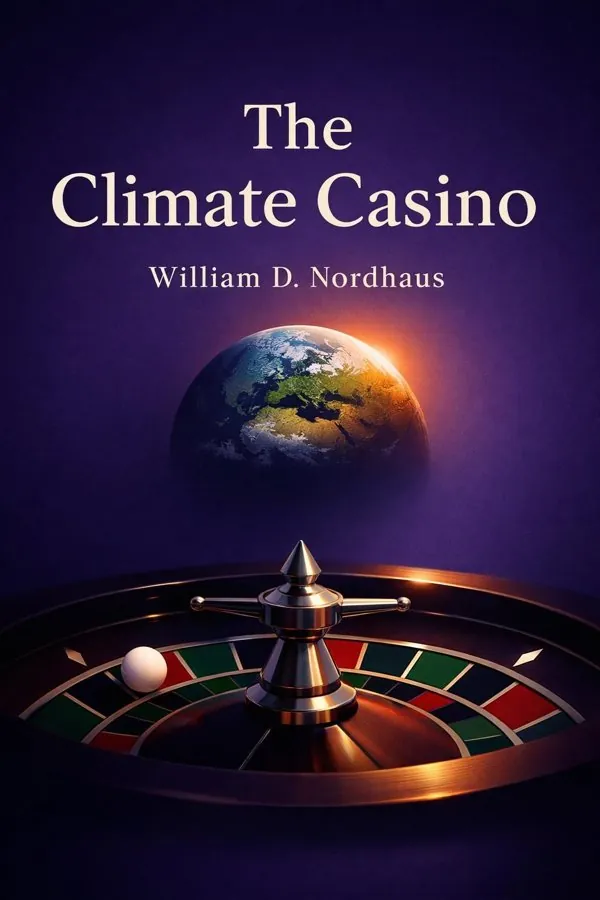
The Climate Casino: Risk, Uncertainty, and Economics for a Warming World: Summary & Key Insights
 10 min8 chaptersAudio available
What Is The Climate Casino: Risk, Uncertainty, and Economics for a Warming World About?
The Climate Casino: Risk, Uncertainty, and Economics for a Warming World by William D. Nordhaus is a economics book spanning 8 pages. In this influential work, Nobel laureate William D. Nordhaus explores the economic and policy dimensions of climate change. He presents the global climate system as a 'casino' in which humanity is gambling with the planet’s future, emphasizing the risks and uncertainties of inaction. Nordhaus integrates scientific evidence with economic modeling to argue for carbon pricing and coordinated international policies as the most effective means to mitigate global warming.
This FizzRead summary covers all 8 key chapters of The Climate Casino: Risk, Uncertainty, and Economics for a Warming World in approximately 10 minutes, distilling the most important ideas, arguments, and takeaways from William D. Nordhaus's work. Also available as an audio summary and Key Quotes Podcast.
The Climate Casino: Risk, Uncertainty, and Economics for a Warming World
In this influential work, Nobel laureate William D. Nordhaus explores the economic and policy dimensions of climate change. He presents the global climate system as a 'casino' in which humanity is gambling with the planet’s future, emphasizing the risks and uncertainties of inaction. Nordhaus integrates scientific evidence with economic modeling to argue for carbon pricing and coordinated international policies as the most effective means to mitigate global warming.
Who Should Read The Climate Casino: Risk, Uncertainty, and Economics for a Warming World?
This book is perfect for anyone interested in economics and looking to gain actionable insights in a short read. Whether you're a student, professional, or lifelong learner, the key ideas from The Climate Casino: Risk, Uncertainty, and Economics for a Warming World by William D. Nordhaus will help you think differently.
- ✓Readers who enjoy economics and want practical takeaways
- ✓Professionals looking to apply new ideas to their work and life
- ✓Anyone who wants the core insights of The Climate Casino: Risk, Uncertainty, and Economics for a Warming World in just 10 minutes
Want the full summary?
Get instant access to this book summary and 100K+ more with Fizz Moment.
Get Free SummaryAvailable on App Store • Free to download
Key Chapters
To understand the gambling metaphor, we must first grasp the rules of the game—the basic physics of the climate system. The Earth’s climate is governed largely by the greenhouse effect: certain gases trap a fraction of the outgoing infrared radiation, keeping the planet’s surface warmer than it would otherwise be. Carbon dioxide, methane, nitrous oxide, and various industrial gases are the principal players. The industrial revolution initiated a massive perturbation to this balance. By burning fossil fuels and altering land use, humanity has increased atmospheric CO₂ concentrations by over forty percent since preindustrial times.
Climate science has provided an increasingly sophisticated picture of what this means. Models project that, if current trends continue, the planet could warm by between two and six degrees Celsius by the end of the century. Even at the lower end of that range, the changes are profound. Ice sheets melt, seas rise, precipitation patterns shift, and ecosystems are disrupted. Although there are uncertainties in the precise magnitude of the response, the basic mechanisms are not in doubt. The physics is robust, the direction of change certain.
In the casino analogy, the dice we roll are loaded. We are increasing the odds of extreme outcomes—just not in a way that humans are evolutionarily trained to perceive. The central challenge, therefore, is not scientific ignorance but behavioral inertia. We know enough to act. The next question is how to design an economic framework that transforms knowledge into rational policy.
The heart of the climate problem lies in its economics. Carbon emissions are an externality: the costs they impose are borne not by the emitter but by society at large. When a factory produces electricity using coal, or when an individual drives a gasoline car, the private cost excludes the damage done to the atmosphere. To correct that misalignment, economists use the concept of internalization—bringing external costs into the decision-making process. In practical terms, this means putting a price on carbon.
Through the DICE model—Dynamic Integrated Climate-Economy model—I developed a way to combine climate science and macroeconomic growth theory. This model allows us to estimate how emissions influence temperature, how temperature affects output, and how policies such as carbon taxes alter long-run trajectories. Integrated assessment models are not crystal balls; they are systematic ways of translating physical and economic knowledge into a coherent analytical framework. They help us answer policy questions such as: What is the optimal carbon price? How much should we invest in mitigation? What are the expected benefits of action relative to its costs?
The principle is simple but profound. When carbon carries a price reflecting its true social cost—the monetary value of damages caused by one additional ton of CO₂—markets can steer investment and innovation toward low-carbon pathways. This is not an appeal to ideology; it is economic common sense. Just as markets respond to price signals for oil, labor, or technology, they would adjust to the price of carbon, redirecting resources toward cleaner substitutes. In the casino metaphor, it is equivalent to raising the table stakes so that reckless bets become less attractive.
+ 6 more chapters — available in the FizzRead app
All Chapters in The Climate Casino: Risk, Uncertainty, and Economics for a Warming World
About the Author
William D. Nordhaus is an American economist and Sterling Professor of Economics at Yale University. He is best known for his pioneering work on the economics of climate change and for developing the DICE model, which integrates economic and environmental systems. Nordhaus was awarded the Nobel Prize in Economic Sciences in 2018 for his contributions to integrating climate change into long-run macroeconomic analysis.
Get This Summary in Your Preferred Format
Read or listen to the The Climate Casino: Risk, Uncertainty, and Economics for a Warming World summary by William D. Nordhaus anytime, anywhere. FizzRead offers multiple formats so you can learn on your terms — all free.
Available formats: App · Audio · PDF · EPUB — All included free with FizzRead
Download The Climate Casino: Risk, Uncertainty, and Economics for a Warming World PDF and EPUB Summary
Key Quotes from The Climate Casino: Risk, Uncertainty, and Economics for a Warming World
“To understand the gambling metaphor, we must first grasp the rules of the game—the basic physics of the climate system.”
“The heart of the climate problem lies in its economics.”
Frequently Asked Questions about The Climate Casino: Risk, Uncertainty, and Economics for a Warming World
The Climate Casino: Risk, Uncertainty, and Economics for a Warming World by William D. Nordhaus is a economics book that explores key ideas across 8 chapters. In this influential work, Nobel laureate William D. Nordhaus explores the economic and policy dimensions of climate change. He presents the global climate system as a 'casino' in which humanity is gambling with the planet’s future, emphasizing the risks and uncertainties of inaction. Nordhaus integrates scientific evidence with economic modeling to argue for carbon pricing and coordinated international policies as the most effective means to mitigate global warming.
You Might Also Like
Business Adventures
John Brooks
10 min
Nudge
Richard H. Thaler, Cass R. Sunstein
10 min
The Hitchhiker"s Guide to the Galaxy
Douglas Adams
10 minThe Muqaddimah
Ibn Khaldun
10 minThe Outsiders
William N. Thorndike
10 min
A Little History of Economics
Niall Kishtainy
10 minBrowse by Category
Ready to read The Climate Casino: Risk, Uncertainty, and Economics for a Warming World?
Get the full summary and 100K+ more books with Fizz Moment.