
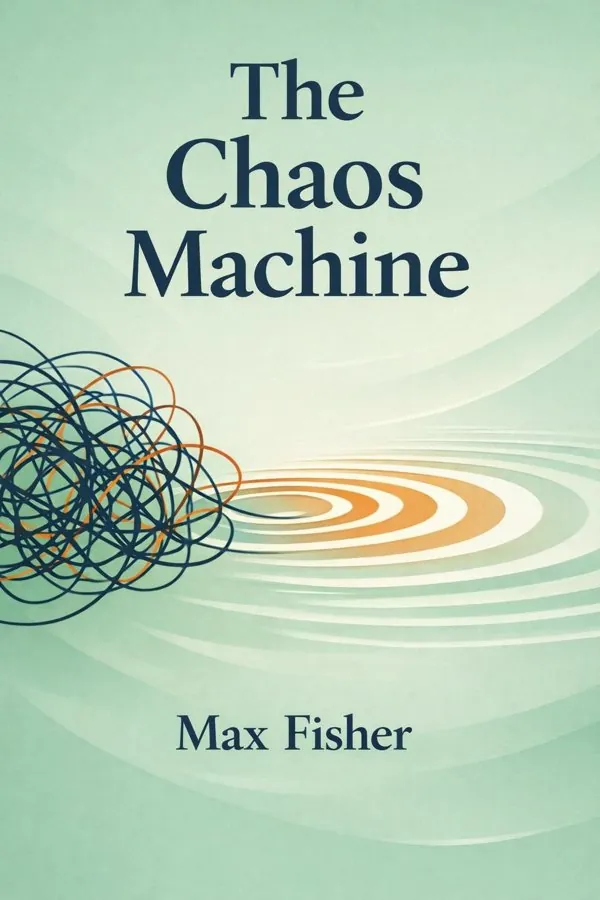
The Chaos Machine: The Inside Story of How Social Media Rewired Our Minds and Our World: Summary & Key Insights
by Max Fisher
 10 min9 chaptersAudio available
What Is The Chaos Machine: The Inside Story of How Social Media Rewired Our Minds and Our World About?
The Chaos Machine: The Inside Story of How Social Media Rewired Our Minds and Our World by Max Fisher is a digital_culture book spanning 9 pages. An investigative work exploring how social media platforms have transformed human behavior, politics, and society. Drawing on interviews, research, and insider accounts, Max Fisher examines the psychological and societal consequences of algorithm-driven engagement and the spread of misinformation.
This FizzRead summary covers all 9 key chapters of The Chaos Machine: The Inside Story of How Social Media Rewired Our Minds and Our World in approximately 10 minutes, distilling the most important ideas, arguments, and takeaways from Max Fisher's work. Also available as an audio summary and Key Quotes Podcast.
The Chaos Machine: The Inside Story of How Social Media Rewired Our Minds and Our World
An investigative work exploring how social media platforms have transformed human behavior, politics, and society. Drawing on interviews, research, and insider accounts, Max Fisher examines the psychological and societal consequences of algorithm-driven engagement and the spread of misinformation.
Who Should Read The Chaos Machine: The Inside Story of How Social Media Rewired Our Minds and Our World?
This book is perfect for anyone interested in digital_culture and looking to gain actionable insights in a short read. Whether you're a student, professional, or lifelong learner, the key ideas from The Chaos Machine: The Inside Story of How Social Media Rewired Our Minds and Our World by Max Fisher will help you think differently.
- ✓Readers who enjoy digital_culture and want practical takeaways
- ✓Professionals looking to apply new ideas to their work and life
- ✓Anyone who wants the core insights of The Chaos Machine: The Inside Story of How Social Media Rewired Our Minds and Our World in just 10 minutes
Want the full summary?
Get instant access to this book summary and 100K+ more with Fizz Moment.
Get Free SummaryAvailable on App Store • Free to download
Key Chapters
All revolutions begin with idealism. When Facebook, Twitter, and YouTube emerged in the mid-2000s, their creators believed they were building tools of liberation. I want you to remember that the earliest engineers genuinely thought connectivity would make humanity better—more transparent, more free. In Palo Alto, idealism mixed with venture capital, and suddenly billions of dollars chased a single idea: if we could connect everyone, the world would heal. What I trace in this part of the book is how quickly those ideals shifted as business needs intervened.
At first, the platforms needed growth. The metric was simple: more users, more activity, more minutes spent. That drove every design decision. But engagement was not just about keeping people online—it became the currency that defined value. Ads sold better when people lingered, scrolled, clicked. Data became gold. Each tap and pause offered insight into how a user felt, and that insight became monetizable.
Facebook’s pivot from a college directory to a global social network was powered by a single realization: attention could be engineered. Likes, comments, shares—these were not innocent features, but behavioral triggers. They encouraged reciprocity, validation, competition. Twitter discovered the same: what drove retweets was not nuance but emotional charge. And YouTube, by committing to endless autoplay, found that the more sensational the content, the longer users stayed. Thus a system emerged not of connection but of compulsion. The market rewarded addictive design.
In those early years, executives celebrated growth without understanding consequence. They saw users as data points, not as vulnerable minds being conditioned through constant feedback. I recount how internal documents showed awareness even in 2011: engineers noticed how extreme content consistently correlated with higher engagement. Yet rather than retreat, platforms leaned into that discovery.
That was the seed of the chaos machine—the point when connection ceased to be the goal and engagement became the religion.
The next stage of the story is the algorithm itself—the engine behind every decision you see on your feed. Algorithms sounded innocent at first: mere mathematical tools to organize content. But in practice, they became powerful psychological filters, shaping what billions of people saw every second.
Through interviews with former insiders, I show how Facebook’s News Feed, Twitter’s timeline, and YouTube’s recommendation system evolved into attention-maximizing devices. They were trained to prioritize whatever provoked the strongest emotional signals—indignation, fear, pride, disgust. Positive content generated some engagement, but outrage dominated. And the system learned faster than any human could intervene.
The algorithmic feedback loop became self-reinforcing. A user reacts angrily, clicks more, shares more; the system interprets that as successful engagement; it then serves up more content with similar emotional charge. Over time, billions of automated decisions collectively reshape public discourse toward extremity. Misinformation thrives in this environment not because people love lies but because manipulation drives clicks.
When I traced the spread of false news through social networks, I found a consistent pattern: the most shared content was often the most divisive. Algorithms don’t understand truth—they understand response. And response became the core metric of success.
Behind this mechanism lies a deeper physics of attention. Humans evolved to respond reflexively to threat and novelty. The platforms weaponized that impulse. By training on those reactions, they built models that predict—as well as steer—our behavior. Imagine a system that doesn’t just observe what makes you angry but learns to make you angrier the next time. That is what engagement optimization became.
This chapter is where we begin to see the shift from a neutral network to a behavioral manipulation machine, one that reshapes collective consciousness while masquerading as freedom.
+ 7 more chapters — available in the FizzRead app
All Chapters in The Chaos Machine: The Inside Story of How Social Media Rewired Our Minds and Our World
About the Author
Max Fisher is an American journalist and author known for his reporting on international affairs and technology. He has written for The New York Times and The Washington Post, focusing on the intersection of media, politics, and global culture.
Get This Summary in Your Preferred Format
Read or listen to the The Chaos Machine: The Inside Story of How Social Media Rewired Our Minds and Our World summary by Max Fisher anytime, anywhere. FizzRead offers multiple formats so you can learn on your terms — all free.
Available formats: App · Audio · PDF · EPUB — All included free with FizzRead
Download The Chaos Machine: The Inside Story of How Social Media Rewired Our Minds and Our World PDF and EPUB Summary
Key Quotes from The Chaos Machine: The Inside Story of How Social Media Rewired Our Minds and Our World
“When Facebook, Twitter, and YouTube emerged in the mid-2000s, their creators believed they were building tools of liberation.”
“The next stage of the story is the algorithm itself—the engine behind every decision you see on your feed.”
Frequently Asked Questions about The Chaos Machine: The Inside Story of How Social Media Rewired Our Minds and Our World
The Chaos Machine: The Inside Story of How Social Media Rewired Our Minds and Our World by Max Fisher is a digital_culture book that explores key ideas across 9 chapters. An investigative work exploring how social media platforms have transformed human behavior, politics, and society. Drawing on interviews, research, and insider accounts, Max Fisher examines the psychological and societal consequences of algorithm-driven engagement and the spread of misinformation.
You Might Also Like
An Ugly Truth: Inside Facebook’s Battle for Domination
Sheera Frenkel, Cecilia Kang
10 min
Cyber Citizens
Ian Goodfellow
10 min
Digital Minimalism: Choosing a Focused Life in a Noisy World
Cal Newport
10 min
E‑Books & Beyond
Various Authors
10 min
The Future of Media
Various Authors
10 min
This Is Why We Can't Have Nice Things
Whitney Phillips
10 minBrowse by Category
Ready to read The Chaos Machine: The Inside Story of How Social Media Rewired Our Minds and Our World?
Get the full summary and 100K+ more books with Fizz Moment.