
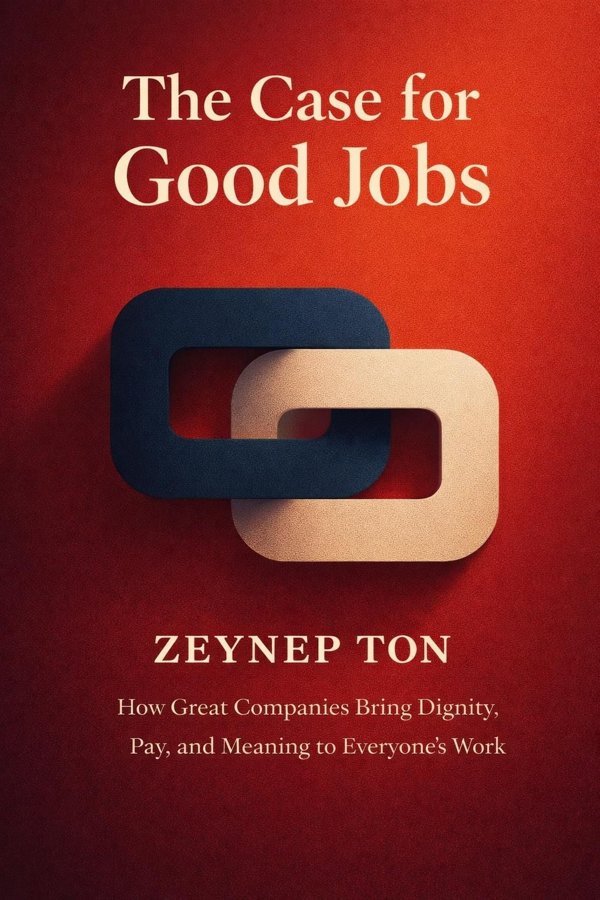
The Case for Good Jobs: How Great Companies Bring Dignity, Pay, and Meaning to Everyone’s Work: Summary & Key Insights
by Zeynep Ton
 10 min12 chaptersAudio available
What Is The Case for Good Jobs: How Great Companies Bring Dignity, Pay, and Meaning to Everyone’s Work About?
The Case for Good Jobs: How Great Companies Bring Dignity, Pay, and Meaning to Everyone’s Work by Zeynep Ton is a leadership book spanning 12 pages. In this book, Zeynep Ton argues that companies can achieve both excellence and humanity by creating good jobs that offer fair pay, stability, and respect. Drawing on years of research and case studies, she demonstrates how operational excellence and human-centered management can coexist, leading to better business outcomes and more meaningful work for employees.
This FizzRead summary covers all 12 key chapters of The Case for Good Jobs: How Great Companies Bring Dignity, Pay, and Meaning to Everyone’s Work in approximately 10 minutes, distilling the most important ideas, arguments, and takeaways from Zeynep Ton's work. Also available as an audio summary and Key Quotes Podcast.
The Case for Good Jobs: How Great Companies Bring Dignity, Pay, and Meaning to Everyone’s Work
In this book, Zeynep Ton argues that companies can achieve both excellence and humanity by creating good jobs that offer fair pay, stability, and respect. Drawing on years of research and case studies, she demonstrates how operational excellence and human-centered management can coexist, leading to better business outcomes and more meaningful work for employees.
Who Should Read The Case for Good Jobs: How Great Companies Bring Dignity, Pay, and Meaning to Everyone’s Work?
This book is perfect for anyone interested in leadership and looking to gain actionable insights in a short read. Whether you're a student, professional, or lifelong learner, the key ideas from The Case for Good Jobs: How Great Companies Bring Dignity, Pay, and Meaning to Everyone’s Work by Zeynep Ton will help you think differently.
- ✓Readers who enjoy leadership and want practical takeaways
- ✓Professionals looking to apply new ideas to their work and life
- ✓Anyone who wants the core insights of The Case for Good Jobs: How Great Companies Bring Dignity, Pay, and Meaning to Everyone’s Work in just 10 minutes
Want the full summary?
Get instant access to this book summary and 100K+ more with Fizz Moment.
Get Free SummaryAvailable on App Store • Free to download
Key Chapters
When we talk about 'bad jobs,' we’re not referring to hardworking people doing low-wage work; we’re referring to a system that treats them as an expendable resource. In my research, I’ve observed how jobs characterized by low pay, unpredictable schedules, and limited autonomy not only erode workers’ lives but also undermine operational efficiency. Retail and service industries, in particular, suffer from excessive turnover, mistakes, and poor customer experiences. The root issue is that these companies operate with short-term cost minimization in mind, using labor as a variable cost to be squeezed, rather than a strategic asset to be cultivated.
In bad jobs systems, employees have no time to learn, innovate, or connect with customers because they’re barely keeping up with daily demands. Managers are often forced into firefighting mode, responding to crises rather than improving processes. I’ve spoken to cashiers who only know their schedules a few days ahead and store managers whose teams change weekly due to constant churn. This instability directly damages operations—shelves go unstocked, mistakes multiply, and morale collapses. The tragedy is that the system itself produces this dysfunction, not the people within it.
Understanding this problem is essential before we can solve it. A company that pursues good jobs must first admit that a bad jobs model is unsustainable—not only ethically, but economically. When your frontline employees are demoralized, your customers feel it, your operational costs rise, and your competitive position erodes. That’s the true cost of bad jobs.
To create good jobs, companies must do more than raise wages; they must rewire the way work is designed and executed. The Good Jobs Framework, developed through years of observation and experimentation, rests on four central principles: **fair pay**, **stable schedules**, **respect and voice**, and **opportunities for growth**. These are not isolated ideals—they form an interconnected system that shapes both employee experience and business performance.
Fair pay establishes security, allowing workers to live decently and focus fully on their jobs. Stability provides predictability, enabling families to plan and employees to commit. Respect ensures that each person’s contribution is valued, creating trust and engagement. Opportunity, the final pillar, converts work from a dead-end grind into a pathway for development. Together, these create an environment where people can take ownership, drive quality, and innovate on the front lines.
In a company that follows this framework, employees become partners in excellence. Consider how, in a well-run supermarket that implements good jobs principles, cashiers anticipate customer needs, stockers proactively improve layout, and managers continuously refine processes—all because systems are built around empowerment rather than control. Good jobs aren’t just about compensation; they’re about capability. When we equip people to do great work, dignity and performance naturally converge.
+ 10 more chapters — available in the FizzRead app
All Chapters in The Case for Good Jobs: How Great Companies Bring Dignity, Pay, and Meaning to Everyone’s Work
About the Author
Zeynep Ton is a professor at the MIT Sloan School of Management and co-founder of the Good Jobs Institute. Her research focuses on how companies can design operations and management systems that create good jobs and superior performance. She is also the author of 'The Good Jobs Strategy.'
Get This Summary in Your Preferred Format
Read or listen to the The Case for Good Jobs: How Great Companies Bring Dignity, Pay, and Meaning to Everyone’s Work summary by Zeynep Ton anytime, anywhere. FizzRead offers multiple formats so you can learn on your terms — all free.
Available formats: App · Audio · PDF · EPUB — All included free with FizzRead
Download The Case for Good Jobs: How Great Companies Bring Dignity, Pay, and Meaning to Everyone’s Work PDF and EPUB Summary
Key Quotes from The Case for Good Jobs: How Great Companies Bring Dignity, Pay, and Meaning to Everyone’s Work
“When we talk about 'bad jobs,' we’re not referring to hardworking people doing low-wage work; we’re referring to a system that treats them as an expendable resource.”
“To create good jobs, companies must do more than raise wages; they must rewire the way work is designed and executed.”
Frequently Asked Questions about The Case for Good Jobs: How Great Companies Bring Dignity, Pay, and Meaning to Everyone’s Work
The Case for Good Jobs: How Great Companies Bring Dignity, Pay, and Meaning to Everyone’s Work by Zeynep Ton is a leadership book that explores key ideas across 12 chapters. In this book, Zeynep Ton argues that companies can achieve both excellence and humanity by creating good jobs that offer fair pay, stability, and respect. Drawing on years of research and case studies, she demonstrates how operational excellence and human-centered management can coexist, leading to better business outcomes and more meaningful work for employees.
You Might Also Like

Extreme Ownership
Jocko Willink
10 min
Dare to Lead
Brene Brown
10 min
Leaders Eat Last
Simon Sinek
10 min
The 21 Irrefutable Laws of Leadership
John Maxwell
10 min
Start With Why
Simon Sinek
10 min
How to Lead When You're Not in Charge
Clay Scroggins
10 minBrowse by Category
Ready to read The Case for Good Jobs: How Great Companies Bring Dignity, Pay, and Meaning to Everyone’s Work?
Get the full summary and 100K+ more books with Fizz Moment.