
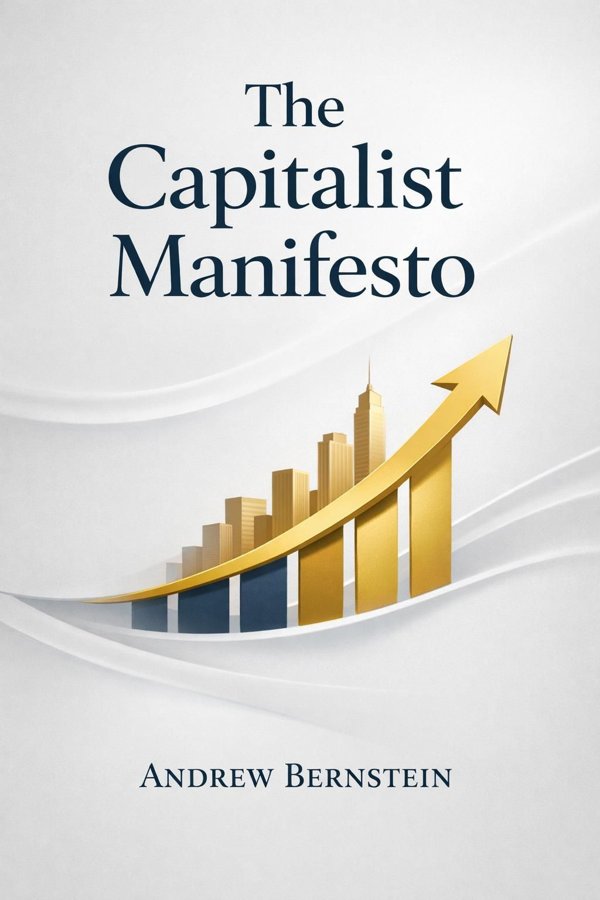
The Capitalist Manifesto: Summary & Key Insights
 10 min7 chaptersAudio available
What Is The Capitalist Manifesto About?
The Capitalist Manifesto by Andrew Bernstein is a economics book spanning 7 pages. The Capitalist Manifesto is a philosophical and economic defense of capitalism written by Andrew Bernstein. It argues that capitalism is the only moral social system because it respects individual rights and promotes human flourishing. Bernstein presents historical and theoretical evidence to show that free markets and private property are essential for progress, innovation, and prosperity.
This FizzRead summary covers all 7 key chapters of The Capitalist Manifesto in approximately 10 minutes, distilling the most important ideas, arguments, and takeaways from Andrew Bernstein's work. Also available as an audio summary and Key Quotes Podcast.
The Capitalist Manifesto
The Capitalist Manifesto is a philosophical and economic defense of capitalism written by Andrew Bernstein. It argues that capitalism is the only moral social system because it respects individual rights and promotes human flourishing. Bernstein presents historical and theoretical evidence to show that free markets and private property are essential for progress, innovation, and prosperity.
Who Should Read The Capitalist Manifesto?
This book is perfect for anyone interested in economics and looking to gain actionable insights in a short read. Whether you're a student, professional, or lifelong learner, the key ideas from The Capitalist Manifesto by Andrew Bernstein will help you think differently.
- ✓Readers who enjoy economics and want practical takeaways
- ✓Professionals looking to apply new ideas to their work and life
- ✓Anyone who wants the core insights of The Capitalist Manifesto in just 10 minutes
Want the full summary?
Get instant access to this book summary and 100K+ more with Fizz Moment.
Get Free SummaryAvailable on App Store • Free to download
Key Chapters
To understand capitalism’s soul, one must first grasp its historical context. Pre-capitalist societies were dominated by brute force—whether the divine right of kings or the collective will of tribes. Wealth came from conquest, not production; status from birth, not ability. What changed history forever was the Enlightenment—the age when reason began to challenge superstition and men dared to think for themselves.
During the Enlightenment, philosophers across Europe began reclaiming the idea that individuals could govern their own lives by reason. Thinkers like John Locke planted the intellectual seed by asserting property rights as natural rights. Entrepreneurs and inventors, empowered by liberty, reshaped the world through industry and exploration. The transition to capitalism was not merely economic—it was spiritual. It marked the moment when human beings ceased to be subjects and became self-made creators.
In tracing this development, I emphasize that capitalism arose not from greed, but from dignity. When individuals were free to choose their work, to trade voluntarily, and to reap the rewards of their effort, civilization began to ascend. Every innovation—from steam engines to modern medicine—was born of minds liberated from authoritarian constraints. This is why capitalism, far from an accident of history, is the logical conclusion of reason applied to human society.
The heart of capitalism lies in its moral dimension. In this book, I advance a radical claim: capitalism is not just efficient, it is good—good in the deepest ethical sense. Why? Because it is the only system that upholds man’s moral right to live for his own sake.
This principle, drawn from Objectivist ethics, affirms that the pursuit of one’s rational self-interest is morally virtuous. To produce, to create, to trade voluntarily—these are acts of integrity. Under capitalism, no one lives by permission from another; every interaction is an exchange of value for value. It is a system grounded not in sacrifice but in justice.
From this moral foundation flows all genuine prosperity. When people act rationally to achieve their goals, they must apply reason, discipline, and respect for others’ rights. Coercion, in contrast, destroys moral virtue. Socialist and collectivist systems demand that one man’s need becomes another’s obligation, thereby erasing personal responsibility. In capitalism, the producer stands proud as a moral hero—the person who transforms ideas into wealth. Such heroism, not altruistic self-denial, constitutes true moral worth.
+ 5 more chapters — available in the FizzRead app
All Chapters in The Capitalist Manifesto
About the Author
Andrew Bernstein is an American philosopher and author associated with Objectivism, the philosophy developed by Ayn Rand. He has written extensively on ethics, politics, and economics, advocating for rational self-interest and laissez-faire capitalism.
Get This Summary in Your Preferred Format
Read or listen to the The Capitalist Manifesto summary by Andrew Bernstein anytime, anywhere. FizzRead offers multiple formats so you can learn on your terms — all free.
Available formats: App · Audio · PDF · EPUB — All included free with FizzRead
Download The Capitalist Manifesto PDF and EPUB Summary
Key Quotes from The Capitalist Manifesto
“To understand capitalism’s soul, one must first grasp its historical context.”
“The heart of capitalism lies in its moral dimension.”
Frequently Asked Questions about The Capitalist Manifesto
The Capitalist Manifesto by Andrew Bernstein is a economics book that explores key ideas across 7 chapters. The Capitalist Manifesto is a philosophical and economic defense of capitalism written by Andrew Bernstein. It argues that capitalism is the only moral social system because it respects individual rights and promotes human flourishing. Bernstein presents historical and theoretical evidence to show that free markets and private property are essential for progress, innovation, and prosperity.
You Might Also Like
Business Adventures
John Brooks
10 min
Nudge
Richard H. Thaler, Cass R. Sunstein
10 min
The Hitchhiker"s Guide to the Galaxy
Douglas Adams
10 minThe Muqaddimah
Ibn Khaldun
10 minThe Outsiders
William N. Thorndike
10 min
A Little History of Economics
Niall Kishtainy
10 minBrowse by Category
Ready to read The Capitalist Manifesto?
Get the full summary and 100K+ more books with Fizz Moment.