
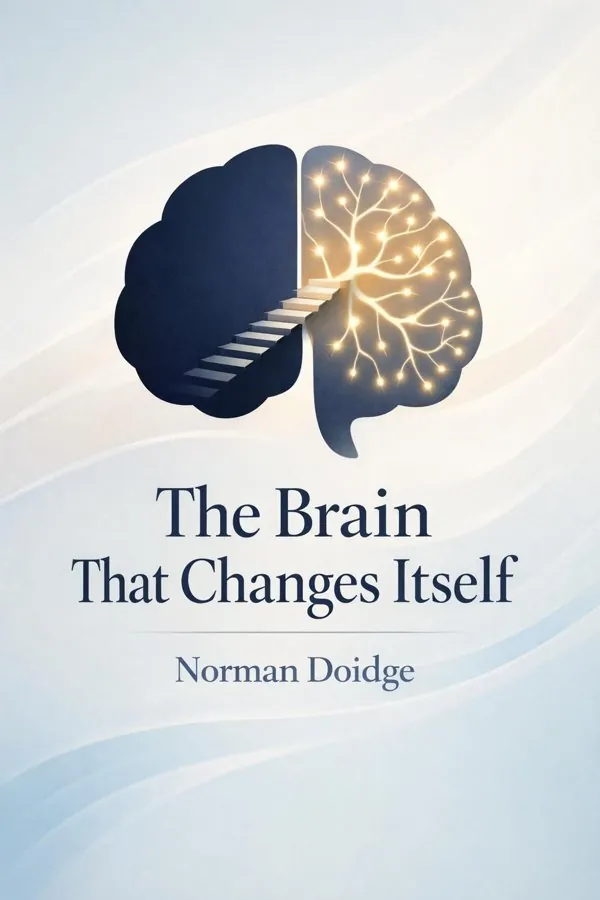
The Brain That Changes Itself: Stories of Personal Triumph from the Frontiers of Brain Science: Summary & Key Insights
 10 min11 chaptersAudio available
What Is The Brain That Changes Itself: Stories of Personal Triumph from the Frontiers of Brain Science About?
The Brain That Changes Itself: Stories of Personal Triumph from the Frontiers of Brain Science by Norman Doidge is a neuroscience book spanning 11 pages. This groundbreaking book explores the concept of neuroplasticity—the brain’s ability to change its structure and function in response to experience and learning. Through compelling case studies, Norman Doidge demonstrates how people have overcome brain injuries, learning disorders, and other neurological challenges by harnessing the brain’s capacity to rewire itself.
This FizzRead summary covers all 11 key chapters of The Brain That Changes Itself: Stories of Personal Triumph from the Frontiers of Brain Science in approximately 10 minutes, distilling the most important ideas, arguments, and takeaways from Norman Doidge's work. Also available as an audio summary and Key Quotes Podcast.
The Brain That Changes Itself: Stories of Personal Triumph from the Frontiers of Brain Science
This groundbreaking book explores the concept of neuroplasticity—the brain’s ability to change its structure and function in response to experience and learning. Through compelling case studies, Norman Doidge demonstrates how people have overcome brain injuries, learning disorders, and other neurological challenges by harnessing the brain’s capacity to rewire itself.
Who Should Read The Brain That Changes Itself: Stories of Personal Triumph from the Frontiers of Brain Science?
This book is perfect for anyone interested in neuroscience and looking to gain actionable insights in a short read. Whether you're a student, professional, or lifelong learner, the key ideas from The Brain That Changes Itself: Stories of Personal Triumph from the Frontiers of Brain Science by Norman Doidge will help you think differently.
- ✓Readers who enjoy neuroscience and want practical takeaways
- ✓Professionals looking to apply new ideas to their work and life
- ✓Anyone who wants the core insights of The Brain That Changes Itself: Stories of Personal Triumph from the Frontiers of Brain Science in just 10 minutes
Want the full summary?
Get instant access to this book summary and 100K+ more with Fizz Moment.
Get Free SummaryAvailable on App Store • Free to download
Key Chapters
In the beginning of our exploration, I invite you to reconsider what you believe about the brain’s limits. For centuries, the idea of a 'static brain' prevailed. Scientists believed neurons were set in their connections like concrete after childhood development. Damage, they thought, was permanent; learning capacities declined with age; recovery from trauma was almost impossible. But emerging evidence began to tell a different story.
Neuroplasticity is the principle that the brain can change both its structure and function in response to experience. This means that every thought, every skill practiced, and every emotion repeated remodels the neural circuits. Synapses strengthen or weaken depending on use—what’s termed 'Hebbian learning'—and entire neural maps can reorganize themselves to accommodate new behaviors or losses.
What I discovered in my research visits and clinical encounters was that this plasticity isn’t merely theoretical. In the labs of scientists like Michael Merzenich and Paul Bach-y-Rita, people with apparent neurological 'deficits' were performing impossible recoveries. These scientists showed that the brain could change through stimulation, training, and sensory substitution. They were proving that learning was a matter not of acquiring new information but of physically reshaping the brain’s wiring.
To understand this, you must think of the brain not as a rigid machine but as a living ecosystem. When certain neurons die or go silent, others can take over their functions. When new inputs are introduced—through intense practice, therapy, or even imagination—the brain builds alternative routes. What seemed fixed now appears fluid.
This insight lays the foundation for the rest of the book. If the brain can reorganize itself, then recovery, education, love, addiction, and aging—all are subject to change. Neuroplasticity becomes the unifying thread of humanity’s most personal and universal struggles.
Cheryl Schiltz was once a vibrant woman whose life lost balance—literally—after a reaction to antibiotics destroyed her vestibular function. Without her inner ear to provide equilibrium, she felt as though she were perpetually falling through space. No conventional treatment could help; the feeling of motion sickness and instability was constant. But then came a breakthrough inspired by the work of the late Paul Bach-y-Rita, one of neuroplasticity’s great pioneers.
Bach-y-Rita believed that if the brain could adapt to new forms of input, then lost senses might be remapped through other sensory channels. He constructed a device known as the 'BrainPort,' which translated balance information into gentle electrical signals on Cheryl’s tongue. Initially, it seemed absurd that the tongue could become a portal for balance—but soon, Cheryl was standing steadily again while the device was in use. Even more astonishing, after repeated sessions, her brain began to retain the balance sensations even when the device was off.
This experiment demonstrated that the brain does not simply repair—it rewires. It can reinterpret sensory information from one source and integrate it as if it were natural. Cheryl’s recovery was not about replacing what was lost but about teaching her brain to find a new path to the same goal.
For me, her case exemplified the essence of neuroplastic healing: a system teaching itself to be whole through creative adaptation. It shows that the brain can recruit regions once used for other purposes to replace damaged functions—a testament to its ingenuity and resilience. The implications extend far beyond balance restoration; they hint at new strategies for sensory loss, mobility, and neural recovery.
In Cheryl’s story, we glimpse the extraordinary truth: the brain’s capacity to transform itself is not a rarity but a fundamental property of its design. Her triumph is proof that even when pathways collapse, new ones can be born through courage and persistence.
+ 9 more chapters — available in the FizzRead app
All Chapters in The Brain That Changes Itself: Stories of Personal Triumph from the Frontiers of Brain Science
About the Author
Norman Doidge is a Canadian psychiatrist, psychoanalyst, and researcher. He is known for his work on neuroplasticity and for making complex neuroscience accessible to general readers through engaging storytelling.
Get This Summary in Your Preferred Format
Read or listen to the The Brain That Changes Itself: Stories of Personal Triumph from the Frontiers of Brain Science summary by Norman Doidge anytime, anywhere. FizzRead offers multiple formats so you can learn on your terms — all free.
Available formats: App · Audio · PDF · EPUB — All included free with FizzRead
Download The Brain That Changes Itself: Stories of Personal Triumph from the Frontiers of Brain Science PDF and EPUB Summary
Key Quotes from The Brain That Changes Itself: Stories of Personal Triumph from the Frontiers of Brain Science
“In the beginning of our exploration, I invite you to reconsider what you believe about the brain’s limits.”
“Cheryl Schiltz was once a vibrant woman whose life lost balance—literally—after a reaction to antibiotics destroyed her vestibular function.”
Frequently Asked Questions about The Brain That Changes Itself: Stories of Personal Triumph from the Frontiers of Brain Science
The Brain That Changes Itself: Stories of Personal Triumph from the Frontiers of Brain Science by Norman Doidge is a neuroscience book that explores key ideas across 11 chapters. This groundbreaking book explores the concept of neuroplasticity—the brain’s ability to change its structure and function in response to experience and learning. Through compelling case studies, Norman Doidge demonstrates how people have overcome brain injuries, learning disorders, and other neurological challenges by harnessing the brain’s capacity to rewire itself.
More by Norman Doidge

You Might Also Like
Anxious
Joseph LeDoux
10 min
Hallucinations
Oliver Sacks
10 min
The Biological Mind: How Brain, Body, and Environment Collaborate to Make Us Who We Are
Alan Jasanoff
10 min
The Feeling of Life Itself: Why Consciousness Is Widespread but Can't Be Computed
Christof Koch
10 min
The No-Nonsense Meditation Book
Steven Laureys
10 min
A General Theory of Love
Thomas Lewis, Fari Amini, Richard Lannon
10 minBrowse by Category
Ready to read The Brain That Changes Itself: Stories of Personal Triumph from the Frontiers of Brain Science?
Get the full summary and 100K+ more books with Fizz Moment.