
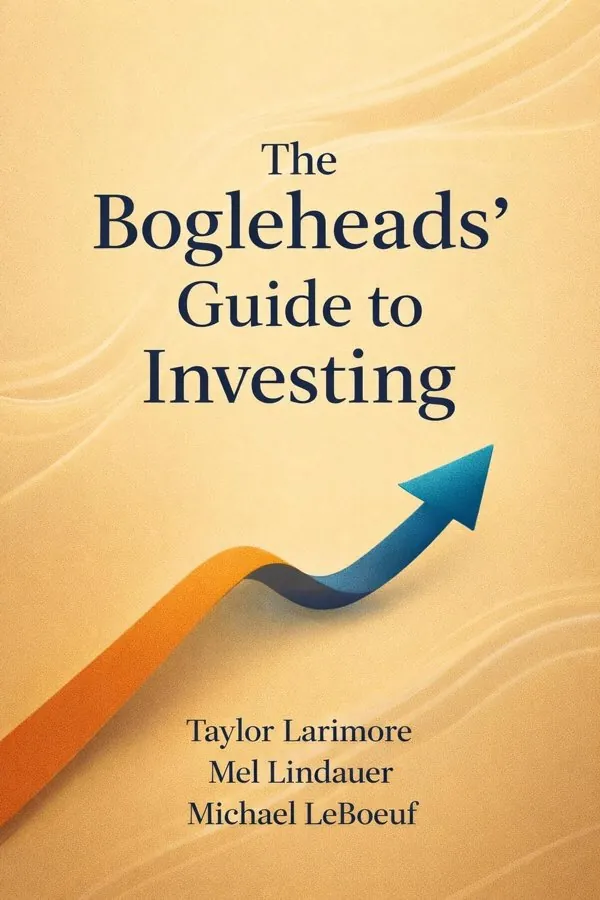
The Bogleheads' Guide to Investing: Summary & Key Insights
by Taylor Larimore, Mel Lindauer, Michael LeBoeuf
 10 min10 chaptersAudio available
Key Takeaways from The Bogleheads' Guide to Investing
A portfolio is only as good as the purpose behind it.
In investing, time often matters more than talent.
The most important investment decision is often not which fund you buy, but how you divide your money among broad asset classes.
Every dollar you pay in fees is a dollar that cannot compound for you.
Investment returns do not matter as much as the returns you keep.
What Is The Bogleheads' Guide to Investing About?
The Bogleheads' Guide to Investing by Taylor Larimore, Mel Lindauer, Michael LeBoeuf is a finance book spanning 10 pages. The Bogleheads' Guide to Investing is one of the clearest and most practical personal finance books ever written for ordinary investors. Drawing on the philosophy of Vanguard founder John C. Bogle, the book argues that successful investing is not about brilliance, prediction, or chasing the next hot stock. It is about doing a few simple things exceptionally well: saving steadily, keeping costs low, diversifying broadly, minimizing taxes, and staying disciplined for decades. That message matters because most investors are overwhelmed by noise, complexity, and financial products designed to enrich intermediaries rather than clients. Taylor Larimore, Mel Lindauer, and Michael LeBoeuf write with unusual credibility because they are not merely theorists; they are respected members of the Bogleheads community who have spent years studying what actually works in real life. Their advice is grounded in evidence, common sense, and investor behavior. The result is a guide that helps readers build wealth with less stress, fewer mistakes, and greater confidence. For anyone who wants a straightforward roadmap to long-term financial security, this book remains a modern classic.
This FizzRead summary covers all 10 key chapters of The Bogleheads' Guide to Investing in approximately 10 minutes, distilling the most important ideas, arguments, and takeaways from Taylor Larimore, Mel Lindauer, Michael LeBoeuf's work. Also available as an audio summary and Key Quotes Podcast.
The Bogleheads' Guide to Investing
The Bogleheads' Guide to Investing is one of the clearest and most practical personal finance books ever written for ordinary investors. Drawing on the philosophy of Vanguard founder John C. Bogle, the book argues that successful investing is not about brilliance, prediction, or chasing the next hot stock. It is about doing a few simple things exceptionally well: saving steadily, keeping costs low, diversifying broadly, minimizing taxes, and staying disciplined for decades. That message matters because most investors are overwhelmed by noise, complexity, and financial products designed to enrich intermediaries rather than clients. Taylor Larimore, Mel Lindauer, and Michael LeBoeuf write with unusual credibility because they are not merely theorists; they are respected members of the Bogleheads community who have spent years studying what actually works in real life. Their advice is grounded in evidence, common sense, and investor behavior. The result is a guide that helps readers build wealth with less stress, fewer mistakes, and greater confidence. For anyone who wants a straightforward roadmap to long-term financial security, this book remains a modern classic.
Who Should Read The Bogleheads' Guide to Investing?
This book is perfect for anyone interested in finance and looking to gain actionable insights in a short read. Whether you're a student, professional, or lifelong learner, the key ideas from The Bogleheads' Guide to Investing by Taylor Larimore, Mel Lindauer, Michael LeBoeuf will help you think differently.
- ✓Readers who enjoy finance and want practical takeaways
- ✓Professionals looking to apply new ideas to their work and life
- ✓Anyone who wants the core insights of The Bogleheads' Guide to Investing in just 10 minutes
Want the full summary?
Get instant access to this book summary and 100K+ more with Fizz Moment.
Get Free SummaryAvailable on App Store • Free to download
Key Chapters
A portfolio is only as good as the purpose behind it. One of the most powerful ideas in The Bogleheads' Guide to Investing is that investing should begin not with funds, markets, or forecasts, but with your goals. Too many people ask, "What should I buy?" before they ask, "What am I trying to accomplish?" That reversal leads to scattered decisions, unnecessary risk, and disappointment when markets behave differently than expected.
The authors encourage investors to define clear objectives: retirement income, a home down payment, college costs, charitable giving, or financial independence. Each goal has its own timeline, required return, and level of flexibility. A 28-year-old saving for retirement can withstand more market volatility than a 62-year-old about to draw income from investments. Likewise, someone saving for a house in three years should not expose that money to the same risks as money intended for use in 30 years.
Risk tolerance is equally important. It is not just what you think you can handle during calm markets, but what you will actually tolerate during a 30% or 40% decline. A portfolio that looks great on paper but causes panic in a downturn is poorly designed. The authors push readers to be honest about emotional resilience, income stability, and need for liquidity.
A practical way to apply this is to list your goals, assign timelines, estimate annual contributions, and choose an asset mix that matches both your need and capacity for risk. For example, retirement savings might go into a diversified stock-and-bond portfolio, while emergency savings remain in cash equivalents.
Actionable takeaway: Before choosing any investment, write down your goals, time horizons, and true risk tolerance, then build your portfolio around that plan rather than around market excitement.
In investing, time often matters more than talent. The book strongly emphasizes that the surest engine of wealth is not finding extraordinary investments but starting early and saving consistently. Compounding turns small, regular contributions into substantial sums because returns begin generating returns of their own. This process seems slow at first, then surprisingly powerful later.
The authors make a simple but profound point: delaying savings is expensive. A person who starts investing in their twenties, even with modest amounts, may end up with more than someone who starts in their forties while contributing much larger sums. That is because early dollars have the longest runway to grow. Time smooths volatility, expands the impact of reinvested earnings, and gives investors flexibility.
This principle is especially valuable because it shifts the focus away from market timing. Many people wait for the "right moment" to invest, fearing a correction or hoping for a better entry point. The Bogleheads argue that this mindset often leads to years of inaction. Regular saving through payroll deductions, automatic transfers, and retirement plan contributions removes emotion from the process and keeps wealth building even during uncertain periods.
For example, a worker who contributes automatically to a 401(k), captures an employer match, and increases contributions by 1% each year is quietly building a powerful long-term system. The exact market conditions this month matter far less than the habit continuing for decades.
The deeper lesson is that personal finance success depends less on dramatic decisions than on repetitive good behavior. A high savings rate, maintained over time, is one of the few factors investors can directly control.
Actionable takeaway: Automate your saving today, contribute consistently regardless of headlines, and increase the amount whenever your income rises.
The most important investment decision is often not which fund you buy, but how you divide your money among broad asset classes. The authors argue that asset allocation drives both risk and return far more than stock picking or economic predictions. A well-designed mix of stocks, bonds, and cash creates a portfolio you can stick with through changing markets.
Stocks provide growth, but they are volatile. Bonds offer stability and income, but usually lower long-term returns. Cash protects near-term needs, but it can lose purchasing power to inflation over time. The right combination depends on your age, goals, spending needs, and tolerance for declines. Younger investors may choose a stock-heavy portfolio because they have time to recover from bear markets. Retirees often hold more bonds to reduce fluctuations and provide liquidity.
Diversification adds another layer of protection. Instead of concentrating in a few companies, sectors, or countries, the Bogleheads favor broad exposure across the entire market. A total U.S. stock index fund, an international stock index fund, and a high-quality bond fund can together provide simple but powerful diversification. This does not eliminate losses, but it reduces the damage caused by any one investment going wrong.
The authors also warn against changing asset allocation based on recent performance. Investors often chase what has just gone up, loading into stocks after a boom or fleeing to bonds after a crash. That behavior turns allocation from a risk-control tool into a performance-chasing habit.
A practical example is setting a target portfolio such as 70% stocks and 30% bonds, then reviewing it periodically. If stocks rise and become 78% of the portfolio, rebalancing brings the mix back to target and keeps risk aligned with the original plan.
Actionable takeaway: Choose a simple stock-bond allocation you can live with in both bull and bear markets, and let that policy guide your investing decisions.
Every dollar you pay in fees is a dollar that cannot compound for you. Few ideas in the book are more central than the insistence on low-cost index fund investing. The authors argue that trying to beat the market through active management is usually a losing game after costs, taxes, and mistakes are included. By contrast, index funds aim to capture the market's return at minimal cost, making them a remarkably efficient tool for long-term investors.
The reasoning is straightforward. Markets are highly competitive, and professional managers collectively are the market before fees. Once expenses are deducted, the average actively managed dollar must underperform the market average. High expense ratios, sales loads, advisory fees, and hidden trading costs all reduce investor returns. Over decades, even seemingly small annual fees can consume a huge portion of a portfolio.
The Bogleheads favor broad-market funds such as total stock market index funds, total international stock funds, and total bond market funds. These funds provide instant diversification, transparency, and low turnover. They are simple to understand and easy to maintain. The book also cautions readers to be skeptical of glamorous products, complex strategies, and heavily marketed funds that promise outperformance but deliver inconsistency.
A practical application is reviewing every account you own and comparing expense ratios. If one fund costs 1.10% and a comparable index fund costs 0.05%, the difference may look small in a single year but become enormous over 20 or 30 years. Replacing expensive funds with low-cost alternatives can meaningfully improve long-term outcomes without increasing risk.
Actionable takeaway: Favor broad, low-cost index funds over expensive, performance-chasing products, and treat every fee as a direct reduction in your future wealth.
Investment returns do not matter as much as the returns you keep. That is why the book places strong emphasis on tax efficiency. Many investors focus intensely on selecting funds while ignoring how taxes quietly erode compounding over time. The Bogleheads show that smart account placement and disciplined tax habits can boost after-tax wealth without requiring better market forecasts.
Tax efficiency starts with understanding the difference between account types. Tax-advantaged accounts such as 401(k)s, IRAs, and Roth accounts provide major benefits, whether through upfront deductions, tax-deferred growth, or tax-free withdrawals. Taxable brokerage accounts offer flexibility but expose investors to capital gains, dividends, and interest taxation. Since different assets are taxed differently, where you place them matters.
The authors generally favor holding tax-inefficient assets, such as taxable bonds or high-turnover funds, in tax-deferred or tax-free accounts when possible. Tax-efficient stock index funds, especially those with low turnover and qualified dividends, are often better suited for taxable accounts. Municipal bonds may also make sense for some higher-income investors in taxable portfolios.
Tax-loss harvesting is another practical technique. If an investment in a taxable account falls below your purchase price, selling it can generate a capital loss that may offset gains or reduce taxable income, provided you avoid wash-sale rule violations. Rebalancing can also be done with tax awareness by directing new contributions into underweighted assets rather than triggering large taxable sales.
The broader lesson is that investing decisions should not be made in isolation from tax planning. A slightly less flashy portfolio that is tax-aware may outperform a more aggressive but tax-inefficient one over time.
Actionable takeaway: Maximize tax-advantaged accounts, place assets in the most tax-efficient locations, and evaluate investments based on after-tax returns rather than headline performance.
The market is dangerous not because it is unpredictable, but because investors often respond to that unpredictability in damaging ways. A major contribution of The Bogleheads' Guide to Investing is its blunt warning that the biggest threat to wealth is frequently not the market itself, but investor behavior. People buy after prices have risen, sell after prices have fallen, chase experts, and mistake activity for progress.
The authors identify common traps: market timing, performance chasing, excessive trading, concentrated bets, and overconfidence. Investors often believe they can sidestep downturns or identify tomorrow's winners. In reality, consistently doing so is extraordinarily difficult. Worse, these efforts usually lead people to miss recoveries, pay more in taxes and transaction costs, and lock in emotional decisions at exactly the wrong moments.
Another trap is consuming too much financial media. Constant exposure to predictions and dramatic headlines creates the illusion that action is required. Yet most market news has little relevance to a disciplined long-term investor. The Bogleheads encourage readers to tune out short-term noise and focus on their personal plan.
Consider the investor who sells during a major market drop because fear overwhelms them, then waits on the sidelines until prices have already recovered. That pattern has repeated for decades. By contrast, an investor who sticks with a diversified allocation and keeps contributing during downturns often benefits from lower purchase prices and eventual recovery.
Avoiding mistakes is less glamorous than finding a superstar investment, but it is far more reliable. A boring investor who stays disciplined often beats an excited investor who constantly reacts.
Actionable takeaway: Create rules that prevent emotional decisions, such as limiting portfolio checks, avoiding market predictions, and committing in advance to stay invested through downturns.
A portfolio should not only seek returns; it should help you remain calm enough to earn them. That is why the authors devote meaningful attention to bonds and other fixed-income investments. Bonds may seem unexciting compared with stocks, but they serve a crucial role: reducing volatility, preserving capital, and providing a buffer during market stress.
The Bogleheads do not present bonds as a shortcut to high returns. Instead, they frame them as a stabilizing force that makes a long-term plan survivable. When stocks suffer large losses, high-quality bonds often hold up better or even appreciate, giving investors emotional and financial flexibility. That stability can prevent panic selling and provide funds for spending needs or rebalancing opportunities.
The book generally favors simplicity here too. Rather than chasing exotic bond products, high-yield temptations, or complex interest-rate bets, the authors lean toward broad, high-quality bond funds and intermediate-term exposure for many investors. The goal is not to outsmart the bond market but to create dependable ballast. Credit quality, duration, inflation risk, and tax treatment all matter, but for most people, a broad bond index fund is sufficient.
A practical example is a retiree who keeps several years of expected withdrawals in bonds and cash rather than holding everything in equities. During a stock bear market, they can draw from safer assets instead of selling stocks at depressed prices. Likewise, a mid-career investor with a 20% or 30% bond allocation may find it much easier to remain invested during sharp downturns.
Bonds also remind investors that the best portfolio is not the one with the highest theoretical return, but the one you can stick with consistently.
Actionable takeaway: Hold enough high-quality bonds to match your need for stability and to help you stay disciplined when stock markets become frightening.
Retirement planning is not a finish line you suddenly reach; it is a process you prepare for decades in advance. The book encourages readers to think about retirement not only as an investment challenge, but as a cash-flow, tax, and lifestyle challenge. Saving is essential, but so is deciding how your portfolio will support spending when paychecks stop.
The authors emphasize using available retirement vehicles fully and intelligently. Employer-sponsored plans, traditional and Roth IRAs, health savings accounts when available, and catch-up contributions later in life all create opportunities to build tax-advantaged assets. Equally important is estimating retirement needs realistically. Many people focus only on the size of their nest egg without considering expected expenses, Social Security, pensions, inflation, healthcare, and withdrawal flexibility.
Asset allocation often changes as retirement approaches, but the Bogleheads caution against becoming either recklessly aggressive or overly conservative. Too much stock exposure can make withdrawals stressful during bear markets, while too little growth can leave retirees vulnerable to inflation and longevity risk. The right balance depends on withdrawal rate, other income sources, and emotional resilience.
The book also reminds readers to plan beyond investments: beneficiary designations, estate documents, insurance needs, and communication with family matter. Retirement success comes from integrating all pieces rather than treating accounts as isolated numbers.
A practical example is someone in their fifties running retirement projections, boosting savings, paying attention to tax diversification between traditional and Roth accounts, and developing a preliminary withdrawal strategy before retirement begins. That preparation reduces uncertainty and improves decision-making later.
Actionable takeaway: Treat retirement as a long-term system, not just a savings target, and build a plan that covers accumulation, taxes, spending, and legacy decisions.
The hardest part of investing is rarely technical; it is psychological. The Bogleheads repeatedly show that investor behavior determines outcomes as much as asset selection. Fear, greed, envy, impatience, and the desire to feel in control can all sabotage otherwise sound plans. Understanding these tendencies helps investors design systems that protect them from themselves.
Behavioral finance explains why intelligent people make irrational money decisions. Loss aversion causes downturns to feel more painful than equivalent gains feel satisfying. Recency bias makes recent market performance seem more predictive than it really is. Herd behavior pushes people toward investments everyone else appears to love. Overconfidence convinces investors they can identify opportunities or turning points better than the evidence suggests.
The book's answer is structure. Automatic contributions reduce hesitation. A written investment policy reduces improvisation. Predetermined rebalancing rules reduce emotional reactions. Broad diversification reduces the temptation to obsess over single holdings. Simplicity itself is a behavioral advantage because confusing portfolios invite second-guessing.
For example, during a market crash, an investor without a clear plan may freeze, sell, or radically redesign their portfolio. An investor with a written policy stating target allocation, rebalancing thresholds, and long-term goals is more likely to stay calm and act rationally. The policy does not remove fear, but it reduces the odds that fear will dictate decisions.
The deeper message is liberating: you do not need to predict markets to invest successfully. You need to create an environment where disciplined behavior is easier than impulsive behavior.
Actionable takeaway: Build guardrails around your investing life by automating decisions, writing down your rules, and recognizing that emotional control is a core investing skill.
Complexity often masquerades as sophistication, but in investing it frequently creates fragility. One of the book's most enduring lessons is that a simple plan, consistently maintained, beats a complicated strategy that is hard to understand or impossible to follow. The authors encourage investors to create a portfolio they can explain in a few sentences and manage with minimal stress.
A simple investing plan usually includes a clear goal, a target asset allocation, a small number of diversified low-cost funds, an automatic contribution schedule, and a rebalancing policy. That is enough. Many investors believe they need tactical shifts, sector tilts, alternative assets, or constant optimization. In practice, these additions often increase costs, taxes, and anxiety while contributing little to long-term success.
Maintenance matters too. Even the best plan requires occasional review. Rebalancing restores target risk. Life changes such as marriage, children, career transitions, inheritance, or retirement may justify updating the allocation. But the review should be deliberate and periodic, not reactive. A plan should evolve because your life changes, not because markets are noisy.
A practical version might be a three-fund portfolio: one total U.S. stock index fund, one total international stock index fund, and one total bond market fund. Contributions are automated monthly. Once or twice a year, the investor checks whether allocations have drifted enough to rebalance. The system is elegant because it is both effective and sustainable.
The Bogleheads philosophy is not anti-thinking; it is anti-unnecessary complexity. It asks investors to spend less time tinkering and more time living their lives.
Actionable takeaway: Create an investment plan simple enough to follow for decades, review it on a schedule, and resist the urge to complicate what already works.
All Chapters in The Bogleheads' Guide to Investing
About the Authors
Taylor Larimore, Mel Lindauer, and Michael LeBoeuf are influential advocates of sensible, low-cost investing and prominent figures connected to the Bogleheads community. Larimore, a retired federal employee and longtime investment educator, is widely respected for his practical guidance and clear explanations of personal finance principles. Lindauer, a former corporate executive and financial writer, helped translate John C. Bogle's ideas into accessible advice for everyday investors. LeBoeuf, a professor emeritus at the University of New Orleans and a bestselling business author, brought a talent for clear communication and motivational insight to the collaboration. Together, they combined real-world investing experience, teaching ability, and deep commitment to evidence-based financial decision-making. Their work has helped countless readers understand that successful investing is less about brilliance and more about discipline, simplicity, and staying the course.
Get This Summary in Your Preferred Format
Read or listen to the The Bogleheads' Guide to Investing summary by Taylor Larimore, Mel Lindauer, Michael LeBoeuf anytime, anywhere. FizzRead offers multiple formats so you can learn on your terms — all free.
Available formats: App · Audio · PDF · EPUB — All included free with FizzRead
Download The Bogleheads' Guide to Investing PDF and EPUB Summary
Key Quotes from The Bogleheads' Guide to Investing
“A portfolio is only as good as the purpose behind it.”
“In investing, time often matters more than talent.”
“The most important investment decision is often not which fund you buy, but how you divide your money among broad asset classes.”
“Every dollar you pay in fees is a dollar that cannot compound for you.”
“Investment returns do not matter as much as the returns you keep.”
Frequently Asked Questions about The Bogleheads' Guide to Investing
The Bogleheads' Guide to Investing by Taylor Larimore, Mel Lindauer, Michael LeBoeuf is a finance book that explores key ideas across 10 chapters. The Bogleheads' Guide to Investing is one of the clearest and most practical personal finance books ever written for ordinary investors. Drawing on the philosophy of Vanguard founder John C. Bogle, the book argues that successful investing is not about brilliance, prediction, or chasing the next hot stock. It is about doing a few simple things exceptionally well: saving steadily, keeping costs low, diversifying broadly, minimizing taxes, and staying disciplined for decades. That message matters because most investors are overwhelmed by noise, complexity, and financial products designed to enrich intermediaries rather than clients. Taylor Larimore, Mel Lindauer, and Michael LeBoeuf write with unusual credibility because they are not merely theorists; they are respected members of the Bogleheads community who have spent years studying what actually works in real life. Their advice is grounded in evidence, common sense, and investor behavior. The result is a guide that helps readers build wealth with less stress, fewer mistakes, and greater confidence. For anyone who wants a straightforward roadmap to long-term financial security, this book remains a modern classic.
You Might Also Like



Browse by Category
Ready to read The Bogleheads' Guide to Investing?
Get the full summary and 100K+ more books with Fizz Moment.