
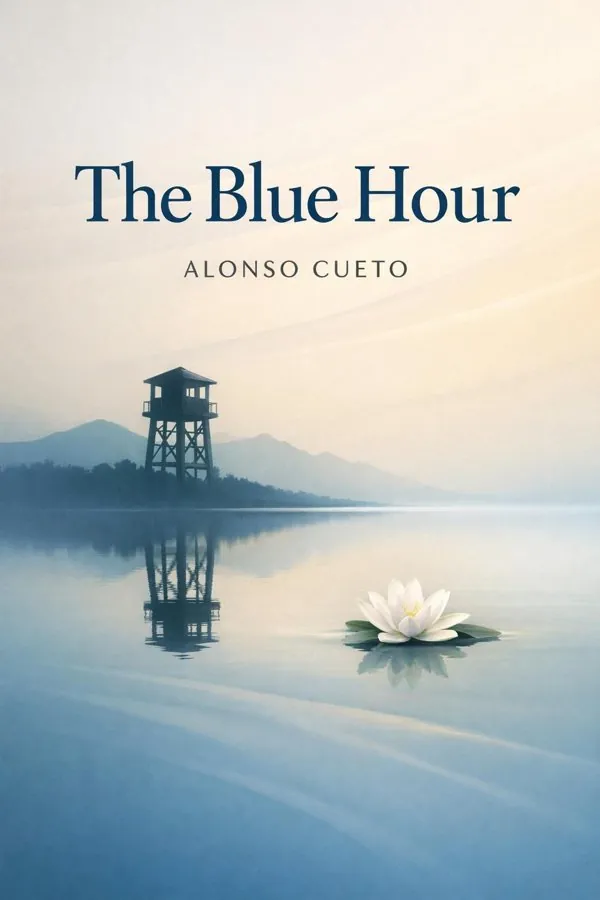
The Blue Hour: Summary & Key Insights
by Alonso Cueto
 10 min8 chaptersAudio available
Key Takeaways from The Blue Hour
A society’s deepest wounds often remain invisible to those most protected from them.
The image we inherit of our parents is rarely the full truth.
Sometimes a search for another person is really a search for a moral self we have never had to build.
A nation can survive violence without ever truly speaking about it.
We do not truly know who we are until our inherited identity stops protecting us.
What Is The Blue Hour About?
The Blue Hour by Alonso Cueto is a bestsellers book spanning 5 pages. The Blue Hour by Alonso Cueto is a haunting literary novel about what happens when personal success can no longer shield someone from the truth. Set in post-conflict Peru, the story follows Adrián Ormache, a wealthy Lima lawyer whose orderly life begins to crack after he learns disturbing details about his late father, a celebrated military officer during Peru’s brutal internal war. What starts as a private inquiry soon becomes a moral descent into buried crimes, class privilege, and the human cost of political violence. As Adrián searches for Miriam, a woman once held by his father, he is forced to confront not only his family’s legacy but also the silence that has protected Peru’s elites from accountability. The novel matters because it turns history into intimate drama: rather than discussing national trauma in abstract terms, Cueto shows how violence lingers in homes, memories, and identities. One of Peru’s most respected contemporary writers, Cueto brings psychological depth, moral complexity, and political insight to a story that is both deeply local and universally resonant.
This FizzRead summary covers all 8 key chapters of The Blue Hour in approximately 10 minutes, distilling the most important ideas, arguments, and takeaways from Alonso Cueto's work. Also available as an audio summary and Key Quotes Podcast.
The Blue Hour
The Blue Hour by Alonso Cueto is a haunting literary novel about what happens when personal success can no longer shield someone from the truth. Set in post-conflict Peru, the story follows Adrián Ormache, a wealthy Lima lawyer whose orderly life begins to crack after he learns disturbing details about his late father, a celebrated military officer during Peru’s brutal internal war. What starts as a private inquiry soon becomes a moral descent into buried crimes, class privilege, and the human cost of political violence. As Adrián searches for Miriam, a woman once held by his father, he is forced to confront not only his family’s legacy but also the silence that has protected Peru’s elites from accountability. The novel matters because it turns history into intimate drama: rather than discussing national trauma in abstract terms, Cueto shows how violence lingers in homes, memories, and identities. One of Peru’s most respected contemporary writers, Cueto brings psychological depth, moral complexity, and political insight to a story that is both deeply local and universally resonant.
Who Should Read The Blue Hour?
This book is perfect for anyone interested in bestsellers and looking to gain actionable insights in a short read. Whether you're a student, professional, or lifelong learner, the key ideas from The Blue Hour by Alonso Cueto will help you think differently.
- ✓Readers who enjoy bestsellers and want practical takeaways
- ✓Professionals looking to apply new ideas to their work and life
- ✓Anyone who wants the core insights of The Blue Hour in just 10 minutes
Want the full summary?
Get instant access to this book summary and 100K+ more with Fizz Moment.
Get Free SummaryAvailable on App Store • Free to download
Key Chapters
A society’s deepest wounds often remain invisible to those most protected from them. At the start of The Blue Hour, Adrián Ormache lives in precisely that kind of protected world. He is a successful lawyer in Lima, financially secure, socially respected, and emotionally detached from the violence that shaped Peru’s recent past. The country’s internal conflict exists for him more as background noise than as lived moral reality. This distance is not just personal; it reflects a broader social habit among Peru’s upper classes, who benefit from stability while avoiding the pain that made their comfort possible.
Cueto uses Adrián’s early life to show how privilege functions through insulation. Adrián does not deny that terrible things happened during the conflict, but he has never had to integrate those events into his self-understanding. He can move through elegant neighborhoods, professional circles, and family rituals without confronting what the state, the military, and people like his father may have done in more remote regions. In this way, forgetting becomes a social skill. Silence protects status.
This idea applies far beyond Peru. Many people inherit systems of comfort without asking what historical injustices helped create them. A family business, a respected surname, a secure social position, or even a national identity may rest on stories left untold. Cueto invites readers to examine where their own emotional blind spots begin.
A practical way to apply this insight is to ask difficult questions about the histories behind apparently normal lives: What events does my family avoid discussing? Which injustices are treated as someone else’s problem? What comforts have I accepted without investigation?
Actionable takeaway: Identify one area of your own life where comfort depends on not knowing too much, and begin replacing passive distance with informed attention.
The image we inherit of our parents is rarely the full truth. The turning point in The Blue Hour comes when Adrián learns that his late father, Colonel Ormache, was not merely a decorated military man but someone implicated in abuse during Peru’s counterinsurgency campaign. This revelation destabilizes more than family memory. It shakes Adrián’s identity, because his father’s honor has long served as a quiet foundation for his own place in society.
Cueto presents this discovery with psychological precision. Adrián is not confronted by a single dramatic confession that instantly transforms him. Instead, the truth emerges in fragments, rumors, and clues, making the process more unsettling. That is how moral reality often arrives: not as a clean verdict, but as a series of details that can no longer be dismissed. The father Adrián admired and the officer others feared begin to overlap. That overlap is intolerable, yet undeniable.
This is one of the novel’s central contributions: it shows how historical violence becomes personal only when it attaches itself to someone we love, respect, or resemble. It is easy to condemn anonymous perpetrators. It is much harder to confront wrongdoing when it belongs to a parent, a mentor, or a national hero. Adrián’s investigation is therefore also a crisis of inheritance. He must decide whether loyalty means protecting the family myth or facing the truth.
In everyday life, similar moments happen when people uncover hidden family histories involving exploitation, prejudice, betrayal, or complicity. The first impulse is often defensiveness. Cueto suggests that maturity begins when we refuse to confuse love with denial.
Actionable takeaway: When a cherished personal narrative is challenged by evidence, resist the urge to defend it immediately; instead, sit with the discomfort long enough to let truth become more important than image.
Sometimes a search for another person is really a search for a moral self we have never had to build. After learning about his father’s abuse, Adrián becomes determined to find Miriam, a woman who had been his father’s prisoner and, in complex ways, his victim. On the surface, this search appears compassionate. Adrián wants to know what happened to her, perhaps help her, perhaps repair something. But Cueto carefully complicates these motives. Adrián is driven by guilt, curiosity, fascination, and a desire for redemption that may serve him as much as it serves Miriam.
This tension makes the novel unusually honest. Efforts at atonement are rarely pure. People often approach those harmed by history carrying mixed motives: remorse, self-interest, loneliness, a need to feel decent, or a craving for absolution. Adrián’s pursuit of Miriam is meaningful precisely because it is morally unstable. He does not know whether he is trying to do justice, ease his conscience, or possess a story that will make him feel transformed.
Cueto also reminds us that victims are not instruments of someone else’s redemption. Miriam is not simply a symbol of innocence or suffering. Her life continues beyond the role assigned to her by Adrián’s imagination. This matters in practical terms. In real life, when people try to “make things right,” they can unintentionally center their own emotional needs instead of the needs of those harmed.
A useful application is to rethink what repair actually means. It may involve listening rather than explaining, offering support without expecting gratitude, and recognizing that forgiveness cannot be demanded or scripted.
Actionable takeaway: If you are trying to repair harm, ask whether your actions truly benefit the other person or mainly help you feel better about yourself.
A nation can survive violence without ever truly speaking about it. One of The Blue Hour’s most powerful themes is the fragmented nature of Peruvian society. Lima’s wealthy districts, military institutions, and professional elites exist at a vast emotional and social distance from the rural, Indigenous, and poor communities that suffered most during the internal conflict. Cueto does not present Peru as one coherent national body grieving together. He presents a divided country in which some remember too much and others almost not at all.
This division gives the novel its political force. Adrián’s journey reveals that silence is not accidental; it is structured by class, race, geography, and power. Those with the fewest resources often carry the heaviest memories, while those with the greatest influence have the greatest ability to turn away. In this sense, forgetting becomes a privilege. Public life continues, careers prosper, and families preserve their reputations because the suffering of others remains socially distant.
The idea applies widely in post-conflict and unequal societies. Collective trauma is not evenly distributed, and neither is the freedom to ignore it. Even outside political violence, communities divided by wealth or status often maintain peace through selective memory. Corporate abuse, institutional discrimination, or neighborhood displacement can all be hidden behind narratives of progress.
A practical lesson from Cueto’s novel is that understanding history requires crossing social boundaries. That may mean reading testimonies from marginalized communities, supporting truth-telling institutions, or noticing whose versions of events dominate public conversation. Real knowledge often begins where comfort ends.
Actionable takeaway: Seek out one account of history told from the perspective of those who bore the greatest costs, and let that perspective challenge the version you usually hear.
We do not truly know who we are until our inherited identity stops protecting us. As Adrián moves deeper into his father’s past, the novel becomes a study of moral awakening. He can no longer remain the composed, successful professional whose life is organized around routine and reputation. The investigation forces him into confrontation: with his family, with social appearances, with his own evasions, and with the gap between legality and justice.
What makes this awakening compelling is that it is not heroic in a simple sense. Adrián does not suddenly become courageous, pure, or politically enlightened. He is hesitant, conflicted, and often self-deceived. Yet that very uncertainty is what gives the story credibility. Moral growth rarely happens through perfect clarity. More often, it comes through embarrassment, obsession, contradiction, and the slow realization that neutrality has been a form of complicity.
Cueto suggests that identity is not fixed by profession, class, or family origin. It is remade by the truths we agree to live with. Adrián begins the novel defined by external success. He gradually discovers that an ethical identity requires difficult attention to harm, even when that attention destabilizes one’s place in the world.
This insight is practical for anyone confronting uncomfortable realities in family, workplace, or society. A promotion, degree, or respected background does not guarantee moral seriousness. Sometimes awakening begins when we stop asking, “How can I preserve my image?” and start asking, “What responsibility follows from what I now know?”
Actionable takeaway: When new knowledge unsettles your self-image, treat that disruption not as a threat to avoid but as an invitation to become more honest and responsible.
Human relationships become most dangerous when desire refuses to recognize unequal power. The Blue Hour is not only a political novel; it is also a psychologically subtle exploration of attraction, obsession, and asymmetry. As Adrián searches for Miriam, his emotional involvement becomes increasingly complicated. He is drawn to her not just as a victim tied to his father’s crimes, but as a figure onto whom he projects longing, pity, fascination, and the hope of transformation.
Cueto refuses to separate ethical concern from erotic or emotional desire. That refusal makes the novel uncomfortable in productive ways. It reveals how easily compassion can blur into possession, and how attempts to rescue others can conceal a wish to control the meaning of their lives. Adrián is not a replica of his father, but the novel asks whether forms of domination can survive in more refined, self-aware guises. The question is not whether his intentions are better; it is whether good intentions are enough when power remains unequal.
This theme matters because many real-world relationships involve hidden imbalances: between employer and employee, helper and dependent, wealthy and poor, urban and rural, or emotionally secure and emotionally vulnerable. People often misread their own motives when they are positioned as rescuers. What feels like love or concern may include vanity, fantasy, or the desire to be needed.
A practical application is to examine whether your closeness to someone depends on their vulnerability. Are you listening to who they are, or enjoying who they make you feel like? Ethical relationships require consent, humility, and awareness of structural inequality—not just emotional intensity.
Actionable takeaway: In any relationship marked by unequal power, pause to ask whether your care increases the other person’s freedom or mainly deepens their dependence on you.
When institutions fail, remembering may become the first available form of justice. Throughout The Blue Hour, Cueto shows that the aftermath of political violence is not defined only by courts, commissions, or official judgments. It is also shaped by memory—who speaks, who is believed, who is mourned, and whose suffering remains outside the story of the nation. Adrián’s journey matters not because he can fix the past, but because he is forced to stop participating in the silence that protects it.
This is an important distinction. Memory is not the same as punishment, and it is certainly not the same as repair. Yet forgetting can be a second injury. For victims and survivors, being erased from public consciousness often extends the original harm. Cueto therefore treats remembrance as an ethical act. To know what happened, to name it, and to allow it to alter one’s understanding of the present—these are modest but necessary steps toward justice.
The novel’s insight is highly relevant today. In families, workplaces, and nations, unresolved harm often persists because people prefer peace without truth. A company may move on from misconduct without accountability. A family may hide abuse behind respectability. A country may celebrate reconciliation while avoiding evidence. In each case, memory becomes inconvenient precisely because it interrupts comfortable narratives.
Practically, this idea encourages active remembrance: reading testimony, supporting archives and truth projects, discussing painful history in education, and refusing language that turns atrocities into vague abstractions. Justice may begin with institutions, but it is sustained by culture.
Actionable takeaway: Choose one neglected history of harm and learn enough about it that you can speak of it clearly, responsibly, and without retreating into euphemism.
Sometimes the most powerful way to understand history is through a single household. One reason The Blue Hour resonates so deeply is that Cueto does not write a broad political chronicle. Instead, he narrows the lens to one family, one son, one father’s legacy, and one woman whose life carries the marks of state violence. By doing so, he shows how national trauma enters ordinary life—not as an abstract event, but as shame, secrecy, desire, class anxiety, and fractured memory.
This technique is part of the novel’s brilliance. Large historical events can feel distant when described only in official terms: dates, factions, casualty figures, policy decisions. But when readers see how those events shape intimacy, marriage, inheritance, and selfhood, history becomes morally immediate. Adrián’s legal career, his family’s status, and his emotional confusion all become evidence that public violence does not remain “out there.” It seeps inward and reorganizes private existence.
This insight offers a practical reading strategy for all serious literature. When a novel tells a small story, it may still be addressing a vast system. A family argument can reveal social hierarchy. A romance can reveal colonial history. A secret can reveal national denial. Readers who look for this connection gain more from fiction and become more alert to hidden structures in real life.
In personal terms, we can also ask what wider histories are embedded in our own family stories. Migration, war, social mobility, silence, and advantage rarely begin with us. They arrive through intimate channels.
Actionable takeaway: When reading or reflecting on family history, ask what larger social or political forces are being expressed through this apparently private story.
All Chapters in The Blue Hour
About the Author
Alonso Cueto is a Peruvian novelist, essayist, and short story writer born in Lima in 1954. He is considered one of the most important voices in contemporary Peruvian literature, known for fiction that blends psychological depth with social and political insight. Much of his work explores the effects of violence, inequality, and memory on private lives, particularly within the Peruvian context. Cueto studied literature and has also worked as a journalist and academic, contributing to public debates on culture and national identity. His novel The Blue Hour, originally published in Spanish as La Hora Azul, received the prestigious Herralde Novel Prize and helped bring him wider international recognition. Across his body of work, Cueto is admired for his elegant prose, moral complexity, and nuanced portrayal of individuals shaped by turbulent history.
Get This Summary in Your Preferred Format
Read or listen to the The Blue Hour summary by Alonso Cueto anytime, anywhere. FizzRead offers multiple formats so you can learn on your terms — all free.
Available formats: App · Audio · PDF · EPUB — All included free with FizzRead
Download The Blue Hour PDF and EPUB Summary
Key Quotes from The Blue Hour
“A society’s deepest wounds often remain invisible to those most protected from them.”
“The image we inherit of our parents is rarely the full truth.”
“Sometimes a search for another person is really a search for a moral self we have never had to build.”
“A nation can survive violence without ever truly speaking about it.”
“We do not truly know who we are until our inherited identity stops protecting us.”
Frequently Asked Questions about The Blue Hour
The Blue Hour by Alonso Cueto is a bestsellers book that explores key ideas across 8 chapters. The Blue Hour by Alonso Cueto is a haunting literary novel about what happens when personal success can no longer shield someone from the truth. Set in post-conflict Peru, the story follows Adrián Ormache, a wealthy Lima lawyer whose orderly life begins to crack after he learns disturbing details about his late father, a celebrated military officer during Peru’s brutal internal war. What starts as a private inquiry soon becomes a moral descent into buried crimes, class privilege, and the human cost of political violence. As Adrián searches for Miriam, a woman once held by his father, he is forced to confront not only his family’s legacy but also the silence that has protected Peru’s elites from accountability. The novel matters because it turns history into intimate drama: rather than discussing national trauma in abstract terms, Cueto shows how violence lingers in homes, memories, and identities. One of Peru’s most respected contemporary writers, Cueto brings psychological depth, moral complexity, and political insight to a story that is both deeply local and universally resonant.
You Might Also Like
The Godfather
Mario Puzo
10 min
The Handmaid's Tale
Margaret Atwood
10 min
The Hunger Games
Suzanne Collins
10 min
The Nightingale
Kristin Hannah
10 min
The Seven Husbands of Evelyn Hugo
Taylor Jenkins Reid
10 min
Backwater Justice
Fern Michaels
10 minBrowse by Category
Ready to read The Blue Hour?
Get the full summary and 100K+ more books with Fizz Moment.