
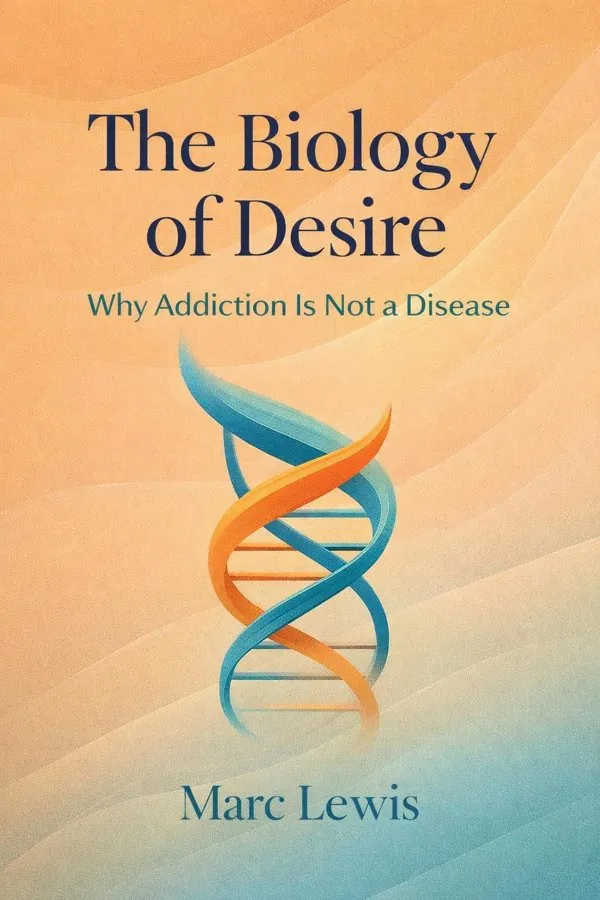
The Biology of Desire: Why Addiction Is Not a Disease: Summary & Key Insights
by Marc Lewis
 10 min8 chaptersAudio available
What Is The Biology of Desire: Why Addiction Is Not a Disease About?
The Biology of Desire: Why Addiction Is Not a Disease by Marc Lewis is a neuroscience book spanning 8 pages. In this groundbreaking work, neuroscientist Marc Lewis challenges the prevailing view that addiction is a chronic, relapsing brain disease. Drawing on his own experiences as a former addict and his research in neuroscience, Lewis argues that addiction is better understood as a developmental process—a learned pattern of behavior that can be unlearned. Through vivid case studies and accessible explanations of brain science, he shows how desire, habit, and emotional learning shape the brain’s pathways, and how recovery involves reshaping those same circuits through new experiences and choices.
This FizzRead summary covers all 8 key chapters of The Biology of Desire: Why Addiction Is Not a Disease in approximately 10 minutes, distilling the most important ideas, arguments, and takeaways from Marc Lewis's work. Also available as an audio summary and Key Quotes Podcast.
The Biology of Desire: Why Addiction Is Not a Disease
In this groundbreaking work, neuroscientist Marc Lewis challenges the prevailing view that addiction is a chronic, relapsing brain disease. Drawing on his own experiences as a former addict and his research in neuroscience, Lewis argues that addiction is better understood as a developmental process—a learned pattern of behavior that can be unlearned. Through vivid case studies and accessible explanations of brain science, he shows how desire, habit, and emotional learning shape the brain’s pathways, and how recovery involves reshaping those same circuits through new experiences and choices.
Who Should Read The Biology of Desire: Why Addiction Is Not a Disease?
This book is perfect for anyone interested in neuroscience and looking to gain actionable insights in a short read. Whether you're a student, professional, or lifelong learner, the key ideas from The Biology of Desire: Why Addiction Is Not a Disease by Marc Lewis will help you think differently.
- ✓Readers who enjoy neuroscience and want practical takeaways
- ✓Professionals looking to apply new ideas to their work and life
- ✓Anyone who wants the core insights of The Biology of Desire: Why Addiction Is Not a Disease in just 10 minutes
Want the full summary?
Get instant access to this book summary and 100K+ more with Fizz Moment.
Get Free SummaryAvailable on App Store • Free to download
Key Chapters
For decades, the medical establishment has promoted a fixed view of addiction: that it is a chronic, relapsing brain disease. This model has comforted many, for it releases the addict from moral blame. If it’s a disease, then it isn’t your fault. Yet, the language of disease carries hidden assumptions—it suggests that addicts have broken brains, that recovery can only come through lifelong management, and that relapse is nearly inevitable.
I walk the reader through the origins of this model. It began in the mid-twentieth century, when rising concern about drug epidemics and social decay intersected with the growing authority of neuroscience and psychiatry. Neuroimaging, particularly the use of PET scans, showed that drug use alters the dopamine pathways in the brain, reducing sensitivity to reward. This was interpreted as physical evidence of disease.
But when we look closer, those same changes appear not only in addicts but in anyone who develops strong habits—gamblers, lovers, or passionate artists. The brain changes with everything we do intensely. This is neuroplasticity, the fundamental feature of our neural architecture. Humans are wired to adapt. The question, then, is not whether addiction changes the brain—it’s how and why those changes can also be reversed.
As I examined the evidence, the disease model began to feel incomplete. It described what addiction looks like under a microscope, but not what it feels like to live it. Neuroscience can measure dopamine surges, but it cannot chart the inner terrain of emotional need, isolation, or trauma that makes those surges so magnetic.
The disease framework assumes passivity: if you have a disease, things happen to you. But addiction is built through choices, repetitions, desires—through a process that is exquisitely personal. It evolves. It’s not a lesion that strikes; it’s a learning pathway reinforced by emotional experience.
This doesn’t mean addicts choose their suffering any more than a child chooses their environment. But it means recovery is possible precisely because the brain can learn again, can rewire. Once we see addiction as learned adaptation—not a static malfunction—we restore agency to those struggling. We move from treatment to transformation.
+ 6 more chapters — available in the FizzRead app
All Chapters in The Biology of Desire: Why Addiction Is Not a Disease
About the Author
Marc Lewis is a developmental neuroscientist and professor of developmental psychology, known for his research on the neuroscience of addiction. A former addict himself, he has written extensively on how brain development and emotional learning contribute to addictive behavior. His work bridges scientific insight and personal experience, offering a compassionate and evidence-based perspective on recovery.
Get This Summary in Your Preferred Format
Read or listen to the The Biology of Desire: Why Addiction Is Not a Disease summary by Marc Lewis anytime, anywhere. FizzRead offers multiple formats so you can learn on your terms — all free.
Available formats: App · Audio · PDF · EPUB — All included free with FizzRead
Download The Biology of Desire: Why Addiction Is Not a Disease PDF and EPUB Summary
Key Quotes from The Biology of Desire: Why Addiction Is Not a Disease
“For decades, the medical establishment has promoted a fixed view of addiction: that it is a chronic, relapsing brain disease.”
“As I examined the evidence, the disease model began to feel incomplete.”
Frequently Asked Questions about The Biology of Desire: Why Addiction Is Not a Disease
The Biology of Desire: Why Addiction Is Not a Disease by Marc Lewis is a neuroscience book that explores key ideas across 8 chapters. In this groundbreaking work, neuroscientist Marc Lewis challenges the prevailing view that addiction is a chronic, relapsing brain disease. Drawing on his own experiences as a former addict and his research in neuroscience, Lewis argues that addiction is better understood as a developmental process—a learned pattern of behavior that can be unlearned. Through vivid case studies and accessible explanations of brain science, he shows how desire, habit, and emotional learning shape the brain’s pathways, and how recovery involves reshaping those same circuits through new experiences and choices.
You Might Also Like
Anxious
Joseph LeDoux
10 min
Hallucinations
Oliver Sacks
10 min
The Biological Mind: How Brain, Body, and Environment Collaborate to Make Us Who We Are
Alan Jasanoff
10 min
The Feeling of Life Itself: Why Consciousness Is Widespread but Can't Be Computed
Christof Koch
10 min
The No-Nonsense Meditation Book
Steven Laureys
10 min
A General Theory of Love
Thomas Lewis, Fari Amini, Richard Lannon
10 minBrowse by Category
Ready to read The Biology of Desire: Why Addiction Is Not a Disease?
Get the full summary and 100K+ more books with Fizz Moment.