
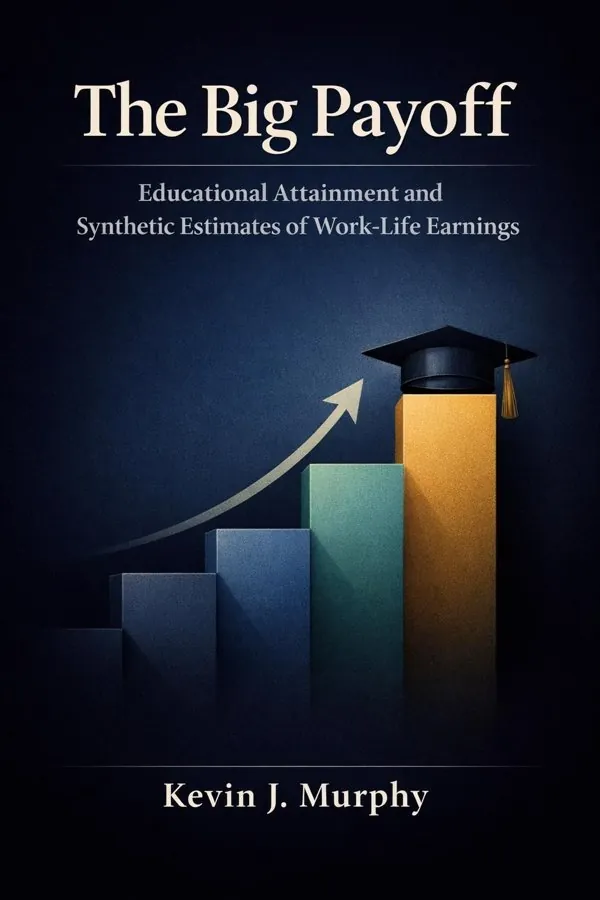
The Big Payoff: Educational Attainment and Synthetic Estimates of Work-Life Earnings: Summary & Key Insights
 10 min3 chaptersAudio available
What Is The Big Payoff: Educational Attainment and Synthetic Estimates of Work-Life Earnings About?
The Big Payoff: Educational Attainment and Synthetic Estimates of Work-Life Earnings by Kevin J. Murphy is a economics book spanning 3 pages. This report by Kevin J. Murphy, published by the U.S. Census Bureau, analyzes the relationship between educational attainment and lifetime earnings in the United States. Using synthetic estimates based on census data, it demonstrates how higher education levels correlate with significantly greater work-life income, providing a statistical foundation for understanding the economic value of education.
This FizzRead summary covers all 3 key chapters of The Big Payoff: Educational Attainment and Synthetic Estimates of Work-Life Earnings in approximately 10 minutes, distilling the most important ideas, arguments, and takeaways from Kevin J. Murphy's work. Also available as an audio summary and Key Quotes Podcast.
The Big Payoff: Educational Attainment and Synthetic Estimates of Work-Life Earnings
This report by Kevin J. Murphy, published by the U.S. Census Bureau, analyzes the relationship between educational attainment and lifetime earnings in the United States. Using synthetic estimates based on census data, it demonstrates how higher education levels correlate with significantly greater work-life income, providing a statistical foundation for understanding the economic value of education.
Who Should Read The Big Payoff: Educational Attainment and Synthetic Estimates of Work-Life Earnings?
This book is perfect for anyone interested in economics and looking to gain actionable insights in a short read. Whether you're a student, professional, or lifelong learner, the key ideas from The Big Payoff: Educational Attainment and Synthetic Estimates of Work-Life Earnings by Kevin J. Murphy will help you think differently.
- ✓Readers who enjoy economics and want practical takeaways
- ✓Professionals looking to apply new ideas to their work and life
- ✓Anyone who wants the core insights of The Big Payoff: Educational Attainment and Synthetic Estimates of Work-Life Earnings in just 10 minutes
Want the full summary?
Get instant access to this book summary and 100K+ more with Fizz Moment.
Get Free SummaryAvailable on App Store • Free to download
Key Chapters
In economic research, one of the core challenges in understanding lifetime outcomes is the limitation of time itself. We cannot wait half a century to gather true lifetime earnings data, so we rely on what we can observe now: annual earnings data collected through large-scale surveys like the Census and the Current Population Survey. But isolated annual data tell only part of the story. By constructing 'synthetic cohorts' — blending median earnings of individuals aged 25, 35, 45, and so on — we can statistically approximate what an individual with a given education might expect to earn over a full career.
The logic is elegantly simple, but its execution requires rigor. Each data point represents a snapshot of Americans at various stages of their working lives, classified by the highest level of education completed. By summing the median annual earnings across ages 25 through 64, we estimate the total 'synthetic' lifetime earnings for that education group.
This approach allows us to compare clearly defined educational categories: less than high school, high school graduate, some college or associate degree, a bachelor’s degree, and advanced degrees. What emerges is striking — not just a gradual increase, but a compounding effect of education on income. For instance, the median lifetime earnings for someone with a bachelor’s degree may approach double that of someone with only a high school diploma when projected across a 40-year work span.
Yet what makes these numbers meaningful is how they reflect choices, environments, and structures. Each educational step brings different opportunities for occupational access, professional development, and income growth potential. The synthetic approach captures that structural dynamic, offering policymakers and individuals a window into the long-term economic consequences of educational investment.
A central insight from the data is that education interacts with demographic realities — gender, race, and age — in complex but illuminating ways. When we disaggregate the statistics, the story deepens: while higher education boosts earnings for all groups, the magnitude and trajectory of those earnings can differ significantly.
Men, on average, out-earn women across all levels of education, but the gap narrows with higher attainment. For example, women with bachelor’s degrees earn considerably more than men with only some college, although still less, on average, than men with the same degree. This pattern reflects both labor market structures and evolving dynamics of gender equity, as participation rates and career persistence change across generations.
Racial and ethnic variations reveal another layer. White and Asian Americans tend to report higher median earnings at equivalent levels of education, compared to Black or Hispanic workers. Yet when education increases, relative disparities diminish — evidence that education remains a powerful equalizing force, even if not a complete correction against systemic inequality.
These demographic patterns matter because they contextualize the value of education not as a uniform multiplier, but as a conditional one. The same degree can translate differently depending on societal and market contexts, yet across all such contexts, it consistently raises the baseline. To put it simply, education amplifies economic opportunity even within systems marked by disparity.
Furthermore, labor force participation rates and full-time status significantly influence work-life income estimates. Those with higher education tend to participate more consistently across their careers and more often in full-time employment, which further reinforces cumulative earnings advantages. By accounting for these participation patterns, the synthetic lifetime model provides a more realistic measure of true economic experience — a reflection of both earning potential and work continuity.
+ 1 more chapters — available in the FizzRead app
All Chapters in The Big Payoff: Educational Attainment and Synthetic Estimates of Work-Life Earnings
About the Author
Kevin J. Murphy is an economist and researcher known for his work on labor economics, compensation, and education-related income analysis. He has contributed to several U.S. government and academic studies on the economic returns of education.
Get This Summary in Your Preferred Format
Read or listen to the The Big Payoff: Educational Attainment and Synthetic Estimates of Work-Life Earnings summary by Kevin J. Murphy anytime, anywhere. FizzRead offers multiple formats so you can learn on your terms — all free.
Available formats: App · Audio · PDF · EPUB — All included free with FizzRead
Download The Big Payoff: Educational Attainment and Synthetic Estimates of Work-Life Earnings PDF and EPUB Summary
Key Quotes from The Big Payoff: Educational Attainment and Synthetic Estimates of Work-Life Earnings
“In economic research, one of the core challenges in understanding lifetime outcomes is the limitation of time itself.”
“A central insight from the data is that education interacts with demographic realities — gender, race, and age — in complex but illuminating ways.”
Frequently Asked Questions about The Big Payoff: Educational Attainment and Synthetic Estimates of Work-Life Earnings
The Big Payoff: Educational Attainment and Synthetic Estimates of Work-Life Earnings by Kevin J. Murphy is a economics book that explores key ideas across 3 chapters. This report by Kevin J. Murphy, published by the U.S. Census Bureau, analyzes the relationship between educational attainment and lifetime earnings in the United States. Using synthetic estimates based on census data, it demonstrates how higher education levels correlate with significantly greater work-life income, providing a statistical foundation for understanding the economic value of education.
You Might Also Like

Business Adventures
John Brooks
10 min
Nudge
Richard H. Thaler, Cass R. Sunstein
10 min
The Hitchhiker"s Guide to the Galaxy
Douglas Adams
10 minThe Muqaddimah
Ibn Khaldun
10 minThe Outsiders
William N. Thorndike
10 min
A Little History of Economics
Niall Kishtainy
10 minBrowse by Category
Ready to read The Big Payoff: Educational Attainment and Synthetic Estimates of Work-Life Earnings?
Get the full summary and 100K+ more books with Fizz Moment.