
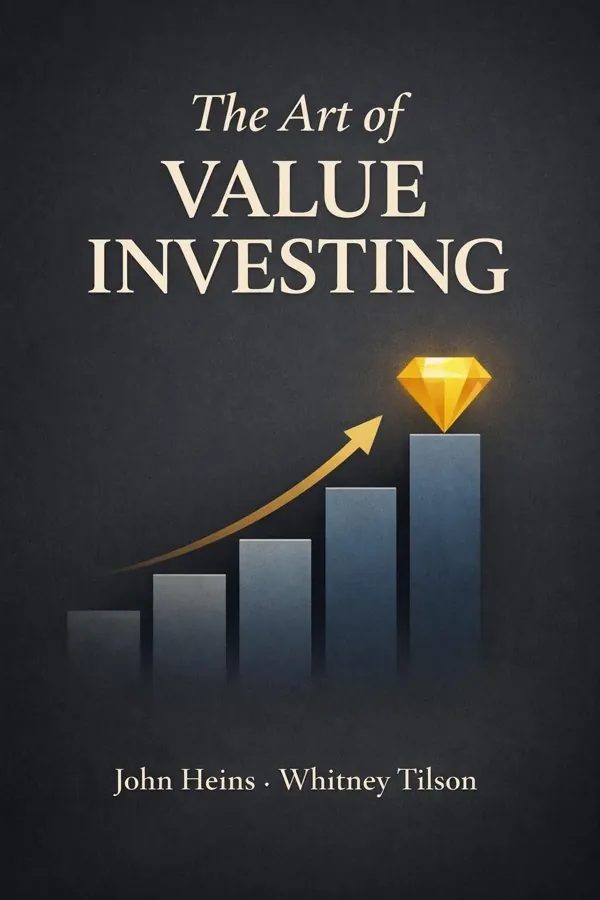
The Art of Value Investing: How the World's Best Investors Beat the Market: Summary & Key Insights
 10 min4 chaptersAudio available
What Is The Art of Value Investing: How the World's Best Investors Beat the Market About?
The Art of Value Investing: How the World's Best Investors Beat the Market by John Heins, Whitney Tilson is a finance book spanning 4 pages. This book presents insights from some of the most successful value investors in the world. Through interviews and analysis, John Heins and Whitney Tilson explore the principles, strategies, and mindsets that allow these investors to consistently outperform the market. It serves as a practical guide for understanding value investing philosophy and applying it to real-world investment decisions.
This FizzRead summary covers all 4 key chapters of The Art of Value Investing: How the World's Best Investors Beat the Market in approximately 10 minutes, distilling the most important ideas, arguments, and takeaways from John Heins, Whitney Tilson's work. Also available as an audio summary and Key Quotes Podcast.
The Art of Value Investing: How the World's Best Investors Beat the Market
This book presents insights from some of the most successful value investors in the world. Through interviews and analysis, John Heins and Whitney Tilson explore the principles, strategies, and mindsets that allow these investors to consistently outperform the market. It serves as a practical guide for understanding value investing philosophy and applying it to real-world investment decisions.
Who Should Read The Art of Value Investing: How the World's Best Investors Beat the Market?
This book is perfect for anyone interested in finance and looking to gain actionable insights in a short read. Whether you're a student, professional, or lifelong learner, the key ideas from The Art of Value Investing: How the World's Best Investors Beat the Market by John Heins, Whitney Tilson will help you think differently.
- ✓Readers who enjoy finance and want practical takeaways
- ✓Professionals looking to apply new ideas to their work and life
- ✓Anyone who wants the core insights of The Art of Value Investing: How the World's Best Investors Beat the Market in just 10 minutes
Want the full summary?
Get instant access to this book summary and 100K+ more with Fizz Moment.
Get Free SummaryAvailable on App Store • Free to download
Key Chapters
Every art form has its roots, and value investing’s ancestry lies in the work of Benjamin Graham and his protégé, Warren Buffett. Graham, often called the father of value investing, brought an engineer’s precision to the study of financial statements and a philosopher’s detachment to the whims of the market. His concept of ‘intrinsic value’—the true worth of a company based on its fundamentals—became the anchor around which generations of investors would build their craft. Buffett translated those ideas into a living, breathing philosophy, shaping value investing into a flexible framework capable of adapting to changing times.
At its core, value investing rests on three guiding pillars. The first is intrinsic value. To invest intelligently, you must view a stock not as a ticker symbol dancing across a screen, but as a fractional ownership in a business. The goal is to estimate what that business is truly worth. The market price may wander wildly above or below that figure, but intrinsic value remains your compass.
The second pillar is the margin of safety. Graham likened it to the engineer’s tolerance for error: you build bridges stronger than necessary to withstand unexpected weight. In investing, you buy with a cushion—paying well below intrinsic value—so even if you misjudge a company’s worth or the world shifts unexpectedly, your downside is limited.
The third pillar is a long‑term perspective. Markets are noisy in the short run but rational in the long run. The value investor, therefore, must cultivate patience. Real wealth in markets grows like a tree; the roots strengthen unseen before the branches bear fruit. Buffett once noted that the stock market is a device for transferring money from the impatient to the patient. Every great value investor we interviewed understood this principle deeply.
Value investing is not a single formula but a discipline expressed through many unique voices. While some investors specialize in deep‑value situations—buying distressed or unfashionable assets at fire‑sale prices—others focus on high‑quality companies temporarily overlooked by the market. The likes of Joel Greenblatt pursue special situations, such as spinoffs or restructurings, where mispricings often arise. Howard Marks emphasizes the importance of understanding cycles—both business and psychological. What unites these investors is not uniform method but shared temperament and logic: all dedicate themselves to independent judgment and emotional restraint.
Behavioral finance helps us understand why such discipline works. The market is not an efficient machine; it is a living crowd, oscillating between euphoria and despair. Investors, being human, succumb to biases—overconfidence after success, panic during downturns, and a deep craving to belong to the herd. Value investors exploit those biases not by predicting moods but by staying anchored to valuation. When others are fearful, they see opportunity; when others are greedy, they step back.
Consider the 2008 financial crisis. While panic drove many to sell indiscriminately, seasoned value investors combed through the wreckage searching for high‑quality firms whose prices had collapsed far below intrinsic worth. Their success was not rooted in clairvoyance but in temperament—the ability to act calmly when others could not. That same mindset applies in bull markets, where caution protects the investor from paying irrational prices for fashionable growth.
+ 2 more chapters — available in the FizzRead app
All Chapters in The Art of Value Investing: How the World's Best Investors Beat the Market
About the Authors
John Heins is the co-founder and editor of Value Investor Insight, a publication dedicated to value investing strategies. Whitney Tilson is an American investor, author, and founder of Kase Learning, known for his expertise in value investing and hedge fund management.
Get This Summary in Your Preferred Format
Read or listen to the The Art of Value Investing: How the World's Best Investors Beat the Market summary by John Heins, Whitney Tilson anytime, anywhere. FizzRead offers multiple formats so you can learn on your terms — all free.
Available formats: App · Audio · PDF · EPUB — All included free with FizzRead
Download The Art of Value Investing: How the World's Best Investors Beat the Market PDF and EPUB Summary
Key Quotes from The Art of Value Investing: How the World's Best Investors Beat the Market
“Every art form has its roots, and value investing’s ancestry lies in the work of Benjamin Graham and his protégé, Warren Buffett.”
“Value investing is not a single formula but a discipline expressed through many unique voices.”
Frequently Asked Questions about The Art of Value Investing: How the World's Best Investors Beat the Market
The Art of Value Investing: How the World's Best Investors Beat the Market by John Heins, Whitney Tilson is a finance book that explores key ideas across 4 chapters. This book presents insights from some of the most successful value investors in the world. Through interviews and analysis, John Heins and Whitney Tilson explore the principles, strategies, and mindsets that allow these investors to consistently outperform the market. It serves as a practical guide for understanding value investing philosophy and applying it to real-world investment decisions.
You Might Also Like
Browse by Category
Ready to read The Art of Value Investing: How the World's Best Investors Beat the Market?
Get the full summary and 100K+ more books with Fizz Moment.