
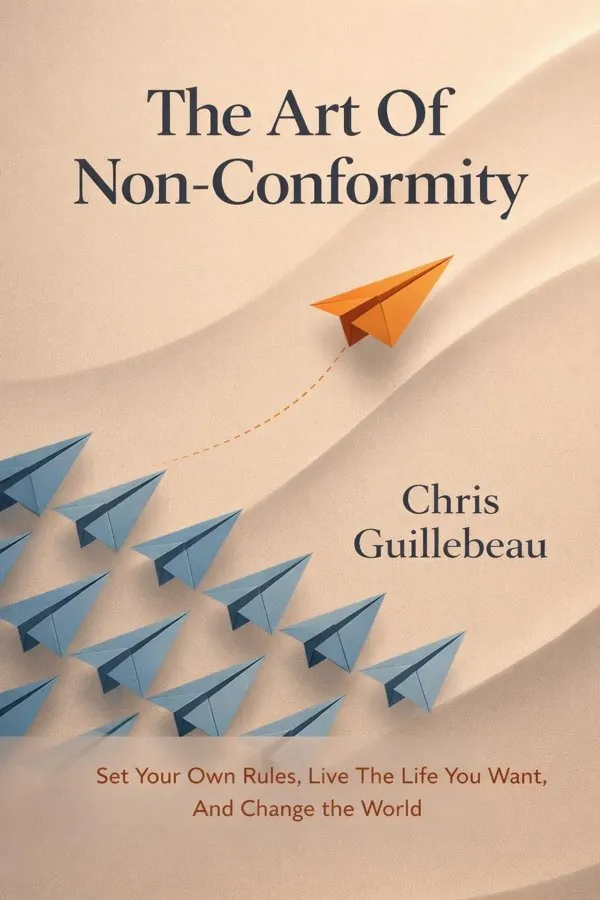
The Art Of Non-Conformity: Set Your Own Rules, Live The Life You Want, And Change The World: Summary & Key Insights
 10 min10 chaptersAudio available
Key Takeaways from The Art Of Non-Conformity: Set Your Own Rules, Live The Life You Want, And Change The World
One of the most dangerous ideas in modern life is that the standard path is automatically the right one.
A surprising amount of human unhappiness comes from forgetting that choice exists.
Fear becomes strongest when it remains vague.
A life can be socially approved and personally empty.
You do not need everyone to understand you.
What Is The Art Of Non-Conformity: Set Your Own Rules, Live The Life You Want, And Change The World About?
The Art Of Non-Conformity: Set Your Own Rules, Live The Life You Want, And Change The World by Chris Guillebeau is a mindset book spanning 11 pages. What if the life you have been told to want is not the life you actually want at all? In The Art Of Non-Conformity, Chris Guillebeau challenges one of modern society’s deepest assumptions: that success must follow a standard script of education, employment, security, retirement, and delayed freedom. Instead, he argues that a meaningful life is built by questioning defaults, choosing intentionally, and creating work and relationships that reflect your values rather than other people’s expectations. This is not a reckless call to rebel for the sake of rebellion. It is a practical guide to living with purpose, autonomy, and courage. Drawing from his own experiences as an entrepreneur, writer, and world traveler who set out to visit every country on Earth, Guillebeau writes with unusual credibility. He has not merely theorized about unconventional living; he has tested it in real life. The result is a book that blends philosophy, personal reflection, and actionable advice. For anyone feeling trapped by routine or hungry for a more deliberate life, this book offers both permission and a plan.
This FizzRead summary covers all 10 key chapters of The Art Of Non-Conformity: Set Your Own Rules, Live The Life You Want, And Change The World in approximately 10 minutes, distilling the most important ideas, arguments, and takeaways from Chris Guillebeau's work. Also available as an audio summary and Key Quotes Podcast.
The Art Of Non-Conformity: Set Your Own Rules, Live The Life You Want, And Change The World
What if the life you have been told to want is not the life you actually want at all? In The Art Of Non-Conformity, Chris Guillebeau challenges one of modern society’s deepest assumptions: that success must follow a standard script of education, employment, security, retirement, and delayed freedom. Instead, he argues that a meaningful life is built by questioning defaults, choosing intentionally, and creating work and relationships that reflect your values rather than other people’s expectations. This is not a reckless call to rebel for the sake of rebellion. It is a practical guide to living with purpose, autonomy, and courage.
Drawing from his own experiences as an entrepreneur, writer, and world traveler who set out to visit every country on Earth, Guillebeau writes with unusual credibility. He has not merely theorized about unconventional living; he has tested it in real life. The result is a book that blends philosophy, personal reflection, and actionable advice. For anyone feeling trapped by routine or hungry for a more deliberate life, this book offers both permission and a plan.
Who Should Read The Art Of Non-Conformity: Set Your Own Rules, Live The Life You Want, And Change The World?
This book is perfect for anyone interested in mindset and looking to gain actionable insights in a short read. Whether you're a student, professional, or lifelong learner, the key ideas from The Art Of Non-Conformity: Set Your Own Rules, Live The Life You Want, And Change The World by Chris Guillebeau will help you think differently.
- ✓Readers who enjoy mindset and want practical takeaways
- ✓Professionals looking to apply new ideas to their work and life
- ✓Anyone who wants the core insights of The Art Of Non-Conformity: Set Your Own Rules, Live The Life You Want, And Change The World in just 10 minutes
Want the full summary?
Get instant access to this book summary and 100K+ more with Fizz Moment.
Get Free SummaryAvailable on App Store • Free to download
Key Chapters
One of the most dangerous ideas in modern life is that the standard path is automatically the right one. From childhood, many people are given a ready-made formula: get good grades, choose a practical career, work steadily, buy the expected things, save for retirement, and postpone real freedom until later. Because this script is so widely repeated, it can feel natural, even inevitable. Guillebeau argues that this is exactly why it deserves scrutiny.
The default path is not evil; it is simply unexamined. It may work well for some people, but it becomes a problem when it is treated as the only respectable option. Many people follow it not because it matches their deepest values, but because deviating from it invites uncertainty, criticism, and risk. The result is a life that appears stable from the outside yet feels disconnected on the inside.
Non-conformity, in Guillebeau’s sense, is not about rejecting tradition just to be different. It is about refusing to outsource your life choices. That could mean starting a business instead of climbing a corporate ladder, designing a simpler lifestyle instead of pursuing status, or structuring your work around freedom instead of prestige. The central question is not “What do people usually do?” but “What kind of life is most meaningful to me?”
A practical way to apply this idea is to audit the major assumptions in your life. Why do you live where you live, work where you work, spend how you spend, and pursue the goals you pursue? If your answer is mostly “because that’s what people do,” it may be time to rethink the blueprint.
Actionable takeaway: List three major life decisions you have accepted by default and rewrite each one as a conscious choice.
A surprising amount of human unhappiness comes from forgetting that choice exists. People often speak as if they are trapped by circumstances, roles, or obligations that cannot be changed. Guillebeau pushes back against this mindset by insisting that freedom starts not with money or perfect timing, but with the recognition that you have more agency than you think.
This does not mean every situation is easy to change or that structural limits are imaginary. It means that within almost every constraint, there are still decisions available: how to respond, what to prioritize, what to stop tolerating, and what to build next. The moment you see yourself as an active participant instead of a passive recipient, your life begins to open up.
Personal choice often appears in small, neglected places. You can choose to reduce unnecessary expenses and buy back time. You can choose to learn marketable skills on your own. You can choose to turn a side project into a source of income. You can choose to leave environments that reward conformity and seek communities that support experimentation. Over time, these choices compound into a radically different life.
Guillebeau’s message is especially powerful because it turns freedom into a practice rather than a fantasy. Waiting for perfect certainty often keeps people stuck. Instead, he encourages making the best decision with the information available, then adapting. Choice creates movement, and movement creates possibility.
A helpful application is to stop describing your life in language of helplessness. Replacing “I have to” with “I choose to” or “I choose not to” reveals what is truly mandatory and what is habit, fear, or social pressure.
Actionable takeaway: For one week, notice every time you say “I can’t” or “I have to,” and rewrite the statement to reflect the choices you actually have.
Fear becomes strongest when it remains vague. Many people stay in unsatisfying jobs, avoid meaningful projects, or delay major changes not because they have carefully evaluated the risks, but because they feel an undefined sense of dread. Guillebeau treats fear as a normal companion to growth, not as a stop sign. The goal is not to eliminate fear entirely, but to understand it, reduce its power, and move forward anyway.
A key insight in the book is that resistance often disguises itself as practicality. We say we are waiting for a better time, more savings, greater confidence, or universal approval. In reality, we may be protecting ourselves from discomfort. Yet discomfort is often the price of alignment. If you want a life that is self-directed, creative, or unconventional, you will almost certainly have to disappoint some expectations, risk some failure, and tolerate some ambiguity.
One useful technique is to define the feared outcome precisely. What exactly are you afraid will happen if you start a business, move abroad, pitch a bold idea, or leave a stable but draining role? Will you lose income temporarily? Will some people judge you? Will you have to adjust your plans? Most of these outcomes are manageable when named clearly. The undefined monster is usually worse than the actual challenge.
Guillebeau also emphasizes building courage through action. Small experiments can train resilience. Launch a side project before quitting your job. Take a short solo trip before relocating internationally. Test demand for an idea before investing heavily in it. Courage grows when reality proves more workable than fear predicted.
Actionable takeaway: Write down one major decision you have postponed, identify the specific worst-case scenario, and design one small experiment that lets you test the idea within the next 30 days.
A life can be socially approved and personally empty. Guillebeau argues that meaning should be the real measure of success, not appearances, titles, or adherence to convention. This shifts the question from “How do I look successful?” to “What kind of life feels deeply worthwhile to live?” That change in perspective can alter everything.
Meaning is rarely found by accident. It emerges when your daily actions connect with your values. For some people, meaning comes from creative work. For others, it comes from service, autonomy, family, travel, learning, or building something useful. The point is not that everyone should want the same thing. The point is that you must decide what matters enough to structure your life around it.
This often requires subtracting what looks impressive but feels hollow. A prestigious job that consumes your health, a lifestyle inflated by debt, or commitments driven by obligation rather than conviction can slowly drain your sense of purpose. By contrast, a simpler life built around chosen priorities can feel rich, even if it earns less status.
Meaning also depends on contribution. Guillebeau’s version of non-conformity is not self-indulgent isolation. He repeatedly connects personal freedom with usefulness. A meaningful life does not only express who you are; it also creates value for others. That is why work, service, and mission remain central themes in the book.
A practical way to uncover meaning is to track energy. Notice which activities leave you feeling alive, focused, generous, and engaged. Those patterns are clues. Meaning often hides in recurring sources of fascination and usefulness.
Actionable takeaway: Identify your top three values and compare them with how you currently spend your time, money, and attention; then make one weekly change that brings your behavior into closer alignment.
You do not need everyone to understand you. One of Guillebeau’s most memorable ideas is the “small army” strategy: instead of trying to win broad, shallow approval, focus on gathering a dedicated group of people who genuinely believe in your mission, work, or message. This idea is liberating because it breaks the illusion that success requires universal appeal.
In conventional settings, people are often taught to smooth out their edges to become acceptable to the largest number of people. But in creative work, entrepreneurship, and movements for change, specificity is often more powerful than broad neutrality. When your values are clear and your work is distinct, some people may ignore you, but the right people will connect deeply. Those are the people who matter.
This principle applies to authors, artists, entrepreneurs, freelancers, nonprofit leaders, and anyone trying to create something meaningful. A musician does not need millions of casual listeners to sustain a career if a smaller, loyal audience supports the work consistently. A coach does not need to be known by everyone if the right clients trust their expertise. A cause does not need instant mainstream acceptance if a core group is committed enough to spread it.
The small army strategy also encourages honesty. If you try to please everyone, your message becomes diluted. If you speak directly to the people you most want to serve, your work gains clarity and power. In the age of digital platforms, this is especially relevant: community often matters more than scale.
To apply this idea, define who your work is truly for. What do those people care about? What problem do they have? What values do they share? Build trust through consistency, generosity, and relevance.
Actionable takeaway: Describe your ideal audience or community in one paragraph and create one specific piece of work this week designed only for them.
Work is one of the main places where conformity hides in plain sight. Many people assume employment must involve hierarchy, limited autonomy, and years of waiting before enjoying flexibility. Guillebeau challenges this belief by presenting entrepreneurship and self-directed work as viable paths to both freedom and contribution. His argument is not that everyone must become a startup founder, but that work can be redesigned around value creation rather than inherited assumptions.
At the center of this idea is a simple principle: if you solve a problem, help people, or create something they care about, income can follow. This reframes earning money from a desperate need into an exchange of value. Instead of asking, “How can I get hired into a role I may not want?” you can ask, “What useful thing can I offer that people will gladly pay for?”
Unconventional work can take many forms: freelancing, consulting, teaching, digital products, service businesses, writing, coaching, or mission-driven microbusinesses. What matters is not glamour but fit. The best work often sits at the intersection of skill, interest, and demand. Someone who loves organization might build a virtual operations business. A strong writer might develop a content strategy practice. A traveler could create destination guides or remote-work resources.
Guillebeau’s approach is especially practical because it favors lean experimentation over grand plans. You do not need massive funding or a flawless business model to begin. Start small, test demand, refine your offer, and keep your overhead low. Freedom becomes more realistic when you reduce complexity and focus on serving real needs.
Actionable takeaway: Make a list of three problems you can help solve, then test one offer by describing it to five potential customers or clients this month.
Ordinary goals often produce ordinary lives. Guillebeau encourages readers to think bigger and more personally by setting radical goals, ambitions that stretch identity rather than merely improving comfort. These are the kinds of goals that make you more alive: visiting every country, building a business around your passion, creating a movement, mastering a difficult craft, or designing a life that is entirely your own.
Radical goals matter because they interrupt passive living. Without deliberate aims, it is easy to drift into routines shaped by other people’s priorities. Bold goals create direction. They also reveal what you are willing to commit to, sacrifice for, and become. In that sense, the real power of a goal is not only the outcome, but the transformation required to pursue it.
At the same time, Guillebeau avoids empty motivational language. Ambitious goals need structure. A dream becomes practical when broken into milestones, timelines, and repeatable actions. If your goal is to create location-independent work, you may need to build a client base, lower your expenses, and establish a remote workflow. If your goal is to write a book, you may need a daily writing habit, a draft deadline, and feedback from early readers.
He also suggests choosing goals that are genuinely yours. A radical goal is not impressive because it is difficult or unusual. It is powerful because it expresses a deeply held desire. Borrowed ambition can be just another form of conformity.
A useful exercise is to imagine yourself ten years from now. What unfinished dream would you regret abandoning? Often the answer reveals the goal that deserves your energy now.
Actionable takeaway: Choose one bold, personally meaningful goal and turn it into a one-page plan with a deadline, three milestones, and the next action you can take today.
Travel, in Guillebeau’s work, is not merely a leisure activity. It is a way of seeing more clearly. By stepping outside familiar environments, people are often able to question assumptions they did not even realize they carried. Customs, routines, social expectations, and ideas of what is “normal” begin to look less fixed when you see how differently people live around the world.
This is why travel can be transformational. It loosens the grip of inherited scripts. A person who has only known one cultural model may unconsciously believe that model is universal. But exposure to different economies, family structures, work habits, and forms of happiness expands the imagination. You begin to understand that there are many ways to organize a meaningful life.
Travel also builds adaptability. Navigating unfamiliar places strengthens confidence, problem-solving, and openness. Even modest travel can shift perspective. A weekend alone in a nearby city can spark reflection. A longer trip abroad can reveal how little you actually need to feel alive. For those pursuing unconventional living, travel often teaches practical lessons in simplicity, resilience, and independence.
Importantly, Guillebeau does not romanticize travel as escape. You do not become wiser simply by collecting passport stamps. The value comes from paying attention, engaging respectfully, and allowing experience to challenge your assumptions. Travel can become a form of education when approached with humility and curiosity.
For readers who cannot travel internationally right now, the deeper principle still applies: seek unfamiliarity. Read globally, meet people outside your usual circles, explore new neighborhoods, or work from different environments. Perspective changes whenever comfort zones expand.
Actionable takeaway: Plan one experience in the next month that exposes you to a different culture, community, or environment, and reflect on what assumptions it challenges.
Financial independence is not about wealth for its own sake. In Guillebeau’s view, money is most useful when it increases freedom, reduces dependence on systems you dislike, and enables meaningful work. This is a crucial distinction because many people pursue income in ways that actually decrease autonomy. They earn more, spend more, and become more trapped.
The book encourages a healthier relationship with money by linking it to value creation and intentional living. If you understand what matters most, you can spend in ways that support those priorities and cut what does not. This might mean living below your means to create options, avoiding debt that narrows your choices, or building multiple income streams so that one employer or one crisis does not determine your future.
Guillebeau also emphasizes that financial freedom often begins with simplicity rather than scale. You may not need a huge salary if your lifestyle is designed thoughtfully. Lower fixed costs can dramatically expand your ability to take risks, work independently, travel, or pursue mission-driven projects. In this sense, frugality becomes strategic, not restrictive.
At the same time, he rejects the idea that money is corrupt or unspiritual. Earning well by helping people is honorable. The real issue is whether money serves your values or replaces them. A business that improves lives and funds a free, purposeful existence is far different from endless accumulation without direction.
A practical application is to examine your current financial structure. Which expenses genuinely support your chosen life, and which ones mainly maintain appearances? Financial clarity often leads to personal clarity.
Actionable takeaway: Review your monthly spending and identify one recurring expense to reduce and one small income opportunity to develop in order to increase your freedom margin.
Many people assume that changing the world is reserved for activists, celebrities, or those with exceptional resources. Guillebeau offers a more democratic and empowering idea: meaningful change often begins when ordinary individuals take responsibility for the sphere they can influence. Personal freedom and social contribution are not separate pursuits. In fact, the most effective non-conformity often channels private conviction into public good.
This idea protects the book from becoming purely self-focused. Living on your own terms is not just about escaping drudgery or maximizing personal enjoyment. It is also about using your time, talents, and independence to make things better. That could mean building a mission-driven business, advocating for a cause, creating art that moves people, mentoring others, or solving practical problems in your community.
The scale of impact matters less than the authenticity of action. You do not need to transform millions of lives to matter. If you help a hundred people deeply, that is real change. If your work inspires one person to live more courageously, that also matters. Guillebeau’s message is that meaningful action becomes possible when you stop waiting for permission and start using what you already have.
A common trap is believing that you must first have total clarity, perfect credentials, or ideal conditions. But contribution often grows through doing. Start with the cause you care about, the people you can serve, and the skills you can offer now. As your confidence and capacity grow, so will your influence.
Actionable takeaway: Choose one issue, community, or problem you care about and commit to one concrete act of service, creation, or leadership this week, however small.
All Chapters in The Art Of Non-Conformity: Set Your Own Rules, Live The Life You Want, And Change The World
About the Author
Chris Guillebeau is an American author, entrepreneur, and speaker known for his work on unconventional living, self-employment, and personal freedom. He first built a wide audience through his writing on how people can create meaningful lives outside traditional career and lifestyle expectations. Guillebeau is also widely recognized for his goal of visiting every country in the world, a project he completed while documenting lessons on travel, independence, and purposeful action. His books, talks, and projects often focus on side hustles, small business creation, and intentional living. What sets him apart is that his ideas come from direct experience rather than abstract theory. Through his writing, he has inspired readers to question defaults, pursue bold goals, and design lives centered on autonomy, contribution, and meaning.
Get This Summary in Your Preferred Format
Read or listen to the The Art Of Non-Conformity: Set Your Own Rules, Live The Life You Want, And Change The World summary by Chris Guillebeau anytime, anywhere. FizzRead offers multiple formats so you can learn on your terms — all free.
Available formats: App · Audio · PDF · EPUB — All included free with FizzRead
Download The Art Of Non-Conformity: Set Your Own Rules, Live The Life You Want, And Change The World PDF and EPUB Summary
Key Quotes from The Art Of Non-Conformity: Set Your Own Rules, Live The Life You Want, And Change The World
“One of the most dangerous ideas in modern life is that the standard path is automatically the right one.”
“A surprising amount of human unhappiness comes from forgetting that choice exists.”
“Fear becomes strongest when it remains vague.”
“A life can be socially approved and personally empty.”
“You do not need everyone to understand you.”
Frequently Asked Questions about The Art Of Non-Conformity: Set Your Own Rules, Live The Life You Want, And Change The World
The Art Of Non-Conformity: Set Your Own Rules, Live The Life You Want, And Change The World by Chris Guillebeau is a mindset book that explores key ideas across 10 chapters. What if the life you have been told to want is not the life you actually want at all? In The Art Of Non-Conformity, Chris Guillebeau challenges one of modern society’s deepest assumptions: that success must follow a standard script of education, employment, security, retirement, and delayed freedom. Instead, he argues that a meaningful life is built by questioning defaults, choosing intentionally, and creating work and relationships that reflect your values rather than other people’s expectations. This is not a reckless call to rebel for the sake of rebellion. It is a practical guide to living with purpose, autonomy, and courage. Drawing from his own experiences as an entrepreneur, writer, and world traveler who set out to visit every country on Earth, Guillebeau writes with unusual credibility. He has not merely theorized about unconventional living; he has tested it in real life. The result is a book that blends philosophy, personal reflection, and actionable advice. For anyone feeling trapped by routine or hungry for a more deliberate life, this book offers both permission and a plan.
More by Chris Guillebeau

Born for This: How to Find the Work You Were Meant to Do
Chris Guillebeau
10 min
Side Hustle: From Idea to Income in 27 Days
Chris Guillebeau
10 min
The Happiness Of Pursuit: Finding The Quest That Will Bring Purpose To Your Life
Chris Guillebeau
10 min
The $100 Startup: Reinvent the Way You Make a Living, Do What You Love, and Create a New Future
Chris Guillebeau
10 minYou Might Also Like

Browse by Category
Ready to read The Art Of Non-Conformity: Set Your Own Rules, Live The Life You Want, And Change The World?
Get the full summary and 100K+ more books with Fizz Moment.