
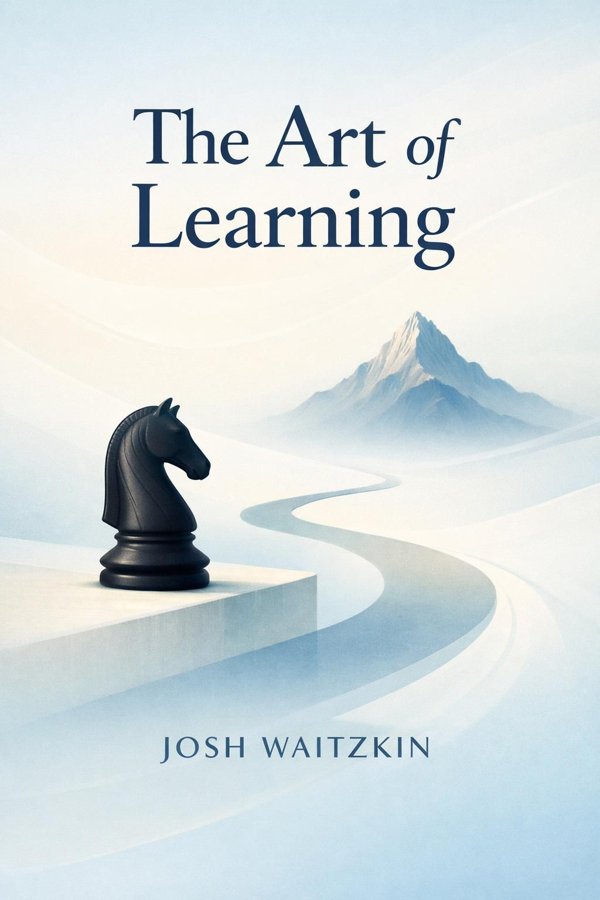
The Art of Learning: An Inner Journey to Optimal Performance: Summary & Key Insights
 10 min9 chaptersAudio available
Key Takeaways from The Art of Learning: An Inner Journey to Optimal Performance
Greatness rarely begins with a grand revelation; more often, it starts with fascination.
Setbacks do not just interrupt growth; they often reveal the hidden weaknesses growth has been covering up.
When one path closes, another can reveal a deeper pattern.
Complex performance looks magical from the outside because observers see the integrated whole, not the layers beneath it.
Peak performance is not a state of frantic intensity; it is often a state of quiet immersion.
What Is The Art of Learning: An Inner Journey to Optimal Performance About?
The Art of Learning: An Inner Journey to Optimal Performance by Josh Waitzkin is a mindset book spanning 9 pages. The Art of Learning is part memoir, part performance manual, and part philosophy of mastery. In it, Josh Waitzkin reflects on his unusual path from child chess prodigy to world champion in Tai Chi Push Hands, showing that excellence is not tied to one field but to the way a person learns, adapts, and performs under pressure. Rather than glorifying talent, Waitzkin argues that true mastery comes from cultivating a resilient mind, breaking complex skills into learnable layers, and turning setbacks into fuel for growth. What makes this book powerful is that it connects elite competition with everyday life: the same principles that help a champion perform in a final round can help a student prepare for exams, a leader make better decisions, or an artist sustain creative focus. Waitzkin writes with unusual authority because he has rebuilt himself at the highest levels in two radically different disciplines. His lessons are grounded not in theory alone, but in lived experience, hard losses, and repeated reinvention. The result is a deeply practical guide to learning how to learn.
This FizzRead summary covers all 9 key chapters of The Art of Learning: An Inner Journey to Optimal Performance in approximately 10 minutes, distilling the most important ideas, arguments, and takeaways from Josh Waitzkin's work. Also available as an audio summary and Key Quotes Podcast.
The Art of Learning: An Inner Journey to Optimal Performance
The Art of Learning is part memoir, part performance manual, and part philosophy of mastery. In it, Josh Waitzkin reflects on his unusual path from child chess prodigy to world champion in Tai Chi Push Hands, showing that excellence is not tied to one field but to the way a person learns, adapts, and performs under pressure. Rather than glorifying talent, Waitzkin argues that true mastery comes from cultivating a resilient mind, breaking complex skills into learnable layers, and turning setbacks into fuel for growth. What makes this book powerful is that it connects elite competition with everyday life: the same principles that help a champion perform in a final round can help a student prepare for exams, a leader make better decisions, or an artist sustain creative focus. Waitzkin writes with unusual authority because he has rebuilt himself at the highest levels in two radically different disciplines. His lessons are grounded not in theory alone, but in lived experience, hard losses, and repeated reinvention. The result is a deeply practical guide to learning how to learn.
Who Should Read The Art of Learning: An Inner Journey to Optimal Performance?
This book is perfect for anyone interested in mindset and looking to gain actionable insights in a short read. Whether you're a student, professional, or lifelong learner, the key ideas from The Art of Learning: An Inner Journey to Optimal Performance by Josh Waitzkin will help you think differently.
- ✓Readers who enjoy mindset and want practical takeaways
- ✓Professionals looking to apply new ideas to their work and life
- ✓Anyone who wants the core insights of The Art of Learning: An Inner Journey to Optimal Performance in just 10 minutes
Want the full summary?
Get instant access to this book summary and 100K+ more with Fizz Moment.
Get Free SummaryAvailable on App Store • Free to download
Key Chapters
Greatness rarely begins with a grand revelation; more often, it starts with fascination. Waitzkin’s early relationship with chess was shaped not by obsession with trophies, but by a love for the intensity of the game itself. As a child in Washington Square Park, he was drawn to the electricity of concentration and the subtle psychological dance between players. This matters because it reveals one of the book’s central claims: sustainable excellence begins when curiosity and disciplined effort work together.
Waitzkin challenges the myth that elite performers are simply born different. While he acknowledges natural inclinations, he emphasizes that talent is cultivated through the quality of practice. His early coach, Bruce Pandolfini, protected the joy of learning while steadily building technical foundations. Instead of overwhelming him with complexity, Bruce taught him to absorb patterns, develop intuition, and build skill from simple principles. This balance of rigor and play created an environment where learning became alive.
The lesson extends well beyond chess. A musician does not begin with concert-level interpretation; they learn scales, rhythm, phrasing, and listening. A programmer develops expertise by understanding core logic before tackling complex systems. In any field, strong fundamentals give later creativity something to stand on. Waitzkin also shows that emotional environment matters. If early learning becomes tied only to pressure or identity, development can become brittle.
The practical application is to design practice that is both demanding and intrinsically engaging. Focus on small improvements, master basic patterns, and protect your love for the craft. Actionable takeaway: identify one foundational skill in your field and spend the next week practicing it slowly, precisely, and without distraction.
Setbacks do not just interrupt growth; they often reveal the hidden weaknesses growth has been covering up. As Waitzkin rose in the chess world, the joy that first animated his learning began to erode under the weight of reputation, expectation, and external narratives. Being labeled a prodigy brought opportunities, but it also created psychological traps. When identity becomes fused with performance, every mistake feels like a threat to the self rather than useful information.
Waitzkin describes how competitive pressure gradually narrowed his freedom. Instead of exploring positions openly, he sometimes played defensively, trying not to lose rather than trying to learn or create. This psychological shift is common in high achievers. A student who once loved math starts fearing wrong answers. An executive who built a career through bold thinking becomes risk-averse to protect status. The outer game may continue, but the inner game weakens.
The turning point comes when failure is reframed. Rather than seeing losses as evidence of limitation, Waitzkin begins to use them diagnostically. Defeat exposes emotional triggers, technical gaps, and habits of mind that success often conceals. This is why resilient performers study moments of collapse with honesty. They ask not, “How do I avoid ever failing again?” but, “What did this experience show me about how I function under stress?”
In practice, this means reviewing failures without self-punishment. After a bad presentation, poor match, or missed opportunity, write down what happened technically, emotionally, and strategically. Separate the event from your identity. Actionable takeaway: choose one recent setback and conduct a calm postmortem, identifying one technical lesson and one psychological lesson you can immediately train.
When one path closes, another can reveal a deeper pattern. After stepping away from competitive chess, Waitzkin’s immersion in Tai Chi Chuan and later Push Hands became more than a new athletic chapter; it became a laboratory for understanding learning itself. Moving from a cerebral board game to a physical martial art might seem like a radical shift, yet Waitzkin discovered that the principles of mastery travel across disciplines.
This cross-disciplinary transition sharpened his awareness of how learning works beneath the surface. In chess, pattern recognition, timing, and positional sensitivity were mental. In Tai Chi, they became embodied. He had to learn to read pressure, maintain balance, relax under attack, and convert incoming force into opportunity. The medium changed, but the underlying process remained familiar: absorb fundamentals, internalize principles, refine sensitivity, and perform under uncertainty.
This is one of the book’s most valuable insights. Many people assume expertise is trapped inside narrow silos, but Waitzkin argues that excellent learners become skilled at transferring core patterns from one domain to another. A dancer may understand timing in business negotiations. A chess player may recognize strategy in investing. A martial artist may bring calm structure into parenting or leadership. Cross-training can deepen rather than dilute expertise because it reveals the architecture beneath surface differences.
Practically, this means asking what your current field can teach you about another area of life. If you are disciplined in exercise but inconsistent in writing, can you transfer your training rituals? If you excel in music, can your sensitivity to rhythm improve public speaking? Actionable takeaway: list one strength from a domain where you perform well and deliberately apply that same learning principle to a weaker area this month.
Complex performance looks magical from the outside because observers see the integrated whole, not the layers beneath it. Waitzkin emphasizes that true learning is structured progressively. You begin with fundamentals, isolate patterns, repeat them until they become natural, and then recombine them at higher levels of sophistication. Mastery is not a leap; it is a carefully stacked architecture.
He often describes learning as moving from conscious incompetence to unconscious competence through deeply internalized chunks. In chess, this means studying core tactical motifs and strategic structures until you no longer calculate everything from scratch. In martial arts, it means drilling posture, alignment, breathing, and weight transfer until they become embodied responses. Once a lower layer is automated, attention is freed for nuance, creativity, and adaptation.
This principle is highly practical in professional and personal life. A writer must internalize sentence control before handling complex narrative flow. A salesperson must master listening before improvising persuasive responses. A manager cannot lead through chaos if they have not built routines for preparation, communication, and reflection. People often plateau because they chase advanced techniques while their foundations remain unstable.
Waitzkin also shows the importance of compression. As skill deepens, large bodies of knowledge can be condensed into efficient mental triggers. What once required many steps becomes one intuitive response. But compression only works after detailed understanding. Skipping the layers creates fragile performance that breaks under pressure.
To apply this, break your craft into component skills and train them separately before integrating them. Ask yourself which layer is currently limiting your performance. Actionable takeaway: choose a complex task you want to improve, divide it into three subskills, and dedicate focused sessions to strengthening the weakest one before attempting the whole.
Peak performance is not a state of frantic intensity; it is often a state of quiet immersion. Waitzkin argues that the best competitors are not those who merely try hardest, but those who become fully present in the moment. When attention is unified, action becomes fluid. In this state, the mind stops being split between execution and self-conscious commentary.
This is where focus and flow intersect. Flow is not something you force by wanting it badly. It emerges when preparation is deep enough and the mind is clear enough to trust what has been trained. In chess, this might feel like entering a position with unusual clarity, sensing key patterns without strain. In martial arts, it might mean responding instantly and naturally to pressure without freezing or overthinking. In everyday work, it can appear during writing, coding, teaching, or speaking when time seems to compress and effort becomes clean.
Waitzkin suggests that immersion is a trained capacity. It grows when distractions are minimized, rituals are established, and emotional noise is understood rather than suppressed. Many people sabotage performance because they fight their nerves, become preoccupied with outcomes, or divide attention across too many stimuli. The answer is not to demand perfect calm, but to cultivate a return to the present.
Useful practices include pre-performance breathing, simplifying cues, and anchoring attention in one controllable variable. Before a meeting, focus on listening rather than impressing. Before an exam, anchor on the next problem rather than the final grade. Before a difficult conversation, attend to tone and breath.
Actionable takeaway: create a short pre-performance ritual of two minutes that includes one breath pattern, one physical reset, and one simple cue word to bring your attention back to the present.
Every error contains a lesson, but only if the ego does not block access to it. Waitzkin repeatedly returns to the idea that mistakes should be treated as information. The most effective learners do not waste energy denying, dramatizing, or disguising their weaknesses. They look directly at what broke down and use that knowledge to refine future performance.
This mindset is deceptively difficult because many cultures reward appearance over process. People want to look polished, intelligent, or naturally gifted. As a result, they hide flaws, avoid difficult tests, and practice only what they already do well. Waitzkin argues that this creates stagnation. Growth accelerates when the learner seeks edge conditions, where weaknesses become visible. A chess player studies lost games. A martial artist examines moments of imbalance. An entrepreneur dissects failed pitches. The common thread is emotional maturity: the ability to remain open while receiving correction.
He also highlights the value of feedback loops. Immediate, accurate feedback helps calibrate technique and sharpen awareness. But feedback should not be passively received. Strong learners actively search for patterns: What type of mistakes recur? Under what conditions do they appear? Which assumptions are repeatedly wrong? This transforms frustration into diagnosis.
A practical example is keeping an error journal. Instead of merely noting that something went poorly, record the trigger, the mistake, the consequence, and the adjustment. Over time, recurring tendencies become obvious. You might discover that rushed work causes most errors, or that emotional defensiveness appears when receiving critique.
Actionable takeaway: after each important performance this week, document one mistake without judgment and write one specific adjustment you will test next time. Improvement begins when honesty becomes habitual.
External competition can sharpen you, but inner competition transforms you. Waitzkin distinguishes between chasing victory over others and using competition as a tool for self-transcendence. Winning matters, especially in serious competition, but if the entire meaning of performance is tied to beating someone else, development becomes unstable. Opponents change. Rankings fluctuate. Public approval disappears. What remains is the quality of your relationship to growth.
This shift changes how one interprets pressure. Instead of viewing a strong opponent as a threat to status, Waitzkin learns to see challenging environments as opportunities to test and deepen his own capacities. The real contest becomes internal: Can I stay creative under stress? Can I remain true to my training? Can I access my best process when outcomes matter most? This inward orientation paradoxically improves outward performance because it reduces the emotional distortion caused by ego.
The idea has broad relevance. In business, a competitor’s success can trigger envy or sharpen innovation. In academics, comparison can create insecurity or motivate disciplined study. In fitness, comparing bodies often breeds discouragement, while comparing habits can inspire consistency. Waitzkin’s point is not to ignore external benchmarks, but to subordinate them to a more durable metric: the depth, clarity, and integrity of your own evolution.
One practical method is process scoring. Instead of evaluating yourself only by results, track whether you executed the behaviors that define strong performance: preparation, composure, timing, adaptability, and follow-through. This preserves motivation even in defeat and prevents hollow victories from masking weak process.
Actionable takeaway: before your next major challenge, define three process goals that represent your best self, and judge success by how faithfully you embodied them, regardless of the final outcome.
Endurance is not built by constant strain; it is built by learning how to oscillate wisely between effort and renewal. Waitzkin stresses that many ambitious people misunderstand toughness. They equate resilience with unbroken intensity, pushing themselves until attention dulls, emotions fray, and performance becomes erratic. But elite growth depends on balancing pressure with recovery.
One of his important performance insights is the cultivation of what he calls softer zones of recovery and composure inside demanding environments. In long chess games or high-stakes martial arts matches, the capacity to reset quickly can be decisive. Rather than remaining mentally clenched between moments of action, strong performers learn to release excess tension and conserve energy. This allows them to sustain clarity over time.
The lesson applies directly to modern life, where cognitive fatigue is common. A founder making nonstop decisions, a student cramming for hours, or a parent juggling responsibilities may assume that more effort always means more progress. In reality, tired minds become reactive, narrow, and error-prone. Recovery is not laziness; it is a performance skill. Short breaks, deliberate breathing, reflective walks, and sleep discipline improve judgment and adaptability.
Waitzkin’s approach also suggests training stress in graduated ways. You expose yourself to challenge, recover, and return stronger. Over time, your nervous system becomes more capable of handling pressure without collapse. This is similar to physical training, where adaptation happens not during exertion alone but through the cycle of stress and repair.
Actionable takeaway: build one deliberate recovery interval into each workday—five to ten minutes of complete mental disengagement, breathing, or movement—and treat it as part of your performance system, not as a reward after exhaustion.
At the highest level, mastery often looks relaxed. Waitzkin’s journey across chess and martial arts leads to a culminating insight: when technical precision, emotional resilience, and self-awareness are integrated, performance takes on a quality of naturalness. This does not mean the path was easy. It means that years of disciplined training eventually become inseparable from one’s way of being.
This integration is what the book means by the inner journey of optimal performance. Technique alone is not enough. Neither is mindset in the abstract. The strongest performers unify body, mind, and intention. They can think clearly without becoming rigid, feel pressure without being ruled by it, and act decisively without losing sensitivity. In martial arts, this may show up as responding to force without brute resistance. In chess, it appears as deep calculation supported by intuition. In life, it can mean remaining centered during conflict, uncertainty, or rapid change.
Waitzkin also hints at something deeply humane: mastery is not only about domination or achievement, but about refinement of consciousness. The pursuit changes the person. You become more attentive, more honest about your patterns, and more capable of bringing poise into difficult situations. That is why the lessons endure beyond competition.
To live this idea, stop treating performance and personal development as separate projects. Your habits of attention, reaction, and recovery shape both. The goal is not to become mechanical, but integrated. Actionable takeaway: choose one recurring stressful situation in your life and practice entering it with a single unified intention—calm, clarity, and responsiveness—until that state becomes more natural than strain.
All Chapters in The Art of Learning: An Inner Journey to Optimal Performance
About the Author
Josh Waitzkin is an American author, strategist, and elite competitor known for excelling in two very different disciplines: chess and martial arts. As a child, he became one of the top young chess players in the United States and later gained national recognition as the real-life subject behind the film Searching for Bobby Fischer. After stepping away from competitive chess, he dedicated himself to Tai Chi Chuan Push Hands and went on to win world championship titles. This rare achievement across both mental and physical arenas shaped his thinking about learning, performance, and mastery. In his writing and teaching, Waitzkin focuses on how people can build resilience, deepen focus, and perform at their best under pressure. His work has influenced athletes, investors, executives, and lifelong learners seeking sustainable excellence.
Get This Summary in Your Preferred Format
Read or listen to the The Art of Learning: An Inner Journey to Optimal Performance summary by Josh Waitzkin anytime, anywhere. FizzRead offers multiple formats so you can learn on your terms — all free.
Available formats: App · Audio · PDF · EPUB — All included free with FizzRead
Download The Art of Learning: An Inner Journey to Optimal Performance PDF and EPUB Summary
Key Quotes from The Art of Learning: An Inner Journey to Optimal Performance
“Greatness rarely begins with a grand revelation; more often, it starts with fascination.”
“Setbacks do not just interrupt growth; they often reveal the hidden weaknesses growth has been covering up.”
“When one path closes, another can reveal a deeper pattern.”
“Complex performance looks magical from the outside because observers see the integrated whole, not the layers beneath it.”
“Peak performance is not a state of frantic intensity; it is often a state of quiet immersion.”
Frequently Asked Questions about The Art of Learning: An Inner Journey to Optimal Performance
The Art of Learning: An Inner Journey to Optimal Performance by Josh Waitzkin is a mindset book that explores key ideas across 9 chapters. The Art of Learning is part memoir, part performance manual, and part philosophy of mastery. In it, Josh Waitzkin reflects on his unusual path from child chess prodigy to world champion in Tai Chi Push Hands, showing that excellence is not tied to one field but to the way a person learns, adapts, and performs under pressure. Rather than glorifying talent, Waitzkin argues that true mastery comes from cultivating a resilient mind, breaking complex skills into learnable layers, and turning setbacks into fuel for growth. What makes this book powerful is that it connects elite competition with everyday life: the same principles that help a champion perform in a final round can help a student prepare for exams, a leader make better decisions, or an artist sustain creative focus. Waitzkin writes with unusual authority because he has rebuilt himself at the highest levels in two radically different disciplines. His lessons are grounded not in theory alone, but in lived experience, hard losses, and repeated reinvention. The result is a deeply practical guide to learning how to learn.
You Might Also Like



Browse by Category
Ready to read The Art of Learning: An Inner Journey to Optimal Performance?
Get the full summary and 100K+ more books with Fizz Moment.