
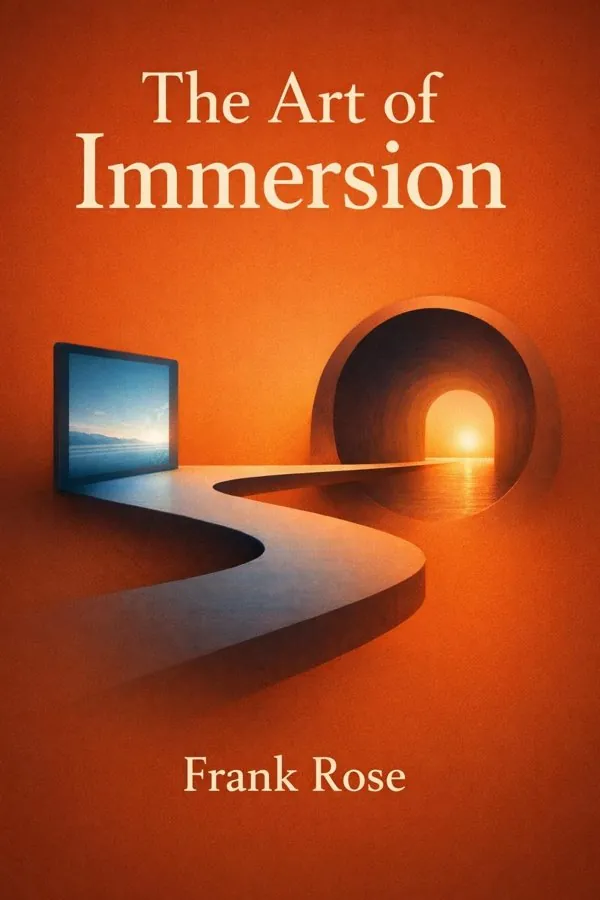
The Art of Immersion: How the Digital Generation Is Remaking Hollywood, Madison Avenue, and the Way We Tell Stories: Summary & Key Insights
by Frank Rose
 10 min8 chaptersAudio available
What Is The Art of Immersion: How the Digital Generation Is Remaking Hollywood, Madison Avenue, and the Way We Tell Stories About?
The Art of Immersion: How the Digital Generation Is Remaking Hollywood, Madison Avenue, and the Way We Tell Stories by Frank Rose is a digital_culture book spanning 8 pages. The Art of Immersion explores how digital technology and the internet have transformed storytelling across media industries. Frank Rose examines how audiences now participate in narratives through games, social media, and interactive experiences, reshaping the relationship between creators and consumers. The book analyzes examples from film, advertising, and online culture to show how immersion and participation redefine modern storytelling.
This FizzRead summary covers all 8 key chapters of The Art of Immersion: How the Digital Generation Is Remaking Hollywood, Madison Avenue, and the Way We Tell Stories in approximately 10 minutes, distilling the most important ideas, arguments, and takeaways from Frank Rose's work. Also available as an audio summary and Key Quotes Podcast.
The Art of Immersion: How the Digital Generation Is Remaking Hollywood, Madison Avenue, and the Way We Tell Stories
The Art of Immersion explores how digital technology and the internet have transformed storytelling across media industries. Frank Rose examines how audiences now participate in narratives through games, social media, and interactive experiences, reshaping the relationship between creators and consumers. The book analyzes examples from film, advertising, and online culture to show how immersion and participation redefine modern storytelling.
Who Should Read The Art of Immersion: How the Digital Generation Is Remaking Hollywood, Madison Avenue, and the Way We Tell Stories?
This book is perfect for anyone interested in digital_culture and looking to gain actionable insights in a short read. Whether you're a student, professional, or lifelong learner, the key ideas from The Art of Immersion: How the Digital Generation Is Remaking Hollywood, Madison Avenue, and the Way We Tell Stories by Frank Rose will help you think differently.
- ✓Readers who enjoy digital_culture and want practical takeaways
- ✓Professionals looking to apply new ideas to their work and life
- ✓Anyone who wants the core insights of The Art of Immersion: How the Digital Generation Is Remaking Hollywood, Madison Avenue, and the Way We Tell Stories in just 10 minutes
Want the full summary?
Get instant access to this book summary and 100K+ more with Fizz Moment.
Get Free SummaryAvailable on App Store • Free to download
Key Chapters
When we talk about immersion, we’re talking about the experience of losing oneself in a story. That experience is as old as the first fireside gatherings, where myths were shared aloud and listeners became part of a communal imagination. Oral storytelling was inherently interactive: the teller responded to the reactions of the listeners, and each performance was slightly different. There was intimacy and immediacy.
With the invention of print, that intimacy began to shift. Readers entered solitary worlds, guided only by the text and their imagination. Yet the emotional power of immersion persisted—novels could pull readers so deeply into fictional lives that those characters felt real. Then cinema revolutionized this again: sight, sound, and movement combined into a total sensory experience that pulled audiences into worlds unlike anything they had known. But for all its beauty, film locked the audience into the role of observer. The more perfect the illusion, the less the viewer could intervene.
Television democratized access to storytelling, bringing daily narratives into living rooms. But its structure—linear programming, commercial breaks, and standard formats—discouraged depth of participation. Audiences could love or hate what they saw, but they couldn’t change it. The model was fixed: producers delivered, consumers consumed.
By tracing this evolution, I wanted readers to see that immersion has always been both a technological and a psychological phenomenon. Every advance in media technology—from the printing press to film to radio and television—has deepened our involvement with stories. But what’s different now is that technology doesn’t just immerse us—it empowers us to respond, to contribute, even to co-create. The conditions for a new kind of immersion were in place long before the internet arrived; we were simply waiting for the tool that could give the audience a voice.
The internet introduced something radically new into storytelling: reciprocity. For the first time, stories could travel in multiple directions. A film, a book, or a brand campaign could spark a conversation that spread, grew, and mutated in the hands of the audience. Online forums appeared where fans dissected every plot twist, built elaborate backstories, and wrote their own versions of events. Communities that had once existed in isolation could suddenly organize around shared obsessions.
In this environment, fan fiction was not simply derivative—it became a laboratory for narrative experimentation. When thousands of fans write their own take on the same universe, they collectively explore its possibilities in ways the original creator never could. Message boards and online games blended storytelling with social interaction, making story worlds not just places to visit, but places to live. The culture of participation that emerged on the web made it impossible for creators to ignore audience input.
It’s important to understand that this new interactivity isn’t a rejection of the old forms. Rather, it builds upon them. The internet takes the communal energy of oral storytelling, merges it with the emotional richness of film, and multiplies it through connection. Storytelling becomes a living system—fluid, collaborative, networked.
+ 6 more chapters — available in the FizzRead app
All Chapters in The Art of Immersion: How the Digital Generation Is Remaking Hollywood, Madison Avenue, and the Way We Tell Stories
About the Author
Frank Rose is an American author and journalist specializing in media, technology, and the impact of digital culture. He has written for publications such as Wired and The New York Times, focusing on how technology transforms entertainment and communication.
Get This Summary in Your Preferred Format
Read or listen to the The Art of Immersion: How the Digital Generation Is Remaking Hollywood, Madison Avenue, and the Way We Tell Stories summary by Frank Rose anytime, anywhere. FizzRead offers multiple formats so you can learn on your terms — all free.
Available formats: App · Audio · PDF · EPUB — All included free with FizzRead
Download The Art of Immersion: How the Digital Generation Is Remaking Hollywood, Madison Avenue, and the Way We Tell Stories PDF and EPUB Summary
Key Quotes from The Art of Immersion: How the Digital Generation Is Remaking Hollywood, Madison Avenue, and the Way We Tell Stories
“When we talk about immersion, we’re talking about the experience of losing oneself in a story.”
“The internet introduced something radically new into storytelling: reciprocity.”
Frequently Asked Questions about The Art of Immersion: How the Digital Generation Is Remaking Hollywood, Madison Avenue, and the Way We Tell Stories
The Art of Immersion: How the Digital Generation Is Remaking Hollywood, Madison Avenue, and the Way We Tell Stories by Frank Rose is a digital_culture book that explores key ideas across 8 chapters. The Art of Immersion explores how digital technology and the internet have transformed storytelling across media industries. Frank Rose examines how audiences now participate in narratives through games, social media, and interactive experiences, reshaping the relationship between creators and consumers. The book analyzes examples from film, advertising, and online culture to show how immersion and participation redefine modern storytelling.
You Might Also Like
An Ugly Truth: Inside Facebook’s Battle for Domination
Sheera Frenkel, Cecilia Kang
10 min
Cyber Citizens
Ian Goodfellow
10 min
Digital Minimalism: Choosing a Focused Life in a Noisy World
Cal Newport
10 min
E‑Books & Beyond
Various Authors
10 min
The Future of Media
Various Authors
10 min
This Is Why We Can't Have Nice Things
Whitney Phillips
10 minBrowse by Category
Ready to read The Art of Immersion: How the Digital Generation Is Remaking Hollywood, Madison Avenue, and the Way We Tell Stories?
Get the full summary and 100K+ more books with Fizz Moment.