
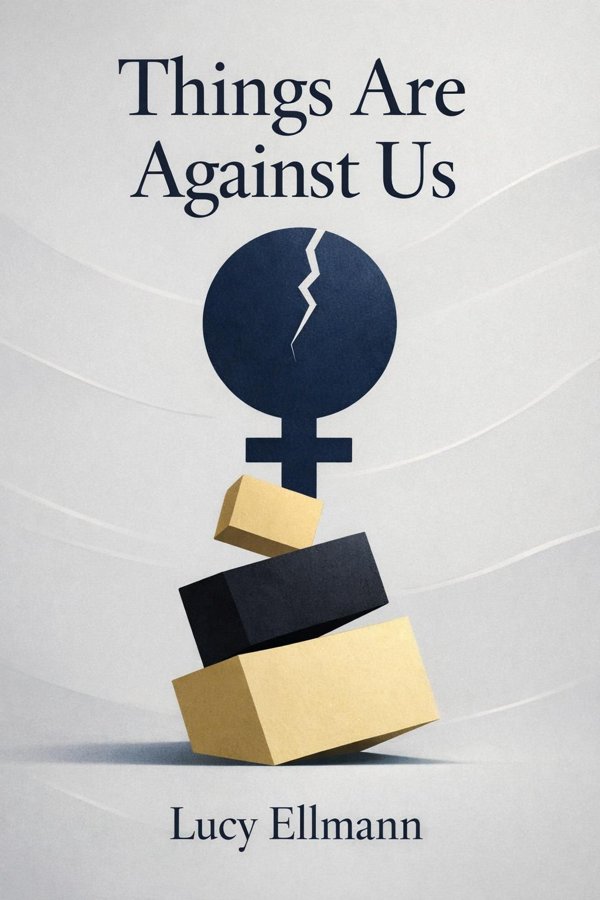
Things Are Against Us: Summary & Key Insights
by Lucy Ellmann
 10 min9 chaptersAudio available
Key Takeaways from Things Are Against Us
One of the book’s sharpest observations is that modern society does not merely encourage consumption; it trains people to build their identities around it.
Ellmann insists that patriarchy survives not only through dramatic acts of oppression but through countless small, normalized humiliations.
A major theme in Things Are Against Us is that domestic life is often romanticized precisely to conceal how much labor it requires.
Ellmann is skeptical of the cheerful story that more technology automatically means more freedom.
Another central idea in the collection is that politics often rewards spectacle, dominance, and self-interest rather than care, honesty, or long-term stewardship.
What Is Things Are Against Us About?
Things Are Against Us by Lucy Ellmann is a essays book spanning 7 pages. Things Are Against Us is a fierce, funny, and deeply unsettling collection of essays in which Lucy Ellmann turns her attention to the everyday cruelties and absurdities of modern life. Moving from consumer culture and domestic drudgery to misogyny, politics, technology, environmental collapse, and media hypocrisy, Ellmann writes with a voice that is equal parts satirical, furious, and painfully observant. Her essays do not simply diagnose what is wrong with contemporary society; they expose how injustice hides inside ordinary habits, respectable institutions, and supposedly harmless cultural norms. What makes this collection matter is its refusal to separate the personal from the political. Ellmann shows how large systems of power shape intimate experience: how women are diminished, how citizens are manipulated, how consumption replaces meaning, and how language itself can normalize harm. She is especially compelling because she combines literary intelligence with comic precision, making even bleak subjects feel vivid and readable. As an acclaimed novelist and essayist known for her feminist and satirical sensibility, Ellmann brings authority, originality, and moral urgency to every page. This is a book for readers who want criticism with bite, humor with purpose, and outrage sharpened into insight.
This FizzRead summary covers all 9 key chapters of Things Are Against Us in approximately 10 minutes, distilling the most important ideas, arguments, and takeaways from Lucy Ellmann's work. Also available as an audio summary and Key Quotes Podcast.
Things Are Against Us
Things Are Against Us is a fierce, funny, and deeply unsettling collection of essays in which Lucy Ellmann turns her attention to the everyday cruelties and absurdities of modern life. Moving from consumer culture and domestic drudgery to misogyny, politics, technology, environmental collapse, and media hypocrisy, Ellmann writes with a voice that is equal parts satirical, furious, and painfully observant. Her essays do not simply diagnose what is wrong with contemporary society; they expose how injustice hides inside ordinary habits, respectable institutions, and supposedly harmless cultural norms.
What makes this collection matter is its refusal to separate the personal from the political. Ellmann shows how large systems of power shape intimate experience: how women are diminished, how citizens are manipulated, how consumption replaces meaning, and how language itself can normalize harm. She is especially compelling because she combines literary intelligence with comic precision, making even bleak subjects feel vivid and readable. As an acclaimed novelist and essayist known for her feminist and satirical sensibility, Ellmann brings authority, originality, and moral urgency to every page. This is a book for readers who want criticism with bite, humor with purpose, and outrage sharpened into insight.
Who Should Read Things Are Against Us?
This book is perfect for anyone interested in essays and looking to gain actionable insights in a short read. Whether you're a student, professional, or lifelong learner, the key ideas from Things Are Against Us by Lucy Ellmann will help you think differently.
- ✓Readers who enjoy essays and want practical takeaways
- ✓Professionals looking to apply new ideas to their work and life
- ✓Anyone who wants the core insights of Things Are Against Us in just 10 minutes
Want the full summary?
Get instant access to this book summary and 100K+ more with Fizz Moment.
Get Free SummaryAvailable on App Store • Free to download
Key Chapters
One of the book’s sharpest observations is that modern society does not merely encourage consumption; it trains people to build their identities around it. In Ellmann’s view, capitalism works best when people stop seeing objects as useful tools and start seeing them as proof of value, success, and even virtue. We are taught that the right clothes, the right gadgets, the right food, and the right lifestyle purchases can make us complete. The result is not satisfaction but perpetual dissatisfaction, because markets thrive on making people feel lacking.
Ellmann’s critique goes beyond obvious luxury culture. She shows how consumerism invades ordinary life through self-improvement products, curated homes, branded morality, and the pressure to perform individuality through shopping. A person is no longer simply a person; they become a collection of purchases and preferences. This affects how people judge one another, how they imagine progress, and how they relate to the planet itself. Endless buying is framed as freedom, even when it creates debt, waste, anxiety, and environmental damage.
In practical terms, this idea invites readers to notice the emotional promises attached to goods. Ask what a purchase is really offering: comfort, status, belonging, distraction, or hope. Consider how often advertising sells not an item but a fantasy of a better self. A useful application is to pause before buying and ask whether the desire comes from need, habit, insecurity, or manipulation.
Actionable takeaway: Practice one week of conscious consumption by delaying nonessential purchases for 24 hours and writing down what feeling each item promises to solve.
Ellmann insists that patriarchy survives not only through dramatic acts of oppression but through countless small, normalized humiliations. Its power lies in its ability to disguise itself as tradition, common sense, humor, or biology. Women are interrupted, judged, sexualized, patronized, underpaid, ignored, overworked, and blamed so routinely that the pattern can seem invisible. Ellmann’s essays expose this invisibility by naming it directly and repeatedly.
Rather than treating sexism as an occasional deviation from fairness, she presents it as a structure woven into ordinary life. This includes media narratives that reduce women to bodies, cultural expectations that reward self-sacrifice, workplace habits that confuse male confidence with competence, and social conventions that make women manage everyone else’s comfort. The cumulative effect is exhausting. Small insults are not minor when they are relentless; they become a social atmosphere.
What makes Ellmann especially persuasive is her attention to tone. She captures the maddening blend of absurdity and injury in sexist interactions. A patronizing comment, a beauty standard, a political dismissal, or a domestic assumption may seem trivial in isolation, but together they form a system that limits freedom and distorts self-perception.
Readers can apply this insight by paying attention to patterns rather than isolated incidents. In meetings, homes, classrooms, and media, ask who is doing the emotional work, who gets interrupted, who is praised for authority, and who is expected to absorb discomfort politely. Naming a pattern is often the first step in challenging it.
Actionable takeaway: For one week, observe one environment closely and note where gendered assumptions shape behavior, then speak up about one pattern you would normally let pass.
A major theme in Things Are Against Us is that domestic life is often romanticized precisely to conceal how much labor it requires. Cleaning, cooking, planning, organizing, caregiving, remembering birthdays, managing moods, and anticipating needs are treated as natural expressions of love rather than as work. Ellmann exposes how this framing traps many women in cycles of invisible responsibility. What is called devotion or competence often masks exploitation.
The brilliance of this argument is that it challenges a deep cultural habit: the tendency to notice domestic failure more than domestic effort. If the house is messy, the work is visible. If everything runs smoothly, the work disappears. This means the person carrying the burden may receive little recognition while remaining essential to everyone else’s comfort. Ellmann shows that this is not a private inconvenience but a political issue, because unequal domestic labor shapes careers, finances, time, health, and creative possibility.
This idea has practical relevance in modern households of every kind. Many couples believe labor is shared until they count not just tasks but mental load: who keeps track of groceries, school forms, doctor appointments, emotional tensions, and social obligations? The answer often reveals imbalance. Treating domestic work seriously means discussing it explicitly instead of relying on vague assumptions about fairness.
A useful application is to make the invisible visible. List recurring household tasks, including planning and remembering, not just physical chores. Compare who handles what and how much uninterrupted leisure each person actually gets. Fairness is easier to pursue when responsibilities are concrete rather than sentimentalized.
Actionable takeaway: Create a full household labor inventory this week, including mental load, then redistribute at least one recurring responsibility more equitably.
Ellmann is skeptical of the cheerful story that more technology automatically means more freedom. She recognizes that digital tools can be useful, but she also warns that convenience often comes bundled with surveillance, distraction, dependency, and dehumanization. Devices promise efficiency while extracting attention; platforms offer connection while monetizing behavior; smart systems simplify life while collecting intimate data. What looks like progress may also be a subtle surrender of privacy and autonomy.
Her critique is especially timely because modern technologies rarely present themselves as coercive. They arrive as helpful assistants, entertainment hubs, productivity tools, or social necessities. Over time, however, they reshape habits and expectations. People become reachable at all times, measurable in new ways, and vulnerable to algorithmic influence. Public discourse gets flattened by speed, outrage, and performance. The self becomes increasingly exposed and increasingly managed.
Ellmann’s point is not nostalgic rejection of all innovation. It is a call to resist technological inevitability, the idea that because something can be built and sold, it must be accepted. Readers can apply this insight by asking not only what a technology does, but what it normalizes. Does it reduce friction in a healthy way, or does it erode boundaries, attention, and genuine reflection?
Practical examples include limiting notifications, questioning workplace monitoring software, being cautious with apps that demand excessive personal information, and creating device-free spaces for conversation and rest. A tool should serve human life, not define it.
Actionable takeaway: Audit your digital environment by turning off nonessential notifications and removing one app or platform that consumes attention without adding real value.
Another central idea in the collection is that politics often rewards spectacle, dominance, and self-interest rather than care, honesty, or long-term stewardship. Ellmann writes with particular anger about leaders and institutions that normalize corruption, cruelty, and environmental destruction while speaking the language of patriotism, stability, or necessity. She shows how public life can become morally upside down: those who do harm present themselves as realists, while those who ask for justice are dismissed as naive or extreme.
This argument matters because it links private frustration to systemic causes. Feelings of helplessness, cynicism, and exhaustion are not merely personal moods; they arise when people repeatedly witness power operating without accountability. Ellmann also highlights the relationship between political failure and ecological collapse. A culture obsessed with profit and short-term gain treats the natural world as expendable, even when the consequences are catastrophic.
The practical lesson is that political language should never be accepted at face value. Readers can examine who benefits from a policy, who bears the costs, and what realities are being hidden behind abstractions like growth, security, or efficiency. Environmental degradation, for example, is often discussed as an unfortunate side effect rather than as the predictable result of economic priorities.
Applied in everyday life, this means following issues beyond headlines, supporting institutions that still value accountability, and resisting the temptation to treat all political behavior as equally bad. Ellmann’s essays suggest that clarity is a form of civic resistance.
Actionable takeaway: Choose one political issue that affects daily life, trace who profits and who pays, and use that knowledge to guide one concrete civic action such as voting, donating, or contacting a representative.
Ellmann is especially incisive on the way media and popular culture construct the female body as a permanent problem to be managed. Women are told to be visible but not too visible, attractive but not vain, youthful but natural, thin but not obsessive, sexual but respectable. These contradictory demands are not accidental; they create endless insecurity, and insecurity is profitable. Industries built on beauty, fashion, wellness, entertainment, and advertising all benefit when women feel perpetually unfinished.
Her essays reveal how this pressure shapes consciousness. Women are encouraged to monitor themselves from the outside, as though constantly being judged by an invisible audience. This weakens freedom because energy that could go toward work, pleasure, thought, or dissent gets redirected toward self-surveillance. The body becomes a project, a liability, or a public performance rather than a lived reality.
This critique remains highly practical. Readers can look at the images and messages they consume and ask what kind of dissatisfaction they are designed to produce. Social media intensifies the problem by making comparison constant and personalized. Even supposedly empowering messages can become new forms of pressure if they insist that confidence itself must look marketable.
A useful application is to change the media environment rather than relying only on willpower. Unfollow accounts that trigger comparison, diversify what beauty and aging look like in your feed, and pay attention to language that treats appearance as moral achievement. Freedom grows when attention shifts from self-display to self-possession.
Actionable takeaway: Curate your media inputs for one week by removing three sources of appearance-based pressure and replacing them with voices that value intelligence, creativity, humor, or political insight.
One of Ellmann’s great strengths is her ability to be hilarious while writing about painful subjects. In this collection, humor is not a decorative flourish or a way of softening critique. It is a method of truth-telling. Satire allows Ellmann to reveal absurdity with precision, making hypocrisy easier to see. Laughter becomes a way of refusing intimidation and puncturing the authority of systems that depend on being treated as natural, serious, or inevitable.
This matters because anger is often policed, especially when expressed by women. Rage is dismissed as irrational, unattractive, or excessive. Ellmann refuses that dismissal, but she also transforms rage into artful argument. Her humor keeps the essays readable without diluting their force. It lets readers feel the madness of the world while also gaining distance from it. A sharp joke can do what a formal argument sometimes cannot: expose the ridiculousness of cruelty.
In practice, this idea suggests that critique need not always sound solemn to be important. People challenging unfairness can use wit to communicate clearly, survive discouragement, and build solidarity. In workplaces, classrooms, and conversations, humor can open space for honesty when direct confrontation feels impossible. The key is that the humor should punch up, not down. It should illuminate power, not excuse it.
Readers can also apply this lesson personally. When faced with bureaucratic nonsense, sexist clichés, or consumer absurdities, naming the ridiculous element can reduce shame and restore perspective. Humor does not replace action, but it can sustain it.
Actionable takeaway: The next time you encounter an unfair or absurd norm, try describing it in one brutally accurate, funny sentence; clarity often begins where fear breaks into laughter.
A subtler but vital idea running through the essays is that language is never neutral. The words societies choose can conceal violence, normalize exploitation, or make injustice sound reasonable. Ellmann pays close attention to euphemism, cliché, and official phrasing because they soften reality. Harm becomes policy. Surveillance becomes convenience. Sexism becomes banter. Ecological destruction becomes development. Once language blurs consequences, resistance becomes harder.
This insight is especially powerful because many people assume manipulation happens mainly through images or laws. Ellmann reminds us that it also happens through vocabulary. The framing of an issue determines what feels thinkable. If unpaid labor is called love, demands for fairness look cold. If consumer excess is called aspiration, restraint looks like failure. If outrage is called overreaction, silence looks mature.
The practical application is to listen for framing devices in media, politics, and everyday conversation. What assumptions are built into a phrase? Who gains from the softened version of events? Readers can also examine their own language. Do they minimize burnout by calling it busyness? Do they excuse inequality by calling it how things are? Better words do not solve structural problems alone, but they can make those problems visible.
This is useful in professional settings too. Clear naming improves accountability. Calling harassment harassment, not misunderstanding, changes the moral landscape. Calling overwork unsustainable, not dedication, opens room for boundaries. Precision is a form of resistance against systems that rely on vagueness.
Actionable takeaway: Pick one commonly used phrase in your environment that disguises a problem, and replace it with more accurate language in your next conversation or piece of writing.
Beneath the wit and fury of Things Are Against Us lies a deeper warning: one of the greatest dangers of modern life is numbness. When absurdity, cruelty, and overload become constant, people adapt by lowering expectations and deadening response. Ellmann resists this emotional surrender. Her essays are meant to irritate readers into consciousness, to restore the ability to notice what has become normalized. She suggests that resignation is politically useful to oppressive systems because exhausted people stop imagining alternatives.
This idea ties the whole collection together. Consumerism distracts, patriarchy wears people down, technology fragments attention, media manufactures insecurity, and politics encourages cynicism. In each case, the result can be passivity. Ellmann’s answer is not optimism in a sentimental sense but alertness. To remain morally awake is already a form of opposition.
Practically, this means creating conditions in which attention and conscience can function. People who are constantly overstimulated or demoralized struggle to act well. Resistance may therefore begin with habits that protect perception: reading deeply rather than skimming endlessly, having honest conversations, limiting manipulative media exposure, and refusing to laugh off what should disturb us.
This does not require grand heroism. It can look like sustained noticing, principled refusal, and small acts of solidarity. Ellmann’s essays encourage readers to trust their discomfort instead of suppressing it. If something feels degrading, exploitative, or absurd, that feeling may be evidence, not oversensitivity.
Actionable takeaway: Choose one area of life where you have grown numb, and reengage deliberately by learning more, talking honestly about it, or taking one small action that interrupts passive acceptance.
All Chapters in Things Are Against Us
About the Author
Lucy Ellmann is a British-American novelist and essayist celebrated for her originality, satire, and uncompromising feminist intelligence. Born in Illinois and raised in England, she is the daughter of distinguished literary critic Richard Ellmann and writer and feminist critic Mary Ellmann. Over the course of her career, she has developed a reputation for fiction and nonfiction that combine formal inventiveness with sharp social observation. Her work often explores gender inequality, consumer culture, family life, politics, and the strangeness of everyday existence. Ellmann’s prose is known for being funny, fierce, expansive, and emotionally exacting. In both her novels and essays, she brings an acute awareness of how power operates through ordinary language and habits. Things Are Against Us showcases her talent for turning outrage into incisive, memorable cultural criticism.
Get This Summary in Your Preferred Format
Read or listen to the Things Are Against Us summary by Lucy Ellmann anytime, anywhere. FizzRead offers multiple formats so you can learn on your terms — all free.
Available formats: App · Audio · PDF · EPUB — All included free with FizzRead
Download Things Are Against Us PDF and EPUB Summary
Key Quotes from Things Are Against Us
“One of the book’s sharpest observations is that modern society does not merely encourage consumption; it trains people to build their identities around it.”
“Ellmann insists that patriarchy survives not only through dramatic acts of oppression but through countless small, normalized humiliations.”
“A major theme in Things Are Against Us is that domestic life is often romanticized precisely to conceal how much labor it requires.”
“Ellmann is skeptical of the cheerful story that more technology automatically means more freedom.”
“Another central idea in the collection is that politics often rewards spectacle, dominance, and self-interest rather than care, honesty, or long-term stewardship.”
Frequently Asked Questions about Things Are Against Us
Things Are Against Us by Lucy Ellmann is a essays book that explores key ideas across 9 chapters. Things Are Against Us is a fierce, funny, and deeply unsettling collection of essays in which Lucy Ellmann turns her attention to the everyday cruelties and absurdities of modern life. Moving from consumer culture and domestic drudgery to misogyny, politics, technology, environmental collapse, and media hypocrisy, Ellmann writes with a voice that is equal parts satirical, furious, and painfully observant. Her essays do not simply diagnose what is wrong with contemporary society; they expose how injustice hides inside ordinary habits, respectable institutions, and supposedly harmless cultural norms. What makes this collection matter is its refusal to separate the personal from the political. Ellmann shows how large systems of power shape intimate experience: how women are diminished, how citizens are manipulated, how consumption replaces meaning, and how language itself can normalize harm. She is especially compelling because she combines literary intelligence with comic precision, making even bleak subjects feel vivid and readable. As an acclaimed novelist and essayist known for her feminist and satirical sensibility, Ellmann brings authority, originality, and moral urgency to every page. This is a book for readers who want criticism with bite, humor with purpose, and outrage sharpened into insight.
More by Lucy Ellmann

You Might Also Like
Browse by Category
Ready to read Things Are Against Us?
Get the full summary and 100K+ more books with Fizz Moment.