
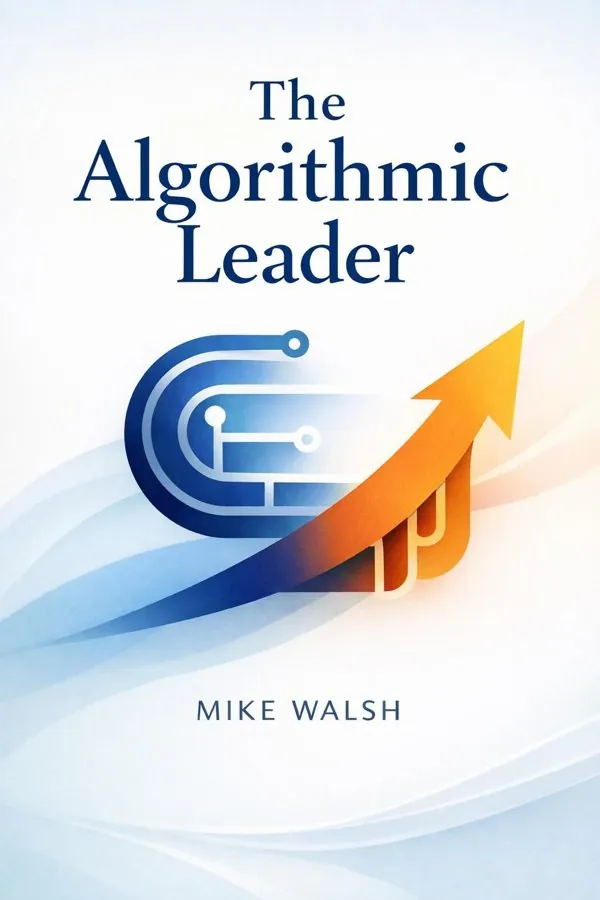
The Algorithmic Leader: How to Be Smart When Machines Are Smarter Than You: Summary & Key Insights
by Mike Walsh
 10 min10 chaptersAudio available
Key Takeaways from The Algorithmic Leader: How to Be Smart When Machines Are Smarter Than You
Leadership used to be celebrated as an art of judgment, instinct, and experience.
Algorithms often seem mysterious because people confuse complexity with magic.
The biggest barrier to digital transformation is rarely technology.
One of the clearest promises of the algorithmic age is better decision-making, but Walsh warns that data alone does not make an organization smarter.
Technology transformation fails when culture stays analog.
What Is The Algorithmic Leader: How to Be Smart When Machines Are Smarter Than You About?
The Algorithmic Leader: How to Be Smart When Machines Are Smarter Than You by Mike Walsh is a leadership book spanning 10 pages. The Algorithmic Leader is a sharp, forward-looking guide to what leadership must become in a world shaped by artificial intelligence, automation, and constant data flows. Mike Walsh’s central argument is both unsettling and energizing: the leaders who thrive in the future will not be the ones who protect old ways of working, but the ones who redesign their thinking, teams, and organizations around the logic of machines. This is not a book about learning to code. It is a book about learning to lead when algorithms increasingly outperform humans at prediction, optimization, and pattern recognition. Walsh shows that the real challenge is not technological adoption but cognitive transformation. Leaders must move beyond intuition-only management, question legacy hierarchies, and build cultures that are experimental, adaptive, and comfortable with uncertainty. Drawing on his work as a futurist and advisor to global companies, he translates abstract trends into practical leadership lessons. The result is a compelling roadmap for executives, entrepreneurs, and ambitious managers who want to remain relevant in an era when being smart is no longer enough. The new competitive advantage is learning how to think, decide, and organize algorithmically.
This FizzRead summary covers all 10 key chapters of The Algorithmic Leader: How to Be Smart When Machines Are Smarter Than You in approximately 10 minutes, distilling the most important ideas, arguments, and takeaways from Mike Walsh's work. Also available as an audio summary and Key Quotes Podcast.
The Algorithmic Leader: How to Be Smart When Machines Are Smarter Than You
The Algorithmic Leader is a sharp, forward-looking guide to what leadership must become in a world shaped by artificial intelligence, automation, and constant data flows. Mike Walsh’s central argument is both unsettling and energizing: the leaders who thrive in the future will not be the ones who protect old ways of working, but the ones who redesign their thinking, teams, and organizations around the logic of machines. This is not a book about learning to code. It is a book about learning to lead when algorithms increasingly outperform humans at prediction, optimization, and pattern recognition.
Walsh shows that the real challenge is not technological adoption but cognitive transformation. Leaders must move beyond intuition-only management, question legacy hierarchies, and build cultures that are experimental, adaptive, and comfortable with uncertainty. Drawing on his work as a futurist and advisor to global companies, he translates abstract trends into practical leadership lessons. The result is a compelling roadmap for executives, entrepreneurs, and ambitious managers who want to remain relevant in an era when being smart is no longer enough. The new competitive advantage is learning how to think, decide, and organize algorithmically.
Who Should Read The Algorithmic Leader: How to Be Smart When Machines Are Smarter Than You?
This book is perfect for anyone interested in leadership and looking to gain actionable insights in a short read. Whether you're a student, professional, or lifelong learner, the key ideas from The Algorithmic Leader: How to Be Smart When Machines Are Smarter Than You by Mike Walsh will help you think differently.
- ✓Readers who enjoy leadership and want practical takeaways
- ✓Professionals looking to apply new ideas to their work and life
- ✓Anyone who wants the core insights of The Algorithmic Leader: How to Be Smart When Machines Are Smarter Than You in just 10 minutes
Want the full summary?
Get instant access to this book summary and 100K+ more with Fizz Moment.
Get Free SummaryAvailable on App Store • Free to download
Key Chapters
Leadership used to be celebrated as an art of judgment, instinct, and experience. But Walsh argues that in an age of machine intelligence, intuition alone is no longer a reliable competitive advantage. The challenge for modern leaders is not to abandon human judgment, but to recognize that many decisions once guided by expertise can now be informed, improved, or even outperformed by data-driven systems.
Algorithmic thinking means approaching problems as systems that can be broken into patterns, inputs, rules, and outcomes. Instead of asking, “What do I feel is right?” leaders increasingly need to ask, “What does the data suggest, what assumptions are we making, and how can we test them?” This represents a major shift in mindset. It moves leadership away from heroic certainty and toward structured curiosity.
Walsh does not claim that machines should replace leaders. Rather, he shows that leaders must become comfortable working with machine logic. For example, a retail executive may once have relied on instinct to choose store inventory. Today, an algorithm can forecast demand with far greater precision. The leader’s value lies in framing the right questions, interpreting trade-offs, and shaping the broader strategy.
This shift matters because markets now change too quickly for static experience to remain sufficient. What worked for ten years may fail in ten weeks. Leaders who cling to instinct as authority risk becoming slower, more biased, and less adaptable than the systems around them.
Actionable takeaway: Audit one major decision area in your organization and ask where intuition is being overused. Then identify how data, experimentation, or predictive models could improve the quality and speed of decision-making.
Algorithms often seem mysterious because people confuse complexity with magic. Walsh strips away that illusion. At their core, algorithms are simply sets of instructions for processing information and making choices. Leaders do not need to become data scientists, but they do need to understand that algorithms are operational tools for turning inputs into decisions at scale.
This matters because fear of algorithms often comes from misunderstanding them. When leaders treat AI as a black box, they either trust it blindly or reject it emotionally. Both responses are dangerous. Effective leaders learn enough about algorithmic systems to ask useful questions: What data is the model trained on? What objective is it optimizing for? Where could bias enter the system? What human oversight is still required?
Consider hiring software that screens job candidates. If a leader only sees efficiency gains, they may miss hidden discrimination in the data. If they reject the software outright, they may lose real advantages in consistency and speed. A smarter approach is informed oversight: understand the logic, test the outcomes, and redesign the process where needed.
Walsh’s broader point is that algorithms are not just technical assets; they are management systems. They shape pricing, customer service, logistics, workforce scheduling, risk evaluation, and more. That means leaders must think of them as strategic infrastructure, not IT side projects.
Actionable takeaway: For every algorithm or AI tool your organization uses, require a simple leadership brief that explains its purpose, inputs, success metric, risks, and limits. Better questions create better oversight.
The biggest barrier to digital transformation is rarely technology. It is the mental model of the people in charge. Walsh argues that algorithmic leaders cultivate a mindset built on experimentation, adaptability, and systems thinking rather than status, certainty, and control. In other words, they stop managing the organization as a rigid machine and start leading it as a dynamic learning system.
An algorithmic mindset begins with intellectual humility. Leaders must accept that they do not always know the answer, that the environment changes constantly, and that assumptions should be tested rather than defended. This creates a shift from planning to iteration. Instead of designing one grand strategy and executing it for years, leaders run smaller experiments, gather feedback, and refine direction continuously.
This mindset also changes how failure is interpreted. In traditional organizations, failure is often punished because it threatens authority and predictability. In algorithmic organizations, failure becomes data. A failed product launch, marketing campaign, or process redesign is not simply a mistake; it is a signal that helps improve the next version.
Walsh suggests that the future belongs to leaders who are less attached to being right and more committed to learning fast. A bank testing a new digital onboarding flow, for example, should not debate endlessly in conference rooms. It should launch a pilot, measure friction points, and improve the system based on actual behavior.
Actionable takeaway: Replace at least one long annual planning cycle with a test-and-learn process that uses shorter experiments, clearer metrics, and rapid feedback loops. Build a culture where learning speed matters as much as execution discipline.
One of the clearest promises of the algorithmic age is better decision-making, but Walsh warns that data alone does not make an organization smarter. Many companies collect enormous volumes of information while still making poor decisions because they confuse access to data with the ability to use it well. The true advantage comes from combining high-quality data, good models, and leaders who know how to act on evidence.
Data-driven leadership requires discipline. Leaders must define what problem they are trying to solve, which metrics matter, and how success will be measured. Otherwise, dashboards become noise. A customer service leader, for example, may track call time, satisfaction scores, and resolution rates, but unless those metrics are tied to a meaningful operating goal, they only create the illusion of control.
Walsh emphasizes that data should challenge assumptions, not decorate presentations. Leaders need to create environments where evidence can override seniority. If customer behavior data shows that a cherished product feature is rarely used, the right move may be to remove it, even if executives personally like it. This requires cultural courage as much as analytical capability.
At the same time, data must be handled responsibly. Metrics can distort behavior if they are too narrow. A sales team measured only on short-term revenue may ignore customer retention. Good algorithmic leadership means selecting metrics that reflect real value and watching for unintended consequences.
Actionable takeaway: Identify the three most important decisions your team makes repeatedly, then redesign each one around better data inputs, clearer metrics, and an explicit review of what the evidence is saying versus what people assume.
Technology transformation fails when culture stays analog. Walsh argues that leaders often invest heavily in new platforms, automation, and analytics while leaving the underlying organization unchanged. The result is predictable: advanced tools layered onto outdated behaviors. To thrive in the algorithmic era, companies must redesign culture itself.
A digital-ready culture values openness, speed, and curiosity. It rewards people for questioning assumptions, sharing information, and collaborating across silos. It reduces the distance between idea and execution. In traditional firms, authority often flows from title and tenure. In more adaptive organizations, influence increasingly comes from insight, initiative, and the ability to learn quickly.
This means leaders must role-model new behaviors. If executives demand innovation but punish failed experiments, employees will protect themselves by staying cautious. If leaders say they value data but override evidence to defend pet projects, trust in transformation collapses. Culture changes when people see what is actually rewarded.
Walsh also points out that digital culture is not just about younger workers or trendy office design. It is about operational norms: how meetings are run, how decisions are made, how information moves, how teams are structured, and how quickly feedback is incorporated. A company that still requires six approvals for minor changes cannot call itself agile, no matter how many AI tools it buys.
Actionable takeaway: Choose one cultural bottleneck such as slow approvals, fear of failure, or information silos, and redesign it in a visible way. Culture becomes real when daily behaviors change, not when values are printed on posters.
The future of leadership is not human versus machine. It is human with machine. Walsh rejects the simplistic fear that AI will make leaders obsolete. Instead, he argues that the most effective organizations will be those that combine machine precision with human imagination, empathy, and ethical judgment.
Machines excel at pattern recognition, optimization, and processing vast amounts of data quickly. Humans remain stronger at context, meaning, storytelling, trust-building, and navigating ambiguity where goals are not purely numerical. Great leaders understand these complementary strengths and redesign work accordingly.
For example, in healthcare, an AI system may detect anomalies in scans more accurately than a clinician. But the doctor still plays an essential role in discussing options, understanding patient values, and making treatment decisions in context. In marketing, algorithms may identify the best audience segments, but human teams still craft the narrative and brand experience. Leadership now involves orchestrating these blended systems.
This requires a shift in job design. Leaders must stop thinking in terms of static roles and begin thinking in terms of tasks. Which tasks should be automated? Which should be augmented? Which require distinctly human capabilities? The wrong approach is protecting jobs as they are. The better approach is redesigning work so people can focus on higher-value contribution.
Actionable takeaway: Break one team’s workflow into individual tasks and classify each as automate, augment, or human-led. Use that map to redesign roles around collaboration with technology rather than resistance to it.
The more decisions organizations delegate to algorithms, the more important leadership ethics becomes. Walsh makes it clear that technology is never neutral in practice. Every algorithm reflects choices about what to measure, what to optimize, whose interests matter, and what risks are acceptable. That means leaders cannot outsource responsibility to machines.
Ethical leadership in the algorithmic age starts with recognizing that speed and efficiency are not the only values that matter. A loan approval system may improve profitability while unfairly disadvantaging certain communities. A productivity algorithm may optimize schedules while exhausting employees. A recommendation engine may boost engagement while spreading harmful content. If leaders judge success only by output, they can create serious human damage.
Walsh’s point is that accountability must remain human, even when decisions are machine-assisted. Leaders should build governance around data quality, transparency, bias testing, and review processes. They must also ask harder strategic questions: Should we build this system? What behaviors will it encourage? What are the second-order consequences?
Ethics is not a compliance department afterthought. It is a leadership capability. The strongest organizations will not simply avoid scandal; they will earn trust by proving they can use powerful technologies responsibly. In a world where customers, employees, and regulators are increasingly skeptical, trust itself becomes a competitive asset.
Actionable takeaway: Create an ethics review checklist for any high-impact algorithmic system, including fairness, transparency, oversight, and potential unintended consequences. Make responsible design part of the launch process, not a reaction after harm appears.
Many companies say they want agility, but their structures are built for stability, hierarchy, and control. Walsh argues that this mismatch is one of the central leadership failures of the digital era. If markets are changing faster, customer expectations are shifting continuously, and AI is accelerating competitive cycles, then organizations must be designed to adapt in real time.
Agility is not just about moving faster. It is about increasing the capacity to sense change, respond intelligently, and reconfigure resources without excessive friction. That means flatter structures, empowered teams, faster information flow, and shorter decision cycles. It also means reducing dependence on top-down approval for every important move.
Walsh suggests that leaders should think less like commanders and more like designers of adaptive systems. A traditional leader seeks to direct action from the center. An algorithmic leader creates conditions where teams can act intelligently at the edges. For example, a global company facing rapid shifts in local customer behavior may benefit more from distributed decision-making supported by shared data than from centralized executive control.
Agility also depends on modularity. Processes, teams, and technology should be built in ways that allow change without requiring total reinvention. Organizations that are too tightly coupled become fragile; when one part breaks, everything slows down.
Actionable takeaway: Identify one area where decisions are bottlenecked at senior levels and push authority closer to the customer or front line, supported by clearer data and guardrails. Agility grows when decision rights match real-time information.
Work is no longer defined primarily by jobs, offices, and linear careers. Walsh describes a future in which tasks are increasingly automated, teams are more fluid, and value shifts toward creativity, adaptability, and learning. The leaders who succeed will be those who stop defending yesterday’s workforce model and start preparing people for continual reinvention.
This future creates both opportunity and anxiety. Employees may worry about displacement as AI takes over routine analysis, reporting, scheduling, and administrative work. Walsh does not dismiss that fear, but he argues that leaders have a responsibility to move beyond vague optimism. They must actively redesign roles, invest in reskilling, and help people develop capabilities machines cannot easily replicate.
Those capabilities include judgment under uncertainty, cross-functional problem solving, emotional intelligence, communication, design thinking, and the ability to learn new systems quickly. In practice, this means organizations should hire less for static credentials and more for adaptability. They should also create more internal mobility so workers can transition into emerging roles rather than being trapped in declining ones.
The future of work also changes leadership expectations. Managers can no longer simply supervise output. They must become coaches, translators, and architects of learning environments. Their role is to help people work effectively with technology while finding meaning and growth in the process.
Actionable takeaway: Review your team’s roles and ask which skills will matter more over the next three years because of automation. Then build a concrete reskilling plan focused on adaptability, digital fluency, and uniquely human strengths.
Walsh’s ultimate message is that algorithmic leadership is not a technical upgrade. It is a personal transformation. The leaders best equipped for the future are not necessarily the most experienced in traditional terms. They are the ones most willing to rethink how they see the world, how they make decisions, and how they define authority.
Becoming an algorithmic leader means letting go of the identity of the all-knowing executive. In a machine-smart world, leaders cannot compete with AI on raw processing power. Their value comes from asking better questions, shaping better systems, setting ethical direction, and cultivating organizations that can learn faster than the environment changes.
This demands courage. It is uncomfortable to lead in ways that are more experimental, less certain, and more transparent about what you do not know. Yet that discomfort is exactly where relevance now lives. Leaders who protect their status through certainty may appear strong in the short term, but they often build brittle organizations. Leaders who embrace uncertainty as part of reality build resilience.
Walsh invites leaders to become more curious, more adaptive, and more ambitious in how they redesign their institutions. The point is not simply to survive technological disruption, but to use this moment to build smarter, fairer, more responsive organizations.
Actionable takeaway: Write your own algorithmic leadership plan. List three beliefs about leadership you need to unlearn, three capabilities you need to strengthen, and one concrete organizational experiment you will launch in the next 30 days.
All Chapters in The Algorithmic Leader: How to Be Smart When Machines Are Smarter Than You
About the Author
Mike Walsh is a futurist, business advisor, author, and keynote speaker focused on the intersection of technology, leadership, and the future of work. He is the founder and CEO of Tomorrow, a global consultancy that helps organizations adapt to digital disruption and prepare for emerging trends. Walsh is widely known for translating complex shifts in artificial intelligence, automation, and consumer behavior into practical leadership insights. In addition to The Algorithmic Leader, he has written books including Futuretainment and The Dictionary of Dangerous Ideas. His work draws on global research, executive advising, and firsthand exposure to how innovative companies are rethinking strategy and culture. Walsh’s perspective is especially valued by leaders seeking to navigate uncertainty with greater adaptability and imagination.
Get This Summary in Your Preferred Format
Read or listen to the The Algorithmic Leader: How to Be Smart When Machines Are Smarter Than You summary by Mike Walsh anytime, anywhere. FizzRead offers multiple formats so you can learn on your terms — all free.
Available formats: App · Audio · PDF · EPUB — All included free with FizzRead
Download The Algorithmic Leader: How to Be Smart When Machines Are Smarter Than You PDF and EPUB Summary
Key Quotes from The Algorithmic Leader: How to Be Smart When Machines Are Smarter Than You
“Leadership used to be celebrated as an art of judgment, instinct, and experience.”
“Algorithms often seem mysterious because people confuse complexity with magic.”
“The biggest barrier to digital transformation is rarely technology.”
“One of the clearest promises of the algorithmic age is better decision-making, but Walsh warns that data alone does not make an organization smarter.”
“Technology transformation fails when culture stays analog.”
Frequently Asked Questions about The Algorithmic Leader: How to Be Smart When Machines Are Smarter Than You
The Algorithmic Leader: How to Be Smart When Machines Are Smarter Than You by Mike Walsh is a leadership book that explores key ideas across 10 chapters. The Algorithmic Leader is a sharp, forward-looking guide to what leadership must become in a world shaped by artificial intelligence, automation, and constant data flows. Mike Walsh’s central argument is both unsettling and energizing: the leaders who thrive in the future will not be the ones who protect old ways of working, but the ones who redesign their thinking, teams, and organizations around the logic of machines. This is not a book about learning to code. It is a book about learning to lead when algorithms increasingly outperform humans at prediction, optimization, and pattern recognition. Walsh shows that the real challenge is not technological adoption but cognitive transformation. Leaders must move beyond intuition-only management, question legacy hierarchies, and build cultures that are experimental, adaptive, and comfortable with uncertainty. Drawing on his work as a futurist and advisor to global companies, he translates abstract trends into practical leadership lessons. The result is a compelling roadmap for executives, entrepreneurs, and ambitious managers who want to remain relevant in an era when being smart is no longer enough. The new competitive advantage is learning how to think, decide, and organize algorithmically.
You Might Also Like

Extreme Ownership
Jocko Willink
10 min
Dare to Lead
Brene Brown
10 min
Leaders Eat Last
Simon Sinek
10 min
The 21 Irrefutable Laws of Leadership
John Maxwell
10 min
Start With Why
Simon Sinek
10 min
How to Lead When You're Not in Charge
Clay Scroggins
10 minBrowse by Category
Ready to read The Algorithmic Leader: How to Be Smart When Machines Are Smarter Than You?
Get the full summary and 100K+ more books with Fizz Moment.