
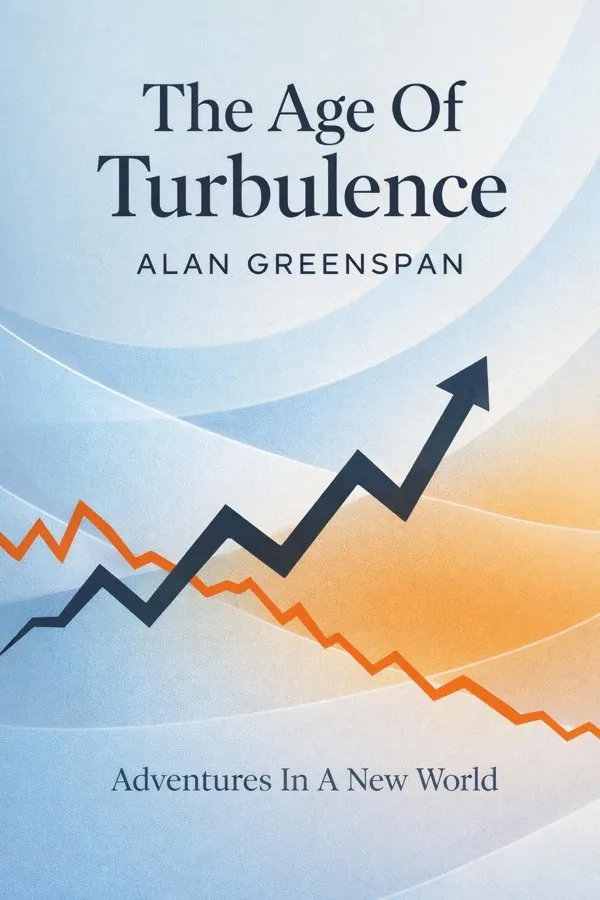
The Age Of Turbulence: Adventures In A New World: Summary & Key Insights
 10 min10 chaptersAudio available
Key Takeaways from The Age Of Turbulence: Adventures In A New World
Economic thinking often begins not with theory, but with curiosity about why some lives feel secure while others are exposed to sudden hardship.
Policies may be made in Washington, but economies are lived in boardrooms, factories, payroll systems, and customer demand.
A central bank does not simply move interest rates; it manages confidence in a system built on promises about the future.
Globalization is often described as a wave of trade and investment, but Greenspan presents it more fundamentally as a restructuring of competitive pressure.
New technologies do more than create new products; they alter the speed, structure, and expectations of the entire economy.
What Is The Age Of Turbulence: Adventures In A New World About?
The Age Of Turbulence: Adventures In A New World by Alan Greenspan is a economics book spanning 8 pages. The Age Of Turbulence: Adventures In A New World is part memoir, part economic history, and part strategic reflection on how modern capitalism actually works under pressure. In this sweeping account, Alan Greenspan traces his journey from a numbers-obsessed child in New York to one of the most powerful central bankers in the world, while also explaining the deeper forces reshaping economies: globalization, technological change, market psychology, politics, and financial risk. The book is not just a recollection of events from inside the Federal Reserve. It is Greenspan’s attempt to make sense of a world where prosperity and instability often grow together. What makes the book matter is its rare vantage point. Greenspan chaired the U.S. Federal Reserve from 1987 to 2006, a period that included the 1987 stock market crash, the Asian financial crisis, the dot-com boom, and the aftermath of 9/11. Few people stood closer to the machinery of economic power. Whether or not readers agree with all his conclusions, his observations are invaluable. This book offers insight into how policymakers think, how markets react, and why uncertainty—not stability—is often the normal condition of modern economic life.
This FizzRead summary covers all 10 key chapters of The Age Of Turbulence: Adventures In A New World in approximately 10 minutes, distilling the most important ideas, arguments, and takeaways from Alan Greenspan's work. Also available as an audio summary and Key Quotes Podcast.
The Age Of Turbulence: Adventures In A New World
The Age Of Turbulence: Adventures In A New World is part memoir, part economic history, and part strategic reflection on how modern capitalism actually works under pressure. In this sweeping account, Alan Greenspan traces his journey from a numbers-obsessed child in New York to one of the most powerful central bankers in the world, while also explaining the deeper forces reshaping economies: globalization, technological change, market psychology, politics, and financial risk. The book is not just a recollection of events from inside the Federal Reserve. It is Greenspan’s attempt to make sense of a world where prosperity and instability often grow together.
What makes the book matter is its rare vantage point. Greenspan chaired the U.S. Federal Reserve from 1987 to 2006, a period that included the 1987 stock market crash, the Asian financial crisis, the dot-com boom, and the aftermath of 9/11. Few people stood closer to the machinery of economic power. Whether or not readers agree with all his conclusions, his observations are invaluable. This book offers insight into how policymakers think, how markets react, and why uncertainty—not stability—is often the normal condition of modern economic life.
Who Should Read The Age Of Turbulence: Adventures In A New World?
This book is perfect for anyone interested in economics and looking to gain actionable insights in a short read. Whether you're a student, professional, or lifelong learner, the key ideas from The Age Of Turbulence: Adventures In A New World by Alan Greenspan will help you think differently.
- ✓Readers who enjoy economics and want practical takeaways
- ✓Professionals looking to apply new ideas to their work and life
- ✓Anyone who wants the core insights of The Age Of Turbulence: Adventures In A New World in just 10 minutes
Want the full summary?
Get instant access to this book summary and 100K+ more with Fizz Moment.
Get Free SummaryAvailable on App Store • Free to download
Key Chapters
Economic thinking often begins not with theory, but with curiosity about why some lives feel secure while others are exposed to sudden hardship. Greenspan’s early life in Washington Heights during the Great Depression shaped that curiosity. Growing up in New York City, he encountered uncertainty not as an abstraction but as a social reality. The instability around him fostered a lifelong interest in patterns, numbers, and the hidden mechanisms behind booms and busts. He was drawn to statistics, markets, and eventually economics because they promised a way to decode the apparent chaos of everyday life.
An unusual aspect of his development was the combination of quantitative reasoning and musical training. Before becoming a policymaker, Greenspan studied clarinet and saxophone and performed professionally. That background mattered more than it may seem. Music trains timing, pattern recognition, discipline, and sensitivity to subtle shifts—all skills that later became valuable in economic forecasting and policy judgment. His education then pushed him toward formal economics, but his mindset was already rooted in observation: look for signals, test assumptions, and remain alert to changes beneath the surface.
This idea matters because it challenges the stereotype that economists are produced only in classrooms. Many of the best strategic thinkers begin by noticing contradictions in the real world. For a business leader, investor, or student, Greenspan’s early path suggests that analytical ability grows when broad interests are connected rather than separated. Reading data, listening carefully, and staying curious are mutually reinforcing habits.
Actionable takeaway: Build your economic judgment the way Greenspan built his—by combining hard data with broad observation. Track a few real-world indicators regularly, such as inflation, interest rates, and employment, and ask what they reveal about the world beneath the headlines.
Policies may be made in Washington, but economies are lived in boardrooms, factories, payroll systems, and customer demand. Before entering high public office, Greenspan spent years in private consulting at Townsend-Greenspan & Co. That experience grounded his economics in operational reality. Instead of discussing markets in general terms, he had to advise companies facing actual constraints: wage pressures, commodity costs, changing regulations, inventory problems, and shifting consumer behavior. Consulting forced him to translate data into decisions.
This period helped shape one of the book’s recurring themes: economic truth is rarely visible from one level alone. Aggregate indicators like GDP, inflation, or unemployment are important, but they can hide turning points visible only at the firm level. A manufacturer postponing capital expenditure, a retailer noticing demand softening, or an executive struggling to hire skilled workers may reveal more than a polished macroeconomic report. Greenspan learned to respect these bottom-up signals, and that habit later informed his central banking style.
The lesson extends beyond economics. In any complex system, leaders make better decisions when they move between macro trends and micro evidence. A CEO should not rely only on quarterly summaries. A policymaker should not trust national statistics without understanding local effects. Even an individual planning a career can use this logic by connecting broad industry trends with firsthand market information.
A practical example is inflation analysis. It is one thing to see a rise in the consumer price index; it is another to hear from logistics firms, builders, and employers that cost pressures are spreading across supply chains. The first is a signal. The second is confirmation.
Actionable takeaway: When making decisions, pair top-down data with bottom-up evidence. Don’t ask only, “What do the numbers say?” Ask, “What are people on the ground already experiencing that the numbers may not fully show yet?”
A central bank does not simply move interest rates; it manages confidence in a system built on promises about the future. Greenspan’s years as chairman of the Federal Reserve reveal how much monetary policy depends on credibility, communication, and timely judgment. During crises, the Fed’s task is not merely technical. It must convince markets that liquidity will be available, panic will not be allowed to spiral, and the financial system remains functional.
Greenspan took office shortly before the 1987 stock market crash, and the response became a defining example of this principle. The Fed signaled its readiness to support the system, helping restore calm before fear became institutional collapse. Similar patterns appeared in later disruptions, including the savings and loan troubles, the Asian financial crisis, the Russian default, and stress around Long-Term Capital Management. In each case, the challenge was less about predicting every event and more about preventing self-reinforcing panic.
The broader concept is that modern economies are deeply dependent on trust. Banks lend because they believe borrowers will repay. Investors buy assets because they believe markets will function tomorrow. Consumers spend because they believe jobs and incomes are reasonably secure. When confidence breaks, normal behavior changes quickly.
This has practical applications for leaders in any domain. Teams, organizations, and institutions all rely on confidence. When uncertainty rises, silence can worsen the damage. Clear communication, visible readiness, and measured action often matter as much as the underlying mechanics.
Greenspan’s approach also highlights the limits of precision. Policymakers rarely act with perfect information. They act under uncertainty, with incomplete data and high stakes. Sound judgment means responding early enough to stabilize the system without overreacting.
Actionable takeaway: In times of stress, focus first on preserving confidence. Communicate clearly, show capacity to act, and address the risk of panic before you try to optimize every technical detail.
Globalization is often described as a wave of trade and investment, but Greenspan presents it more fundamentally as a restructuring of competitive pressure. As capital, goods, technology, and ideas move more freely across borders, companies and workers face a world in which local protection becomes harder to sustain. The rewards can be enormous: lower costs, larger markets, faster innovation, and rising standards of living. But the adjustment can also be painful, especially for industries and communities built around older economic arrangements.
Greenspan argues that globalization helped restrain inflation and raise productivity by increasing competition. Firms could source inputs globally, shift production more efficiently, and adopt best practices faster. Consumers benefited from cheaper products. Investors gained access to wider opportunity. Yet these gains were unevenly distributed. Workers without adaptable skills were more vulnerable to outsourcing and technological displacement. National politics often lagged behind the speed of these changes.
This dual reality is one of the book’s most important contributions. Globalization is neither a simple blessing nor a pure threat. It is a force multiplier. Economies with strong institutions, flexible labor markets, investment in education, and openness to change tend to benefit most. Those that resist adaptation often experience stagnation or social backlash.
A practical example is how businesses respond to international competition. Some fail by defending old cost structures. Others survive by moving up the value chain, improving logistics, investing in design, or specializing in areas where quality matters more than low wages. Individuals face a similar choice: compete on tasks that can be replicated cheaply, or develop skills that are harder to replace.
Actionable takeaway: Treat globalization as a reality to navigate, not a trend to wish away. Build flexibility—through skills, savings, innovation, and strategic adaptability—so external change becomes an advantage rather than a threat.
New technologies do more than create new products; they alter the speed, structure, and expectations of the entire economy. Greenspan was one of the prominent policymakers trying to interpret the productivity surge associated with information technology in the 1990s. He recognized earlier than many that computers, software, telecommunications, and improved business systems were not temporary novelties. They were driving genuine gains in output, logistics, inventory control, and managerial efficiency.
This mattered because productivity changes affect core economic judgments. If productivity rises faster, businesses can grow without creating the same inflation pressures. Wages can increase more sustainably. Interest rate policy may need to be calibrated differently. Greenspan’s interpretation of the “new economy” helped explain why the United States could expand longer than many traditional models predicted.
But the book also underscores a second lesson: real technological progress can coexist with speculative excess. The dot-com era included genuine transformation and irrational exuberance at the same time. Investors correctly sensed that the internet would change business, but many wildly overestimated which firms would win and how quickly profits would follow. This is a recurring pattern in economic history. Railroads, electricity, automobiles, and digital platforms all produced both lasting progress and bubbles.
For readers today, the implication is clear. When a technology is transformative, the strategic question is not whether it matters, but how to distinguish durable value from collective excitement. Organizations should invest in productivity-enhancing tools, but remain disciplined about valuation, timelines, and execution. Individuals should learn the new tools without assuming every market story about them is true.
Actionable takeaway: Embrace technological change for its productivity potential, but separate adoption from hype. Ask two questions consistently: “Does this innovation solve a real problem?” and “Are expectations racing far ahead of sustainable economics?”
Markets do not operate in a political vacuum. Greenspan’s reflections on the years after 9/11 show how deeply economic performance depends on geopolitical stability, national security, and public confidence. The attacks were not only a human catastrophe; they were also a shock to a highly interconnected economic system. Transportation, finance, business continuity, consumer sentiment, and global coordination were all suddenly under pressure.
In the aftermath, central banking and economic policy had to address more than inflation or employment. Policymakers had to ensure that payment systems worked, liquidity remained available, and the wider economy did not seize up. This was a vivid reminder that institutions supporting commerce are fragile when national trauma disrupts ordinary assumptions. Economic policy became inseparable from crisis management.
Greenspan extends this insight into broader reflections on oil, the Middle East, and the strategic implications of resource dependence. He argues that energy markets can shape foreign policy, domestic growth, and inflation risk in ways many people underestimate. Economies may appear market-driven, but key inputs such as energy carry political and strategic consequences that spill into every sector.
For modern readers, this chapter has ongoing relevance. Supply chain disruptions, wars, sanctions, cyberattacks, and security threats all show that economics cannot be understood in purely financial terms. A company expanding internationally must assess political risk. An investor studying commodities must understand diplomacy and conflict. Governments cannot separate economic resilience from national preparedness.
Actionable takeaway: Expand your economic lens to include geopolitical risk. Whenever you evaluate an industry, investment, or policy, ask not only “Is it efficient?” but also “How exposed is it to conflict, disruption, or strategic dependency?”
Greenspan is a strong defender of markets, but his defense is more nuanced than a slogan. One of his recurring arguments is that capitalism remains the most effective system for generating innovation, allocating resources, and raising living standards. Prices communicate information, competition disciplines inefficiency, and decentralized decision-making allows societies to adapt faster than rigid planning can. Yet markets do not function well in the absence of trust, law, and institutional discipline.
This is where Greenspan’s reflections on human nature become especially important. People are not perfectly rational calculators. They are moved by fear, greed, ambition, self-interest, imitation, and ideology. Market systems harness some of these motives productively, but they also remain vulnerable to deception, short-termism, and excess. Rules matter not because they replace markets, but because they make market exchange reliable. Property rights, contract enforcement, accounting standards, and credible institutions are not obstacles to capitalism; they are preconditions for it.
The practical implication is that good policy should neither suffocate enterprise nor assume virtue where incentives encourage abuse. Corporate governance, financial disclosure, and measured regulation are necessary because prosperity depends on confidence in the fairness and transparency of the system. At the same time, overregulation can reduce experimentation, investment, and responsiveness.
This balance is useful for any reader trying to think beyond ideological extremes. The question is rarely “market or government?” The better question is “what framework allows markets to produce the most value while limiting destructive behavior?” That perspective is more realistic and more durable.
Actionable takeaway: Support systems that combine freedom with accountability. In business and personal finance, create incentives for performance, but also install clear checks, transparency, and consequences that keep trust intact.
Economic history does not stand still, and Greenspan pays close attention to how emerging powers—especially China and India—were reshaping the world economy. Their rise signaled more than larger export volumes or growing middle classes. It represented a shift in the distribution of labor, capital, influence, and strategic leverage. Countries once seen mainly as peripheral producers were becoming central actors in trade, manufacturing, finance, and geopolitics.
Greenspan sees this transformation as one of the defining realities of the new world. Large populations entering global markets changed wage dynamics, supply chains, resource demand, and competitive intensity. For advanced economies, this brought both opportunity and disruption. Firms gained access to new consumers and lower-cost production, but workers in exposed industries faced pressure. Commodity producers benefited from rising demand, while policymakers had to manage the consequences of global imbalances and shifting capital flows.
This idea remains highly relevant. Economic leadership now depends not only on domestic policy but also on how nations position themselves within a multipolar system. Businesses must think globally even when operating locally. Talent, financing, production, and competition increasingly cross borders. A small company selling online may suddenly find itself competing with firms from multiple continents.
For individuals, the lesson is that careers and investments should be viewed through a global lens. Language skills, cross-cultural competence, digital fluency, and awareness of international trends are no longer specialized advantages; they are becoming basic strategic assets.
Actionable takeaway: Prepare for a world where economic power is more distributed. Track major global players, understand how international developments affect your field, and build capabilities that remain valuable across borders and shifting centers of growth.
Perhaps the book’s deepest message is that instability is not an unfortunate interruption to economic life; it is part of the system itself. Greenspan does not present turbulence as a rare anomaly caused by a few bad actors or isolated shocks. In a dynamic capitalist world, innovation, competition, leverage, optimism, and fear constantly interact. That interaction produces growth, but it also generates cycles, surprises, and reversals. The challenge is not to eliminate turbulence entirely. It is to live, decide, and build institutions intelligently within it.
This perspective changes how readers think about risk. If volatility is normal, then the goal cannot be permanent prediction or perfect control. Instead, the priorities become adaptability, humility, and resilience. Policymakers must avoid overconfidence in their models. Investors must prepare for scenarios outside consensus expectations. Businesses must design operations that can handle disruptions. Households must avoid building lives that depend on every favorable condition remaining in place.
Greenspan’s own career illustrates this principle. He repeatedly faced situations in which historical patterns offered guidance but not certainty. Decisions had to be made with incomplete knowledge. That is true for all leaders. Strategic maturity lies in accepting uncertainty without becoming paralyzed by it.
A practical application is decision-making under ambiguity. Rather than betting everything on one forecast, create options. Hold liquidity. Diversify. Maintain room to revise plans. Build organizations that learn quickly instead of merely executing rigidly.
Actionable takeaway: Stop treating turbulence as a temporary deviation from normal life. Assume volatility will recur, then organize your finances, career, and decisions so that uncertainty becomes manageable instead of catastrophic.
All Chapters in The Age Of Turbulence: Adventures In A New World
About the Author
Alan Greenspan, born in 1926 in New York City, is an American economist and former chairman of the U.S. Federal Reserve. He served as Fed chair from 1987 to 2006, making him one of the most influential central bankers of the modern era. During his tenure, he guided U.S. monetary policy through events such as the 1987 stock market crash, the long 1990s expansion, the Asian financial crisis, the dot-com boom, and the aftermath of 9/11. Before entering public service, Greenspan built his reputation as a private economic consultant and analyst. Known for his data-driven approach and cautious public style, he became a central figure in debates about inflation, interest rates, financial stability, and globalization. After leaving the Fed, he continued writing, speaking, and advising on economic issues.
Get This Summary in Your Preferred Format
Read or listen to the The Age Of Turbulence: Adventures In A New World summary by Alan Greenspan anytime, anywhere. FizzRead offers multiple formats so you can learn on your terms — all free.
Available formats: App · Audio · PDF · EPUB — All included free with FizzRead
Download The Age Of Turbulence: Adventures In A New World PDF and EPUB Summary
Key Quotes from The Age Of Turbulence: Adventures In A New World
“Economic thinking often begins not with theory, but with curiosity about why some lives feel secure while others are exposed to sudden hardship.”
“Policies may be made in Washington, but economies are lived in boardrooms, factories, payroll systems, and customer demand.”
“A central bank does not simply move interest rates; it manages confidence in a system built on promises about the future.”
“Globalization is often described as a wave of trade and investment, but Greenspan presents it more fundamentally as a restructuring of competitive pressure.”
“New technologies do more than create new products; they alter the speed, structure, and expectations of the entire economy.”
Frequently Asked Questions about The Age Of Turbulence: Adventures In A New World
The Age Of Turbulence: Adventures In A New World by Alan Greenspan is a economics book that explores key ideas across 10 chapters. The Age Of Turbulence: Adventures In A New World is part memoir, part economic history, and part strategic reflection on how modern capitalism actually works under pressure. In this sweeping account, Alan Greenspan traces his journey from a numbers-obsessed child in New York to one of the most powerful central bankers in the world, while also explaining the deeper forces reshaping economies: globalization, technological change, market psychology, politics, and financial risk. The book is not just a recollection of events from inside the Federal Reserve. It is Greenspan’s attempt to make sense of a world where prosperity and instability often grow together. What makes the book matter is its rare vantage point. Greenspan chaired the U.S. Federal Reserve from 1987 to 2006, a period that included the 1987 stock market crash, the Asian financial crisis, the dot-com boom, and the aftermath of 9/11. Few people stood closer to the machinery of economic power. Whether or not readers agree with all his conclusions, his observations are invaluable. This book offers insight into how policymakers think, how markets react, and why uncertainty—not stability—is often the normal condition of modern economic life.
You Might Also Like
Business Adventures
John Brooks
10 min
Nudge
Richard H. Thaler, Cass R. Sunstein
10 min
The Hitchhiker"s Guide to the Galaxy
Douglas Adams
10 minThe Muqaddimah
Ibn Khaldun
10 minThe Outsiders
William N. Thorndike
10 min
A Little History of Economics
Niall Kishtainy
10 minBrowse by Category
Ready to read The Age Of Turbulence: Adventures In A New World?
Get the full summary and 100K+ more books with Fizz Moment.