
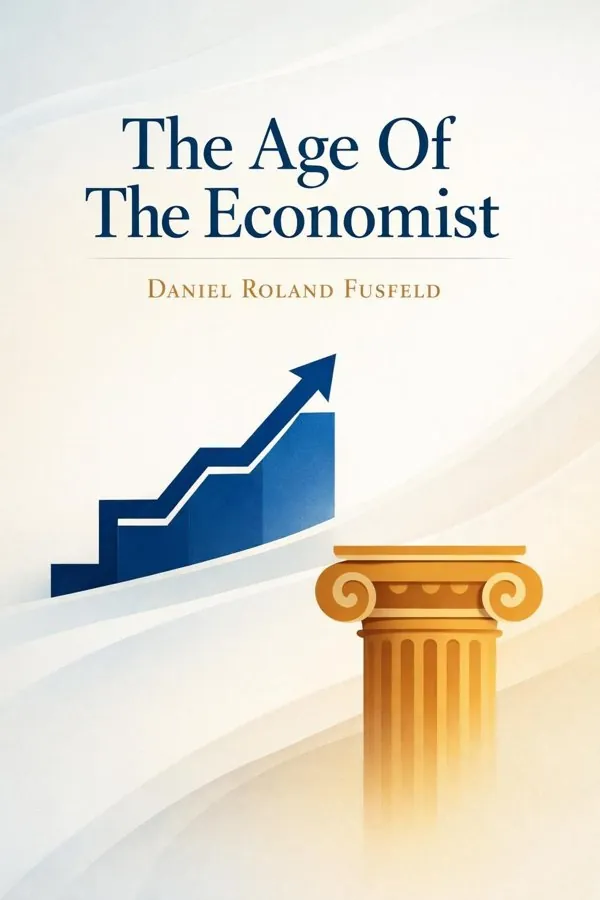
The Age Of The Economist: Summary & Key Insights
 10 min11 chaptersAudio available
What Is The Age Of The Economist About?
The Age Of The Economist by Daniel Roland Fusfeld is a economics book spanning 11 pages. This book offers a concise historical overview of economic thought and development from the classical economists to modern theories. It traces how economic ideas evolved in response to social and political changes, providing readers with a clear understanding of the major schools of economic thought and their influence on policy and society.
This FizzRead summary covers all 11 key chapters of The Age Of The Economist in approximately 10 minutes, distilling the most important ideas, arguments, and takeaways from Daniel Roland Fusfeld's work. Also available as an audio summary and Key Quotes Podcast.
The Age Of The Economist
This book offers a concise historical overview of economic thought and development from the classical economists to modern theories. It traces how economic ideas evolved in response to social and political changes, providing readers with a clear understanding of the major schools of economic thought and their influence on policy and society.
Who Should Read The Age Of The Economist?
This book is perfect for anyone interested in economics and looking to gain actionable insights in a short read. Whether you're a student, professional, or lifelong learner, the key ideas from The Age Of The Economist by Daniel Roland Fusfeld will help you think differently.
- ✓Readers who enjoy economics and want practical takeaways
- ✓Professionals looking to apply new ideas to their work and life
- ✓Anyone who wants the core insights of The Age Of The Economist in just 10 minutes
Want the full summary?
Get instant access to this book summary and 100K+ more with Fizz Moment.
Get Free SummaryAvailable on App Store • Free to download
Key Chapters
In the mercantilist age, economics had not yet become the independent discipline we know today. It was intertwined with politics, national power, and imperial ambition. People measured wealth by the precious metals stored in their treasuries, not by production or living standards. The mercantilists were pragmatic observers of trade and empire who believed that national prosperity depended on favorable balances of trade—exporting more than you imported, and accumulating gold.
I see the mercantilist period as the first attempt to use systematic economic reasoning in service of the state. It flourished in the seventeenth and eighteenth centuries, as nations competed for colonial dominance. Economic ideas were expressed through policy rather than theory. Laws restricted imports, navigation acts controlled shipping, and taxes encouraged domestic industry. Commerce was not simply a private affair but an instrument of national security.
Behind these policies lay a worldview: the economy was a zero-sum game. One nation’s gain was another’s loss. Merchants and governments alike believed that wealth could only be extracted from others—through conquest, trade monopolies, or protectionism. Yet within these restrictive ideas, new economic realities were taking shape. The expansion of trade routes, the rise of banking, and the accumulation of commercial data all hinted that wealth might be created through exchange and labor, not merely hoarded.
Mercantilism’s historical role was pivotal—it laid the administrative and intellectual foundations for modern capitalism. The obsession with trade balances led governments to collect statistics on imports, exports, and production. Those numbers became the earliest tools for economic analysis. And when critics eventually turned against mercantilist policies, they were responding to its very success in transforming trade and production into measurable phenomena.
To study mercantilism is to see the roots of a modern paradox: the tension between state control and market freedom. The mercantilists taught us the possibility—and the danger—of using economics as an instrument of power. Their view of wealth as national strength would echo through later centuries, resurfacing whenever economic policy served ideological or geopolitical ends.
When Adam Smith, David Ricardo, and Thomas Malthus arrived on the scene, they shifted economic thought from the treasury to the marketplace. With Smith’s *Wealth of Nations* in 1776, economics became a science of human behavior and social order. I see Smith as the architect of a moral system grounded in freedom and mutual benefit. He envisioned a world where individuals seeking their own advantage, within the limits of justice, could collectively produce prosperity. His invisible hand remains the most elegant metaphor for spontaneous economic order.
For Smith, wealth did not lie in gold or trade surpluses but in productive labor. The nation’s prosperity depended on its ability to organize work efficiently. Ricardo deepened this analysis, exploring how value arises from labor and how distribution among wages, profits, and rents evolves under competition. His theory of comparative advantage introduced a powerful insight: nations prosper when they specialize according to efficiency rather than hoard resources.
Malthus added a somber note, warning of population pressures and scarcity. His essays were not prophecies of doom but analyses of balance—the struggle between human fertility and food supply that defined society’s limits. Together, these thinkers built a coherent system: free markets, labor value, and the harmony of self-interest. They saw the economic world as governed by natural laws that could be studied, understood, and improved upon.
But classical thought was not blind optimism. Beneath its celebration of freedom lay the conviction that economic order requires moral restraint and prudence. Smith’s sympathy for the poor and Ricardo’s concern with rent-seeking both signal awareness of inequality. Classical economics became the intellectual foundation of liberal capitalism—yet it also planted the seeds of later criticism, for its vision assumed competition would always yield justice, an assumption that history would repeatedly test.
Their legacy endures. The classical economists redefined humanity as the producer and trader, liberated from feudal obligation and guided by reason. They built the lens through which later thinkers would see economic life: not as a battle among nations, but as a complex system of exchange among individuals and classes.
+ 9 more chapters — available in the FizzRead app
All Chapters in The Age Of The Economist
About the Author
Daniel Roland Fusfeld (1918–2007) was an American economist and professor at the University of Michigan. He specialized in the history of economic thought and development economics, authoring several influential works that made complex economic ideas accessible to general readers.
Get This Summary in Your Preferred Format
Read or listen to the The Age Of The Economist summary by Daniel Roland Fusfeld anytime, anywhere. FizzRead offers multiple formats so you can learn on your terms — all free.
Available formats: App · Audio · PDF · EPUB — All included free with FizzRead
Download The Age Of The Economist PDF and EPUB Summary
Key Quotes from The Age Of The Economist
“In the mercantilist age, economics had not yet become the independent discipline we know today.”
“When Adam Smith, David Ricardo, and Thomas Malthus arrived on the scene, they shifted economic thought from the treasury to the marketplace.”
Frequently Asked Questions about The Age Of The Economist
The Age Of The Economist by Daniel Roland Fusfeld is a economics book that explores key ideas across 11 chapters. This book offers a concise historical overview of economic thought and development from the classical economists to modern theories. It traces how economic ideas evolved in response to social and political changes, providing readers with a clear understanding of the major schools of economic thought and their influence on policy and society.
You Might Also Like
Business Adventures
John Brooks
10 min
Nudge
Richard H. Thaler, Cass R. Sunstein
10 min
The Hitchhiker"s Guide to the Galaxy
Douglas Adams
10 minThe Muqaddimah
Ibn Khaldun
10 minThe Outsiders
William N. Thorndike
10 min
A Little History of Economics
Niall Kishtainy
10 minBrowse by Category
Ready to read The Age Of The Economist?
Get the full summary and 100K+ more books with Fizz Moment.