
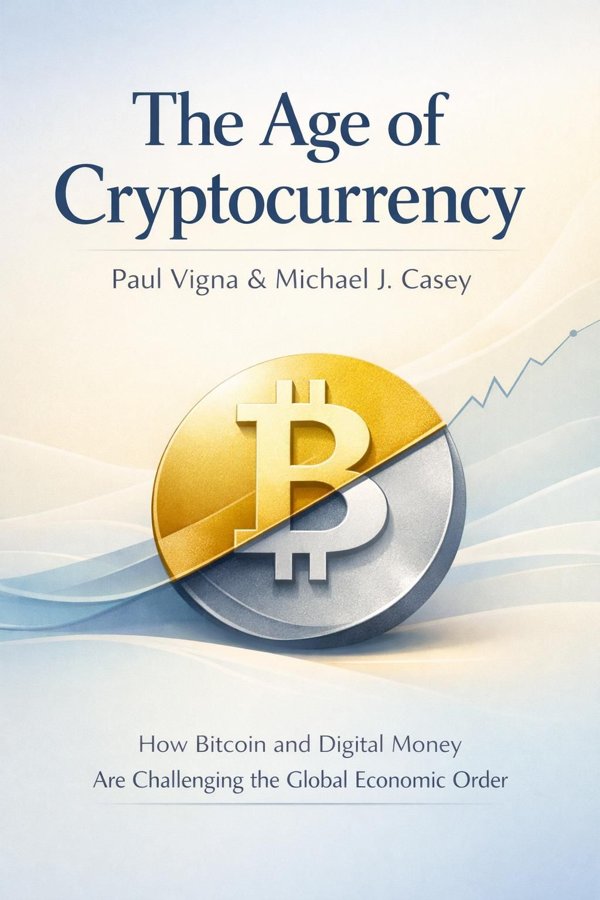
The Age of Cryptocurrency: How Bitcoin and Digital Money Are Challenging the Global Economic Order: Summary & Key Insights
by Paul Vigna, Michael J. Casey
 10 min7 chaptersAudio available
What Is The Age of Cryptocurrency: How Bitcoin and Digital Money Are Challenging the Global Economic Order About?
The Age of Cryptocurrency: How Bitcoin and Digital Money Are Challenging the Global Economic Order by Paul Vigna & Michael J. Casey is a finance book spanning 7 pages. The book explores the rise of Bitcoin and other digital currencies, explaining how they work, their potential to disrupt traditional financial systems, and their implications for the global economy. It provides a detailed narrative of the origins of cryptocurrency, its technological foundations, and the social and economic forces driving its adoption.
This FizzRead summary covers all 7 key chapters of The Age of Cryptocurrency: How Bitcoin and Digital Money Are Challenging the Global Economic Order in approximately 10 minutes, distilling the most important ideas, arguments, and takeaways from Paul Vigna & Michael J. Casey's work. Also available as an audio summary and Key Quotes Podcast.
The Age of Cryptocurrency: How Bitcoin and Digital Money Are Challenging the Global Economic Order
The book explores the rise of Bitcoin and other digital currencies, explaining how they work, their potential to disrupt traditional financial systems, and their implications for the global economy. It provides a detailed narrative of the origins of cryptocurrency, its technological foundations, and the social and economic forces driving its adoption.
Who Should Read The Age of Cryptocurrency: How Bitcoin and Digital Money Are Challenging the Global Economic Order?
This book is perfect for anyone interested in finance and looking to gain actionable insights in a short read. Whether you're a student, professional, or lifelong learner, the key ideas from The Age of Cryptocurrency: How Bitcoin and Digital Money Are Challenging the Global Economic Order by Paul Vigna & Michael J. Casey will help you think differently.
- ✓Readers who enjoy finance and want practical takeaways
- ✓Professionals looking to apply new ideas to their work and life
- ✓Anyone who wants the core insights of The Age of Cryptocurrency: How Bitcoin and Digital Money Are Challenging the Global Economic Order in just 10 minutes
Want the full summary?
Get instant access to this book summary and 100K+ more with Fizz Moment.
Get Free SummaryAvailable on App Store • Free to download
Key Chapters
At the heart of our story is the mysterious figure of Satoshi Nakamoto—the pseudonym behind Bitcoin’s creation. Satoshi’s invention wasn’t born out of greed or even technological vanity, but from a profound dissatisfaction with the way trust and power are distributed in modern finance. In our research and reporting, we found that Nakamoto’s ideas crystallized shortly after the 2008 financial crisis, a time when confidence in banks and governments reached historic lows. His white paper, published that same year, was not just a technical document—it was a manifesto. It proposed a digital currency liberated from central authority, one that relied not on promises but on code.
When we think of Nakamoto’s motivations, it’s essential to understand the climate of pain and cynicism that fertilized Bitcoin’s birth. Traditional money depends on intermediaries—a bank to hold it, a government to verify and regulate it. But what happens when those intermediaries lose credibility? Nakamoto offered an alternative system in which mathematical consensus replaced institutional trust. Transactions would be transparent, verifiable, and free from manipulation. The goal was to return ownership and control to individual users, rather than centralized powers.
In writing this, we wanted readers to grasp that Bitcoin wasn’t randomly conceived. It was an act of rebellion and restoration—a technological response to human disillusionment. Satoshi’s design paired economic theory with cryptography, fusing peer-to-peer networking with anti-inflationary logic. The limited supply of 21 million bitcoins echoed a discipline that fiat currencies lacked. The concept was radical, yes, but also deeply pragmatic. Bitcoin’s appeal lies precisely in how it redefines value for a networked world.
One cannot understand Bitcoin without understanding blockchain. The beauty of this technology lies in its simplicity layered with mathematical elegance. In our examination, we described the blockchain as a distributed ledger—a continuously growing list of records or 'blocks' linked and secured through cryptography. This invention solved what computer scientists once deemed insurmountable: the double-spending problem. It proved that in a digital environment, value could be transferred securely without duplication or deceit, all without a central clearing house.
Each participant in the Bitcoin network contributes to this collective ledger, validating transactions via consensus algorithms. That consensus is the lifeblood of decentralized trust. Instead of a bank verifying your payment, thousands of nodes around the world perform cryptographic checks, ensuring that every transaction aligns with the network’s rules. This global system is public yet anonymous, transparent yet private—a paradox that gave blockchain its revolutionary aura.
In our reporting, we met coders, miners, and cryptographers who viewed Bitcoin not merely as an innovation but as a philosophy. They saw blockchain as a template for a fairer financial system where verification and accountability are baked into mathematics itself. As the technology evolved, its potential applications extended far beyond currency: smart contracts, digital identity, supply-chain tracking, and even governance reforms anchored in transparent code.
For readers, we wanted this section to demystify blockchain not as intimidating jargon but as a new language of trust. It’s an architecture designed to empower rather than control. And that principle—the decentralization of power—is what marks the fundamental shift from traditional financial systems to the age of cryptocurrency.
+ 5 more chapters — available in the FizzRead app
All Chapters in The Age of Cryptocurrency: How Bitcoin and Digital Money Are Challenging the Global Economic Order
About the Authors
Paul Vigna is a reporter for The Wall Street Journal covering cryptocurrencies and financial markets. Michael J. Casey is a senior advisor at MIT Media Lab’s Digital Currency Initiative and a former columnist for The Wall Street Journal. Together, they have written extensively on the intersection of technology and finance.
Get This Summary in Your Preferred Format
Read or listen to the The Age of Cryptocurrency: How Bitcoin and Digital Money Are Challenging the Global Economic Order summary by Paul Vigna & Michael J. Casey anytime, anywhere. FizzRead offers multiple formats so you can learn on your terms — all free.
Available formats: App · Audio · PDF · EPUB — All included free with FizzRead
Download The Age of Cryptocurrency: How Bitcoin and Digital Money Are Challenging the Global Economic Order PDF and EPUB Summary
Key Quotes from The Age of Cryptocurrency: How Bitcoin and Digital Money Are Challenging the Global Economic Order
“At the heart of our story is the mysterious figure of Satoshi Nakamoto—the pseudonym behind Bitcoin’s creation.”
“One cannot understand Bitcoin without understanding blockchain.”
Frequently Asked Questions about The Age of Cryptocurrency: How Bitcoin and Digital Money Are Challenging the Global Economic Order
The Age of Cryptocurrency: How Bitcoin and Digital Money Are Challenging the Global Economic Order by Paul Vigna & Michael J. Casey is a finance book that explores key ideas across 7 chapters. The book explores the rise of Bitcoin and other digital currencies, explaining how they work, their potential to disrupt traditional financial systems, and their implications for the global economy. It provides a detailed narrative of the origins of cryptocurrency, its technological foundations, and the social and economic forces driving its adoption.
You Might Also Like



Browse by Category
Ready to read The Age of Cryptocurrency: How Bitcoin and Digital Money Are Challenging the Global Economic Order?
Get the full summary and 100K+ more books with Fizz Moment.