
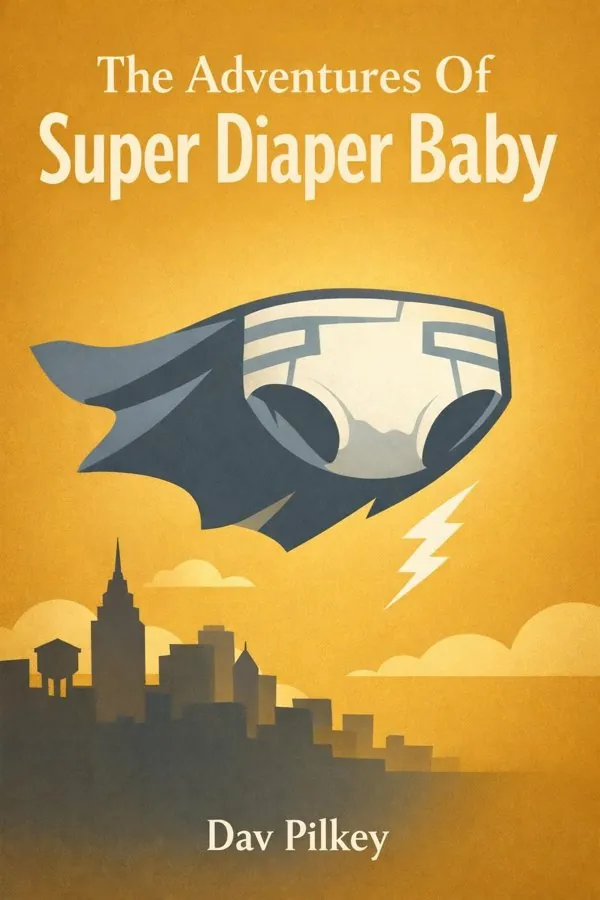
The Adventures Of Super Diaper Baby: Summary & Key Insights
by Dav Pilkey
 10 min9 chaptersAudio available
Key Takeaways from The Adventures Of Super Diaper Baby
A superhero story becomes memorable when it turns the ordinary into the unforgettable.
Many villains are frightening because they want control, but the funniest villains are often the ones who take themselves too seriously.
The funniest battles in children’s literature often carry the clearest moral contrasts.
The end of a comic adventure often feels simple: the villain loses and peace returns.
One of the most powerful things a children’s book can do is make reading feel less like work and more like play.
What Is The Adventures Of Super Diaper Baby About?
The Adventures Of Super Diaper Baby by Dav Pilkey is a bestsellers book spanning 4 pages. The Adventures Of Super Diaper Baby is Dav Pilkey at his most gleefully absurd: a fast, funny graphic novel about a seemingly ordinary baby who ends up with extraordinary powers and a talent for defeating overblown villains. Framed as a homemade comic created by George and Harold, the prank-loving kids from the Captain Underpants universe, the story combines superhero parody, slapstick comedy, and childlike imagination into a book that feels both chaotic and surprisingly clever. Beneath the diaper jokes and exaggerated action scenes, Pilkey celebrates creativity, resilience, and the joyful freedom of making stories without worrying about perfection. What makes this book matter is not just that it entertains children, but that it invites them into the act of storytelling itself. Young readers see how wild ideas can become a full adventure, and reluctant readers discover that books can be visual, playful, and laugh-out-loud fun. Dav Pilkey brings unusual authority to this kind of work: he is one of the most influential creators in children’s literature, known for turning humor, empathy, and cartoon energy into books that build reading confidence. The Adventures Of Super Diaper Baby is silly on the surface, but its deeper message is serious: imagination is a superpower.
This FizzRead summary covers all 9 key chapters of The Adventures Of Super Diaper Baby in approximately 10 minutes, distilling the most important ideas, arguments, and takeaways from Dav Pilkey's work. Also available as an audio summary and Key Quotes Podcast.
The Adventures Of Super Diaper Baby
The Adventures Of Super Diaper Baby is Dav Pilkey at his most gleefully absurd: a fast, funny graphic novel about a seemingly ordinary baby who ends up with extraordinary powers and a talent for defeating overblown villains. Framed as a homemade comic created by George and Harold, the prank-loving kids from the Captain Underpants universe, the story combines superhero parody, slapstick comedy, and childlike imagination into a book that feels both chaotic and surprisingly clever. Beneath the diaper jokes and exaggerated action scenes, Pilkey celebrates creativity, resilience, and the joyful freedom of making stories without worrying about perfection.
What makes this book matter is not just that it entertains children, but that it invites them into the act of storytelling itself. Young readers see how wild ideas can become a full adventure, and reluctant readers discover that books can be visual, playful, and laugh-out-loud fun. Dav Pilkey brings unusual authority to this kind of work: he is one of the most influential creators in children’s literature, known for turning humor, empathy, and cartoon energy into books that build reading confidence. The Adventures Of Super Diaper Baby is silly on the surface, but its deeper message is serious: imagination is a superpower.
Who Should Read The Adventures Of Super Diaper Baby?
This book is perfect for anyone interested in bestsellers and looking to gain actionable insights in a short read. Whether you're a student, professional, or lifelong learner, the key ideas from The Adventures Of Super Diaper Baby by Dav Pilkey will help you think differently.
- ✓Readers who enjoy bestsellers and want practical takeaways
- ✓Professionals looking to apply new ideas to their work and life
- ✓Anyone who wants the core insights of The Adventures Of Super Diaper Baby in just 10 minutes
Want the full summary?
Get instant access to this book summary and 100K+ more with Fizz Moment.
Get Free SummaryAvailable on App Store • Free to download
Key Chapters
A superhero story becomes memorable when it turns the ordinary into the unforgettable. That is exactly what The Adventures Of Super Diaper Baby does with its origin story. Billy begins life as a regular baby, but through the exaggerated comic logic that George and Harold love, he transforms into Super Diaper Baby, a hero whose innocence and ridiculous appearance make him both hilarious and unexpectedly powerful. Pilkey takes one of the most familiar comic-book structures, the superhero origin, and flips it into a joke that children instantly understand: what if the strongest person in the story still needed a diaper?
This origin matters because it invites young readers to see possibility where adults often see limitation. Babies are usually thought of as helpless, but here a baby becomes the ultimate problem-solver. That reversal gives the book much of its comic energy, but it also carries a deeper idea. Great stories often begin by challenging assumptions. Pilkey shows that heroes do not have to look polished, intimidating, or traditionally impressive. A hero can be messy, funny, small, and still save the day.
In practical terms, this idea encourages children to rethink labels. A quiet child can be brave. A goofy class clown can be creative. Someone underestimated by others may still have hidden strengths. Teachers and parents can use this part of the story to talk about confidence and originality, especially with children who feel overlooked.
The origin of Super Diaper Baby also models imaginative play at its best. George and Harold do not wait for permission to make a grand story; they create one from the materials already in their lives. Their homemade comic style tells readers that storytelling starts with noticing, combining, and exaggerating.
Actionable takeaway: look at one ordinary thing in your day and imagine how it could become the center of an amazing story.
Many villains are frightening because they want control, but the funniest villains are often the ones who take themselves too seriously. Deputy Dangerous is one of those villains. He begins as a power-hungry authority figure who wants order on his own terms, and after a bizarre transformation he becomes Super Powerless, a name that hilariously undercuts the inflated menace he tries to project. Pilkey uses this character to parody comic-book villains while also poking fun at the kind of adult who mistakes force for leadership.
This storyline works because it turns a familiar fear into something manageable. Children often encounter authority in the form of rules, discipline, and adults who seem larger than life. By making the villain both threatening and ridiculous, Pilkey helps young readers laugh at power instead of feeling crushed by it. Super Powerless may strut, bark orders, and scheme dramatically, but his self-importance becomes part of the joke.
The transformation from Deputy Dangerous to Super Powerless also highlights a central theme of the book: chasing power for selfish reasons usually leads to humiliation. In contrast to Super Diaper Baby, whose heroism is instinctive and unpretentious, the villain is obsessed with domination and image. He is a comic exaggeration of what happens when someone values control more than kindness.
There is a practical lesson here for readers of all ages. Leadership rooted in fear often backfires. Whether in a classroom, at home, or on a team, people respond better to fairness and respect than to bullying. Children can understand this through the exaggerated battle between a pompous villain and a diapered hero.
Actionable takeaway: when you notice someone acting powerful just to impress or intimidate, ask what real strength would look like instead.
The funniest battles in children’s literature often carry the clearest moral contrasts. In Super Diaper Baby’s clashes with Super Powerless, Pilkey stages more than a string of slapstick action scenes. He creates a showdown between natural goodness and manufactured authority, between spontaneous heroism and ego-driven control. Super Diaper Baby does not act like a traditional superhero. He does not posture, deliver long speeches, or seek applause. He simply responds, often chaotically, to wrongdoing. That simplicity becomes the source of his strength.
The title Super Powerless is itself a joke with a point. The villain craves power, yet he is emotionally weak because he depends on fear, status, and domination. Super Diaper Baby, by contrast, appears absurd and vulnerable, but he is secure in the way children often are before self-consciousness takes over. Pilkey turns the superhero formula upside down to suggest that real strength can look silly from the outside.
This conflict resonates with young readers because many of them have experienced situations where the loudest person seemed strongest, only to discover that kindness or courage mattered more. A child standing up for a friend on the playground may not feel powerful in the conventional sense, but that act can have more moral force than the behavior of someone trying to control others.
Pilkey also keeps the battles visually dynamic and emotionally accessible. The comic-book format lets readers follow action, expression, and consequence quickly, which is especially useful for emerging or reluctant readers. They can see the difference between bluster and bravery in every panel.
Actionable takeaway: when facing someone who acts intimidating, remember that calm courage and doing the right thing often outlast noise and showmanship.
The end of a comic adventure often feels simple: the villain loses and peace returns. But in The Adventures Of Super Diaper Baby, that ending does more than wrap up the plot. It reinforces the emotional rhythm children crave in stories. Chaos erupts, danger escalates, the hero prevails, and the world settles again. That pattern reassures readers that disorder can be confronted and that scary or confusing situations do not last forever.
Pilkey understands that many children enjoy wildness in fiction precisely because they trust the story will guide them safely back to stability. Super Powerless creates disruption through his greed and need for control, but his defeat restores a moral balance. The ending suggests that selfishness and bullying may cause temporary trouble, yet they are not permanent forces. Justice, even in a ridiculously comic form, remains possible.
This return to peace also highlights the restorative role of laughter. Pilkey does not end with heavy moralizing. Instead, he lets humor carry the resolution. Children leave the story entertained, but also subtly reassured. The emotional message is that problems can be overwhelming in the moment and still be survivable. This matters especially for young readers who use stories to process real-life anxieties about school, rules, conflict, or change.
Adults can apply this structure in conversations with children. When a child feels upset after a difficult day, it helps to frame the experience as part of a larger arc: something went wrong, people responded, and things can improve. Stories like this model that sense of movement from confusion back to calm.
Actionable takeaway: after a stressful moment, ask yourself or a child, “What helped bring things back to normal?” to build confidence in recovery and resilience.
One of the most powerful things a children’s book can do is make reading feel less like work and more like play. Dav Pilkey achieves that through relentless humor. The Adventures Of Super Diaper Baby is packed with visual gags, exaggerated names, toilet humor, absurd reversals, and energetic pacing. Children laugh first, and in the process they keep reading. That is not a side effect of the book; it is one of its core achievements.
Humor lowers resistance. A child who might feel intimidated by longer prose can enter this story through funny pictures and short bursts of text. Every joke becomes a reward for attention. Pilkey understands that engagement comes before analysis, especially for younger readers. Once a child is emotionally hooked, reading comprehension, vocabulary growth, and narrative understanding follow more naturally.
This matters because many adults underestimate comedic books. They may see silliness as lightweight, when in fact it often serves as a bridge to literacy. A child who proudly finishes a funny graphic novel gains reading confidence, and confidence tends to create momentum. That same child may then become more willing to try other books.
The book also validates children’s own sense of humor. It tells them that what they find funny matters. That can be deeply motivating, especially for reluctant readers who have not yet found books that speak their language. In classrooms and homes, humorous graphic novels can help establish positive reading habits instead of framing reading as a test.
Actionable takeaway: if a child resists reading, start with books that genuinely make them laugh, because enjoyment is often the doorway to lasting literacy.
Children become more invested in stories when they can imagine making stories of their own. A major charm of The Adventures Of Super Diaper Baby is that it is presented as a comic invented by George and Harold. That framing is not just a gimmick from the Captain Underpants world; it is a celebration of kid-made art. The drawings are intentionally playful, the logic is gleefully exaggerated, and the whole book feels like something children could dream up on a rainy afternoon with paper, pencils, and too much excitement.
This matters because it removes the intimidating aura that can surround books. Instead of presenting storytelling as something only polished adults do, Pilkey shows it as a living act of play. George and Harold are mischievous, impulsive, and imperfect, but they are also creators. Their comic demonstrates that imagination does not need to be refined before it deserves expression.
For children, this is empowering. They can see that weird ideas are welcome. A baby superhero, an overdramatic villain, and a chain of nonsense events can still become a coherent, entertaining story. That realization encourages experimentation in writing, drawing, and imaginative play. It gives permission to begin before feeling ready.
Parents and teachers can use this book as a springboard for creative projects. Children might invent their own superhero, draw a mini comic, or rewrite a scene from another perspective. Because Pilkey’s style is accessible and humorous, it invites participation rather than passive admiration.
The deeper lesson is that creativity grows through doing, not waiting. George and Harold create because they enjoy it, and that joy is contagious.
Actionable takeaway: make something messy and fun this week, a comic page, doodle, or short story, without worrying whether it looks professional.
Format can be as important as content when helping children become stronger readers. The Adventures Of Super Diaper Baby uses the graphic novel form to make storytelling immediate, visual, and accessible. Panels break action into manageable pieces, facial expressions clarify emotion, and short text segments prevent the page from feeling overwhelming. For many children, especially reluctant readers or those still building fluency, this structure transforms reading from a frustrating task into an inviting experience.
Pilkey’s use of graphics is not decorative; it is instructional in the best sense. Readers learn to follow sequence, infer meaning from images, connect dialogue with action, and understand pacing. These are genuine literacy skills. The book teaches them invisibly, through enjoyment rather than formal instruction. A child may think they are simply laughing at a diaper joke while actually practicing visual interpretation and narrative prediction.
This format also supports different kinds of learners. Visual readers can grasp plot quickly. Struggling readers can use illustrations to fill gaps in vocabulary. Confident readers can move swiftly and focus on tone, parody, and structure. That broad accessibility helps explain why Pilkey has been so successful with children who do not always connect with traditional chapter books.
There is also a social benefit. Graphic novels often feel easier to share, reread, and discuss. Children point to favorite panels, mimic sound effects, and revisit scenes they love. That repeated engagement deepens comprehension while keeping the experience fun.
Adults sometimes worry that graphic novels are not “real reading,” but books like this prove otherwise. They are often a powerful route into sustained reading habits.
Actionable takeaway: treat graphic novels as legitimate reading tools and let children choose visual books that make them feel capable and eager to continue.
The most enduring children’s books often hide wisdom inside nonsense. On the surface, The Adventures Of Super Diaper Baby is outrageously silly, filled with exaggerated action and bathroom humor. Yet that silliness carries serious emotional truths about courage, fairness, identity, and the way children process the adult world. Pilkey understands that children do not always need solemn stories to explore meaningful ideas. Often, humor is the safer and more effective vehicle.
Take the book’s central contrast: a baby in a diaper becomes a hero, while an authority figure becomes ridiculous through his hunger for control. This is funny, but it also reflects a child’s perspective on power. Adults may seem big and all-knowing, yet children often sense their flaws. Comedy allows that perception to surface without turning the book into a lecture or a rebellion manual. Readers get to laugh while also recognizing that status does not automatically equal virtue.
The book also validates messy emotions. Its chaos mirrors the intensity of childhood, when frustrations, fears, and triumphs can all feel oversized. By transforming that intensity into cartoon adventure, Pilkey offers emotional release. Readers see conflict, absurdity, danger, and resolution compressed into a format they can handle.
This has practical value. Funny books can open conversations that serious books sometimes cannot. A child may be more willing to talk about bullies, unfair rules, or feeling small after first laughing at a villain being exposed as foolish. The silliness lowers defenses.
Actionable takeaway: do not dismiss funny stories as empty; ask what fear, feeling, or truth the humor might be helping a child explore.
Parody is not just about mocking familiar genres; at its best, it helps readers understand them and claim them for themselves. The Adventures Of Super Diaper Baby borrows the grand style of superhero comics, secret origins, overblown villains, dramatic battles, and triumphant endings, then reinvents them with childish logic and comic chaos. In doing so, Dav Pilkey makes a genre that can sometimes feel larger than life feel available to children.
This matters because many superhero stories revolve around idealized bodies, epic destinies, and polished competence. Pilkey replaces that with diapers, accidents, and improvisation. The result is democratizing. Children do not need to resemble flawless heroes to imagine themselves as brave or important. They can be awkward, noisy, underestimated, or weird and still belong in an adventure.
The parody also teaches media awareness in a gentle way. Readers begin to recognize genre patterns, the origin story, the villain monologue, the climactic showdown, because Pilkey exaggerates them so clearly. That recognition builds critical reading skills. Children learn not only to consume stories but to notice how stories are built.
In everyday life, this kind of playful awareness can help children become more creative thinkers. Once they understand a formula, they can remix it. A child who reads Super Diaper Baby may later invent a superhero janitor, a villainous hamster, or a dramatic rescue involving lunchboxes. Parody opens creative doors.
Pilkey’s larger contribution is showing that imitation can be the beginning of invention. Children often start by copying the stories they love, then twist them into something uniquely their own.
Actionable takeaway: identify one familiar story formula you know and reimagine it in the funniest, strangest way possible.
All Chapters in The Adventures Of Super Diaper Baby
About the Author
Dav Pilkey is an American author and illustrator whose work has transformed children’s publishing through humor, comics, and highly accessible storytelling. He is best known for creating the Captain Underpants and Dog Man series, both of which have become global favorites among young readers. Pilkey has often spoken about struggling in school as a child, experiences that later shaped his commitment to making books fun, visually engaging, and welcoming for kids who may not see themselves as strong readers. His stories blend outrageous comedy with empathy, friendship, and creativity, helping children build confidence while enjoying the reading process. With his distinctive mix of cartoon energy and emotional intelligence, Pilkey has become one of the most influential and widely read children’s authors of his generation.
Get This Summary in Your Preferred Format
Read or listen to the The Adventures Of Super Diaper Baby summary by Dav Pilkey anytime, anywhere. FizzRead offers multiple formats so you can learn on your terms — all free.
Available formats: App · Audio · PDF · EPUB — All included free with FizzRead
Download The Adventures Of Super Diaper Baby PDF and EPUB Summary
Key Quotes from The Adventures Of Super Diaper Baby
“A superhero story becomes memorable when it turns the ordinary into the unforgettable.”
“Many villains are frightening because they want control, but the funniest villains are often the ones who take themselves too seriously.”
“The funniest battles in children’s literature often carry the clearest moral contrasts.”
“The end of a comic adventure often feels simple: the villain loses and peace returns.”
“One of the most powerful things a children’s book can do is make reading feel less like work and more like play.”
Frequently Asked Questions about The Adventures Of Super Diaper Baby
The Adventures Of Super Diaper Baby by Dav Pilkey is a bestsellers book that explores key ideas across 9 chapters. The Adventures Of Super Diaper Baby is Dav Pilkey at his most gleefully absurd: a fast, funny graphic novel about a seemingly ordinary baby who ends up with extraordinary powers and a talent for defeating overblown villains. Framed as a homemade comic created by George and Harold, the prank-loving kids from the Captain Underpants universe, the story combines superhero parody, slapstick comedy, and childlike imagination into a book that feels both chaotic and surprisingly clever. Beneath the diaper jokes and exaggerated action scenes, Pilkey celebrates creativity, resilience, and the joyful freedom of making stories without worrying about perfection. What makes this book matter is not just that it entertains children, but that it invites them into the act of storytelling itself. Young readers see how wild ideas can become a full adventure, and reluctant readers discover that books can be visual, playful, and laugh-out-loud fun. Dav Pilkey brings unusual authority to this kind of work: he is one of the most influential creators in children’s literature, known for turning humor, empathy, and cartoon energy into books that build reading confidence. The Adventures Of Super Diaper Baby is silly on the surface, but its deeper message is serious: imagination is a superpower.
More by Dav Pilkey


You Might Also Like

The Godfather
Mario Puzo
10 min
The Handmaid's Tale
Margaret Atwood
10 min
The Hunger Games
Suzanne Collins
10 min
The Nightingale
Kristin Hannah
10 min
The Seven Husbands of Evelyn Hugo
Taylor Jenkins Reid
10 min
Backwater Justice
Fern Michaels
10 minBrowse by Category
Ready to read The Adventures Of Super Diaper Baby?
Get the full summary and 100K+ more books with Fizz Moment.