
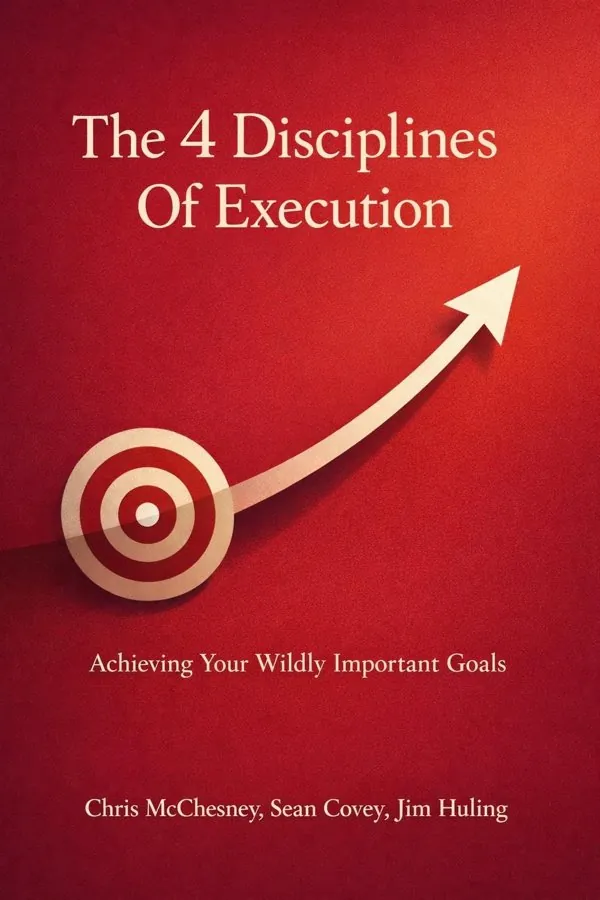
The 4 Disciplines Of Execution: Achieving Your Wildly Important Goals: Summary & Key Insights
by Chris McChesney, Sean Covey, Jim Huling
 10 min5 chaptersAudio available
What Is The 4 Disciplines Of Execution: Achieving Your Wildly Important Goals About?
The 4 Disciplines Of Execution: Achieving Your Wildly Important Goals by Chris McChesney, Sean Covey, Jim Huling is a leadership book spanning 5 pages. The 4 Disciplines of Execution (4DX) es una fórmula simple, repetible y probada para ejecutar las prioridades estratégicas más importantes en medio de las distracciones diarias. El libro presenta cuatro disciplinas clave: enfocarse en las metas más importantes, actuar sobre las medidas de predicción, mantener un tablero de resultados convincente y crear una cadencia de responsabilidad. A través de ejemplos y estudios de caso, los autores muestran cómo líderes y equipos pueden convertir la estrategia en acción y lograr resultados extraordinarios.
This FizzRead summary covers all 5 key chapters of The 4 Disciplines Of Execution: Achieving Your Wildly Important Goals in approximately 10 minutes, distilling the most important ideas, arguments, and takeaways from Chris McChesney, Sean Covey, Jim Huling's work. Also available as an audio summary and Key Quotes Podcast.
The 4 Disciplines Of Execution: Achieving Your Wildly Important Goals
The 4 Disciplines of Execution (4DX) es una fórmula simple, repetible y probada para ejecutar las prioridades estratégicas más importantes en medio de las distracciones diarias. El libro presenta cuatro disciplinas clave: enfocarse en las metas más importantes, actuar sobre las medidas de predicción, mantener un tablero de resultados convincente y crear una cadencia de responsabilidad. A través de ejemplos y estudios de caso, los autores muestran cómo líderes y equipos pueden convertir la estrategia en acción y lograr resultados extraordinarios.
Who Should Read The 4 Disciplines Of Execution: Achieving Your Wildly Important Goals?
This book is perfect for anyone interested in leadership and looking to gain actionable insights in a short read. Whether you're a student, professional, or lifelong learner, the key ideas from The 4 Disciplines Of Execution: Achieving Your Wildly Important Goals by Chris McChesney, Sean Covey, Jim Huling will help you think differently.
- ✓Readers who enjoy leadership and want practical takeaways
- ✓Professionals looking to apply new ideas to their work and life
- ✓Anyone who wants the core insights of The 4 Disciplines Of Execution: Achieving Your Wildly Important Goals in just 10 minutes
Want the full summary?
Get instant access to this book summary and 100K+ more with Fizz Moment.
Get Free SummaryAvailable on App Store • Free to download
Key Chapters
The first discipline begins with focus—disciplined, ruthless, laser-sharp focus. It’s easy to confuse energy with progress. We attend endless meetings, juggle dozens of priorities, and call that productivity. But true progress comes from narrowing the field to what matters most. That’s where our concept of Wildly Important Goals, or WIGs, changes the game.
Every organization has multiple good ideas, but not all good ideas are equal. Discipline 1 demands that you identify one or two WIGs—the few goals that would make all the difference if achieved. These are not just important; they’re transformative. The act of choosing them forces clarity: what’s the one thing that will move the needle? If everything is priority one, then nothing truly is.
In our experience, leaders often resist narrowing their focus. It feels restrictive, even risky. Yet, when the focus sharpens, energy concentrates, and results compound. The power of concentration—the human equivalent of a laser beam—transforms outcomes. I’ve seen teams move from scattered urgency to consistent momentum once they committed to their WIGs.
When defining WIGs, precision is key. A WIG must be expressed as an outcome, not an activity. ‘Improve customer satisfaction from 80% to 95% by year-end’ is a WIG. ‘Implement new feedback systems’ is not. The difference matters because outcomes inspire accountability; activities don’t. Your team must understand clearly what winning looks like.
Alignment follows naturally. Each team identifies its own WIG that supports the organization’s broader goal. The process is like tuning instruments in an orchestra—all must harmonize for the music to flow. Once each team finds its WIG, the organization begins to move in one coherent direction, with energy focused tightly on what matters most.
Focus is not about ignoring the whirlwind of daily operations; it’s about dedicating steady attention to what will shape the future. Discipline 1 builds the foundation for all that follows.
Once the Wildly Important Goals are clear, the next discipline asks: what will actually produce those results? Most teams measure success through lag indicators—sales, profit, customer satisfaction—that tell you after the fact whether you succeeded. They’re vital, but they don’t drive action because you can’t alter them directly. Discipline 2 shifts attention to *lead measures*: the predictive and influenceable indicators that create success.
Lag measures are the scoreboard; lead measures are the plays that score points. For instance, if your WIG is to increase sales revenue, the lead measures might include the number of qualified customer interactions per week, the time spent following up leads, or the response rate to targeted campaigns. These specific, controllable actions predict the eventual success of the WIG.
Lead measures create leverage. They define the behaviors that can be changed today to alter tomorrow’s outcomes. This discipline also demands responsibility because it requires tracking actions you can control. The act of measuring these behaviors transforms intentions into habits, and habits, over time, create results.
Implementing lead measures means more than recording metrics—it’s about creating rhythm. The measures should live in your team’s daily consciousness. I’ve seen leaders accelerate performance by helping teams connect their weekly actions directly to the lead measures that drive results. When team members see that their small, daily contributions move the needle, engagement rises dramatically.
The discipline here builds a bridge between vision and mechanics. It transforms abstract ambition into tangible, moment-by-moment effort. The magic of execution is that lead measures, once institutionalized, turn the act of change into something measurable, manageable, and motivational.
+ 3 more chapters — available in the FizzRead app
All Chapters in The 4 Disciplines Of Execution: Achieving Your Wildly Important Goals
About the Authors
Chris McChesney es consultor principal en FranklinCovey y co-creador del modelo 4DX. Sean Covey es presidente de FranklinCovey Education y autor de varios libros sobre liderazgo y efectividad personal. Jim Huling es líder de ejecución en FranklinCovey y coautor de The 4 Disciplines of Execution.
Get This Summary in Your Preferred Format
Read or listen to the The 4 Disciplines Of Execution: Achieving Your Wildly Important Goals summary by Chris McChesney, Sean Covey, Jim Huling anytime, anywhere. FizzRead offers multiple formats so you can learn on your terms — all free.
Available formats: App · Audio · PDF · EPUB — All included free with FizzRead
Download The 4 Disciplines Of Execution: Achieving Your Wildly Important Goals PDF and EPUB Summary
Key Quotes from The 4 Disciplines Of Execution: Achieving Your Wildly Important Goals
“The first discipline begins with focus—disciplined, ruthless, laser-sharp focus.”
“Once the Wildly Important Goals are clear, the next discipline asks: what will actually produce those results?”
Frequently Asked Questions about The 4 Disciplines Of Execution: Achieving Your Wildly Important Goals
The 4 Disciplines Of Execution: Achieving Your Wildly Important Goals by Chris McChesney, Sean Covey, Jim Huling is a leadership book that explores key ideas across 5 chapters. The 4 Disciplines of Execution (4DX) es una fórmula simple, repetible y probada para ejecutar las prioridades estratégicas más importantes en medio de las distracciones diarias. El libro presenta cuatro disciplinas clave: enfocarse en las metas más importantes, actuar sobre las medidas de predicción, mantener un tablero de resultados convincente y crear una cadencia de responsabilidad. A través de ejemplos y estudios de caso, los autores muestran cómo líderes y equipos pueden convertir la estrategia en acción y lograr resultados extraordinarios.
You Might Also Like

Extreme Ownership
Jocko Willink
10 min
Dare to Lead
Brene Brown
10 min
Leaders Eat Last
Simon Sinek
10 min
The 21 Irrefutable Laws of Leadership
John Maxwell
10 min
Start With Why
Simon Sinek
10 min
How to Lead When You're Not in Charge
Clay Scroggins
10 minBrowse by Category
Ready to read The 4 Disciplines Of Execution: Achieving Your Wildly Important Goals?
Get the full summary and 100K+ more books with Fizz Moment.