
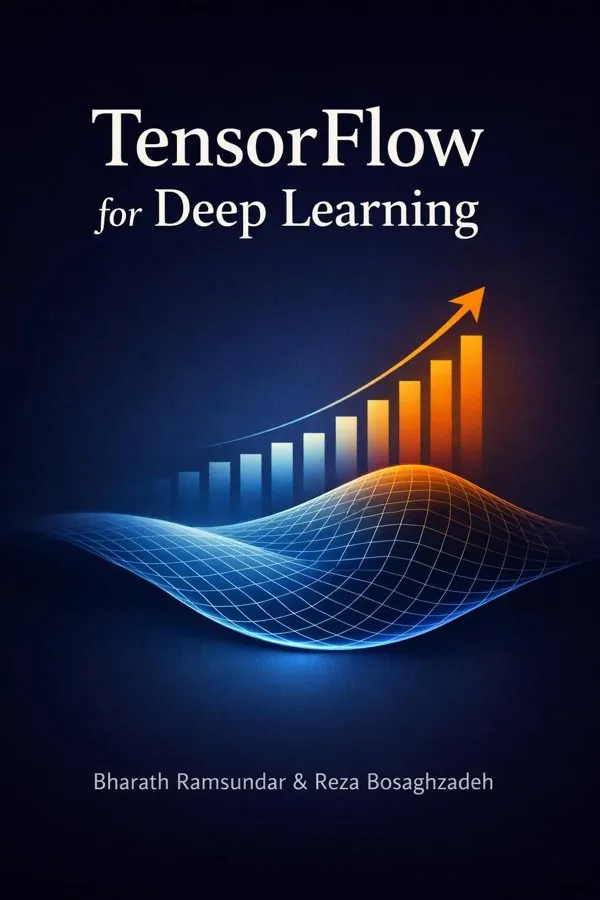
TensorFlow for Deep Learning: From Linear Regression to Reinforcement Learning: Summary & Key Insights
by Bharath Ramsundar, Reza Bosaghzadeh
 10 min9 chaptersAudio available
Key Takeaways from TensorFlow for Deep Learning: From Linear Regression to Reinforcement Learning
Every powerful learning system begins with a surprisingly humble question: how do we fit a curve to data well enough to make useful predictions?
Prediction becomes far more interesting when the goal is not estimating a number, but deciding among alternatives.
A single line can only separate a world that is simple enough to be split by a line.
Images are not just collections of pixels; they are organized patterns in space.
Many of the most valuable patterns in data are not static at all; they unfold over time.
What Is TensorFlow for Deep Learning: From Linear Regression to Reinforcement Learning About?
TensorFlow for Deep Learning: From Linear Regression to Reinforcement Learning by Bharath Ramsundar & Reza Bosaghzadeh is a ai_ml book spanning 8 pages. Deep learning often looks intimidating from the outside: dense math, abstract architectures, and a fast-moving ecosystem of tools that can overwhelm even experienced programmers. TensorFlow for Deep Learning: From Linear Regression to Reinforcement Learning cuts through that confusion by teaching the field the way practitioners actually learn it—step by step, model by model, problem by problem. Bharath Ramsundar and Reza Bosaghzadeh begin with foundational techniques like linear regression and gradient descent, then build toward neural networks, convolutional models, recurrent systems, unsupervised learning, and reinforcement learning. The result is not just a survey of algorithms, but a practical map of how modern machine learning is constructed and deployed. What makes the book especially valuable is its balance of theory and implementation: readers gain intuition for why models work while also learning how TensorFlow turns ideas into working systems. Ramsundar’s background in machine learning research and applied science, combined with Bosaghzadeh’s engineering and educational experience, gives the book both technical credibility and teaching clarity. For engineers, data scientists, and ambitious beginners, it offers a grounded path into real-world deep learning.
This FizzRead summary covers all 9 key chapters of TensorFlow for Deep Learning: From Linear Regression to Reinforcement Learning in approximately 10 minutes, distilling the most important ideas, arguments, and takeaways from Bharath Ramsundar & Reza Bosaghzadeh's work. Also available as an audio summary and Key Quotes Podcast.
TensorFlow for Deep Learning: From Linear Regression to Reinforcement Learning
Deep learning often looks intimidating from the outside: dense math, abstract architectures, and a fast-moving ecosystem of tools that can overwhelm even experienced programmers. TensorFlow for Deep Learning: From Linear Regression to Reinforcement Learning cuts through that confusion by teaching the field the way practitioners actually learn it—step by step, model by model, problem by problem. Bharath Ramsundar and Reza Bosaghzadeh begin with foundational techniques like linear regression and gradient descent, then build toward neural networks, convolutional models, recurrent systems, unsupervised learning, and reinforcement learning. The result is not just a survey of algorithms, but a practical map of how modern machine learning is constructed and deployed. What makes the book especially valuable is its balance of theory and implementation: readers gain intuition for why models work while also learning how TensorFlow turns ideas into working systems. Ramsundar’s background in machine learning research and applied science, combined with Bosaghzadeh’s engineering and educational experience, gives the book both technical credibility and teaching clarity. For engineers, data scientists, and ambitious beginners, it offers a grounded path into real-world deep learning.
Who Should Read TensorFlow for Deep Learning: From Linear Regression to Reinforcement Learning?
This book is perfect for anyone interested in ai_ml and looking to gain actionable insights in a short read. Whether you're a student, professional, or lifelong learner, the key ideas from TensorFlow for Deep Learning: From Linear Regression to Reinforcement Learning by Bharath Ramsundar & Reza Bosaghzadeh will help you think differently.
- ✓Readers who enjoy ai_ml and want practical takeaways
- ✓Professionals looking to apply new ideas to their work and life
- ✓Anyone who wants the core insights of TensorFlow for Deep Learning: From Linear Regression to Reinforcement Learning in just 10 minutes
Want the full summary?
Get instant access to this book summary and 100K+ more with Fizz Moment.
Get Free SummaryAvailable on App Store • Free to download
Key Chapters
Every powerful learning system begins with a surprisingly humble question: how do we fit a curve to data well enough to make useful predictions? The book starts with linear regression because it reveals the essential mechanics that remain present even in advanced deep learning. At its heart, a model makes a prediction, compares it with reality, measures error through a loss function, and updates parameters to reduce that error. This cycle is the foundation of modern machine learning.
Ramsundar and Bosaghzadeh use linear regression not as an outdated technique, but as a transparent window into optimization. Readers see how features, weights, bias terms, and cost functions work together. They also learn why gradient descent matters: rather than solving every problem analytically, machine learning usually improves models incrementally by following the slope of error downward. TensorFlow becomes valuable here because it automates much of the bookkeeping, letting practitioners focus on structure, experimentation, and interpretation.
The practical significance is enormous. A business forecasting revenue, a hospital estimating patient risk, or a manufacturer predicting demand all rely on the same basic pipeline: define inputs, choose targets, minimize error, evaluate performance. Even when the final model is a deep network, success still depends on understanding these fundamentals. Without this grounding, later architectures become magic tricks instead of understandable tools.
The authors show that mastering simple models develops habits that scale: clean data preparation, sensible evaluation, awareness of overfitting, and disciplined iteration. Actionable takeaway: before rushing into complex neural networks, build and inspect a simple regression model to understand your data, loss function, and training dynamics.
Prediction becomes far more interesting when the goal is not estimating a number, but deciding among alternatives. The shift from regression to classification marks one of the most important conceptual leaps in machine learning, because it forces us to think in probabilities instead of raw outputs. The book introduces logistic regression and softmax regression as the natural starting points for this transition.
Rather than producing unconstrained values, logistic regression maps outputs into probabilities for binary decisions such as fraud versus legitimate, diseased versus healthy, or churn versus retention. Softmax extends the same idea to multi-class problems like classifying handwritten digits or labeling product categories. These methods may be simpler than deep networks, but they teach a crucial lesson: useful AI systems often need calibrated confidence, not just hard labels. Knowing that a model is 51% confident is very different from knowing it is 99% confident.
TensorFlow helps readers move from theory into implementation by showing how to represent labels, define cross-entropy loss, and train classifiers efficiently. The authors also emphasize that classification performance is not judged only by accuracy. Precision, recall, class imbalance, and threshold tuning often matter more in practice. For example, a medical screening system may tolerate more false positives to avoid missing dangerous cases, while a spam filter may optimize for convenience and user trust.
This chapter matters because classification problems dominate many real business and consumer applications. Learning the logic of decision boundaries and probability-based outputs prepares readers for deeper neural architectures later in the book. Actionable takeaway: when solving a classification problem, focus not just on predicted labels but on probabilities, loss functions, and the real-world cost of different types of mistakes.
A single line can only separate a world that is simple enough to be split by a line. Real data rarely cooperates. That is why the multilayer perceptron, or MLP, is such a decisive milestone in deep learning: it gives models the ability to learn nonlinear relationships that simpler algorithms cannot capture. In the book, the authors use MLPs to show how depth transforms pattern recognition.
An MLP stacks layers of neurons, each applying weighted transformations and nonlinear activation functions. This allows the network to build internal representations of data rather than relying solely on hand-engineered features. A shallow model might fail to separate customer segments or detect subtle interactions among variables, but a multilayer network can combine signals across dimensions and learn hidden structure. The authors explain this accessibly, clarifying how activations, hidden layers, and backpropagation work together during training.
What makes the discussion practical is its emphasis on design choices. How many layers should you use? How wide should they be? Which activation functions help learning? How do you avoid vanishing gradients or unstable training? TensorFlow provides a framework for answering these questions experimentally. Readers see that building deep models is not about blindly adding layers; it is about balancing expressiveness, data availability, computational cost, and generalization.
Applications of MLPs span recommendation systems, tabular prediction, anomaly detection, and baseline models for almost every supervised learning task. Even if later architectures become more specialized, the multilayer perceptron remains the conceptual bridge from classical statistics to deep representation learning. Actionable takeaway: use an MLP when relationships in your data are clearly nonlinear, but start with a modest architecture and improve it through measurement rather than guesswork.
Images are not just collections of pixels; they are organized patterns in space. Convolutional neural networks succeed because they respect that structure instead of flattening it away. In this section, the book explains why CNNs revolutionized computer vision and why they remain one of the clearest examples of architecture matching the shape of data.
Unlike fully connected networks, convolutional layers scan local regions and reuse the same filters across an image. This gives CNNs two major advantages: parameter efficiency and sensitivity to meaningful spatial patterns such as edges, textures, shapes, and object parts. Pooling and deeper layers then help transform local features into higher-level abstractions. The authors show how these design ideas allow models to detect handwritten digits, classify photos, and eventually support tasks like medical image analysis or autonomous driving.
The chapter is especially useful because it moves beyond buzzwords. Readers learn what filters actually do, why translation invariance matters, and how TensorFlow can define convolutional pipelines efficiently. Practical concerns also come into view: preprocessing image data, choosing kernel sizes, balancing model depth, and avoiding overfitting when datasets are limited. A face recognition system, for instance, needs robust feature extraction across lighting changes and minor shifts, while an industrial inspection model must notice subtle defects that may occupy only a small region.
CNNs also teach a broader lesson: architecture should emerge from the structure of the problem. A good model is not merely powerful; it is aligned with the information geometry of its input. Actionable takeaway: when working with image-like or spatial data, prefer convolutional architectures and think carefully about what local patterns your model needs to detect and preserve.
Many of the most valuable patterns in data are not static at all; they unfold over time. Language, speech, financial signals, user behavior, and sensor streams all depend on order. The book addresses this challenge through recurrent neural networks and long short-term memory networks, showing how models can learn not only from individual inputs but from sequences of inputs.
A recurrent network processes data step by step, carrying information forward in a hidden state. In principle, this allows it to remember what came before. In practice, standard recurrent networks struggle to preserve long-range dependencies, which is where LSTMs become important. By introducing gates that control what to remember, what to forget, and what to output, LSTMs greatly improve a network’s ability to model context over longer sequences. The authors explain these mechanisms in an intuitive way, helping readers understand why sequence modeling is a fundamentally different challenge from image or tabular learning.
The applications are immediate and familiar. Predicting the next word in a sentence, analyzing sentiment from text, forecasting demand over time, transcribing speech, or detecting anomalies in machine telemetry all require sensitivity to order. TensorFlow supports these models by handling sequence inputs, recurrent loops, and training procedures at scale. The book also helps readers think about practical limitations such as exploding or vanishing gradients, variable sequence lengths, and the trade-off between model complexity and interpretability.
Perhaps the deepest lesson here is that memory changes what a model can know. Systems that understand sequence can infer intent, trend, and dependency rather than merely react to isolated snapshots. Actionable takeaway: when your problem depends on order or history, choose sequence-aware models and design your dataset so temporal context is preserved rather than discarded.
A model architecture may look elegant on paper, but training is where good intentions meet reality. One of the book’s most practical contributions is its treatment of optimization and regularization—the set of methods that determine whether a neural network actually learns useful patterns or simply memorizes noise. This is where deep learning shifts from concept to craft.
The authors show that optimization is not just about minimizing loss, but about doing so stably and efficiently. Gradient descent, stochastic mini-batching, adaptive optimizers, learning rates, and initialization choices all influence whether training converges or stalls. TensorFlow allows these ingredients to be adjusted systematically, making experimentation central to model development. Readers learn that training curves are diagnostic tools, not just metrics to report at the end.
Regularization enters because expressive models are dangerously capable of overfitting. Techniques such as dropout, early stopping, weight penalties, and data augmentation help networks generalize beyond the training set. This matters in nearly every domain. A fraud model that memorizes historical quirks will fail on new attacks. An image classifier trained on a narrow dataset may collapse in real-world conditions. A recommendation engine may optimize offline metrics while disappointing actual users.
What the book makes clear is that performance is often won not by inventing a new architecture, but by tuning the training process intelligently. The best practitioners spend enormous energy on validation strategy, hyperparameter search, and honest evaluation. Deep learning is powerful precisely because it is trainable, but that trainability must be managed with discipline. Actionable takeaway: monitor both training and validation behavior closely, and treat optimization and regularization as first-class design decisions rather than afterthoughts.
Some of the richest datasets in the world come without labels. That simple fact is why unsupervised learning matters so much. The book introduces unsupervised methods as a way of extracting patterns, representations, and latent structure from data when explicit supervision is limited or unavailable. In doing so, it broadens the reader’s view of what machine learning can be.
Instead of predicting a known target, unsupervised models search for organization hidden inside the inputs themselves. This can mean learning compact representations, identifying clusters, denoising signals, or discovering useful features for downstream tasks. In TensorFlow, these ideas often appear through architectures such as autoencoders, which compress data into a lower-dimensional code and then reconstruct it. That process encourages the model to capture essential structure rather than surface-level variation.
The practical uses are extensive. A retailer might cluster customers into behavioral segments before building personalized campaigns. A cybersecurity team might detect anomalies by modeling normal network activity and flagging unusual patterns. A scientific researcher might use representation learning to uncover structure in molecular or genomic data. Unsupervised learning is also a powerful precursor to supervised performance, since good learned representations can reduce the need for extensive feature engineering.
The authors help readers appreciate that labels are not the only source of learning signal. Structure, similarity, and reconstruction error can all guide a model toward insight. This is especially important in modern AI, where data volume often grows faster than annotation budgets. Actionable takeaway: when labeled examples are scarce, start by asking what structure can be learned directly from the raw data and how those representations might strengthen later supervised tasks.
Not every problem is solved by predicting the right label from a fixed dataset. Some systems must act, observe consequences, and improve through trial and error. Reinforcement learning addresses this setting, and the book introduces it as the natural next step for readers ready to think beyond supervised prediction. Here, intelligence is not only about recognition but about decision-making over time.
In reinforcement learning, an agent interacts with an environment, takes actions, receives rewards, and learns a policy that maximizes long-term return. This creates a different logic from standard machine learning. The challenge is no longer simply fitting inputs to outputs, but balancing exploration and exploitation, assigning credit across delayed rewards, and adapting to dynamic feedback. TensorFlow supports these methods by providing the tools to represent value functions, policies, and training loops efficiently.
The applications are compelling: game playing, robotics, recommendation strategies, resource allocation, traffic control, and sequential decision systems in operations. A recommendation engine, for instance, might not only predict what a user likes now, but learn which sequence of suggestions produces better engagement over time. A robot arm may need many iterations to discover an efficient grasping strategy. Reinforcement learning shines where actions reshape future states.
The authors present the field in a way that is accessible without minimizing its difficulty. They make clear that reinforcement learning can be unstable, data-hungry, and sensitive to reward design. Yet they also show why it matters: many real-world problems involve learning from consequences, not static labels. Actionable takeaway: consider reinforcement learning when your system must make sequential decisions, but define rewards carefully because the agent will optimize exactly what you ask for, not necessarily what you intend.
A model that works in a notebook is only a promising prototype. The book’s attention to deployment is one of its most valuable strengths because it reminds readers that machine learning creates value only when models survive contact with real users, real data, and real operational constraints. Production is where technical elegance meets accountability.
Moving from experiment to application requires more than exporting weights. Data pipelines must remain consistent between training and inference. Latency and memory constraints may force architecture changes. Monitoring becomes essential because model behavior can drift as input distributions change over time. TensorFlow’s ecosystem helps bridge this gap by offering tools for serving, scaling, and integrating models into broader software systems. The authors show that engineering discipline is not peripheral to AI; it is part of the work.
This matters across domains. A medical model must be auditable and reliable under strict governance. A consumer app needs fast predictions and robust fallback behavior. A fraud detection service must update quickly as attackers evolve. In each case, deployment introduces concerns like versioning, reproducibility, evaluation under live traffic, and ongoing retraining. The best-performing research model may not be the best production model if it is too slow, too fragile, or too difficult to maintain.
By ending with deployment, the book makes a subtle but powerful argument: deep learning should be judged by useful outcomes, not only by benchmark scores. Building models is only half the journey; operating them responsibly is the other half. Actionable takeaway: design for deployment from the beginning by considering data consistency, monitoring, speed, and maintainability alongside raw model accuracy.
All Chapters in TensorFlow for Deep Learning: From Linear Regression to Reinforcement Learning
About the Authors
Bharath Ramsundar is a machine learning researcher, entrepreneur, and author known for his work at the intersection of deep learning, scientific computing, and applied AI. He has contributed to areas such as computational chemistry and practical machine learning systems, and is widely recognized for making complex technical subjects approachable for working practitioners. Reza Bosaghzadeh is a software engineer, educator, and AI specialist with experience in machine learning, data science, and building production-ready systems. Together, they bring a valuable combination of research depth and engineering pragmatism. Their collaboration reflects a shared strength: explaining difficult ideas clearly while keeping them grounded in implementation. That balance is what makes their writing especially useful for readers who want both understanding and practical capability.
Get This Summary in Your Preferred Format
Read or listen to the TensorFlow for Deep Learning: From Linear Regression to Reinforcement Learning summary by Bharath Ramsundar & Reza Bosaghzadeh anytime, anywhere. FizzRead offers multiple formats so you can learn on your terms — all free.
Available formats: App · Audio · PDF · EPUB — All included free with FizzRead
Download TensorFlow for Deep Learning: From Linear Regression to Reinforcement Learning PDF and EPUB Summary
Key Quotes from TensorFlow for Deep Learning: From Linear Regression to Reinforcement Learning
“Every powerful learning system begins with a surprisingly humble question: how do we fit a curve to data well enough to make useful predictions?”
“Prediction becomes far more interesting when the goal is not estimating a number, but deciding among alternatives.”
“A single line can only separate a world that is simple enough to be split by a line.”
“Images are not just collections of pixels; they are organized patterns in space.”
“Many of the most valuable patterns in data are not static at all; they unfold over time.”
Frequently Asked Questions about TensorFlow for Deep Learning: From Linear Regression to Reinforcement Learning
TensorFlow for Deep Learning: From Linear Regression to Reinforcement Learning by Bharath Ramsundar & Reza Bosaghzadeh is a ai_ml book that explores key ideas across 9 chapters. Deep learning often looks intimidating from the outside: dense math, abstract architectures, and a fast-moving ecosystem of tools that can overwhelm even experienced programmers. TensorFlow for Deep Learning: From Linear Regression to Reinforcement Learning cuts through that confusion by teaching the field the way practitioners actually learn it—step by step, model by model, problem by problem. Bharath Ramsundar and Reza Bosaghzadeh begin with foundational techniques like linear regression and gradient descent, then build toward neural networks, convolutional models, recurrent systems, unsupervised learning, and reinforcement learning. The result is not just a survey of algorithms, but a practical map of how modern machine learning is constructed and deployed. What makes the book especially valuable is its balance of theory and implementation: readers gain intuition for why models work while also learning how TensorFlow turns ideas into working systems. Ramsundar’s background in machine learning research and applied science, combined with Bosaghzadeh’s engineering and educational experience, gives the book both technical credibility and teaching clarity. For engineers, data scientists, and ambitious beginners, it offers a grounded path into real-world deep learning.
You Might Also Like
Life 3.0
Max Tegmark
10 min
Superintelligence
Nick Bostrom
10 min
TensorFlow in Action
Thushan Ganegedara
10 min
AI Made Simple: A Beginner’s Guide to Generative AI, ChatGPT, and the Future of Work
Rajeev Kapur
10 min
AI Snake Oil
Arvind Narayanan, Sayash Kapoor
10 min
AI Superpowers: China, Silicon Valley, and the New World Order
Kai-Fu Lee
10 minBrowse by Category
Ready to read TensorFlow for Deep Learning: From Linear Regression to Reinforcement Learning?
Get the full summary and 100K+ more books with Fizz Moment.