
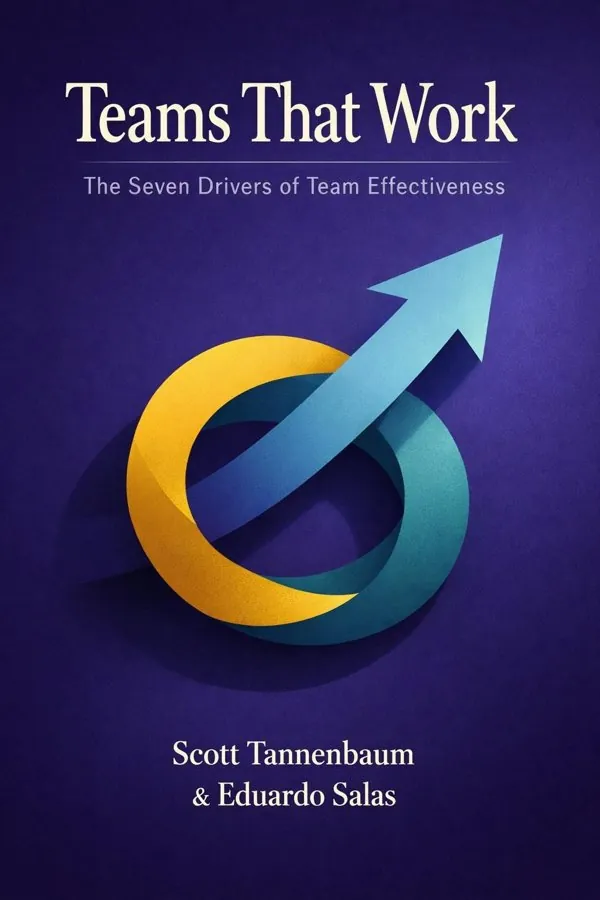
Teams That Work: The Seven Drivers of Team Effectiveness: Summary & Key Insights
by Scott Tannenbaum, Eduardo Salas
 10 min10 chaptersAudio available
What Is Teams That Work: The Seven Drivers of Team Effectiveness About?
Teams That Work: The Seven Drivers of Team Effectiveness by Scott Tannenbaum, Eduardo Salas is a leadership book spanning 10 pages. Teams That Work: The Seven Drivers of Team Effectiveness explores the science behind what makes teams successful. Drawing on decades of research and practical experience, the authors identify seven key drivers that influence team performance, including shared understanding, supportive context, and strong leadership. The book provides actionable insights for managers, team leaders, and members to improve collaboration, communication, and results in any organizational setting.
This FizzRead summary covers all 10 key chapters of Teams That Work: The Seven Drivers of Team Effectiveness in approximately 10 minutes, distilling the most important ideas, arguments, and takeaways from Scott Tannenbaum, Eduardo Salas's work. Also available as an audio summary and Key Quotes Podcast.
Teams That Work: The Seven Drivers of Team Effectiveness
Teams That Work: The Seven Drivers of Team Effectiveness explores the science behind what makes teams successful. Drawing on decades of research and practical experience, the authors identify seven key drivers that influence team performance, including shared understanding, supportive context, and strong leadership. The book provides actionable insights for managers, team leaders, and members to improve collaboration, communication, and results in any organizational setting.
Who Should Read Teams That Work: The Seven Drivers of Team Effectiveness?
This book is perfect for anyone interested in leadership and looking to gain actionable insights in a short read. Whether you're a student, professional, or lifelong learner, the key ideas from Teams That Work: The Seven Drivers of Team Effectiveness by Scott Tannenbaum, Eduardo Salas will help you think differently.
- ✓Readers who enjoy leadership and want practical takeaways
- ✓Professionals looking to apply new ideas to their work and life
- ✓Anyone who wants the core insights of Teams That Work: The Seven Drivers of Team Effectiveness in just 10 minutes
Want the full summary?
Get instant access to this book summary and 100K+ more with Fizz Moment.
Get Free SummaryAvailable on App Store • Free to download
Key Chapters
Before diving into the seven drivers, I want to clarify what we mean by a team that actually “works.” Too many organizations measure team success solely in terms of output—metrics like sales closed, patients treated, or products launched. While outcomes matter, they rarely tell the full story. A team can hit its targets while burning out its members, compromising safety, or learning nothing from the process.
In our research, true effectiveness encompasses three dimensions: performance, learning, and viability. Performance is the immediate execution—meeting goals and maintaining quality. Learning concerns how a team improves over time, acquiring better strategies and building adaptive capacity. Viability refers to sustainability—whether members remain willing and able to keep working together effectively.
A team that merely executes without learning stagnates. One that learns but fails to perform loses credibility. And one that performs and learns but destroys trust and morale cannot endure. Team effectiveness must therefore integrate all three dimensions, and the seven drivers help us do precisely that. They offer the structure through which performance, learning, and viability can coexist and reinforce one another.
Every team begins with its members—their skills, knowledge, and experiences. Capability is not simply about having talented individuals; it’s about having the right constellation of capabilities for the team’s mission. In my own observations, high-performing teams rarely consist of the ‘best’ individuals in isolation. Rather, they’re composed of members whose strengths complement one another, covering the full range of technical, interpersonal, and cognitive skills that the task demands.
Think of a surgical team, for instance. A brilliant surgeon who cannot coordinate with anesthesiologists or nurses can jeopardize a procedure. Capability here is collective readiness—the ability of the team as a system to handle complex, dynamic challenges.
Building capability therefore involves rigorous selection, but also continuous development. Teams that invest in cross-training, who take time to understand one another’s roles and decision processes, expand their collective capability. As leaders, we should view every project as an opportunity to deepen that pool of shared expertise. Over time, high capability manifests as mutual confidence—the quiet assurance that no single failure will derail the team because competence is distributed and reinforced.
+ 8 more chapters — available in the FizzRead app
All Chapters in Teams That Work: The Seven Drivers of Team Effectiveness
About the Authors
Scott Tannenbaum is an organizational psychologist and president of the Group for Organizational Effectiveness, specializing in team and leadership development. Eduardo Salas is a professor of psychology at Rice University and a leading expert in team dynamics, training, and performance. Together, they have collaborated extensively on research and consulting projects focused on improving teamwork across industries.
Get This Summary in Your Preferred Format
Read or listen to the Teams That Work: The Seven Drivers of Team Effectiveness summary by Scott Tannenbaum, Eduardo Salas anytime, anywhere. FizzRead offers multiple formats so you can learn on your terms — all free.
Available formats: App · Audio · PDF · EPUB — All included free with FizzRead
Download Teams That Work: The Seven Drivers of Team Effectiveness PDF and EPUB Summary
Key Quotes from Teams That Work: The Seven Drivers of Team Effectiveness
“Before diving into the seven drivers, I want to clarify what we mean by a team that actually “works.”
“Every team begins with its members—their skills, knowledge, and experiences.”
Frequently Asked Questions about Teams That Work: The Seven Drivers of Team Effectiveness
Teams That Work: The Seven Drivers of Team Effectiveness by Scott Tannenbaum, Eduardo Salas is a leadership book that explores key ideas across 10 chapters. Teams That Work: The Seven Drivers of Team Effectiveness explores the science behind what makes teams successful. Drawing on decades of research and practical experience, the authors identify seven key drivers that influence team performance, including shared understanding, supportive context, and strong leadership. The book provides actionable insights for managers, team leaders, and members to improve collaboration, communication, and results in any organizational setting.
You Might Also Like

Extreme Ownership
Jocko Willink
10 min
Dare to Lead
Brene Brown
10 min
Leaders Eat Last
Simon Sinek
10 min
The 21 Irrefutable Laws of Leadership
John Maxwell
10 min
Start With Why
Simon Sinek
10 min
How to Lead When You're Not in Charge
Clay Scroggins
10 minBrowse by Category
Ready to read Teams That Work: The Seven Drivers of Team Effectiveness?
Get the full summary and 100K+ more books with Fizz Moment.