
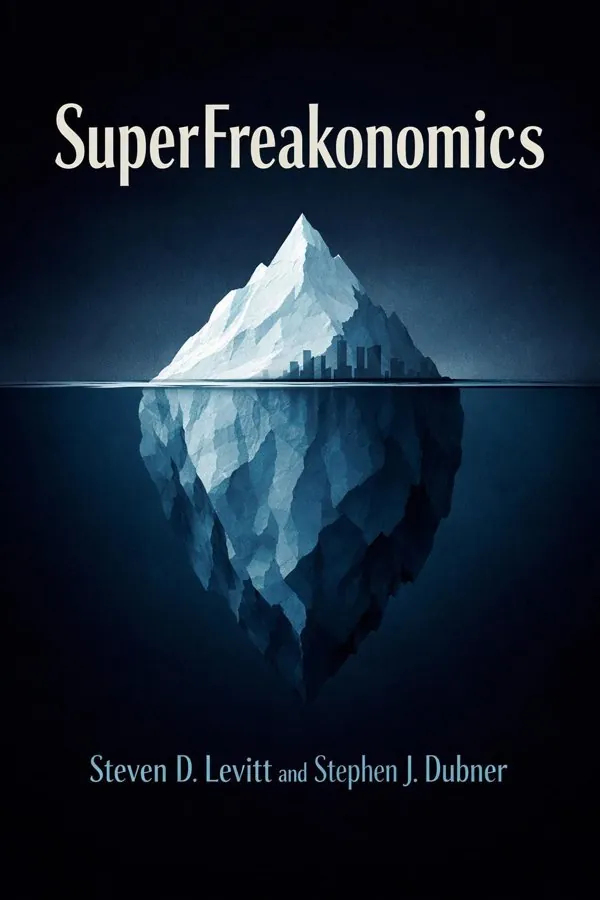
SuperFreakonomics: Global Cooling, Patriotic Prostitutes, and Why Suicide Bombers Should Buy Life Insurance: Summary & Key Insights
by Steven D. Levitt, Stephen J. Dubner
 10 min9 chaptersAudio available
Key Takeaways from SuperFreakonomics: Global Cooling, Patriotic Prostitutes, and Why Suicide Bombers Should Buy Life Insurance
The simplest way to understand human behavior is often the least flattering: people respond to incentives.
One of the book’s most uncomfortable but useful ideas is that self-interest is not the opposite of social good.
A policy can be compassionate, intelligent, and well-funded and still fail spectacularly.
People love stories, but stories often mislead.
What people fear most is often not what is most likely to harm them.
What Is SuperFreakonomics: Global Cooling, Patriotic Prostitutes, and Why Suicide Bombers Should Buy Life Insurance About?
SuperFreakonomics: Global Cooling, Patriotic Prostitutes, and Why Suicide Bombers Should Buy Life Insurance by Steven D. Levitt and Stephen J. Dubner is a economics book spanning 8 pages. SuperFreakonomics is a provocative, data-driven tour through the hidden logic of human behavior. In this follow-up to Freakonomics, Steven D. Levitt and Stephen J. Dubner ask the kinds of questions most people never think to ask: Why do incentives so often backfire? What does prostitution reveal about markets? Why do people misjudge risk? And can big global problems sometimes be solved more cheaply and creatively than experts assume? Rather than offering tidy moral lessons, the book uses economics as a lens for seeing how people actually behave when faced with rewards, pressures, uncertainty, and social expectations. What makes the book matter is its refusal to accept conventional wisdom at face value. Levitt, a renowned University of Chicago economist, brings analytical rigor and a talent for finding patterns in surprising places. Dubner, an accomplished journalist and storyteller, translates complex ideas into memorable narratives. Together, they show that many social problems are less mysterious when you follow incentives, examine data carefully, and remain open to uncomfortable conclusions. SuperFreakonomics is not just about economics; it is about learning to think more clearly in a world full of myths, assumptions, and unintended consequences.
This FizzRead summary covers all 9 key chapters of SuperFreakonomics: Global Cooling, Patriotic Prostitutes, and Why Suicide Bombers Should Buy Life Insurance in approximately 10 minutes, distilling the most important ideas, arguments, and takeaways from Steven D. Levitt and Stephen J. Dubner's work. Also available as an audio summary and Key Quotes Podcast.
SuperFreakonomics: Global Cooling, Patriotic Prostitutes, and Why Suicide Bombers Should Buy Life Insurance
SuperFreakonomics is a provocative, data-driven tour through the hidden logic of human behavior. In this follow-up to Freakonomics, Steven D. Levitt and Stephen J. Dubner ask the kinds of questions most people never think to ask: Why do incentives so often backfire? What does prostitution reveal about markets? Why do people misjudge risk? And can big global problems sometimes be solved more cheaply and creatively than experts assume? Rather than offering tidy moral lessons, the book uses economics as a lens for seeing how people actually behave when faced with rewards, pressures, uncertainty, and social expectations.
What makes the book matter is its refusal to accept conventional wisdom at face value. Levitt, a renowned University of Chicago economist, brings analytical rigor and a talent for finding patterns in surprising places. Dubner, an accomplished journalist and storyteller, translates complex ideas into memorable narratives. Together, they show that many social problems are less mysterious when you follow incentives, examine data carefully, and remain open to uncomfortable conclusions. SuperFreakonomics is not just about economics; it is about learning to think more clearly in a world full of myths, assumptions, and unintended consequences.
Who Should Read SuperFreakonomics: Global Cooling, Patriotic Prostitutes, and Why Suicide Bombers Should Buy Life Insurance?
This book is perfect for anyone interested in economics and looking to gain actionable insights in a short read. Whether you're a student, professional, or lifelong learner, the key ideas from SuperFreakonomics: Global Cooling, Patriotic Prostitutes, and Why Suicide Bombers Should Buy Life Insurance by Steven D. Levitt and Stephen J. Dubner will help you think differently.
- ✓Readers who enjoy economics and want practical takeaways
- ✓Professionals looking to apply new ideas to their work and life
- ✓Anyone who wants the core insights of SuperFreakonomics: Global Cooling, Patriotic Prostitutes, and Why Suicide Bombers Should Buy Life Insurance in just 10 minutes
Want the full summary?
Get instant access to this book summary and 100K+ more with Fizz Moment.
Get Free SummaryAvailable on App Store • Free to download
Key Chapters
The simplest way to understand human behavior is often the least flattering: people respond to incentives. That does not mean everyone is greedy or immoral. It means choices change when costs, benefits, rewards, and penalties change. SuperFreakonomics builds on this core insight by showing how incentives shape behavior in places where moral explanations alone fall short.
Levitt and Dubner argue that incentives are the hidden architecture behind much of everyday life. A parent, employee, criminal, voter, doctor, or politician may describe their actions in noble terms, but behavior often shifts dramatically once incentives shift. This is why badly designed systems can produce bad outcomes even when the people inside them mean well. If a policy rewards appearances rather than results, people optimize appearances. If a rule punishes honesty, people hide information. If a market creates profitable demand, suppliers appear, even when society condemns the product or service.
The book repeatedly illustrates that incentives can be financial, social, moral, or reputational. A prostitute may adjust pricing and client selection based on risk and timing. A terrorist organization may exploit status incentives as much as ideology. Climate policy can fail when symbolic gestures earn praise while practical fixes earn suspicion. The point is not that money explains everything, but that motivations are usually more concrete than people admit.
In real life, this idea applies everywhere: workplace bonuses, school grading, online platforms, public health campaigns, even family routines. When results seem irrational, ask what behavior is being rewarded. Often, the system is functioning exactly as its incentives dictate.
Actionable takeaway: Before judging behavior, map the incentives. Ask, “What does this person or system gain, avoid, or protect by acting this way?”
One of the book’s most uncomfortable but useful ideas is that self-interest is not the opposite of social good. In many cases, it is the mechanism that creates it. SuperFreakonomics challenges the instinct to divide behavior into clean categories of selfish and altruistic. Instead, Levitt and Dubner show that people often do good for mixed reasons, and that well-designed systems can harness self-interest to create better outcomes.
Economics has long treated self-interest as a basic explanatory force, but the authors remind us that this is not a moral accusation. It is an observational tool. A person may donate, cooperate, volunteer, or innovate because they care about others, but also because they gain status, satisfaction, income, safety, or reciprocal support. The key question is not whether motives are pure. It is whether the resulting behavior solves a problem.
This perspective helps explain many social arrangements. Markets work not because people are saints, but because systems can align personal gain with useful action. A business owner serves customers to earn profit. A scientist seeks recognition while producing knowledge. Even behavior that appears noble can involve strategic calculation. Likewise, behavior labeled selfish can sometimes create spillover benefits for others.
The practical power of this idea lies in policy design. Programs often fail when they rely on idealism alone and ignore actual motivation. If you want people to conserve energy, disclose information, or reduce risky behavior, it helps to make the desired choice personally rewarding or socially attractive.
The book does not celebrate selfishness. It encourages realism. Good systems do not demand perfect motives; they channel ordinary motives toward valuable ends.
Actionable takeaway: When trying to change behavior, stop asking for purity of intention and start designing environments where doing the right thing is also in people’s interest.
A policy can be compassionate, intelligent, and well-funded and still fail spectacularly. Why? Because intentions do not determine outcomes; incentives and reactions do. One of the central lessons of SuperFreakonomics is that every intervention changes behavior, often in ways its designers never anticipated.
Levitt and Dubner explore this through stories in which seemingly sensible solutions create new problems. This is the economist’s habit of mind: look beyond the first-order effect and ask what happens next. If a government subsidizes one action, what gaming behavior does it invite? If a safety measure lowers perceived danger, do people become more reckless? If a moral campaign stigmatizes one behavior, does it simply push it underground where it becomes harder to monitor?
This mindset is especially important in public policy, medicine, education, and environmental planning. A law designed to protect workers may reduce hiring. A campaign intended to reduce teen risk may fail if it ignores peer status. A security measure can make people feel safer without making them safer. Even a well-meaning ban can create black markets, inflate profits for bad actors, and worsen the underlying problem.
The authors do not argue that reform is pointless. They argue that serious problem-solving requires humility. Human systems are adaptive. People learn quickly how to exploit loopholes, avoid costs, and reinterpret rules. That means solutions should be tested, measured, and revised rather than defended on moral grounds alone.
In daily life, this applies to parenting, management, and personal habits. A rule at work can inspire compliance or creativity in evasion. A family rule can build trust or encourage secrecy. If behavior changes in a strange direction, that is not always resistance; it may be adaptation.
Actionable takeaway: When considering any solution, ask not only “What problem does this address?” but also “How will people change their behavior once this rule exists?”
People love stories, but stories often mislead. A dramatic anecdote can feel more convincing than a mountain of evidence, even when it points in the wrong direction. SuperFreakonomics argues that if you want to understand the world, you must learn to distrust intuition and look closely at data.
This does not mean numbers are always objective or easy to interpret. It means reality is often less obvious than it seems. The authors use empirical evidence to challenge assumptions about risk, social behavior, and cause and effect. A phenomenon that appears moral may be economic. A trend that seems dangerous may be overstated. A popular explanation may collapse once better data enters the picture.
One of the book’s strengths is showing that good questions matter as much as good statistics. Data is useful only when paired with curiosity. Levitt’s style of thinking involves asking unconventional questions, gathering evidence from overlooked sources, and testing whether accepted beliefs survive contact with facts. Dubner then turns that process into compelling narrative, showing readers that data analysis is not cold abstraction but a detective tool.
In practical terms, this mindset is essential in business, media, politics, and personal decision-making. Before accepting a claim, ask what evidence supports it. Is the sample representative? Is correlation being mistaken for causation? Are rare events dominating attention because they are vivid? In a world flooded with opinion, data offers a way to cut through performance and panic.
The book ultimately champions an evidence-based approach to social understanding. It invites readers to be less impressed by authority, more curious about patterns, and more willing to revise beliefs.
Actionable takeaway: The next time you hear a confident claim, ask, “Compared to what, according to which data, and what else could explain the pattern?”
What people fear most is often not what is most likely to harm them. SuperFreakonomics explores the gap between perceived risk and actual risk, showing that human beings are notoriously bad at evaluating danger. We overreact to vivid, unusual threats and underreact to common, slow-moving ones.
This mismatch has major consequences. Public attention, political energy, and private behavior often cluster around dramatic but statistically rare events. Meanwhile, more ordinary risks receive too little attention because they feel familiar or boring. The authors use this pattern to show how emotion, media coverage, and social narrative distort our judgment. Fear is not random; it follows visibility.
The implications are broad. Individuals may spend heavily to avoid sensational dangers while neglecting more probable health or financial risks. Governments may fund visible security theater while underinvesting in less dramatic but more effective protections. Families may focus on extreme scenarios and ignore habits that matter more over time.
The book also shows that people adapt poorly when risk is bundled with identity or morality. Once an issue becomes symbolic, it becomes harder to discuss probabilities honestly. Rational assessment gives way to signaling, outrage, or wishful thinking. This is one reason debates about public safety, medicine, terrorism, and the environment often generate more heat than clarity.
A better approach is comparative thinking. Instead of asking whether something is frightening, ask how likely it is, how severe it is, and what tradeoffs are involved in reducing it. This does not remove uncertainty, but it improves judgment.
Actionable takeaway: Replace emotional risk questions like “Could this happen?” with analytical ones like “How often does this happen, how serious is it, and what cheaper, higher-impact precautions am I ignoring?”
Large global problems are often treated as if only grand, expensive, morally uplifting solutions count. SuperFreakonomics pushes against this tendency, especially in its discussion of climate change. The authors do not deny the seriousness of environmental problems; instead, they question whether the most celebrated responses are the most effective.
Their argument is rooted in cost-benefit thinking and innovation. If reducing emissions through political coordination is slow, expensive, and globally fragile, should societies also pursue alternative methods that directly reduce warming? This is where the book introduces geoengineering and other unconventional ideas. The point is not that one simple fix solves everything, but that problem-solving should be practical rather than ideological.
The climate discussion became controversial because it challenged the moral framing surrounding environmental action. Levitt and Dubner suggest that when a problem is urgent and incentives for coordinated sacrifice are weak, cheaper and more targeted interventions may deserve serious attention. This is a deeply economic argument: compare alternatives, measure likely impact, and avoid assuming that the most virtuous-seeming path is the best one.
Beyond climate, this lesson applies to every difficult social issue. Prestige often attaches to solutions that signal commitment rather than those that maximize results. Yet innovation frequently comes from outsiders who ask blunt, unromantic questions: What exactly are we trying to change? What is the cheapest lever? What can be tested quickly?
Even when readers disagree with the authors’ conclusions, the underlying habit is valuable. It encourages experimentation, skepticism toward policy theater, and openness to neglected tools.
Actionable takeaway: When facing a large problem, separate symbolic action from effective action and compare solutions by cost, speed, and measurable impact rather than by moral appeal alone.
When people confront difficult social problems, they often reach first for blame, slogans, and political identity. SuperFreakonomics argues that this instinct can block real progress. The book repeatedly suggests that innovation, trial-and-error problem solving, and pragmatic engineering often outperform moral grandstanding.
This is not an argument against ethics. It is an argument against confusing moral intensity with practical effectiveness. A society may loudly condemn pollution, disease, crime, or exploitation and still make little progress if it neglects incentives, technologies, and implementation. By contrast, a less glamorous intervention can transform outcomes if it changes the underlying mechanics of a problem.
The authors highlight thinkers and inventors who look for leverage rather than applause. Instead of demanding that people become better, they ask how systems can be redesigned so that even ordinary behavior leads to better results. This orientation is deeply useful because it respects human limitations. People are inconsistent, distracted, status-conscious, and self-interested. Innovation works best when it accepts that reality rather than wishing it away.
Business leaders, policymakers, and everyday problem-solvers can all use this lesson. If a team is underperforming, a speech about values may matter less than a redesigned incentive structure. If a public campaign is failing, a clever default option or lower-friction process may matter more than more messaging. If a household routine keeps breaking down, a simpler system may beat more discipline.
The deeper contribution of the book is to reframe intelligence itself. Intelligence is not only the ability to criticize. It is the ability to discover workable solutions under real constraints.
Actionable takeaway: The next time you face a stubborn problem, spend less time asking who is at fault and more time asking what low-cost innovation could change behavior immediately.
Even in areas wrapped in taboo, emotion, or patriotism, market forces are still at work. SuperFreakonomics is famous for applying economic reasoning to topics many people prefer to discuss only morally. Prostitution, terrorism, and other socially charged subjects become, in the authors’ hands, opportunities to ask how supply, demand, pricing, and incentives shape behavior.
This does not reduce human life to dollars and cents. It reveals that whenever choices involve scarcity, tradeoffs, and reward, market logic appears. In the book’s discussion of prostitution, for example, social stigma does not eliminate economic calculation. Risk, timing, information, client preferences, and bargaining power still affect prices and decisions. Similarly, in the discussion of suicide terrorism, ideological narratives coexist with strategic incentives and organizational structures.
The benefit of market analysis is clarity. Moral outrage can describe how we feel about a behavior, but it may not explain why the behavior persists. Economics asks what conditions make the behavior sustainable. Who benefits? What risks are being priced in? What substitutes exist? How do rules affect the transaction? Those questions can produce more effective responses than condemnation alone.
This framework also helps in ordinary life. Housing, dating apps, college admissions, healthcare, freelance work, and social media all contain market-like dynamics, even when participants resist that language. Understanding these forces helps explain competition, signaling, reputation, and strategic behavior.
The authors’ broader lesson is that economic reasoning is not confined to banks or stock markets. It is a method for understanding any system in which people respond to constraints and opportunities.
Actionable takeaway: When a social phenomenon seems puzzling or morally baffling, ask what the underlying market is: who wants what, who provides it, what the costs are, and what rules shape the exchange.
It is easy to look backward and impose logic on events. It is much harder to forecast what happens next. SuperFreakonomics emphasizes the limits of prediction, especially in complex social systems where human beings adapt, react, and change the rules while the game is still being played.
The authors show that explanation and prediction are not the same skill. A researcher may identify a pattern in past data without being able to project it reliably into the future. Why? Because once people become aware of incentives, trends, or policies, they respond to them. Social systems are not like physics experiments with fixed particles. They are populated by strategic actors.
This matters because institutions often overestimate their forecasting power. Experts produce confident models, media outlets amplify certainty, and leaders make plans based on assumptions that may be fragile. Economic forecasting, crime prediction, technological diffusion, public health behavior, and political outcomes all contain more uncertainty than pundits usually admit.
The book encourages a humbler form of intelligence: test ideas, update quickly, and build systems that can adapt when predictions fail. In business, that means running experiments instead of betting everything on one forecast. In policy, it means piloting programs before scaling them. In personal life, it means treating plans as revisable rather than sacred.
The deeper message is not pessimism but flexibility. If the future is hard to predict, resilience matters more than confidence. Good decision-makers do not need perfect foresight; they need feedback loops and willingness to learn.
Actionable takeaway: Hold predictions lightly. Build plans that can survive surprises, and prefer small experiments with fast feedback over grand strategies built on certainty.
All Chapters in SuperFreakonomics: Global Cooling, Patriotic Prostitutes, and Why Suicide Bombers Should Buy Life Insurance
About the Authors
Steven D. Levitt is an American economist and professor at the University of Chicago known for applying economic reasoning to unconventional subjects such as crime, corruption, incentives, and social behavior. His research helped expand public interest in economics by showing how data can illuminate surprising patterns in everyday life. Stephen J. Dubner is an American journalist, bestselling author, and former magazine editor celebrated for making complex ideas engaging and accessible. Together, Levitt and Dubner created the Freakonomics series, blending analytical rigor with vivid storytelling. Their collaboration has introduced millions of readers to economics as a way of thinking rather than a technical discipline, encouraging curiosity, skepticism, and a deeper understanding of the hidden forces that shape human decisions.
Get This Summary in Your Preferred Format
Read or listen to the SuperFreakonomics: Global Cooling, Patriotic Prostitutes, and Why Suicide Bombers Should Buy Life Insurance summary by Steven D. Levitt and Stephen J. Dubner anytime, anywhere. FizzRead offers multiple formats so you can learn on your terms — all free.
Available formats: App · Audio · PDF · EPUB — All included free with FizzRead
Download SuperFreakonomics: Global Cooling, Patriotic Prostitutes, and Why Suicide Bombers Should Buy Life Insurance PDF and EPUB Summary
Key Quotes from SuperFreakonomics: Global Cooling, Patriotic Prostitutes, and Why Suicide Bombers Should Buy Life Insurance
“The simplest way to understand human behavior is often the least flattering: people respond to incentives.”
“One of the book’s most uncomfortable but useful ideas is that self-interest is not the opposite of social good.”
“A policy can be compassionate, intelligent, and well-funded and still fail spectacularly.”
“People love stories, but stories often mislead.”
“What people fear most is often not what is most likely to harm them.”
Frequently Asked Questions about SuperFreakonomics: Global Cooling, Patriotic Prostitutes, and Why Suicide Bombers Should Buy Life Insurance
SuperFreakonomics: Global Cooling, Patriotic Prostitutes, and Why Suicide Bombers Should Buy Life Insurance by Steven D. Levitt and Stephen J. Dubner is a economics book that explores key ideas across 9 chapters. SuperFreakonomics is a provocative, data-driven tour through the hidden logic of human behavior. In this follow-up to Freakonomics, Steven D. Levitt and Stephen J. Dubner ask the kinds of questions most people never think to ask: Why do incentives so often backfire? What does prostitution reveal about markets? Why do people misjudge risk? And can big global problems sometimes be solved more cheaply and creatively than experts assume? Rather than offering tidy moral lessons, the book uses economics as a lens for seeing how people actually behave when faced with rewards, pressures, uncertainty, and social expectations. What makes the book matter is its refusal to accept conventional wisdom at face value. Levitt, a renowned University of Chicago economist, brings analytical rigor and a talent for finding patterns in surprising places. Dubner, an accomplished journalist and storyteller, translates complex ideas into memorable narratives. Together, they show that many social problems are less mysterious when you follow incentives, examine data carefully, and remain open to uncomfortable conclusions. SuperFreakonomics is not just about economics; it is about learning to think more clearly in a world full of myths, assumptions, and unintended consequences.
You Might Also Like

Business Adventures
John Brooks
10 min
Nudge
Richard H. Thaler, Cass R. Sunstein
10 min
The Hitchhiker"s Guide to the Galaxy
Douglas Adams
10 minThe Muqaddimah
Ibn Khaldun
10 minThe Outsiders
William N. Thorndike
10 min
A Little History of Economics
Niall Kishtainy
10 minBrowse by Category
Ready to read SuperFreakonomics: Global Cooling, Patriotic Prostitutes, and Why Suicide Bombers Should Buy Life Insurance?
Get the full summary and 100K+ more books with Fizz Moment.