
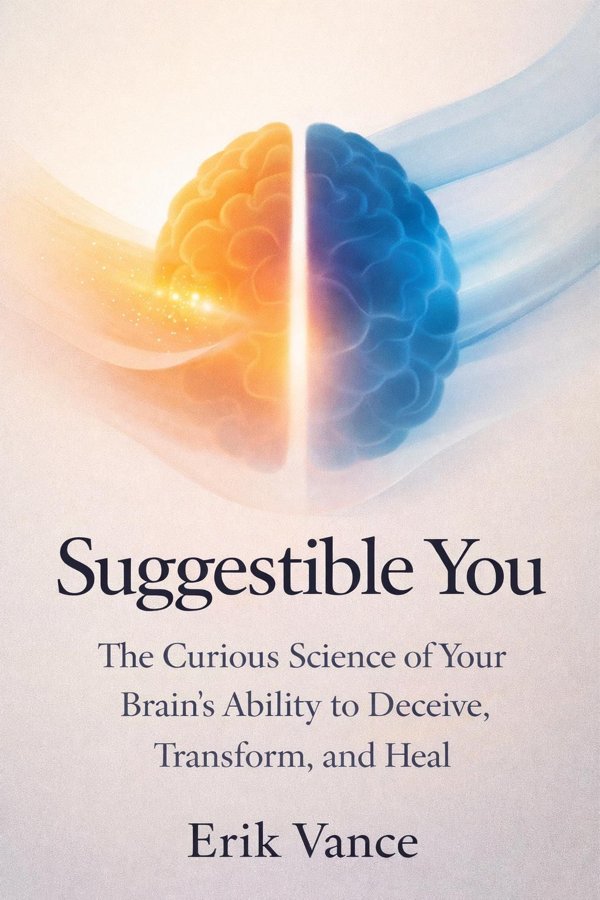
Suggestible You: The Curious Science of Your Brain’s Ability to Deceive, Transform, and Heal: Summary & Key Insights
by Erik Vance
 10 min6 chaptersAudio available
What Is Suggestible You: The Curious Science of Your Brain’s Ability to Deceive, Transform, and Heal About?
Suggestible You: The Curious Science of Your Brain’s Ability to Deceive, Transform, and Heal by Erik Vance is a neuroscience book spanning 6 pages. In this book, science writer Erik Vance explores the fascinating world of suggestion, placebo effects, hypnosis, and the power of belief. Drawing on neuroscience, psychology, and personal stories, he investigates how our expectations and perceptions can shape our physical and mental experiences, sometimes even altering our biology. Through engaging narratives and scientific insights, Vance reveals how the mind’s suggestibility can both heal and deceive us.
This FizzRead summary covers all 6 key chapters of Suggestible You: The Curious Science of Your Brain’s Ability to Deceive, Transform, and Heal in approximately 10 minutes, distilling the most important ideas, arguments, and takeaways from Erik Vance's work. Also available as an audio summary and Key Quotes Podcast.
Suggestible You: The Curious Science of Your Brain’s Ability to Deceive, Transform, and Heal
In this book, science writer Erik Vance explores the fascinating world of suggestion, placebo effects, hypnosis, and the power of belief. Drawing on neuroscience, psychology, and personal stories, he investigates how our expectations and perceptions can shape our physical and mental experiences, sometimes even altering our biology. Through engaging narratives and scientific insights, Vance reveals how the mind’s suggestibility can both heal and deceive us.
Who Should Read Suggestible You: The Curious Science of Your Brain’s Ability to Deceive, Transform, and Heal?
This book is perfect for anyone interested in neuroscience and looking to gain actionable insights in a short read. Whether you're a student, professional, or lifelong learner, the key ideas from Suggestible You: The Curious Science of Your Brain’s Ability to Deceive, Transform, and Heal by Erik Vance will help you think differently.
- ✓Readers who enjoy neuroscience and want practical takeaways
- ✓Professionals looking to apply new ideas to their work and life
- ✓Anyone who wants the core insights of Suggestible You: The Curious Science of Your Brain’s Ability to Deceive, Transform, and Heal in just 10 minutes
Want the full summary?
Get instant access to this book summary and 100K+ more with Fizz Moment.
Get Free SummaryAvailable on App Store • Free to download
Key Chapters
When scientists tell you that a sugar pill can relieve real pain, it sounds like a parable about human gullibility. Yet beneath the surface of that simplicity lies one of the most profound discoveries of modern neuroscience. The placebo effect is not trickery; it’s chemistry triggered by trust and expectation. In my reporting, I visited labs where subjects experience measurable pain relief after receiving inert substances, simply because they believe treatment is underway. PET scans reveal that their brains release endorphins, the body’s natural opioids, in regions similar to those activated by morphine. The key is not the pill itself, but the anticipation — that subtle, invisible whisper in the mind that says, “I’m going to feel better.”
This phenomenon resonates beyond medicine. Whether it’s a patient entering surgery with confidence in their doctor or an athlete feeling an energy surge from a drink labeled “performance-enhancing,” expectation creates physiological cascades that mirror genuine interventions. Our brains are predictive machines. They constantly forecast what’s coming next, and when that forecast aligns with our beliefs, chemistry follows suit.
Yet there’s an important caution here. Placebos aren’t magic — they’re mirrors. They reflect the emotional relationship between belief and biology. When trust is broken, the effect vanishes. When anxiety rises, it reverses. I came to realize that understanding how placebo works is not about tricking ourselves into health, but about appreciating how deeply our perceptions govern our bodies. The doctor’s bedside manner, the ritual of swallowing a pill, the very tone of reassurance activate ancient circuits of healing built through evolution to respond to hope. This is the biology of belief in action.
As I delved deeper into the neuroscience behind suggestibility, I discovered that belief isn’t some ethereal concept floating apart from the body — it’s physically inscribed in neural pathways of reward and anticipation. The brain’s capacity for belief rides upon its dopaminergic system, the same circuitry that drives motivation, pleasure, and addiction. In studies of expectation, when participants anticipate relief or reward, dopamine surges in the nucleus accumbens — the brain’s motivational hub — matching patterns observed in genuine pharmacological stimulation.
This mechanism explains why belief can be intoxicating. When you think a treatment will work, your brain rewards that expectation with chemical reinforcement. The reward loop strengthens belief, and belief heightens the reward. Yet it also explains the darker side — how false hope and manipulation operate. Placebo responses share neurochemical foundations with gambling impulses, romantic infatuation, and cravings. Our biology cannot distinguish between hope rooted in truth and hope born of illusion. This duality is what makes suggestibility both miraculous and morally complex.
In my travels, I met scientists who study patients with Parkinson’s disease. They showed how placebo interventions could momentarily restore fluid movement, a reflection of dopamine’s role in motor control. It feels almost magical — until you recognize that this is the brain performing its own therapy. Belief flips the biochemical switches that drugs usually control. To me, it demonstrates that human consciousness isn’t merely a passive receiver of reality; it’s an active participant in shaping it.
+ 4 more chapters — available in the FizzRead app
All Chapters in Suggestible You: The Curious Science of Your Brain’s Ability to Deceive, Transform, and Heal
About the Author
Erik Vance is an American science journalist whose work focuses on the intersection of science and human behavior. He has written for publications such as National Geographic, The New York Times, and Scientific American. His reporting often explores how belief, perception, and psychology influence health and decision-making.
Get This Summary in Your Preferred Format
Read or listen to the Suggestible You: The Curious Science of Your Brain’s Ability to Deceive, Transform, and Heal summary by Erik Vance anytime, anywhere. FizzRead offers multiple formats so you can learn on your terms — all free.
Available formats: App · Audio · PDF · EPUB — All included free with FizzRead
Download Suggestible You: The Curious Science of Your Brain’s Ability to Deceive, Transform, and Heal PDF and EPUB Summary
Key Quotes from Suggestible You: The Curious Science of Your Brain’s Ability to Deceive, Transform, and Heal
“When scientists tell you that a sugar pill can relieve real pain, it sounds like a parable about human gullibility.”
“The brain’s capacity for belief rides upon its dopaminergic system, the same circuitry that drives motivation, pleasure, and addiction.”
Frequently Asked Questions about Suggestible You: The Curious Science of Your Brain’s Ability to Deceive, Transform, and Heal
Suggestible You: The Curious Science of Your Brain’s Ability to Deceive, Transform, and Heal by Erik Vance is a neuroscience book that explores key ideas across 6 chapters. In this book, science writer Erik Vance explores the fascinating world of suggestion, placebo effects, hypnosis, and the power of belief. Drawing on neuroscience, psychology, and personal stories, he investigates how our expectations and perceptions can shape our physical and mental experiences, sometimes even altering our biology. Through engaging narratives and scientific insights, Vance reveals how the mind’s suggestibility can both heal and deceive us.
You Might Also Like
Anxious
Joseph LeDoux
10 min
Hallucinations
Oliver Sacks
10 min
The Biological Mind: How Brain, Body, and Environment Collaborate to Make Us Who We Are
Alan Jasanoff
10 min
The Feeling of Life Itself: Why Consciousness Is Widespread but Can't Be Computed
Christof Koch
10 min
The No-Nonsense Meditation Book
Steven Laureys
10 min
A General Theory of Love
Thomas Lewis, Fari Amini, Richard Lannon
10 minBrowse by Category
Ready to read Suggestible You: The Curious Science of Your Brain’s Ability to Deceive, Transform, and Heal?
Get the full summary and 100K+ more books with Fizz Moment.