
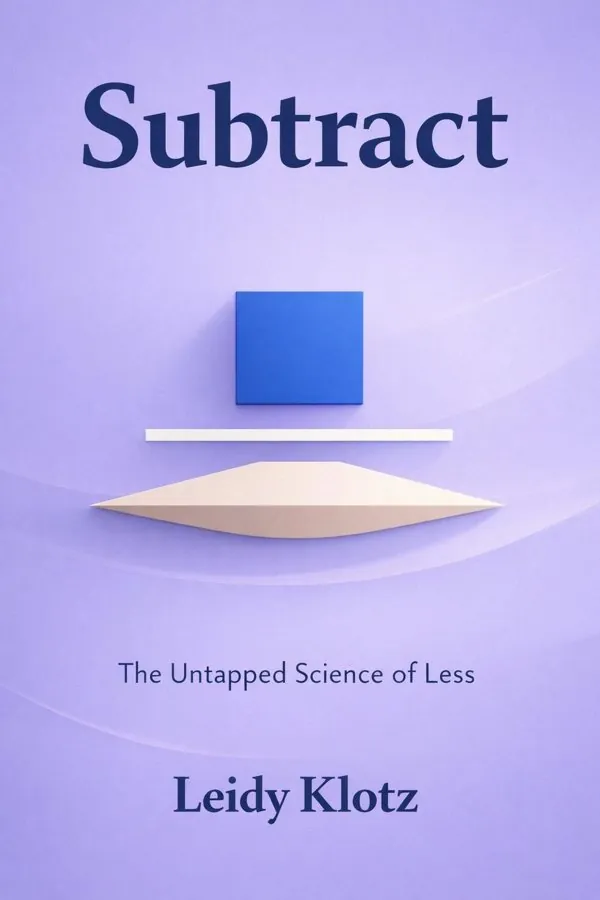
Subtract: The Untapped Science of Less: Summary & Key Insights
by Leidy Klotz
 10 min10 chaptersAudio available
What Is Subtract: The Untapped Science of Less About?
Subtract: The Untapped Science of Less by Leidy Klotz is a mindset book spanning 10 pages. In 'Subtract: The Untapped Science of Less', Leidy Klotz explores why humans tend to add rather than subtract when solving problems, designing systems, or improving their lives. Drawing on research from behavioral science, design, and engineering, Klotz reveals how subtraction—removing, simplifying, and reducing—can lead to more effective solutions and greater satisfaction. The book challenges the cultural bias toward accumulation and addition, offering a new framework for thinking about creativity, efficiency, and progress.
This FizzRead summary covers all 10 key chapters of Subtract: The Untapped Science of Less in approximately 10 minutes, distilling the most important ideas, arguments, and takeaways from Leidy Klotz's work. Also available as an audio summary and Key Quotes Podcast.
Subtract: The Untapped Science of Less
In 'Subtract: The Untapped Science of Less', Leidy Klotz explores why humans tend to add rather than subtract when solving problems, designing systems, or improving their lives. Drawing on research from behavioral science, design, and engineering, Klotz reveals how subtraction—removing, simplifying, and reducing—can lead to more effective solutions and greater satisfaction. The book challenges the cultural bias toward accumulation and addition, offering a new framework for thinking about creativity, efficiency, and progress.
Who Should Read Subtract: The Untapped Science of Less?
This book is perfect for anyone interested in mindset and looking to gain actionable insights in a short read. Whether you're a student, professional, or lifelong learner, the key ideas from Subtract: The Untapped Science of Less by Leidy Klotz will help you think differently.
- ✓Readers who enjoy mindset and want practical takeaways
- ✓Professionals looking to apply new ideas to their work and life
- ✓Anyone who wants the core insights of Subtract: The Untapped Science of Less in just 10 minutes
Want the full summary?
Get instant access to this book summary and 100K+ more with Fizz Moment.
Get Free SummaryAvailable on App Store • Free to download
Key Chapters
The journey begins with acknowledgment — we are wired to add. Across hundreds of studies and thousands of observations, the same pattern emerges: presented with the opportunity to improve something, people add. They add features to designs, steps to processes, arguments to essays. Rarely do they consider subtraction. Even when prompted, the idea of removing feels counterintuitive.
My colleagues and I conducted experiments that capture this beautifully. For instance, when participants were asked to improve a Lego bridge to make it stable, most quickly added bricks. Only a few recognized that removing unnecessary bricks from one side achieved the same goal faster and more efficiently. This wasn’t about intelligence. It was about visibility: subtraction rarely enters the mental list of options.
The bias toward addition stems from the way we frame problems. Adding appears active, creative, and constructive. Removing appears passive or destructive. In behavioral terms, addition triggers reward — the satisfaction of ‘doing something.’ Subtraction, however, feels like absence or loss. We celebrate accumulation, not elimination. So, even when subtraction offers the most elegant path, we overlook it simply because it does not feel like progress.
Recognizing this bias is liberating. Once aware, we start to question our reflexes: Do I need to add this new rule, this new layer of data, or could I remove something instead? Every instance of subtraction uncovers a hidden opportunity — a chance to sculpt rather than build. Through this lens, design, decision-making, and life itself become exercises in refinement, not expansion.
To understand why addition rules our thinking, we must trace its origins to the wiring of the human mind. Evolution favored accumulation — of resources, tools, alliances. In ancient environments where scarcity threatened survival, adding was safer than subtracting. Those who gathered more food, made more nets, or built thicker shelters were rewarded by nature’s selective pressures.
The residue of this survival logic lingers in our modern cognition. Our brains still interpret ‘more’ as safety and success. But the world we inhabit now operates differently. Layers of technology, information, and obligations create overload rather than protection. Yet the instinct persists, quietly shaping every choice.
Psychologically, addition aligns with motivation circuitry — it activates dopaminergic reward pathways. We feel good when we act, when we add, when we expand. Subtraction lacks that feedback. Moreover, cognitive heuristics—those shortcuts we use to save mental energy—favor visible actions. Removing is subtle, harder to visualize. When we stand before a blank canvas, the brushstroke appears; the decision not to paint does not. That invisibility of subtraction makes it harder for the brain to acknowledge it as progress.
Understanding these roots offers empathy: we subtract not because we are lazy, but because evolution didn’t equip us to celebrate less. Still, recognizing this allows us to evolve beyond our wiring—to design systems and habits that cultivate awareness, reminding ourselves that removal is an act of creation too.
+ 8 more chapters — available in the FizzRead app
All Chapters in Subtract: The Untapped Science of Less
About the Author
Leidy Klotz is a professor at the University of Virginia, where he studies the intersection of engineering, design, and behavioral science. His research focuses on how people make decisions about adding and subtracting in pursuit of improvement. Klotz has published widely in academic journals and popular media, and his work has been featured in outlets such as The Washington Post, Harvard Business Review, and Nature.
Get This Summary in Your Preferred Format
Read or listen to the Subtract: The Untapped Science of Less summary by Leidy Klotz anytime, anywhere. FizzRead offers multiple formats so you can learn on your terms — all free.
Available formats: App · Audio · PDF · EPUB — All included free with FizzRead
Download Subtract: The Untapped Science of Less PDF and EPUB Summary
Key Quotes from Subtract: The Untapped Science of Less
“The journey begins with acknowledgment — we are wired to add.”
“To understand why addition rules our thinking, we must trace its origins to the wiring of the human mind.”
Frequently Asked Questions about Subtract: The Untapped Science of Less
Subtract: The Untapped Science of Less by Leidy Klotz is a mindset book that explores key ideas across 10 chapters. In 'Subtract: The Untapped Science of Less', Leidy Klotz explores why humans tend to add rather than subtract when solving problems, designing systems, or improving their lives. Drawing on research from behavioral science, design, and engineering, Klotz reveals how subtraction—removing, simplifying, and reducing—can lead to more effective solutions and greater satisfaction. The book challenges the cultural bias toward accumulation and addition, offering a new framework for thinking about creativity, efficiency, and progress.
You Might Also Like


Browse by Category
Ready to read Subtract: The Untapped Science of Less?
Get the full summary and 100K+ more books with Fizz Moment.