
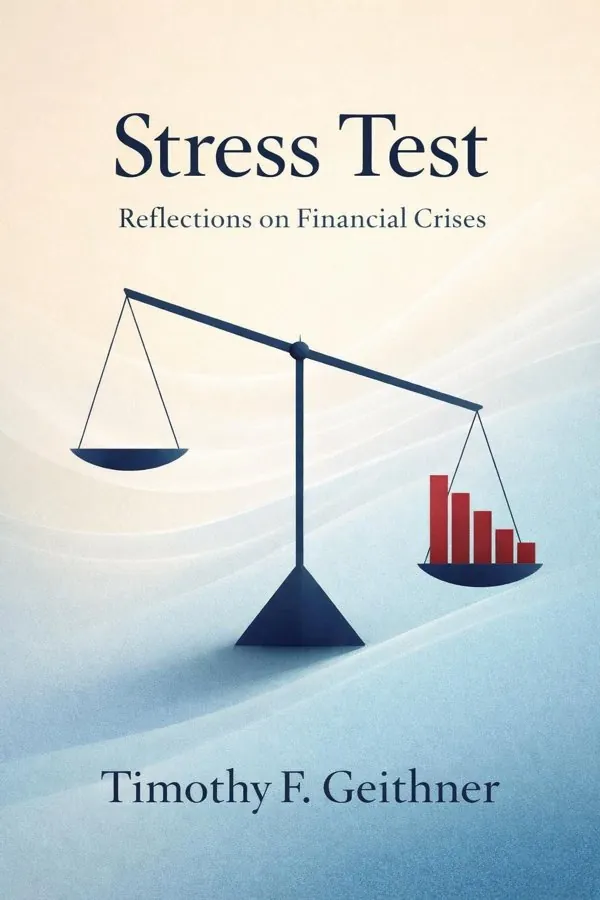
Stress Test: Reflections on Financial Crises: Summary & Key Insights
 10 min12 chaptersAudio available
What Is Stress Test: Reflections on Financial Crises About?
Stress Test: Reflections on Financial Crises by Timothy F. Geithner is a economics book spanning 12 pages. In this candid memoir, former U.S. Treasury Secretary Timothy F. Geithner recounts his experience managing the 2008 global financial crisis. He provides an insider’s view of the decisions, debates, and pressures that shaped the U.S. government’s response to the worst economic collapse since the Great Depression. Geithner explains the rationale behind controversial rescue measures, the lessons learned from the crisis, and his reflections on leadership under extreme stress.
This FizzRead summary covers all 12 key chapters of Stress Test: Reflections on Financial Crises in approximately 10 minutes, distilling the most important ideas, arguments, and takeaways from Timothy F. Geithner's work. Also available as an audio summary and Key Quotes Podcast.
Stress Test: Reflections on Financial Crises
In this candid memoir, former U.S. Treasury Secretary Timothy F. Geithner recounts his experience managing the 2008 global financial crisis. He provides an insider’s view of the decisions, debates, and pressures that shaped the U.S. government’s response to the worst economic collapse since the Great Depression. Geithner explains the rationale behind controversial rescue measures, the lessons learned from the crisis, and his reflections on leadership under extreme stress.
Who Should Read Stress Test: Reflections on Financial Crises?
This book is perfect for anyone interested in economics and looking to gain actionable insights in a short read. Whether you're a student, professional, or lifelong learner, the key ideas from Stress Test: Reflections on Financial Crises by Timothy F. Geithner will help you think differently.
- ✓Readers who enjoy economics and want practical takeaways
- ✓Professionals looking to apply new ideas to their work and life
- ✓Anyone who wants the core insights of Stress Test: Reflections on Financial Crises in just 10 minutes
Want the full summary?
Get instant access to this book summary and 100K+ more with Fizz Moment.
Get Free SummaryAvailable on App Store • Free to download
Key Chapters
My life in public service began long before the 2008 crisis made me a household name. In my early years at the Treasury Department under Robert Rubin and Lawrence Summers, I immersed myself in the turbulent landscape of international finance. The Asian financial crisis of the late 1990s was my first real exposure to systemic panic—how fear and uncertainty can turn solvency problems into full-blown financial contagion. Later, as Undersecretary for International Affairs, and then at the IMF, I observed how fragile emerging economies could be when confidence evaporates. These experiences shaped not only my understanding of finance, but also my instinct for crisis management: act decisively, communicate clearly, and don’t be paralyzed by the perfect becoming the enemy of the good.
When I became President of the Federal Reserve Bank of New York in 2003, I inherited new responsibilities. The U.S. financial system looked calm on the surface. The economy was expanding, and Wall Street was engineering complex new forms of credit and risk distribution. But beneath the optimism, leverage was accumulating, regulation was fragmented, and complacency was pervasive. Serving at the Fed taught me something fundamental: stability breeds the seeds of instability. When the system looks safest, that’s when it’s often most exposed.
By 2006 and 2007, troubling signs began to appear. The housing market had inflated into a bubble supported by a vast, fragile network of subprime mortgages, derivatives, and off-balance-sheet vehicles that no regulator fully understood. Banks were borrowing heavily relative to their capital, and confidence in financial innovation blinded many to its risks. This was not a crisis triggered by one bad actor but by a collective delusion—the belief that markets could self-correct even in the absence of adequate oversight.
Within the Fed and Treasury, we discussed leverage ratios, securitization, and capital adequacy. Yet despite warnings from some quarters, the system’s vulnerabilities were deeply embedded. The very tools that had once made risk seem manageable—the ability to hedge, to tranche, to securitize—had also made it dangerously opaque. These were conditions ripe for panic: when no one truly knows who is solvent, everyone assumes no one is.
+ 10 more chapters — available in the FizzRead app
All Chapters in Stress Test: Reflections on Financial Crises
About the Author
Timothy F. Geithner served as the 75th United States Secretary of the Treasury from 2009 to 2013 under President Barack Obama. Before that, he was President of the Federal Reserve Bank of New York. After leaving public office, he became President of Warburg Pincus, a global private equity firm. Geithner is known for his expertise in financial policy and crisis management.
Get This Summary in Your Preferred Format
Read or listen to the Stress Test: Reflections on Financial Crises summary by Timothy F. Geithner anytime, anywhere. FizzRead offers multiple formats so you can learn on your terms — all free.
Available formats: App · Audio · PDF · EPUB — All included free with FizzRead
Download Stress Test: Reflections on Financial Crises PDF and EPUB Summary
Key Quotes from Stress Test: Reflections on Financial Crises
“My life in public service began long before the 2008 crisis made me a household name.”
“By 2006 and 2007, troubling signs began to appear.”
Frequently Asked Questions about Stress Test: Reflections on Financial Crises
Stress Test: Reflections on Financial Crises by Timothy F. Geithner is a economics book that explores key ideas across 12 chapters. In this candid memoir, former U.S. Treasury Secretary Timothy F. Geithner recounts his experience managing the 2008 global financial crisis. He provides an insider’s view of the decisions, debates, and pressures that shaped the U.S. government’s response to the worst economic collapse since the Great Depression. Geithner explains the rationale behind controversial rescue measures, the lessons learned from the crisis, and his reflections on leadership under extreme stress.
You Might Also Like
Business Adventures
John Brooks
10 min
Nudge
Richard H. Thaler, Cass R. Sunstein
10 min
The Hitchhiker"s Guide to the Galaxy
Douglas Adams
10 minThe Muqaddimah
Ibn Khaldun
10 minThe Outsiders
William N. Thorndike
10 min
A Little History of Economics
Niall Kishtainy
10 minBrowse by Category
Ready to read Stress Test: Reflections on Financial Crises?
Get the full summary and 100K+ more books with Fizz Moment.