
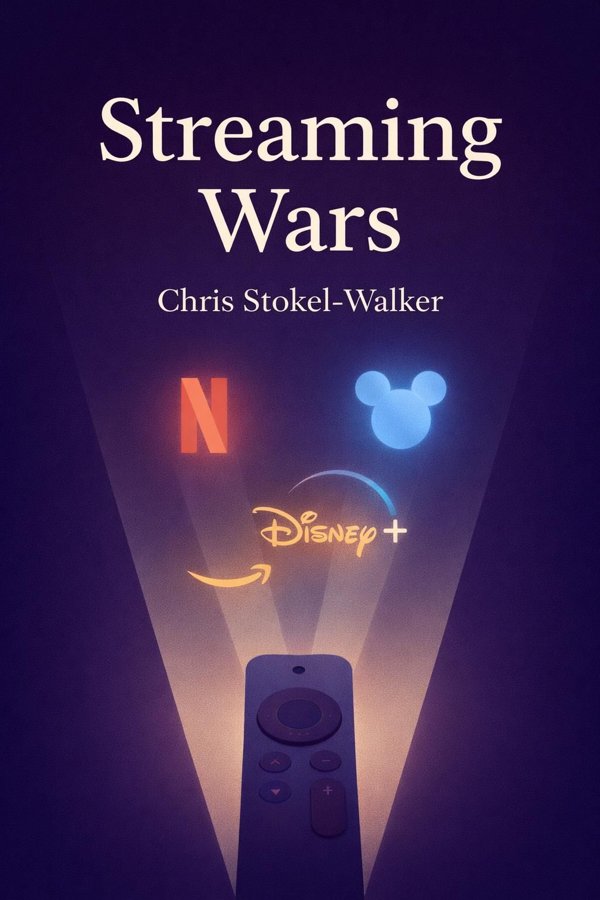
Streaming Wars: Summary & Key Insights
 10 min9 chaptersAudio available
Key Takeaways from Streaming Wars
One of the most important shifts in media history began with a deceptively simple promise: viewers should decide what to watch and when to watch it.
Disruption often looks obvious in hindsight, but at the time it usually appears risky, expensive, and slightly absurd.
Established empires rarely surrender quietly, especially when they suddenly realize the future is arriving faster than expected.
In the streaming era, one number came to dominate headlines, investor calls, and corporate strategy: subscribers.
The streaming revolution did not just change how content is delivered; it changed how content is discovered.
What Is Streaming Wars About?
Streaming Wars by Chris Stokel-Walker is a digital_culture book spanning 5 pages. Streaming Wars by Chris Stokel-Walker is a sharp, timely look at the battle to control the future of entertainment. What began as a convenient way to watch movies and television on demand has become a global struggle involving technology companies, Hollywood studios, telecom giants, and billions of viewers. Stokel-Walker examines how Netflix disrupted the old order, how Disney, Amazon, Apple, and Warner responded, and why the race for subscribers has reshaped everything from what gets made to how culture spreads across borders. The book matters because streaming is no longer just about entertainment; it is about data, attention, pricing power, and the changing relationship between consumers and media corporations. It helps explain why audiences now expect instant access, why beloved shows disappear overnight, and why companies spend staggering sums to win loyalty in an overcrowded market. As a journalist who has written extensively about technology, media, and digital culture, Stokel-Walker brings both industry knowledge and narrative clarity to a fast-moving subject. His book offers a useful map of the forces transforming modern media.
This FizzRead summary covers all 9 key chapters of Streaming Wars in approximately 10 minutes, distilling the most important ideas, arguments, and takeaways from Chris Stokel-Walker's work. Also available as an audio summary and Key Quotes Podcast.
Streaming Wars
Streaming Wars by Chris Stokel-Walker is a sharp, timely look at the battle to control the future of entertainment. What began as a convenient way to watch movies and television on demand has become a global struggle involving technology companies, Hollywood studios, telecom giants, and billions of viewers. Stokel-Walker examines how Netflix disrupted the old order, how Disney, Amazon, Apple, and Warner responded, and why the race for subscribers has reshaped everything from what gets made to how culture spreads across borders. The book matters because streaming is no longer just about entertainment; it is about data, attention, pricing power, and the changing relationship between consumers and media corporations. It helps explain why audiences now expect instant access, why beloved shows disappear overnight, and why companies spend staggering sums to win loyalty in an overcrowded market. As a journalist who has written extensively about technology, media, and digital culture, Stokel-Walker brings both industry knowledge and narrative clarity to a fast-moving subject. His book offers a useful map of the forces transforming modern media.
Who Should Read Streaming Wars?
This book is perfect for anyone interested in digital_culture and looking to gain actionable insights in a short read. Whether you're a student, professional, or lifelong learner, the key ideas from Streaming Wars by Chris Stokel-Walker will help you think differently.
- ✓Readers who enjoy digital_culture and want practical takeaways
- ✓Professionals looking to apply new ideas to their work and life
- ✓Anyone who wants the core insights of Streaming Wars in just 10 minutes
Want the full summary?
Get instant access to this book summary and 100K+ more with Fizz Moment.
Get Free SummaryAvailable on App Store • Free to download
Key Chapters
One of the most important shifts in media history began with a deceptively simple promise: viewers should decide what to watch and when to watch it. For most of the twentieth century, television was organized around schedules. Broadcasters controlled timing, audiences adapted their routines, and advertising funded the entire arrangement. Streaming overturned that logic. Instead of scarcity, it offered abundance. Instead of waiting, it offered instant access. Instead of programming grids, it offered searchable libraries available on phones, laptops, and smart TVs.
Stokel-Walker shows that this change did not happen overnight. It required faster internet connections, improvements in data compression, smarter recommendation tools, and widespread comfort with digital payments. Early experiments in online video often looked clumsy or limited, but they proved that convenience could outweigh tradition. Netflix became the breakthrough case because it understood that technology alone was not enough; the service had to feel easier and more personal than old television.
The broader consequence was psychological as much as technical. Audiences stopped thinking of content as something delivered at a certain hour and started thinking of it as something permanently available. This changed expectations across the entire industry. People now abandon platforms that feel hard to navigate, complain when episodes release too slowly, and treat seamless access as a basic right rather than a premium feature.
A practical way to apply this idea is to notice how your own expectations have been trained by streaming. If you work in media, education, or any digital service, ask whether you still design around your institution’s timetable rather than the user’s convenience. The actionable takeaway: in a streaming-shaped world, control is the product—give people flexibility, and they will reward you with attention.
Disruption often looks obvious in hindsight, but at the time it usually appears risky, expensive, and slightly absurd. Netflix began as a DVD-by-mail company, hardly the profile of a future media empire. Yet Stokel-Walker shows how the company’s real genius was strategic reinvention. Netflix recognized earlier than most rivals that digital distribution would eventually replace physical delivery, and it was willing to undermine its own successful model before competitors did it for them.
That willingness mattered because incumbents were trapped by profitable old systems. Cable bundles, licensing deals, and broadcast advertising still generated huge revenues for legacy firms, so they hesitated to embrace a lower-margin future. Netflix, by contrast, had less to lose and more to gain. It focused relentlessly on user experience, subscription simplicity, and content breadth. Then it took a second leap: making original programming. Once House of Cards and Orange Is the New Black proved that streaming platforms could produce prestige hits, Netflix was no longer merely a distributor. It had become a studio, a brand, and a direct relationship with the audience.
This strategy had huge implications. It pushed the entire market toward subscription economics and encouraged investors to value growth over short-term profit. It also taught competitors that owning customer relationships and exclusive content was more powerful than renting attention through third-party distributors.
For readers, the lesson goes beyond entertainment. Markets often change because a company solves a convenience problem and then expands into adjacent activities. Consider how many industries are vulnerable to the same pattern. The actionable takeaway: if you want to understand where a business is headed, watch for the moment it stops defending its original model and starts replacing it.
Established empires rarely surrender quietly, especially when they suddenly realize the future is arriving faster than expected. Stokel-Walker explains how the success of Netflix forced traditional entertainment companies to rethink decades of assumptions. Disney, WarnerMedia, NBCUniversal, and others initially benefited from licensing content to streamers. But over time they saw a dangerous pattern: they were supplying the very platforms that were weakening their own television networks, cable channels, and theatrical leverage.
The response was dramatic. Companies reclaimed rights, launched direct-to-consumer services, and restructured themselves around streaming. Disney+ became the clearest example of how a legacy giant could mobilize beloved intellectual property, global marketing, and deep production capabilities to enter the market at scale. Franchises like Marvel, Star Wars, and Pixar were not just entertainment assets; they were weapons in a competitive battle for monthly subscriptions.
Yet the move came with costs. By pulling content from third-party platforms, media companies sacrificed licensing revenue in exchange for uncertain subscriber growth. They also discovered that running a streaming platform required capabilities they had not fully mastered, including software design, personalization, retention analytics, and constant product iteration. Owning great shows did not automatically mean being great at digital service management.
This chapter of the streaming wars illustrates a wider business truth: incumbents can adapt, but adaptation often demands painful trade-offs. You cannot preserve the old model and dominate the new one without conflict. For professionals in any field, this is a reminder that defensive delay can be more dangerous than imperfect action. The actionable takeaway: when market conditions shift, assess which legacy advantages remain useful and which ones have become anchors holding you back.
In the streaming era, one number came to dominate headlines, investor calls, and corporate strategy: subscribers. Stokel-Walker highlights how platforms turned audience membership into the key measure of power. The logic was straightforward. More subscribers meant more recurring revenue, more data, more market credibility, and a larger base over which to spread the enormous costs of content and technology. But this focus also created distortions.
Companies began spending extraordinary sums to acquire and retain users. Introductory discounts, blockbuster originals, sports rights, and expensive international launches were all justified in the name of growth. For years, Wall Street rewarded this behavior, especially when interest rates were low and investors were willing to fund long-term expansion. Yet subscriber growth can be deceptive. A platform may gain millions of users while still losing money, suffering high churn, or depending on a handful of prestige hits to prevent cancellations.
The result was a business environment that often looked more like a land grab than a stable industry. Platforms were not merely competing for entertainment budgets; they were racing to become indispensable before consumers hit subscription fatigue. As prices rose and households began reevaluating which services they truly used, growth at any cost became harder to sustain.
This idea applies widely in digital business. Metrics can illuminate reality, but they can also narrow vision. A company that fixates on one number may miss profitability, loyalty, or long-term resilience. As a consumer, you can apply the same thinking by reviewing which services you actually value versus those you keep out of habit. The actionable takeaway: treat headline growth metrics with skepticism and always ask what quality, cost, and sustainability lie beneath them.
The streaming revolution did not just change how content is delivered; it changed how content is discovered. In the old system, editors, critics, schedulers, and channel identities played a major role in guiding attention. Streaming platforms replaced much of that visible curation with recommendation engines. Stokel-Walker examines how algorithms now influence what viewers see first, what gets promoted, what fades into the background, and even what kinds of shows are commissioned in the first place.
Recommendation systems are often presented as neutral helpers, but they are deeply connected to business goals. A platform wants you to keep watching, avoid cancellation, and feel that its library is constantly relevant. That means the interface itself becomes a battleground. Thumbnail images change. Categories shift. Trailers autoplay. Different users encounter different versions of the same service. What appears to be personal taste may partly be a response to what the system keeps surfacing.
These tools can be beneficial. They reduce search costs, help niche content find audiences, and create surprisingly accurate suggestions. But they also narrow visibility. If a show is not boosted, many users may never know it exists. This affects culture as well as commerce: shared mass audiences become rarer, and attention is fragmented into customized streams.
There is a practical lesson here for viewers and creators alike. If you rely entirely on platform recommendations, you may mistake algorithmic convenience for genuine preference. Try searching beyond the homepage, following independent critics, or creating intentional watch lists. The actionable takeaway: do not let the platform fully decide your cultural diet—use recommendations as a tool, not as your only guide.
When every platform needs exclusive reasons for people to subscribe, content stops being just programming and becomes ammunition. Stokel-Walker describes how the streaming wars triggered a spending frenzy unlike anything entertainment had seen before. Companies poured billions into scripted dramas, documentaries, reality formats, children’s programming, and franchise extensions. The goal was not simply to make good shows. It was to make enough must-watch content to justify a recurring monthly fee and prevent users from clicking cancel.
This arms race had mixed effects. On one hand, it created opportunities for creators, expanded the range of stories being told, and enabled riskier projects that might never have survived under traditional broadcast logic. On the other hand, it inflated budgets, intensified pressure for immediate impact, and encouraged platforms to greenlight projects according to strategic needs rather than artistic patience. A series could be lavishly funded one year and canceled abruptly the next if it failed to meet opaque retention or completion benchmarks.
The obsession with exclusivity also changed the value of intellectual property. Familiar franchises became especially prized because they offered built-in audiences and merchandising potential. Original ideas still mattered, but recognizable brands often got priority because they reduced uncertainty in an increasingly crowded market.
For anyone in a creative industry, this dynamic offers a caution. More money in a sector does not automatically mean healthier conditions. It may produce abundance while increasing insecurity. As a viewer, you can support diverse storytelling by actively watching beyond giant franchises and finishing shows you value. The actionable takeaway: pay attention not just to what platforms spend, but to what kinds of stories that spending encourages and what it leaves behind.
A streaming platform may launch in Silicon Valley or Hollywood, but its real ambition is planetary. Stokel-Walker emphasizes that the streaming wars are not confined to the United States. Growth increasingly depends on international markets, where hundreds of millions of future subscribers live and where competition for local attention can be fierce. This global dimension changes everything from pricing to production strategy.
Netflix was especially aggressive in treating the world as one interconnected market. By investing in local-language originals from South Korea, Spain, India, and elsewhere, it did more than expand its catalog. It proved that a show made for one market could become a worldwide phenomenon. Series such as Money Heist and Squid Game demonstrated that subtitles were no longer the barrier executives once feared. This encouraged platforms to think globally while producing locally.
But international expansion is not simple. Companies must navigate regulations, censorship rules, broadband limitations, payment systems, and cultural preferences that differ radically by country. A business model that works in North America may fail in a price-sensitive market where mobile-first viewing dominates and piracy remains widespread. Local competitors may also understand audiences better than global giants do.
The larger lesson is that digital scale does not erase local reality. If anything, it makes cultural adaptation more important. Readers can apply this insight beyond media: any platform business that assumes one-size-fits-all expansion will eventually collide with regional complexity. The actionable takeaway: whenever a company claims global dominance, ask how well it understands local habits, local rules, and local storytelling traditions.
Streaming promised liberation from rigid schedules, bloated cable packages, and limited choice. In many ways, it delivered. Viewers can now watch across devices, pause and resume anywhere, and explore a far wider range of content than earlier generations could imagine. Yet Stokel-Walker makes clear that consumer empowerment came with unexpected frustrations. As more companies launched their own services, convenience gave way to fragmentation.
Instead of one cable bill, households now juggle multiple subscriptions. Instead of a unified library, content is scattered across exclusive platforms. A beloved show can vanish when rights shift. Price increases arrive quietly. Ad-supported tiers reintroduce interruptions many users thought they had escaped. Password-sharing crackdowns further reveal the tension between platform growth strategies and consumer habits.
This is a classic pattern in digital markets. Early disruption often feels inexpensive and liberating because firms are subsidizing adoption. Later, once behavior changes and competitors multiply, costs rise and the user experience becomes more complicated. What looked like a simple replacement for old television starts to resemble a new bundle, only distributed differently.
For viewers, this means becoming more deliberate. Rotating subscriptions, tracking renewals, and prioritizing a few genuinely valued services can reduce both cost and clutter. For businesses, it is a reminder that customer trust depends not only on innovation but on maintaining simplicity over time. The actionable takeaway: treat streaming as an active budgeting decision rather than a passive default, and regularly audit whether the convenience you are paying for still exists.
The most important question in the streaming wars is no longer who can launch fastest; it is who can survive profitably. Stokel-Walker argues that the industry’s next phase will be defined by discipline rather than exuberance. After years of expansion fueled by investor optimism, platforms are under pressure to prove that streaming can generate durable returns. That means rethinking pricing, advertising, bundling, licensing, and content strategy.
Several trends point to this transition. Ad-supported tiers acknowledge that subscription-only models may leave money on the table. Bundling is reemerging because consumers resist paying separately for every service. Some companies are rediscovering the value of licensing content instead of hoarding every title exclusively. Others are focusing on fewer, more strategic originals rather than sheer volume. In short, the market is becoming less ideological and more pragmatic.
This matters because it reveals that streaming was never purely a technology story. It is an economics story. Platforms need enough revenue to support content production, enough retention to justify customer acquisition costs, and enough flexibility to adapt when audience behavior changes. The winners may not be those with the biggest libraries, but those with the clearest value proposition and the most resilient business model.
Readers can use this framework whenever they evaluate a digital service. Ask not only whether it is popular, but whether its economics make sense. Unsustainable convenience eventually disappears or gets repriced. The actionable takeaway: judge the future of streaming through the lens of business sustainability, because lasting media revolutions depend on workable economics, not just exciting innovation.
All Chapters in Streaming Wars
About the Author
Chris Stokel-Walker is a British journalist and author who specializes in technology, media, and digital culture. He has written for prominent publications including The Guardian, Wired, and The Economist, where he has covered the ways digital platforms reshape business, communication, and everyday life. His reporting often focuses on the intersection of innovation and power, making complex industries understandable to general readers without losing analytical depth. That expertise makes him especially well suited to explain the streaming boom, which sits at the crossroads of Silicon Valley ambition and Hollywood reinvention. In Streaming Wars, Stokel-Walker brings together industry insight, careful research, and clear storytelling to show how online video changed not only television, but the wider economics and culture of media consumption.
Get This Summary in Your Preferred Format
Read or listen to the Streaming Wars summary by Chris Stokel-Walker anytime, anywhere. FizzRead offers multiple formats so you can learn on your terms — all free.
Available formats: App · Audio · PDF · EPUB — All included free with FizzRead
Download Streaming Wars PDF and EPUB Summary
Key Quotes from Streaming Wars
“One of the most important shifts in media history began with a deceptively simple promise: viewers should decide what to watch and when to watch it.”
“Disruption often looks obvious in hindsight, but at the time it usually appears risky, expensive, and slightly absurd.”
“Established empires rarely surrender quietly, especially when they suddenly realize the future is arriving faster than expected.”
“In the streaming era, one number came to dominate headlines, investor calls, and corporate strategy: subscribers.”
“The streaming revolution did not just change how content is delivered; it changed how content is discovered.”
Frequently Asked Questions about Streaming Wars
Streaming Wars by Chris Stokel-Walker is a digital_culture book that explores key ideas across 9 chapters. Streaming Wars by Chris Stokel-Walker is a sharp, timely look at the battle to control the future of entertainment. What began as a convenient way to watch movies and television on demand has become a global struggle involving technology companies, Hollywood studios, telecom giants, and billions of viewers. Stokel-Walker examines how Netflix disrupted the old order, how Disney, Amazon, Apple, and Warner responded, and why the race for subscribers has reshaped everything from what gets made to how culture spreads across borders. The book matters because streaming is no longer just about entertainment; it is about data, attention, pricing power, and the changing relationship between consumers and media corporations. It helps explain why audiences now expect instant access, why beloved shows disappear overnight, and why companies spend staggering sums to win loyalty in an overcrowded market. As a journalist who has written extensively about technology, media, and digital culture, Stokel-Walker brings both industry knowledge and narrative clarity to a fast-moving subject. His book offers a useful map of the forces transforming modern media.
You Might Also Like
An Ugly Truth: Inside Facebook’s Battle for Domination
Sheera Frenkel, Cecilia Kang
10 min
Cyber Citizens
Ian Goodfellow
10 min
Digital Minimalism: Choosing a Focused Life in a Noisy World
Cal Newport
10 min
E‑Books & Beyond
Various Authors
10 min
The Future of Media
Various Authors
10 min
This Is Why We Can't Have Nice Things
Whitney Phillips
10 minBrowse by Category
Ready to read Streaming Wars?
Get the full summary and 100K+ more books with Fizz Moment.