
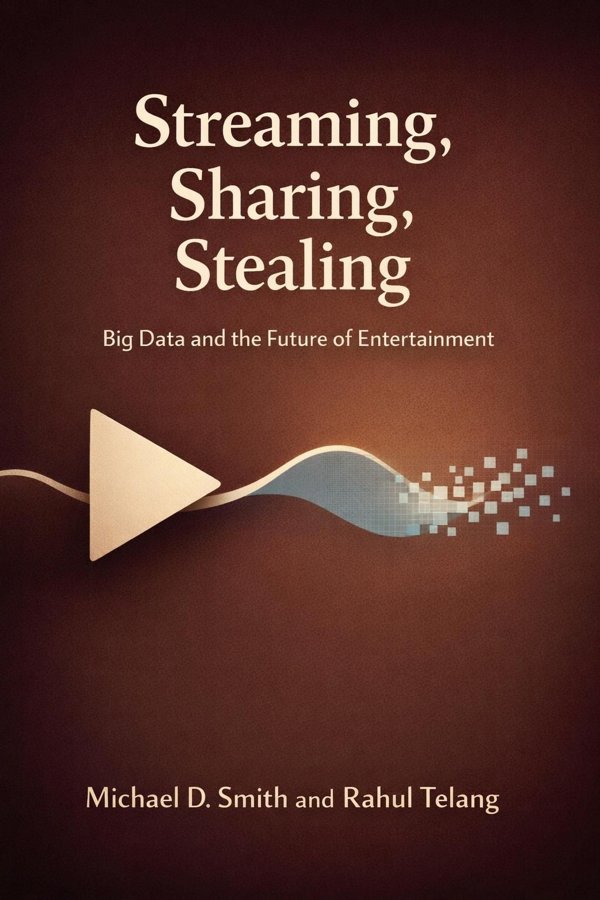
Streaming, Sharing, Stealing: Big Data and the Future of Entertainment: Summary & Key Insights
by Michael D. Smith, Rahul Telang
 10 min8 chaptersAudio available
What Is Streaming, Sharing, Stealing: Big Data and the Future of Entertainment About?
Streaming, Sharing, Stealing: Big Data and the Future of Entertainment by Michael D. Smith and Rahul Telang is a digital_culture book spanning 8 pages. This book explores how digital technologies and big data have transformed the entertainment industry, from music and movies to television and publishing. The authors analyze how streaming, sharing, and piracy have disrupted traditional business models and how creators and companies can adapt to the new digital landscape.
This FizzRead summary covers all 8 key chapters of Streaming, Sharing, Stealing: Big Data and the Future of Entertainment in approximately 10 minutes, distilling the most important ideas, arguments, and takeaways from Michael D. Smith and Rahul Telang's work. Also available as an audio summary and Key Quotes Podcast.
Streaming, Sharing, Stealing: Big Data and the Future of Entertainment
This book explores how digital technologies and big data have transformed the entertainment industry, from music and movies to television and publishing. The authors analyze how streaming, sharing, and piracy have disrupted traditional business models and how creators and companies can adapt to the new digital landscape.
Who Should Read Streaming, Sharing, Stealing: Big Data and the Future of Entertainment?
This book is perfect for anyone interested in digital_culture and looking to gain actionable insights in a short read. Whether you're a student, professional, or lifelong learner, the key ideas from Streaming, Sharing, Stealing: Big Data and the Future of Entertainment by Michael D. Smith and Rahul Telang will help you think differently.
- ✓Readers who enjoy digital_culture and want practical takeaways
- ✓Professionals looking to apply new ideas to their work and life
- ✓Anyone who wants the core insights of Streaming, Sharing, Stealing: Big Data and the Future of Entertainment in just 10 minutes
Want the full summary?
Get instant access to this book summary and 100K+ more with Fizz Moment.
Get Free SummaryAvailable on App Store • Free to download
Key Chapters
For over a century, entertainment economics were organized around physical scarcity. Records, DVDs, books—all were tangible goods that could be controlled, priced, and distributed through limited channels. The shift to digital media destroyed these constraints. A song in MP3 format or a film streamed over the internet can be reproduced and distributed at nearly zero marginal cost. As economists, Rahul and I saw how that simple fact overturned nearly every assumption that had governed the industry.
The traditional model thrived on exclusivity: consumers paid for access to something they couldn’t otherwise obtain. Once content became infinitely copyable, the logic of value shifted toward convenience, usability, and experience. Instead of selling discrete units, businesses began selling access or personalization. Think of Spotify: it doesn’t sell you a specific album—it sells instant, portable access to nearly all albums. Netflix doesn’t profit by selling discs but by curating and recommending streams. This transformation reshapes pricing, competition, and creative incentives.
But while costs of distribution have plummeted, new fixed costs have arisen: servers, bandwidth, recommendation algorithms, and user acquisition. Success in the digital economy depends as much on data science as on storytelling. Meanwhile, the abundance of choice intensifies competition for attention, making marketing and user retention vital. The result is a paradox: the marginal cost of reproduction approaches zero, but the cost of reaching and retaining audiences can be enormous.
Digital distribution also redefines consumer expectations. Because online goods can be sampled and shared instantly, consumers are less tolerant of inconvenience or delay. They expect on-demand access wherever they are. Companies that fail to meet these expectations—through region restrictions, high prices, or delays—often find themselves undercut by piracy or competitors who simply offer better user experiences. The digital economy rewards flexibility, responsiveness, and a deep understanding of audience behavior. It punishes inertia.
Of all the disruptions, piracy is perhaps the most polarizing. At the dawn of Napster, many observers predicted the end of the music industry. Yet, contrary to the popular narrative, our research and that of others show that piracy’s effects were more complex. Yes, it reduced revenues, especially in recorded music. But it also revealed an insatiable appetite for accessible content. Piracy was, in essence, a signal of unmet consumer demand.
In our studies at Carnegie Mellon, we found that consumers were far more likely to resort to illegal channels when legal options were inconvenient, expensive, or unavailable. Delays between U.S. and international film releases, for instance, correlated strongly with spikes in piracy abroad. When Hulu or Spotify entered markets with well-priced, easy-to-use platforms, piracy declined significantly. This pattern suggests that consumers aren’t inherently immoral—they’re pragmatic. They respond to the incentives and frictions created by markets.
Piracy also taught the industry an invaluable lesson about abundance economics. In a world of near-infinite supply, controlling distribution through enforcement becomes almost impossible. Instead, value must come from service, integration, and branding. For instance, Apple’s iTunes won consumers largely because it made paying more convenient than stealing. Later, streaming services further reduced piracy by offering immediate access at a reasonable subscription cost.
That isn’t to say piracy has disappeared—it remains a persistent drag, particularly in countries lacking strong enforcement or viable legal alternatives. But from a broader perspective, piracy catalyzed innovation. It forced companies to confront the realities of digital consumption and to rethink what consumers truly value. In that sense, piracy wasn’t only theft—it was also feedback.
+ 6 more chapters — available in the FizzRead app
All Chapters in Streaming, Sharing, Stealing: Big Data and the Future of Entertainment
About the Authors
Michael D. Smith is a professor of information technology and marketing at Carnegie Mellon University. Rahul Telang is a professor of information systems and management at Carnegie Mellon University. Both specialize in the economics of digital goods and the impact of technology on media industries.
Get This Summary in Your Preferred Format
Read or listen to the Streaming, Sharing, Stealing: Big Data and the Future of Entertainment summary by Michael D. Smith and Rahul Telang anytime, anywhere. FizzRead offers multiple formats so you can learn on your terms — all free.
Available formats: App · Audio · PDF · EPUB — All included free with FizzRead
Download Streaming, Sharing, Stealing: Big Data and the Future of Entertainment PDF and EPUB Summary
Key Quotes from Streaming, Sharing, Stealing: Big Data and the Future of Entertainment
“For over a century, entertainment economics were organized around physical scarcity.”
“Of all the disruptions, piracy is perhaps the most polarizing.”
Frequently Asked Questions about Streaming, Sharing, Stealing: Big Data and the Future of Entertainment
Streaming, Sharing, Stealing: Big Data and the Future of Entertainment by Michael D. Smith and Rahul Telang is a digital_culture book that explores key ideas across 8 chapters. This book explores how digital technologies and big data have transformed the entertainment industry, from music and movies to television and publishing. The authors analyze how streaming, sharing, and piracy have disrupted traditional business models and how creators and companies can adapt to the new digital landscape.
You Might Also Like
An Ugly Truth: Inside Facebook’s Battle for Domination
Sheera Frenkel, Cecilia Kang
10 min
Cyber Citizens
Ian Goodfellow
10 min
Digital Minimalism: Choosing a Focused Life in a Noisy World
Cal Newport
10 min
E‑Books & Beyond
Various Authors
10 min
The Future of Media
Various Authors
10 min
This Is Why We Can't Have Nice Things
Whitney Phillips
10 minBrowse by Category
Ready to read Streaming, Sharing, Stealing: Big Data and the Future of Entertainment?
Get the full summary and 100K+ more books with Fizz Moment.