
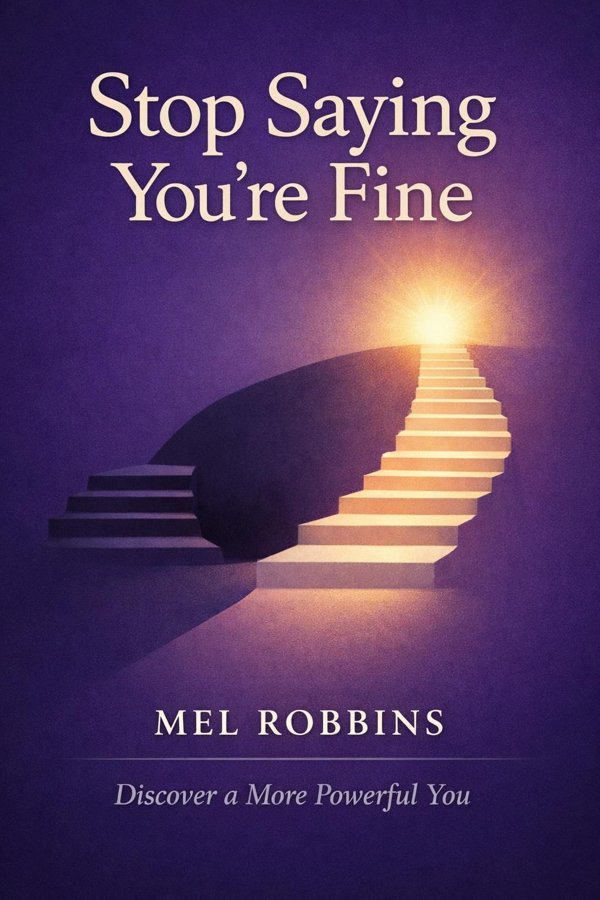
Stop Saying You're Fine: Discover a More Powerful You: Summary & Key Insights
by Mel Robbins
 10 min11 chaptersAudio available
What Is Stop Saying You're Fine: Discover a More Powerful You About?
Stop Saying You're Fine: Discover a More Powerful You by Mel Robbins is a mindset book spanning 11 pages. In this motivational self-help book, Mel Robbins challenges readers to stop settling for mediocrity and pretending that everything is 'fine.' Drawing on psychology and personal experience, she offers practical strategies to break through fear, procrastination, and self-doubt, empowering readers to take decisive action toward meaningful change.
This FizzRead summary covers all 11 key chapters of Stop Saying You're Fine: Discover a More Powerful You in approximately 10 minutes, distilling the most important ideas, arguments, and takeaways from Mel Robbins's work. Also available as an audio summary and Key Quotes Podcast.
Stop Saying You're Fine: Discover a More Powerful You
In this motivational self-help book, Mel Robbins challenges readers to stop settling for mediocrity and pretending that everything is 'fine.' Drawing on psychology and personal experience, she offers practical strategies to break through fear, procrastination, and self-doubt, empowering readers to take decisive action toward meaningful change.
Who Should Read Stop Saying You're Fine: Discover a More Powerful You?
This book is perfect for anyone interested in mindset and looking to gain actionable insights in a short read. Whether you're a student, professional, or lifelong learner, the key ideas from Stop Saying You're Fine: Discover a More Powerful You by Mel Robbins will help you think differently.
- ✓Readers who enjoy mindset and want practical takeaways
- ✓Professionals looking to apply new ideas to their work and life
- ✓Anyone who wants the core insights of Stop Saying You're Fine: Discover a More Powerful You in just 10 minutes
Want the full summary?
Get instant access to this book summary and 100K+ more with Fizz Moment.
Get Free SummaryAvailable on App Store • Free to download
Key Chapters
When we tell ourselves that we’re ‘fine,’ it feels safe. It’s a word that smooths over discomfort and keeps us from confronting pain. But behind the illusion lies the real reason you're not thrilled with your life—you’ve normalized mediocrity. Our culture even rewards it. We celebrate busy schedules, tolerate dull routines, and convince ourselves that as long as nothing is catastrophically wrong, we must be okay.
In this chapter, I explain how the illusion operates. It’s not the absence of disaster that equals fulfillment. Fine is actually your brain’s compromise—a way to avoid the effort, vulnerability, and risk of change. You deny your restlessness because facing it means admitting dissatisfaction. But in reality, that dissatisfaction is the most powerful form of intuition. It’s your system’s way of signaling that you’re out of alignment.
The moment you stop saying you're fine, you start reclaiming your emotional truth. You expose the gap between what you settle for and what you want. That honest reckoning is painful at first. Facing the fact that you’re bored, unhappy, or underutilized can feel destabilizing—but it’s also liberating. You begin to see how ‘fine’ has protected you from effort, from asking more of yourself, from possibility itself.
The key shift here isn’t intellectual—it’s emotional. Once your dissatisfaction is validated, it becomes fuel. You start recognizing that frustration isn’t a character flaw but an unexpressed need for movement. In redefining ‘fine,’ you learn to see your discomfort not as something to silence but something to follow.
If we’re going to challenge the illusion of fine, we have to talk about fear. The fundamental reason you resist change lies inside your own physiology. Your brain is engineered to keep you safe, not fulfilled. So when you consider doing something unfamiliar—whether leaving a job, speaking up, or trying something new—the first response your brain generates is fear.
In the book, I explain how the limbic system, particularly the basal ganglia and the amygdala, interprets change as danger. Even minor deviations from habitual behavior trigger an alarm. That alarm manifests as hesitation—a momentary freeze signal designed to stop you from doing anything uncertain. But this reaction, while essential to survival, often hijacks modern ambition. You're not facing a tiger; you’re facing emotional or social risk. Yet your brain reacts exactly the same way.
Once you understand this mechanism, you’ll stop blaming yourself for lacking courage or willpower. You’ll realize that self-doubt and panic are not flaws—they’re the echo of your biology doing its job. What we need to do is rewire the way your mind interprets those signals.
The process starts with awareness. When you notice hesitation or anxiety creeping in, recognize it not as a verdict but as evidence of momentum. It means you’re stepping beyond what’s familiar. Instead of trying to suppress the fear, use it as a compass—it’s proof that you’re growing. Next, we pair that awareness with immediate action. Taking a physical step—speaking up, standing, calling, writing—sends new feedback to your brain that the threat has passed, retraining your circuitry over time to associate motion with safety.
In short: you can’t think your way out of fear. You can only act your way through it.
+ 9 more chapters — available in the FizzRead app
All Chapters in Stop Saying You're Fine: Discover a More Powerful You
About the Author
Mel Robbins is an American motivational speaker, author, and former CNN commentator known for her practical, science-based approach to personal development. She gained international recognition for her TEDx talk on 'The 5 Second Rule' and has written several bestselling books on motivation and behavior change.
Get This Summary in Your Preferred Format
Read or listen to the Stop Saying You're Fine: Discover a More Powerful You summary by Mel Robbins anytime, anywhere. FizzRead offers multiple formats so you can learn on your terms — all free.
Available formats: App · Audio · PDF · EPUB — All included free with FizzRead
Download Stop Saying You're Fine: Discover a More Powerful You PDF and EPUB Summary
Key Quotes from Stop Saying You're Fine: Discover a More Powerful You
“When we tell ourselves that we’re ‘fine,’ it feels safe.”
“If we’re going to challenge the illusion of fine, we have to talk about fear.”
Frequently Asked Questions about Stop Saying You're Fine: Discover a More Powerful You
Stop Saying You're Fine: Discover a More Powerful You by Mel Robbins is a mindset book that explores key ideas across 11 chapters. In this motivational self-help book, Mel Robbins challenges readers to stop settling for mediocrity and pretending that everything is 'fine.' Drawing on psychology and personal experience, she offers practical strategies to break through fear, procrastination, and self-doubt, empowering readers to take decisive action toward meaningful change.
More by Mel Robbins

You Might Also Like



Browse by Category
Ready to read Stop Saying You're Fine: Discover a More Powerful You?
Get the full summary and 100K+ more books with Fizz Moment.