
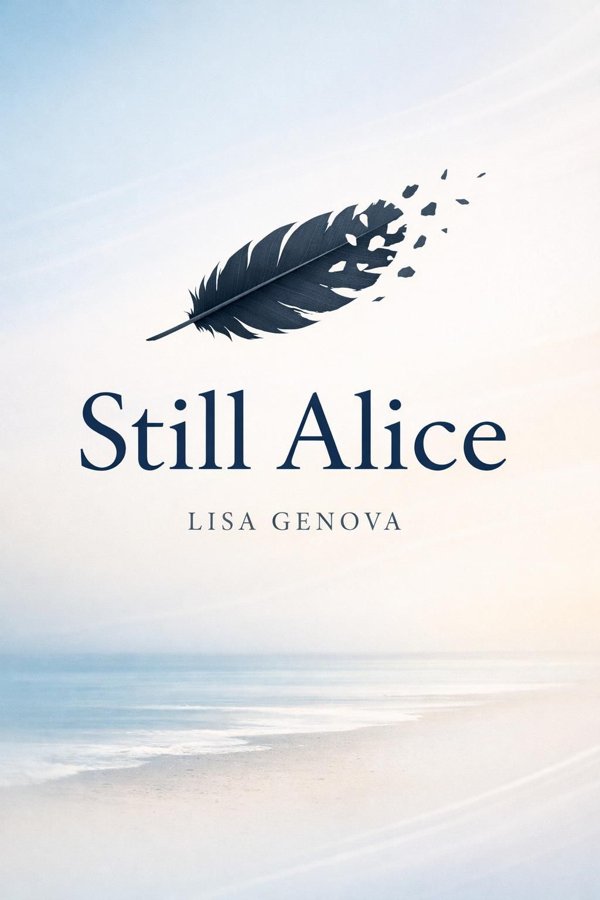
Still Alice: Summary & Key Insights
by Lisa Genova
 10 min3 chaptersAudio available
What Is Still Alice About?
Still Alice by Lisa Genova is a bestsellers book spanning 3 pages. Still Alice is a novel about Alice Howland, a 50-year-old cognitive psychology professor at Harvard who is diagnosed with early-onset Alzheimer’s disease. The story follows her struggle to maintain her identity and relationships as her memory and intellect deteriorate. It offers a deeply human portrayal of the impact of Alzheimer’s on both the patient and her family.
This FizzRead summary covers all 3 key chapters of Still Alice in approximately 10 minutes, distilling the most important ideas, arguments, and takeaways from Lisa Genova's work. Also available as an audio summary and Key Quotes Podcast.
Still Alice
Still Alice is a novel about Alice Howland, a 50-year-old cognitive psychology professor at Harvard who is diagnosed with early-onset Alzheimer’s disease. The story follows her struggle to maintain her identity and relationships as her memory and intellect deteriorate. It offers a deeply human portrayal of the impact of Alzheimer’s on both the patient and her family.
Who Should Read Still Alice?
This book is perfect for anyone interested in bestsellers and looking to gain actionable insights in a short read. Whether you're a student, professional, or lifelong learner, the key ideas from Still Alice by Lisa Genova will help you think differently.
- ✓Readers who enjoy bestsellers and want practical takeaways
- ✓Professionals looking to apply new ideas to their work and life
- ✓Anyone who wants the core insights of Still Alice in just 10 minutes
Want the full summary?
Get instant access to this book summary and 100K+ more with Fizz Moment.
Get Free SummaryAvailable on App Store • Free to download
Key Chapters
At the beginning of Alice’s journey, life is defined by precision. She lectures on cognitive psychology at Harvard, commands attention in her field, and moves through her days with the confidence of someone fully at home in her intellect. But then, small lapses start whispering through her life—she forgets a word mid-lecture, she finds herself disoriented during a run through Harvard Square. At first, these moments irritate her, then disturb her. The expert of cognition cannot explain her own cognitive errors.
I crafted these early chapters to make you feel that dissonance—the gradual, imperceptible shift from certainty to doubt. For a scientist, forgetting isn’t just human; it’s diagnostic. Alice begins testing herself, creating rational explanations. Fatigue. Menopause. Stress. But the truth resists her logic. When she misses a flight she had meticulously planned, her composure cracks.
Her visit to the neurologist marks the crossing of a threshold. The tests feel clinical, antiseptic, but behind every question—"What day is it?", "Can you spell 'world' backward?"—lurks the possibility that her professional life and self-image are at risk. When she hears the phrase *early-onset Alzheimer’s disease*, the world recalibrates. She is fifty, still full of vitality, and the diagnosis seems unfathomable. Yet, in that sterile room, the scientist becomes the subject of her own field.
This moment serves as an emotional turning point. Alice begins living two parallel lives—the one she shows the world, striving to remain composed and productive, and the private life filled with fear and sorrow. Her mind, once her strongest fortress, has turned porous. She experiences moments of confusion like stepping into the wrong version of a familiar place. Still, I wanted readers to sense that even amidst disorientation, she clings to logic, developing coping strategies: post-it notes, lists, questions. Alzheimer’s begins as an invisible thief, but Alice refuses to surrender silently. She is determined to document, to measure, to resist.
The next phase of Alice’s story is a study in contrasts—the struggle to remain the person she was and the inevitability of transformation. She hides her diagnosis from colleagues, continuing lectures with painstaking focus. Yet language, her lifelong ally, starts betraying her. Common words vanish mid-sentence, replaced by terrifying blanks. In academic halls, surrounded by students and peers, Alice comes face to face with professional mortality.
Her husband, John, provides both tenderness and denial. A scientist himself, he clings to data, to probabilities, to the hope that something has been misread. His love for Alice is real, but it often manifests as a defense mechanism—if he keeps working, if he stays in motion, perhaps the disease will pause. Their children each respond differently: Anna with pragmatic control, Lydia with empathy and intuition. Lydia, the aspiring actress, becomes the novel’s emotional compass, translating the intangible into connection.
As months pass, Alice’s symptoms worsen. She creates one of the novel’s most poignant metaphors—the “Butterfly” folder on her phone. It holds instructions for her future self: questions she must answer to assess her cognitive state, and a video message she will watch when she no longer can. The butterfly symbolizes fragility but also continuity. Even as one stage of life dissolves, another form of existence emerges.
One of the most powerful scenes comes when Alice delivers her speech at the Alzheimer’s conference. This isn’t the voice of a professor, but of a woman reclaiming her narrative. She speaks of living with Alzheimer’s, of the courage it takes to stay visible in a society that often turns away. I wrote that speech not as advocacy alone, but as protest against invisibility. Alice insists on being seen. Her mind may fracture, but her voice—steady, eloquent—becomes a testament to dignity.
And yet, every victory carries cost. Eventually, Alice can no longer perform her teaching duties. Harvard, the pinnacle of her identity, fades from reach. She must retire, not because she wants to, but because her cognitive world has narrowed. This loss is profound; it is not only a career but a mirror of selfhood breaking. Still, even here, she discovers new tenderness—with Lydia, with her family, and even in the moments of quiet recognition that linger before they too forget.
+ 1 more chapters — available in the FizzRead app
All Chapters in Still Alice
About the Author
Lisa Genova is an American neuroscientist and author known for her fiction that explores neurological disorders. She earned a Ph.D. in neuroscience from Harvard University and has written several bestselling novels, including Still Alice, Left Neglected, and Every Note Played.
Get This Summary in Your Preferred Format
Read or listen to the Still Alice summary by Lisa Genova anytime, anywhere. FizzRead offers multiple formats so you can learn on your terms — all free.
Available formats: App · Audio · PDF · EPUB — All included free with FizzRead
Download Still Alice PDF and EPUB Summary
Key Quotes from Still Alice
“At the beginning of Alice’s journey, life is defined by precision.”
“The next phase of Alice’s story is a study in contrasts—the struggle to remain the person she was and the inevitability of transformation.”
Frequently Asked Questions about Still Alice
Still Alice by Lisa Genova is a bestsellers book that explores key ideas across 3 chapters. Still Alice is a novel about Alice Howland, a 50-year-old cognitive psychology professor at Harvard who is diagnosed with early-onset Alzheimer’s disease. The story follows her struggle to maintain her identity and relationships as her memory and intellect deteriorate. It offers a deeply human portrayal of the impact of Alzheimer’s on both the patient and her family.
More by Lisa Genova
You Might Also Like
The Godfather
Mario Puzo
10 min
The Handmaid's Tale
Margaret Atwood
10 min
The Hunger Games
Suzanne Collins
10 min
The Nightingale
Kristin Hannah
10 min
The Seven Husbands of Evelyn Hugo
Taylor Jenkins Reid
10 min
Backwater Justice
Fern Michaels
10 minBrowse by Category
Ready to read Still Alice?
Get the full summary and 100K+ more books with Fizz Moment.