
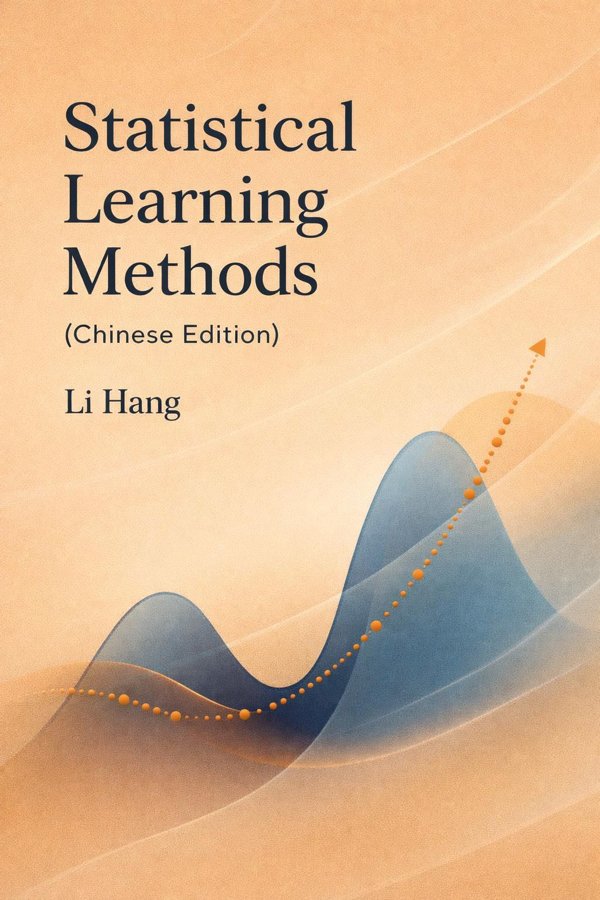
Statistical Learning Methods (Chinese Edition): Summary & Key Insights
by Li Hang
 10 min6 chaptersAudio available
What Is Statistical Learning Methods (Chinese Edition) About?
Statistical Learning Methods (Chinese Edition) by Li Hang is a ai_ml book spanning 6 pages. Statistical Learning Methods (Chinese Edition) is a comprehensive textbook on machine learning written by Li Hang. It systematically introduces the fundamental concepts of statistical learning, supervised learning methods, and their theoretical derivations. The book covers ten major algorithms, including the perceptron, k-nearest neighbors, naive Bayes, decision trees, logistic regression, maximum entropy models, support vector machines, boosting methods, the EM algorithm, and hidden Markov models. It emphasizes the combination of mathematical derivation and algorithmic principles, making it suitable for beginners and researchers in machine learning.
This FizzRead summary covers all 6 key chapters of Statistical Learning Methods (Chinese Edition) in approximately 10 minutes, distilling the most important ideas, arguments, and takeaways from Li Hang's work. Also available as an audio summary and Key Quotes Podcast.
Statistical Learning Methods (Chinese Edition)
Statistical Learning Methods (Chinese Edition) is a comprehensive textbook on machine learning written by Li Hang. It systematically introduces the fundamental concepts of statistical learning, supervised learning methods, and their theoretical derivations. The book covers ten major algorithms, including the perceptron, k-nearest neighbors, naive Bayes, decision trees, logistic regression, maximum entropy models, support vector machines, boosting methods, the EM algorithm, and hidden Markov models. It emphasizes the combination of mathematical derivation and algorithmic principles, making it suitable for beginners and researchers in machine learning.
Who Should Read Statistical Learning Methods (Chinese Edition)?
This book is perfect for anyone interested in ai_ml and looking to gain actionable insights in a short read. Whether you're a student, professional, or lifelong learner, the key ideas from Statistical Learning Methods (Chinese Edition) by Li Hang will help you think differently.
- ✓Readers who enjoy ai_ml and want practical takeaways
- ✓Professionals looking to apply new ideas to their work and life
- ✓Anyone who wants the core insights of Statistical Learning Methods (Chinese Edition) in just 10 minutes
Want the full summary?
Get instant access to this book summary and 100K+ more with Fizz Moment.
Get Free SummaryAvailable on App Store • Free to download
Key Chapters
Everything in statistical learning begins with the same fundamental question: how do we learn from data? Before we can define algorithms, we must first define what 'learning' means in mathematical terms. In this book, I begin by anchoring learning theory on three pillars — probability theory, statistics, and optimization. Learning, in essence, is an act of inference. Given data drawn from an unknown distribution, we want to infer a rule that performs well on unseen samples. To make this idea concrete, we introduce random variables, joint and conditional distributions, and the concept of expectation as a means to quantify uncertainty.
At the heart of statistical learning is the risk function — an expectation of loss with respect to the underlying data distribution. Because this distribution is unknown, we estimate risk empirically from samples, leading to the principle of empirical risk minimization. But as I often stress, minimizing training error is not enough; the model must generalize. Thus emerges the principle of structural risk minimization, which balances empirical performance against model complexity. This balance — between fitting and generalization — is the axis upon which the entire discipline turns.
Through these definitions, we see that all algorithms in this book share a common task: minimize some form of expected loss under constraints. Whether it is a perceptron adjusting parameters through misclassification, an SVM optimizing a convex margin, or an EM algorithm maximizing likelihood in hidden structures, they all instantiate the same core philosophy. By starting from probability, we gain a consistent, unifying perspective. Statistical learning, you will realize, is not a loose collection of computational tricks but a systematic way of reasoning about data-driven inference.
The perceptron, one of the earliest learning algorithms, marks the birth of machine learning as a formal field. It teaches a profound lesson: learning can be reduced to finding a linear discriminant that separates data into categories. In the perceptron model, we consider a binary classification problem. Each sample has a feature vector and an associated label, and the goal is to find a weight vector that defines a hyperplane separating the two classes.
The perceptron learning algorithm adjusts weights iteratively: if a sample is misclassified, the algorithm corrects the weights by shifting in the direction of the sample’s true label. Its simplicity is striking — no probabilistic assumptions, no complex optimization — yet it captures the essence of learning as iterative correction based on error. In the book, I derive the perceptron convergence theorem, showing that if the data are linearly separable, the algorithm will find a correct solution in a finite number of steps. This theorem provides one of the earliest mathematical guarantees of learning.
When we reflect on it, the perceptron is more than a simple classifier. It introduces the idea of hypothesis space (the set of linear functions that can be represented) and an objective (to correctly classify training examples). The limitations of the perceptron — its inability to handle nonlinearly separable data — motivated the development of more powerful models like support vector machines and neural networks. Thus, the perceptron stands as both the beginning and the conceptual foundation of modern classification theory.
+ 4 more chapters — available in the FizzRead app
All Chapters in Statistical Learning Methods (Chinese Edition)
About the Author
Li Hang holds a Ph.D. from Tsinghua University and has long been engaged in research on natural language processing, machine learning, and information retrieval. He has served as a researcher at Microsoft Research Asia and as Chief Scientist at Huawei Noah’s Ark Lab. He is recognized as one of the leading scholars in the field of machine learning in China.
Get This Summary in Your Preferred Format
Read or listen to the Statistical Learning Methods (Chinese Edition) summary by Li Hang anytime, anywhere. FizzRead offers multiple formats so you can learn on your terms — all free.
Available formats: App · Audio · PDF · EPUB — All included free with FizzRead
Download Statistical Learning Methods (Chinese Edition) PDF and EPUB Summary
Key Quotes from Statistical Learning Methods (Chinese Edition)
“Everything in statistical learning begins with the same fundamental question: how do we learn from data?”
“The perceptron, one of the earliest learning algorithms, marks the birth of machine learning as a formal field.”
Frequently Asked Questions about Statistical Learning Methods (Chinese Edition)
Statistical Learning Methods (Chinese Edition) by Li Hang is a ai_ml book that explores key ideas across 6 chapters. Statistical Learning Methods (Chinese Edition) is a comprehensive textbook on machine learning written by Li Hang. It systematically introduces the fundamental concepts of statistical learning, supervised learning methods, and their theoretical derivations. The book covers ten major algorithms, including the perceptron, k-nearest neighbors, naive Bayes, decision trees, logistic regression, maximum entropy models, support vector machines, boosting methods, the EM algorithm, and hidden Markov models. It emphasizes the combination of mathematical derivation and algorithmic principles, making it suitable for beginners and researchers in machine learning.
You Might Also Like

Life 3.0
Max Tegmark
10 min
Superintelligence
Nick Bostrom
10 min
TensorFlow in Action
Thushan Ganegedara
10 min
AI Made Simple: A Beginner’s Guide to Generative AI, ChatGPT, and the Future of Work
Rajeev Kapur
10 min
AI Snake Oil
Arvind Narayanan, Sayash Kapoor
10 min
AI Superpowers: China, Silicon Valley, and the New World Order
Kai-Fu Lee
10 minBrowse by Category
Ready to read Statistical Learning Methods (Chinese Edition)?
Get the full summary and 100K+ more books with Fizz Moment.