
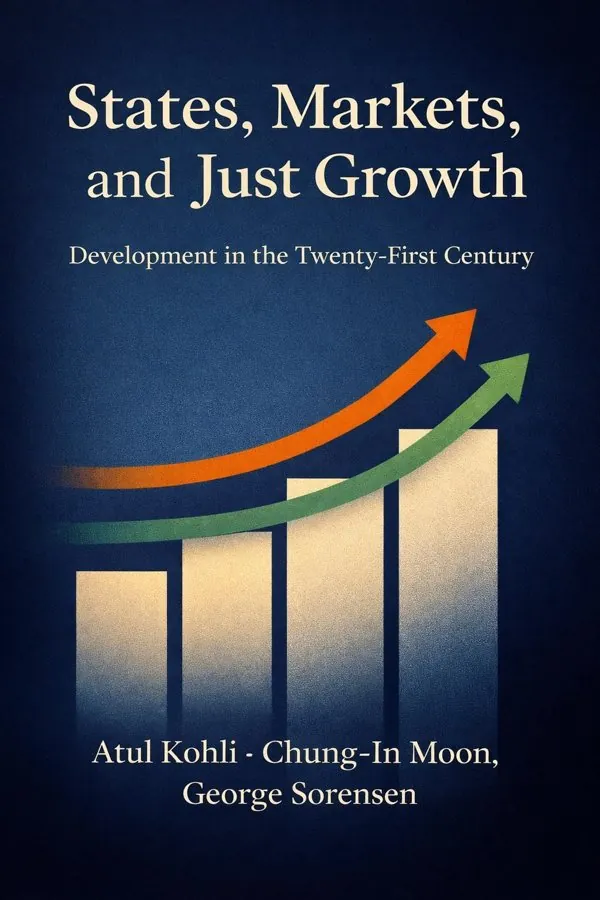
States, Markets, and Just Growth: Development in the Twenty-First Century: Summary & Key Insights
by Atul Kohli, Chung-In Moon, George Sorensen
 10 min11 chaptersAudio available
What Is States, Markets, and Just Growth: Development in the Twenty-First Century About?
States, Markets, and Just Growth: Development in the Twenty-First Century by Atul Kohli, Chung-In Moon, George Sorensen is a economics book spanning 11 pages. This book explores the relationship between state policies, market forces, and equitable economic growth in developing countries. It examines how different institutional arrangements and governance structures influence the ability of nations to achieve both economic efficiency and social justice in the context of globalization.
This FizzRead summary covers all 11 key chapters of States, Markets, and Just Growth: Development in the Twenty-First Century in approximately 10 minutes, distilling the most important ideas, arguments, and takeaways from Atul Kohli, Chung-In Moon, George Sorensen's work. Also available as an audio summary and Key Quotes Podcast.
States, Markets, and Just Growth: Development in the Twenty-First Century
This book explores the relationship between state policies, market forces, and equitable economic growth in developing countries. It examines how different institutional arrangements and governance structures influence the ability of nations to achieve both economic efficiency and social justice in the context of globalization.
Who Should Read States, Markets, and Just Growth: Development in the Twenty-First Century?
This book is perfect for anyone interested in economics and looking to gain actionable insights in a short read. Whether you're a student, professional, or lifelong learner, the key ideas from States, Markets, and Just Growth: Development in the Twenty-First Century by Atul Kohli, Chung-In Moon, George Sorensen will help you think differently.
- ✓Readers who enjoy economics and want practical takeaways
- ✓Professionals looking to apply new ideas to their work and life
- ✓Anyone who wants the core insights of States, Markets, and Just Growth: Development in the Twenty-First Century in just 10 minutes
Want the full summary?
Get instant access to this book summary and 100K+ more with Fizz Moment.
Get Free SummaryAvailable on App Store • Free to download
Key Chapters
At the heart of our analysis lies the concept of 'just growth.' By this we mean more than growth accompanied by redistribution; we mean a developmental trajectory that simultaneously advances economic efficiency and social justice. These two goals have often been portrayed as conflicting: efficiency thrives on competition, while justice demands protection and fairness. Yet our research demonstrates that under the right institutional arrangements, they can reinforce each other.
In constructing this framework, we drew on three intellectual traditions. From classical political economy, we take the idea that markets are essential engines of productivity. From developmental state theory, we learn that strategic state intervention can guide markets toward structural transformation. And from theories of social justice, we adopt the belief that inclusiveness is not merely an ethical imperative but an economic asset: societies that educate their citizens, protect the vulnerable, and distribute opportunities broadly are more resilient and innovative.
The relationship between states and markets, then, is never static. It is a negotiated, context-specific balance. States must provide the legal and regulatory foundations that enable markets to allocate resources efficiently; markets, in turn, generate the revenues and innovation that sustain effective states. But equilibrium alone is not sufficient. Without deliberate public action, growth will likely deepen inequalities rather than reduce them. Thus, the pursuit of 'just growth' is not a technocratic adjustment—it is a political endeavor. It requires legitimacy, accountability, and a shared vision of justice that transcends class, region, and generation.
Our analytical model views state capacity, market maturity, and social inclusion as interconnected dimensions. A developmental state without accountability may deliver growth but not justice; an unregulated market may deliver efficiency but undermine social cohesion. The key, therefore, lies in institutional synergy—where policy coherence, competent administration, and participatory governance make justice and efficiency mutually reinforcing. This framework becomes our lens for examining the historical and contemporary experiences of developing nations.
To understand the twenty-first century, we must first look back at the twentieth. The development strategies of that period reflected deep ideological divides. Many postcolonial states adopted state-led industrialization, inspired by Keynesian and structuralist ideas. The state, it was believed, could correct market failures, build infrastructure, and promote industrialization through planning, protection, and public ownership. For a time, this strategy delivered rapid growth and employment, but by the 1970s, inefficiency, rent-seeking, and debt had eroded its legitimacy.
In contrast, the late twentieth century saw a powerful ideological shift toward market liberalization. The so-called Washington Consensus prescribed deregulation, privatization, and openness as panaceas for developmental stagnation. Governments were told to get out of the way and let markets work. Yet as we document, the results were uneven. While liberalization boosted growth in some sectors, it often deepened inequality and weakened the institutional foundations of effective governance. Poverty declined selectively; insecurity and social exclusion multiplied.
The lesson of these contrasting experiences is not that one model is superior but that sustainable, equitable development requires context-sensitive synthesis. The East Asian developmental states demonstrated how disciplined intervention could complement markets, steering investment, and fostering learning industries. In contrast, many Latin American economies oscillated between populist state expansion and neoliberal retrenchment, missing the institutional coherence necessary for sustained, just growth. The historical record reminds us: growth models are not ideological templates to be copied, but institutional architectures to be built—each responsive to local histories, capacities, and social contracts.
+ 9 more chapters — available in the FizzRead app
All Chapters in States, Markets, and Just Growth: Development in the Twenty-First Century
About the Authors
Atul Kohli is a professor of politics and international affairs at Princeton University, specializing in comparative political economy and development. Chung-In Moon is a professor of political science at Yonsei University, focusing on international relations and East Asian development. George Sorensen is a Danish political scientist known for his work on international relations and development theory.
Get This Summary in Your Preferred Format
Read or listen to the States, Markets, and Just Growth: Development in the Twenty-First Century summary by Atul Kohli, Chung-In Moon, George Sorensen anytime, anywhere. FizzRead offers multiple formats so you can learn on your terms — all free.
Available formats: App · Audio · PDF · EPUB — All included free with FizzRead
Download States, Markets, and Just Growth: Development in the Twenty-First Century PDF and EPUB Summary
Key Quotes from States, Markets, and Just Growth: Development in the Twenty-First Century
“At the heart of our analysis lies the concept of 'just growth.”
“To understand the twenty-first century, we must first look back at the twentieth.”
Frequently Asked Questions about States, Markets, and Just Growth: Development in the Twenty-First Century
States, Markets, and Just Growth: Development in the Twenty-First Century by Atul Kohli, Chung-In Moon, George Sorensen is a economics book that explores key ideas across 11 chapters. This book explores the relationship between state policies, market forces, and equitable economic growth in developing countries. It examines how different institutional arrangements and governance structures influence the ability of nations to achieve both economic efficiency and social justice in the context of globalization.
You Might Also Like

Business Adventures
John Brooks
10 min
Nudge
Richard H. Thaler, Cass R. Sunstein
10 min
The Hitchhiker"s Guide to the Galaxy
Douglas Adams
10 minThe Muqaddimah
Ibn Khaldun
10 minThe Outsiders
William N. Thorndike
10 min
A Little History of Economics
Niall Kishtainy
10 minBrowse by Category
Ready to read States, Markets, and Just Growth: Development in the Twenty-First Century?
Get the full summary and 100K+ more books with Fizz Moment.