
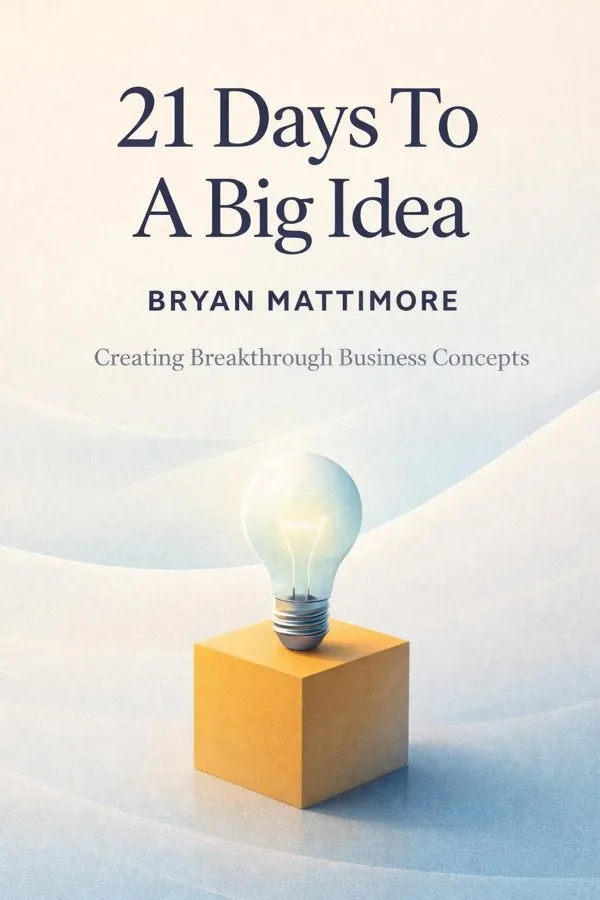
21 Days To A Big Idea: Creating Breakthrough Business Concepts: Summary & Key Insights
 10 min8 chaptersAudio available
Key Takeaways from 21 Days To A Big Idea: Creating Breakthrough Business Concepts
A breakthrough idea is rarely a random accident.
Too much freedom can weaken creativity.
The fastest route to a great idea is often through a large number of imperfect ones.
Most business thinking stays trapped inside accepted assumptions.
Some of the best ideas come from outside your industry.
What Is 21 Days To A Big Idea: Creating Breakthrough Business Concepts About?
21 Days To A Big Idea: Creating Breakthrough Business Concepts by Bryan Mattimore is a entrepreneurship book. Great business ideas rarely appear as lightning bolts. More often, they emerge from a disciplined process that helps people challenge assumptions, combine unexpected insights, and turn vague possibilities into compelling concepts. In 21 Days To A Big Idea, innovation consultant Bryan Mattimore argues that creativity is not a mysterious talent reserved for a gifted few. It is a practical skill that can be strengthened through structure, repetition, and the right mental tools. The book presents a step-by-step program designed to help entrepreneurs, marketers, product teams, and leaders generate breakthrough business concepts in just three weeks. Rather than waiting for inspiration, Mattimore shows readers how to create the conditions that make breakthrough thinking more likely. He draws on decades of experience helping organizations develop new products, sharpen strategic thinking, and uncover high-value opportunities. What makes this book matter is its balance of imagination and execution. It is not only about brainstorming more ideas, but about producing better ones: ideas that are original, relevant, and usable. For anyone trying to solve a stubborn business problem or build something new, this book offers a repeatable roadmap for moving from blank page to bold concept.
This FizzRead summary covers all 8 key chapters of 21 Days To A Big Idea: Creating Breakthrough Business Concepts in approximately 10 minutes, distilling the most important ideas, arguments, and takeaways from Bryan Mattimore's work. Also available as an audio summary and Key Quotes Podcast.
21 Days To A Big Idea: Creating Breakthrough Business Concepts
Great business ideas rarely appear as lightning bolts. More often, they emerge from a disciplined process that helps people challenge assumptions, combine unexpected insights, and turn vague possibilities into compelling concepts. In 21 Days To A Big Idea, innovation consultant Bryan Mattimore argues that creativity is not a mysterious talent reserved for a gifted few. It is a practical skill that can be strengthened through structure, repetition, and the right mental tools.
The book presents a step-by-step program designed to help entrepreneurs, marketers, product teams, and leaders generate breakthrough business concepts in just three weeks. Rather than waiting for inspiration, Mattimore shows readers how to create the conditions that make breakthrough thinking more likely. He draws on decades of experience helping organizations develop new products, sharpen strategic thinking, and uncover high-value opportunities.
What makes this book matter is its balance of imagination and execution. It is not only about brainstorming more ideas, but about producing better ones: ideas that are original, relevant, and usable. For anyone trying to solve a stubborn business problem or build something new, this book offers a repeatable roadmap for moving from blank page to bold concept.
Who Should Read 21 Days To A Big Idea: Creating Breakthrough Business Concepts?
This book is perfect for anyone interested in entrepreneurship and looking to gain actionable insights in a short read. Whether you're a student, professional, or lifelong learner, the key ideas from 21 Days To A Big Idea: Creating Breakthrough Business Concepts by Bryan Mattimore will help you think differently.
- ✓Readers who enjoy entrepreneurship and want practical takeaways
- ✓Professionals looking to apply new ideas to their work and life
- ✓Anyone who wants the core insights of 21 Days To A Big Idea: Creating Breakthrough Business Concepts in just 10 minutes
Want the full summary?
Get instant access to this book summary and 100K+ more with Fizz Moment.
Get Free SummaryAvailable on App Store • Free to download
Key Chapters
A breakthrough idea is rarely a random accident. One of Bryan Mattimore’s central insights is that innovation becomes far more reliable when it is treated as a deliberate process instead of a lucky event. Many people assume creativity is spontaneous, but that belief often becomes an excuse for inconsistency. Teams wait for inspiration, hold a rushed brainstorm, and then wonder why the results feel predictable. Mattimore challenges that pattern by showing that powerful ideas are usually the product of preparation, stimulus, and disciplined iteration.
The book’s 21-day framework is built on the idea that ideation improves when you engage with a problem repeatedly over time. This matters because the first thoughts people generate are often obvious and conventional. It is only after sustained exploration that more original combinations appear. By returning to the challenge each day with new prompts and perspectives, you train the mind to move beyond familiar thinking.
In practice, this could mean setting a clear innovation goal, such as reimagining a retail experience or designing a new service model, and then dedicating a short daily session to generating possibilities. A founder might collect customer frustrations on day one, study adjacent industries on day five, and test provocative assumptions on day ten. Each step builds creative momentum.
The larger lesson is reassuring: you do not need to wait for genius. You need a system that increases the odds of insight. Actionable takeaway: Treat ideation like a scheduled business activity, not an occasional flash of inspiration, and commit to a structured creative routine long enough to move past obvious answers.
Too much freedom can weaken creativity. That sounds backward, yet Mattimore shows that meaningful constraints often lead to stronger ideas than open-ended brainstorming ever does. When teams are told to "think of anything," they frequently drift into vague, impractical, or repetitive territory. But when the challenge is sharply defined, the mind has something to push against, and that pressure creates originality.
Constraints can take many forms: a specific customer segment, a tight budget, a target market shift, a sustainability requirement, or a business model limit. Rather than reducing creativity, these boundaries sharpen it. They force people to look for unexpected ways to deliver value within a real-world context. This is especially important in entrepreneurship, where resources are limited and ideas must eventually survive market conditions.
Imagine a startup trying to reinvent healthy snacking. An unconstrained brainstorm may produce broad, generic suggestions. But add real constraints, such as "must be shelf-stable," "must retail under three dollars," and "must appeal to commuters," and the team begins solving a meaningful problem. The resulting ideas become more concrete, more differentiated, and more likely to work.
Mattimore’s approach encourages readers to define the opportunity carefully before trying to solve it. A breakthrough concept is not simply novel; it fits a need, a context, and a business reality. Good constraints create that fit.
Actionable takeaway: Before generating ideas, write down three to five useful constraints tied to customer needs, business realities, or market goals, and use them to focus the creative effort instead of restricting it.
The fastest route to a great idea is often through a large number of imperfect ones. Mattimore reinforces a classic but often ignored truth about innovation: quality usually emerges from quantity. People tend to self-edit too early, judging ideas before they have a chance to evolve. That habit limits originality because breakthrough concepts often begin as awkward, incomplete, or even unrealistic thoughts.
Generating many ideas creates two advantages. First, it reduces attachment to any single option, making people more open-minded and experimental. Second, it increases the probability of discovering a fresh combination that would never surface in a smaller pool. A weak idea can also serve as a bridge to a stronger one. In creative work, a dead end is often just a stepping stone.
For example, a business team looking for new subscription offerings might list fifty possibilities without evaluating them. The first fifteen may feel ordinary, but by the time they reach thirty or forty, more unusual ideas begin to appear: hybrid membership models, community-based rewards, or usage-triggered service bundles. These later ideas often build on fragments of earlier ones.
Mattimore’s process helps readers delay judgment long enough to let novelty develop. Evaluation matters, but only after the idea field is rich enough to justify selection. This sequence is crucial. If you critique too early, you protect the status quo.
Actionable takeaway: Set a numeric ideation goal before you begin, such as 30 or 50 ideas, and forbid evaluation until you reach it. The discipline of volume will help you uncover ideas that initial caution would have prevented.
Most business thinking stays trapped inside accepted assumptions. Mattimore emphasizes that breakthrough concepts often require deliberate provocation: introducing ideas, questions, or scenarios that seem strange enough to disrupt normal mental habits. Without provocation, teams tend to improve what already exists rather than invent what could exist.
Provocative prompts force the brain to explore unfamiliar territory. What if your product were free? What if customers designed it themselves? What if a competitor had to run your company? What if your service had to work without human staff? These questions may not lead directly to a final concept, but they expose hidden assumptions about pricing, ownership, control, distribution, and experience.
Consider a hotel business asking, "What if guests never checked in at a front desk?" That provocation could lead to mobile access, personalized pre-arrival setup, or entirely new hospitality formats. A manufacturer might ask, "What if our revenue depended on customer outcomes rather than unit sales?" That could inspire a shift toward subscription, performance contracts, or service layers around the product.
The value of provocation is not absurdity for its own sake. It is the ability to loosen fixed patterns so better possibilities can emerge. Mattimore’s techniques help readers use bold questions as temporary tools for expanding creative range.
Actionable takeaway: When stuck, write five "What if" questions that challenge the core assumptions of your industry, then mine the answers for practical elements you can adapt into real opportunities.
Some of the best ideas come from outside your industry. Mattimore highlights analogy as one of the most powerful tools for creative thinking because it allows people to import useful patterns from unrelated fields. When a business problem feels overfamiliar, looking sideways can reveal solutions that would remain invisible from within the same frame of reference.
Analogical thinking works by asking, "Who else has solved a similar kind of problem?" A retailer might study theme parks to improve customer flow. A software company might examine fitness coaching to design better engagement systems. A healthcare startup might borrow from hospitality to create more comforting and intuitive patient experiences. The industries differ, but the underlying challenge, such as trust, convenience, motivation, or loyalty, may be similar.
This method is especially useful because it combines novelty with relevance. Instead of generating random ideas, you adapt tested principles from one context to another. That can lead to concepts that feel both fresh and grounded. For entrepreneurs, this is a major advantage: they can innovate without starting from zero.
Suppose a meal-planning app studies video game design and notices how games reward progress through levels, streaks, and achievement cues. The app could then build a system that turns healthy eating into a more engaging, habit-forming experience. The result is not a copy of gaming, but a business concept enriched by gaming principles.
Actionable takeaway: Identify the core challenge you are trying to solve, then examine three unrelated industries that handle a similar challenge well, and adapt one of their operating principles into your own business model or offering.
Not all progress happens while you are actively thinking. Mattimore recognizes the importance of incubation: the period in which ideas mature beneath conscious awareness. In a fast-moving business culture, people often expect immediate answers, but creative breakthroughs frequently need distance, reflection, and mental downtime before they fully take shape.
This is one reason the book’s three-week structure matters. By spreading ideation over time, Mattimore gives the subconscious mind room to keep working between sessions. A problem explored on Monday may produce a surprising insight during a walk on Wednesday. What seemed unresolved at first may reorganize itself after exposure to different prompts, examples, and perspectives.
Incubation does not mean passivity. It works best when active effort is followed by deliberate release. A team might spend a session generating concepts, then pause evaluation until the next day. An entrepreneur might write down a strategic challenge before bed, then revisit it after sleep. Even brief breaks can improve idea quality by helping people escape fixation on their first solution.
For example, someone developing a new educational service may initially focus only on course content. After a few days away from direct analysis, they may suddenly realize the bigger opportunity lies in accountability systems or peer support. The better idea emerges because the mind has had time to recombine information.
Actionable takeaway: Build recovery and reflection into your innovation process by alternating focused ideation sessions with breaks, sleep, walks, or unrelated work, and always capture insights that appear after you step away.
A flood of ideas is useless without a way to identify the ones worth developing. Mattimore makes clear that innovation is a two-part discipline: first expand possibilities, then evaluate them intelligently. Many teams either judge too early or fail to judge rigorously enough. Both mistakes are costly. Early criticism kills originality, while weak selection leaves organizations with flashy but unworkable concepts.
Good evaluation balances creativity with practicality. The best ideas are not simply the most unusual. They are the ones that combine novelty, customer relevance, strategic fit, and business potential. A concept may be exciting, but if it solves no real problem or cannot be executed with available capabilities, it is not yet a breakthrough. Likewise, a highly feasible idea that adds little differentiation may not justify investment.
In practice, selection can use criteria such as desirability, feasibility, profitability, timing, and brand alignment. A company exploring new services might narrow fifty ideas to ten based on customer impact, then test those ten against financial and operational realities. This staged filtering preserves ambition while introducing discipline.
Mattimore’s contribution here is to show that creative confidence grows when people know there is a fair process for choosing among alternatives. They become more willing to generate bold concepts because they trust that refinement will follow.
Actionable takeaway: After idea generation, score your top concepts against a small set of agreed criteria, such as originality, customer value, and feasibility, and use that structured review to identify the few ideas deserving deeper development.
Innovation is not just an individual act; it is a cultural outcome. Mattimore suggests that organizations produce better ideas when they create environments where curiosity, experimentation, and unconventional thinking are consistently supported. A company may claim to value creativity, but if meetings reward caution, hierarchy, and quick criticism, breakthrough ideas will remain hidden.
A creative culture does not require chaos. In fact, it depends on norms that make ideation feel safe and productive. People need permission to suggest incomplete thoughts without embarrassment. Leaders must ask expansive questions rather than only demanding immediate answers. Teams should be exposed to fresh inputs, including customer stories, emerging trends, and examples from other industries. Most of all, organizations need repeated innovation rituals rather than one-off brainstorming events.
For entrepreneurs and small teams, culture may be built through simple habits: keeping a shared idea log, dedicating time to explore customer frustrations, celebrating experiments even when they fail, and reviewing assumptions regularly. In larger firms, it may involve cross-functional workshops, idea challenges, or innovation training that makes creative methods accessible to everyone.
The deeper point is that creativity is often suppressed by default systems. If you want breakthrough concepts, you must design for them. Processes, language, incentives, and leadership behavior all shape whether people think boldly or play it safe.
Actionable takeaway: Create one recurring team habit that normalizes idea generation, such as a weekly opportunity session or a shared document for provocative questions, and protect it long enough for creative confidence to grow.
All Chapters in 21 Days To A Big Idea: Creating Breakthrough Business Concepts
About the Author
Bryan Mattimore is an innovation expert, consultant, and author who has spent decades helping companies develop breakthrough ideas for products, services, and business strategy. He is widely recognized for translating creativity into practical methods that organizations can use to solve problems and discover growth opportunities. Through his consulting work and facilitated ideation sessions, he has worked with teams seeking more effective ways to innovate in competitive markets. Mattimore’s writing reflects this hands-on experience, combining creative thinking tools with a clear focus on execution and business relevance. His work stands out for making innovation accessible to people who may not consider themselves naturally creative, while still offering enough depth to be valuable for experienced leaders and entrepreneurs.
Get This Summary in Your Preferred Format
Read or listen to the 21 Days To A Big Idea: Creating Breakthrough Business Concepts summary by Bryan Mattimore anytime, anywhere. FizzRead offers multiple formats so you can learn on your terms — all free.
Available formats: App · Audio · PDF · EPUB — All included free with FizzRead
Download 21 Days To A Big Idea: Creating Breakthrough Business Concepts PDF and EPUB Summary
Key Quotes from 21 Days To A Big Idea: Creating Breakthrough Business Concepts
“A breakthrough idea is rarely a random accident.”
“That sounds backward, yet Mattimore shows that meaningful constraints often lead to stronger ideas than open-ended brainstorming ever does.”
“The fastest route to a great idea is often through a large number of imperfect ones.”
“Most business thinking stays trapped inside accepted assumptions.”
“Some of the best ideas come from outside your industry.”
Frequently Asked Questions about 21 Days To A Big Idea: Creating Breakthrough Business Concepts
21 Days To A Big Idea: Creating Breakthrough Business Concepts by Bryan Mattimore is a entrepreneurship book that explores key ideas across 8 chapters. Great business ideas rarely appear as lightning bolts. More often, they emerge from a disciplined process that helps people challenge assumptions, combine unexpected insights, and turn vague possibilities into compelling concepts. In 21 Days To A Big Idea, innovation consultant Bryan Mattimore argues that creativity is not a mysterious talent reserved for a gifted few. It is a practical skill that can be strengthened through structure, repetition, and the right mental tools. The book presents a step-by-step program designed to help entrepreneurs, marketers, product teams, and leaders generate breakthrough business concepts in just three weeks. Rather than waiting for inspiration, Mattimore shows readers how to create the conditions that make breakthrough thinking more likely. He draws on decades of experience helping organizations develop new products, sharpen strategic thinking, and uncover high-value opportunities. What makes this book matter is its balance of imagination and execution. It is not only about brainstorming more ideas, but about producing better ones: ideas that are original, relevant, and usable. For anyone trying to solve a stubborn business problem or build something new, this book offers a repeatable roadmap for moving from blank page to bold concept.
You Might Also Like

Lean Analytics
Alistair Croll, Benjamin Yoskovitz
10 min
Sam Walton: Made in America: My Story
Sam Walton
10 min
10x Is Easier Than 2x: How World-Class Entrepreneurs Achieve More by Doing Less
Dan Sullivan, Benjamin Hardy
10 min
12 Months to $1 Million: How to Pick a Winning Product, Build a Real Business, and Become a Seven-Figure Entrepreneur
Ryan Daniel Moran
10 min
24 Assets: Create a Digital, Scalable, Valuable Business
Daniel Priestley
10 min
After the Idea: The Power and Pursuit of Innovation in Business
Martin Neil Baily, James A. Chesbrough, and Robert E. Litan
10 minFeatured In
Browse by Category
Ready to read 21 Days To A Big Idea: Creating Breakthrough Business Concepts?
Get the full summary and 100K+ more books with Fizz Moment.