
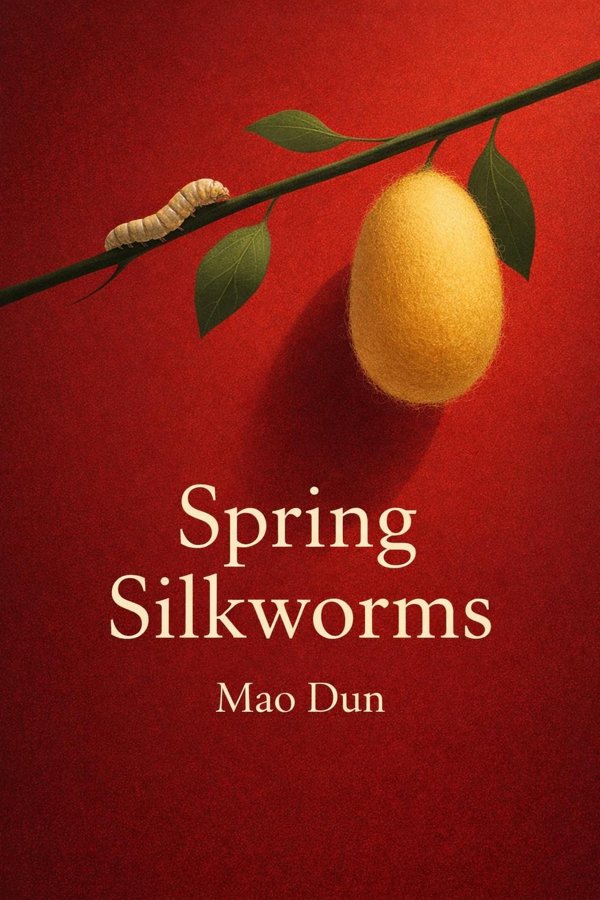
Spring Silkworms: Summary & Key Insights
by Mao Dun
 10 min9 chaptersAudio available
Key Takeaways from Spring Silkworms
A season of hope can also be a season of entrapment.
Few ideas in literature are more unsettling than this one: effort and reward do not reliably match.
What looks like household cooperation often conceals enormous hidden sacrifice.
No community is truly isolated once market forces begin to define survival.
Custom can give people identity, rhythm, and continuity, but it cannot always shield them from change.
What Is Spring Silkworms About?
Spring Silkworms by Mao Dun is a classics book. Spring Silkworms by Mao Dun is a powerful short story about rural Chinese families whose survival depends on one fragile seasonal gamble: raising silkworms. Set in the early twentieth century, the story follows peasant households as they pour labor, hope, money, and emotion into the annual silk cycle, only to find that forces far beyond their control shape the outcome. What begins as a local story of farming and family gradually becomes a wider portrait of poverty, debt, market instability, and social change. The story matters because it turns a seemingly narrow subject into a profound study of economic vulnerability. Mao Dun shows how ordinary people can work tirelessly and still remain trapped when prices collapse, credit tightens, and larger systems exploit their labor. His realism gives the narrative unusual force: every detail of village life, from feeding worms to bargaining over cocoons, reveals both dignity and desperation. Mao Dun, one of modern China’s most important writers, was known for combining literary skill with sharp social observation. In Spring Silkworms, he transforms agricultural routine into a compelling exploration of class, uncertainty, and the human cost of economic dependence.
This FizzRead summary covers all 9 key chapters of Spring Silkworms in approximately 10 minutes, distilling the most important ideas, arguments, and takeaways from Mao Dun's work. Also available as an audio summary and Key Quotes Podcast.
Spring Silkworms
Spring Silkworms by Mao Dun is a powerful short story about rural Chinese families whose survival depends on one fragile seasonal gamble: raising silkworms. Set in the early twentieth century, the story follows peasant households as they pour labor, hope, money, and emotion into the annual silk cycle, only to find that forces far beyond their control shape the outcome. What begins as a local story of farming and family gradually becomes a wider portrait of poverty, debt, market instability, and social change.
The story matters because it turns a seemingly narrow subject into a profound study of economic vulnerability. Mao Dun shows how ordinary people can work tirelessly and still remain trapped when prices collapse, credit tightens, and larger systems exploit their labor. His realism gives the narrative unusual force: every detail of village life, from feeding worms to bargaining over cocoons, reveals both dignity and desperation.
Mao Dun, one of modern China’s most important writers, was known for combining literary skill with sharp social observation. In Spring Silkworms, he transforms agricultural routine into a compelling exploration of class, uncertainty, and the human cost of economic dependence.
Who Should Read Spring Silkworms?
This book is perfect for anyone interested in classics and looking to gain actionable insights in a short read. Whether you're a student, professional, or lifelong learner, the key ideas from Spring Silkworms by Mao Dun will help you think differently.
- ✓Readers who enjoy classics and want practical takeaways
- ✓Professionals looking to apply new ideas to their work and life
- ✓Anyone who wants the core insights of Spring Silkworms in just 10 minutes
Want the full summary?
Get instant access to this book summary and 100K+ more with Fizz Moment.
Get Free SummaryAvailable on App Store • Free to download
Key Chapters
A season of hope can also be a season of entrapment. One of the most striking ideas in Spring Silkworms is that aspiration is not always liberating; sometimes it is the very mechanism that keeps people bound to hardship. The peasant families in the story do not raise silkworms simply because they enjoy tradition or craft. They do it because sericulture appears to offer one of the few chances to earn cash, pay debts, and preserve household stability. Yet that same hope forces them into risky borrowing, exhausting labor, and dependence on volatile markets.
Mao Dun carefully shows how the villagers invest in mulberry leaves, silkworm eggs, equipment, and time with no guarantee of return. Their optimism is practical rather than naive. They know the work is difficult, but the possibility of a better outcome compels them forward. This is what makes the story so powerful: hope is not portrayed as foolish fantasy, but as a necessary emotional resource in an unjust economic system. At the same time, that hope becomes exploitable. Traders, lenders, and market conditions all benefit from the peasants’ need to believe the season will save them.
This idea remains relevant far beyond rural China. People today may take on precarious gig work, risky loans, or unstable investments because they see no safer path to security. The emotional logic is similar: when options are limited, hope itself becomes costly.
As a reader, the practical lesson is to examine situations where optimism is tied to structural dependence. Ask not only whether an opportunity seems promising, but also who controls the terms, who bears the risk, and who profits if things go wrong. The actionable takeaway: whenever hope requires major sacrifice, map the system around it before committing fully.
Few ideas in literature are more unsettling than this one: effort and reward do not reliably match. In Spring Silkworms, Mao Dun dismantles the comforting belief that diligent labor naturally leads to success. The villagers work with extraordinary discipline. Raising silkworms demands constant attention, careful timing, clean conditions, and physical endurance. Families reorganize their lives around the worms’ needs, sacrificing sleep and comfort in order to protect the delicate creatures that represent their economic future.
Yet the story refuses to romanticize labor. However committed the households are, their fate is ultimately shaped by external forces such as prices, middlemen, debt obligations, and larger economic currents. This does not make their work meaningless. On the contrary, Mao Dun portrays labor with deep respect. But he insists that respect for labor should not blind us to the systems that strip workers of fair return.
That insight gives the story its enduring political and moral weight. The peasants are not poor because they are lazy or incompetent. They are poor because they live inside structures that extract value from their effort. This shift in perspective matters. It moves blame away from individuals and toward the economic arrangements that produce insecurity.
Modern readers can apply this lesson in workplaces, freelance markets, and small-business environments. A person may be talented and hardworking yet remain financially fragile because compensation, pricing power, or access to capital is unequal. Recognizing that mismatch can lead to better decisions about negotiating, organizing, and evaluating risk.
The actionable takeaway: do not judge outcomes by effort alone. When assessing success or failure, look at the broader structure of incentives, bargaining power, and market control.
What looks like household cooperation often conceals enormous hidden sacrifice. In Spring Silkworms, the family is both a unit of care and a unit of production. Everyone participates in the silkworm season: elders contribute experience, adults carry the heaviest burden, and younger members are drawn into routines shaped by necessity. On the surface, this collective effort can seem admirable and even efficient. But Mao Dun reveals the unseen costs embedded in family labor.
These costs include physical exhaustion, emotional strain, lost rest, and the narrowing of daily life around economic survival. Because the labor happens inside the household, it can be overlooked or treated as natural rather than valued as real work. Family members do not always receive wages, recognition, or choice. Their contribution disappears into the idea that this is simply what a family must do.
The brilliance of Mao Dun’s realism is that he does not reduce the family to pure oppression. There is loyalty, mutual dependence, and shared purpose. Yet affection does not erase exploitation. In conditions of poverty, the household becomes the place where economic pressure is absorbed. Instead of the market or state bearing the burden of instability, families internalize it through overwork and sacrifice.
This pattern remains familiar today. Family businesses often rely on unpaid help. Care work is still undervalued. Financial crises are frequently managed through private sacrifice rather than public support. When we say a family is “coping,” we may be ignoring what that coping actually costs.
The actionable takeaway: whenever a household appears to be functioning under pressure, ask what invisible labor makes that possible. Name that labor, value it, and look for ways to distribute burdens more fairly.
No community is truly isolated once market forces begin to define survival. A central achievement of Spring Silkworms is its demonstration that even a traditional rural village is deeply connected to wider economic systems. The peasants may work in local spaces, using familiar routines and inherited knowledge, but the value of their labor depends on forces far beyond the village. Silk prices, demand patterns, trade networks, and intermediaries all enter the household indirectly, shaping choices that seem local but are actually global in effect.
Mao Dun shows this with remarkable subtlety. The villagers are not abstract victims of “the economy.” They encounter the market through concrete experiences: buying supplies, calculating possible returns, negotiating sales, and confronting disappointment when prices fail. This makes economic transformation feel intimate rather than distant. The market is not somewhere else; it lives in the timing of chores, the mood of family conversations, and the anxiety surrounding each stage of production.
The story therefore challenges the idea that rural life exists outside modern economic complexity. It also helps readers understand how modernization often arrives unevenly. Villagers may become economically exposed without gaining meaningful protection, bargaining power, or knowledge. They are integrated into the market as risk-bearers, not as equal participants.
This insight applies strongly today. Small farmers, online creators, and independent sellers all operate in environments shaped by platforms, pricing shifts, and distant demand. Their work feels personal, but their income depends on systems they do not control.
The actionable takeaway: if your livelihood depends on a market, learn the larger chain around your work. Understand who sets prices, who captures margins, and how external shocks can affect your daily decisions.
Custom can give people identity, rhythm, and continuity, but it cannot always shield them from change. In Spring Silkworms, sericulture is not merely an economic activity; it is also embedded in village habit, seasonal memory, and inherited practice. Families know how to raise silkworms because generations have done so. This tradition gives structure to life and creates a sense of competence in a world of uncertainty.
But Mao Dun shows that tradition has limits. Familiar methods and inherited wisdom do not guarantee security when economic conditions have shifted. The villagers may understand the biological needs of silkworms, yet that knowledge does not protect them from collapsing prices or exploitative trade relations. In this sense, the story is not hostile to tradition, but realistic about what tradition can and cannot do.
This is one reason the story feels modern. It portrays a society in transition, where old forms of knowledge still matter but no longer fully organize reality. People continue to act through inherited patterns because those patterns remain meaningful. However, meaning is not the same as power. A community can preserve rituals and still lose control over its economic future.
Readers can see similar dynamics today when long-standing professions, local crafts, or family businesses confront digital disruption, inflation, or global competition. Tradition can sustain morale and identity, but adaptation is often necessary for survival.
The actionable takeaway: respect inherited practices, but do not assume they are sufficient for new conditions. Preserve what gives meaning while honestly assessing what must change in response to shifting economic realities.
Debt is never purely financial; it rearranges the inner life of a household. In Spring Silkworms, economic pressure is not presented only through numbers or transactions. Mao Dun reveals debt as a psychological atmosphere. It influences how people speak, plan, worry, and relate to one another. The possibility of profit from silkworms is inseparable from the fear of failing to meet obligations. Every decision carries emotional charge because cash flow is linked to dignity, reputation, and survival.
This is one of the story’s most sophisticated insights. Debt creates a future that feels already occupied. Money not yet earned has already been claimed. As a result, even moments of apparent progress are shadowed by anxiety. The peasants cannot simply enjoy the promise of a good cocoon yield because repayment, bargaining, and uncertainty hover over the season. Their emotional life becomes structured by anticipation and vulnerability.
Mao Dun’s treatment of debt helps explain why poverty is so exhausting. It is not only that resources are limited. It is that mental space is consumed by calculation and fear. This reduces freedom, weakens resilience, and can intensify family tension. Debt narrows imagination because too much thought must be devoted to immediate obligations.
Modern readers can recognize this in student loans, medical bills, credit debt, or unstable business financing. The emotional burden often exceeds the visible balance. People under debt pressure may appear distracted, irritable, or overly cautious not because they lack discipline, but because financial strain is occupying attention.
The actionable takeaway: treat debt as both an economic and emotional condition. When making plans, factor in not only the repayment schedule but also the psychological weight the obligation will place on your daily life.
Sometimes the quietest stories deliver the sharpest critique. Spring Silkworms is not dramatic in the conventional sense; it does not rely on sensational twists or heroic speeches. Instead, Mao Dun uses realism to expose what might be called structural violence: harm produced not by a single villain, but by economic arrangements that steadily wear people down. The story’s power comes from detail. By showing the rhythms of labor, the fragility of income, and the dependence on market forces, Mao Dun makes systemic injustice visible in ordinary life.
This literary method matters. Structural problems often remain hidden because they are normalized. If everyone in a village works this way, borrows this way, and suffers this way, hardship can begin to seem natural. Realism interrupts that illusion. It asks readers to see routine suffering as historically produced rather than inevitable. The peasants’ struggle is not fate; it is the result of social and economic conditions.
Mao Dun’s realism is also ethically effective because it avoids oversimplification. The story does not turn characters into symbols only. They remain human, with habits, hopes, and contradictions. This preserves complexity while still pointing toward critique.
For readers today, the lesson is to pay attention to the ordinary. Housing insecurity, burnout, and low-wage instability may appear as personal issues when viewed in isolation. But careful observation often reveals patterns shaped by policy, ownership, and institutions.
The actionable takeaway: use realism as a tool for understanding your own world. When a hardship seems common, ask whether it has been normalized rather than justified, and look for the structural causes beneath everyday routine.
The people with the least control often carry the greatest uncertainty. In Spring Silkworms, peasant households function as small producers operating at the edge of survival. They absorb biological risk, labor risk, weather risk, and market risk all at once. If the silkworms fail, if conditions shift, or if prices disappoint, the loss falls most heavily on them. Yet they have little power over the systems that determine whether their work will be rewarded.
Mao Dun presents this imbalance with great clarity. The villagers commit time, energy, and scarce resources before they know what return they will receive. By contrast, intermediaries and larger market actors often face less exposure while retaining more influence over prices and terms. This is a familiar pattern in many economies: small producers shoulder uncertainty so that others can maintain flexibility and profit.
What makes the story especially compelling is that risk is not abstract. It appears in the family’s calculations, in their urgent care for the worms, and in the emotional stakes attached to each phase of production. The entire household lives under conditional security. One season can determine whether debts deepen or survival becomes slightly more manageable.
Today, small farmers, independent contractors, and micro-entrepreneurs often face similar realities. They prepay costs, work without guaranteed returns, and remain vulnerable to price swings or platform decisions. Admiring their resilience is not enough; the key question is whether the distribution of risk is fair.
The actionable takeaway: when evaluating any economic arrangement, identify who takes the upfront risk and who controls the outcome. If those are not the same people, the system likely deserves closer scrutiny.
Poverty can limit options without erasing dignity. One of the most humane dimensions of Spring Silkworms is Mao Dun’s refusal to depict the villagers as passive victims or romantic symbols. They are constrained, but they are also resourceful, observant, and deeply invested in the meaning of their work. Even within an exploitative system, they continue to make judgments, care for one another, and act with seriousness toward their responsibilities.
This matters because literature about hardship can sometimes flatten people into examples of suffering. Mao Dun does the opposite. He reveals pain while preserving complexity. The peasants are anxious, tired, and vulnerable, yet they still possess knowledge, pride, and emotional depth. Their labor is not only a means of survival; it is also tied to self-respect and family continuity. By attending to these dimensions, the story insists that economic hardship should never be confused with moral inferiority.
This idea has practical relevance in how we think about class and social inequality. People under pressure are often judged for short-term decisions, visible stress, or limited choices. But dignity does not depend on financial success. Recognizing this can lead to more humane institutions, better policy, and more respectful everyday interactions.
Readers can apply this insight by changing how they interpret struggle in others and in themselves. Financial instability is often treated as evidence of failure when it may actually reflect structural disadvantage combined with resilience.
The actionable takeaway: separate economic status from human worth. In any context where hardship is visible, begin with respect for the intelligence, effort, and dignity of those living through it.
All Chapters in Spring Silkworms
About the Author
Mao Dun was the pen name of Shen Dehong, a major Chinese novelist, short story writer, critic, and cultural figure born in 1896. He emerged as one of the leading voices of modern Chinese realism, known for portraying the social tensions of a country undergoing rapid political and economic change. His fiction often examined class relations, labor, urban and rural hardship, and the pressures of modernization. Beyond his literary work, Mao Dun was active in journalism and public cultural life, which deepened his engagement with the realities he depicted. He became one of the most influential writers of twentieth-century China, admired for combining narrative craft with social analysis. He died in 1981, leaving a lasting legacy in modern Chinese literature.
Get This Summary in Your Preferred Format
Read or listen to the Spring Silkworms summary by Mao Dun anytime, anywhere. FizzRead offers multiple formats so you can learn on your terms — all free.
Available formats: App · Audio · PDF · EPUB — All included free with FizzRead
Download Spring Silkworms PDF and EPUB Summary
Key Quotes from Spring Silkworms
“A season of hope can also be a season of entrapment.”
“Few ideas in literature are more unsettling than this one: effort and reward do not reliably match.”
“What looks like household cooperation often conceals enormous hidden sacrifice.”
“No community is truly isolated once market forces begin to define survival.”
“Custom can give people identity, rhythm, and continuity, but it cannot always shield them from change.”
Frequently Asked Questions about Spring Silkworms
Spring Silkworms by Mao Dun is a classics book that explores key ideas across 9 chapters. Spring Silkworms by Mao Dun is a powerful short story about rural Chinese families whose survival depends on one fragile seasonal gamble: raising silkworms. Set in the early twentieth century, the story follows peasant households as they pour labor, hope, money, and emotion into the annual silk cycle, only to find that forces far beyond their control shape the outcome. What begins as a local story of farming and family gradually becomes a wider portrait of poverty, debt, market instability, and social change. The story matters because it turns a seemingly narrow subject into a profound study of economic vulnerability. Mao Dun shows how ordinary people can work tirelessly and still remain trapped when prices collapse, credit tightens, and larger systems exploit their labor. His realism gives the narrative unusual force: every detail of village life, from feeding worms to bargaining over cocoons, reveals both dignity and desperation. Mao Dun, one of modern China’s most important writers, was known for combining literary skill with sharp social observation. In Spring Silkworms, he transforms agricultural routine into a compelling exploration of class, uncertainty, and the human cost of economic dependence.
More by Mao Dun
You Might Also Like

Browse by Category
Ready to read Spring Silkworms?
Get the full summary and 100K+ more books with Fizz Moment.