
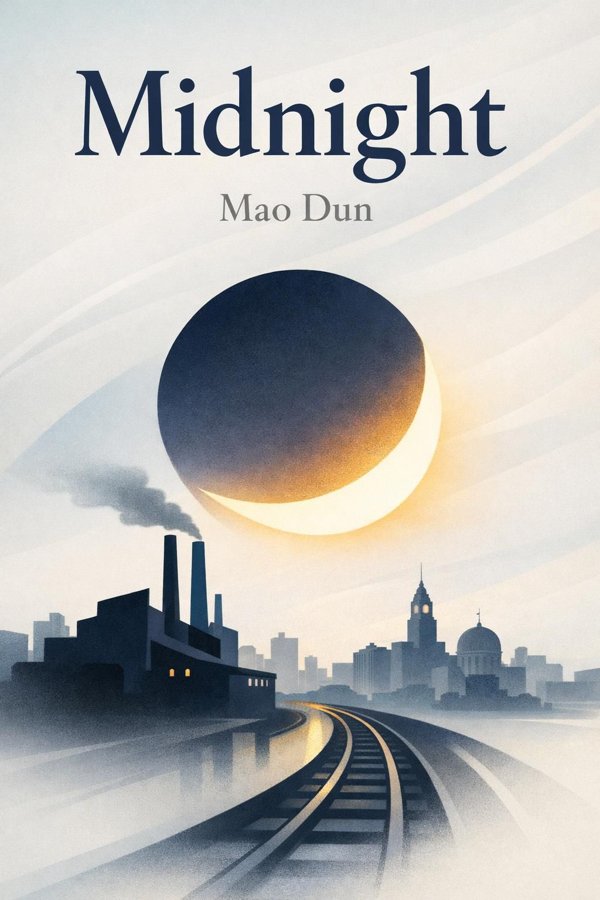
Midnight: Summary & Key Insights
by Mao Dun
 10 min9 chaptersAudio available
Key Takeaways from Midnight
A society can look energetic on the surface while becoming dangerously fragile underneath.
The most dangerous form of confidence is the kind that mistakes ambition for mastery.
Class conflict is not only a matter of slogans, strikes, or political speeches; it lives inside daily routines, workplaces, homes, and desires.
People rarely become morally compromised all at once; more often, they adapt step by step to systems that reward compromise.
Cities promise freedom, but they often intensify dependency.
What Is Midnight About?
Midnight by Mao Dun is a classics book. What happens to a society when money moves faster than conscience, politics serves profit, and ordinary people are swept into forces they barely understand? Mao Dun’s Midnight is one of the great realist novels of modern Chinese literature because it answers those questions not through abstract theory, but through a vivid portrait of urban life in 1930s Shanghai. First published in 1933, the novel follows financiers, factory owners, clerks, speculators, workers, and intellectuals as they collide in a city driven by capital, ambition, and crisis. At its center is the businessman Wu Sunfu, whose rise and unraveling expose the instability of a system built on debt, competition, and illusion. Mao Dun, a major novelist, critic, and cultural figure of twentieth-century China, wrote with unusual breadth about the social transformations of his time. His authority comes from both literary skill and historical insight: he captures how economics shapes family life, morality, labor, and political choice. Midnight matters because it remains a sharp, unsettling study of capitalism, class conflict, and the human cost of modernity.
This FizzRead summary covers all 9 key chapters of Midnight in approximately 10 minutes, distilling the most important ideas, arguments, and takeaways from Mao Dun's work. Also available as an audio summary and Key Quotes Podcast.
Midnight
What happens to a society when money moves faster than conscience, politics serves profit, and ordinary people are swept into forces they barely understand? Mao Dun’s Midnight is one of the great realist novels of modern Chinese literature because it answers those questions not through abstract theory, but through a vivid portrait of urban life in 1930s Shanghai. First published in 1933, the novel follows financiers, factory owners, clerks, speculators, workers, and intellectuals as they collide in a city driven by capital, ambition, and crisis. At its center is the businessman Wu Sunfu, whose rise and unraveling expose the instability of a system built on debt, competition, and illusion. Mao Dun, a major novelist, critic, and cultural figure of twentieth-century China, wrote with unusual breadth about the social transformations of his time. His authority comes from both literary skill and historical insight: he captures how economics shapes family life, morality, labor, and political choice. Midnight matters because it remains a sharp, unsettling study of capitalism, class conflict, and the human cost of modernity.
Who Should Read Midnight?
This book is perfect for anyone interested in classics and looking to gain actionable insights in a short read. Whether you're a student, professional, or lifelong learner, the key ideas from Midnight by Mao Dun will help you think differently.
- ✓Readers who enjoy classics and want practical takeaways
- ✓Professionals looking to apply new ideas to their work and life
- ✓Anyone who wants the core insights of Midnight in just 10 minutes
Want the full summary?
Get instant access to this book summary and 100K+ more with Fizz Moment.
Get Free SummaryAvailable on App Store • Free to download
Key Chapters
A society can look energetic on the surface while becoming dangerously fragile underneath. One of Midnight’s most powerful ideas is that modern capitalism generates enormous movement—money circulating, factories expanding, markets fluctuating, fortunes rising and falling—but that this movement often hides deep instability. In Shanghai, business life appears sophisticated and dynamic, yet every gain depends on credit, speculation, political maneuvering, and ruthless competition. Wealth is not secure; it is constantly threatened by market shocks, rival firms, labor unrest, and shifts in state power.
Mao Dun dramatizes this through the world of industrialists and financiers who chase expansion as if growth itself were proof of control. But the novel repeatedly shows that control is an illusion. A businessman may dominate one day and panic the next. Economic systems do not simply reward talent; they expose everyone to forces larger than individual will. The city becomes a machine that promises advancement while pushing its participants into anxiety and overreach.
This insight still feels modern. Today, companies celebrate disruption, rapid scaling, and aggressive competition, yet many operate under similar pressures: debt dependency, short-term decision-making, and constant uncertainty. An entrepreneur may appear powerful but still be trapped by investors, market sentiment, and external shocks. Likewise, workers and consumers experience the consequences of volatility they did not create.
Midnight invites readers to look beyond the glamour of growth. Whenever a system seems highly productive, ask what forms of risk, exhaustion, and inequality make that productivity possible. Actionable takeaway: when judging success—whether in business, institutions, or personal ambition—look not only at momentum, but at what keeps the system stable, humane, and sustainable.
The most dangerous form of confidence is the kind that mistakes ambition for mastery. Wu Sunfu, the novel’s central capitalist figure, is not a cartoon villain but a complex embodiment of modern ambition. He is intelligent, energetic, disciplined, and determined to shape events rather than be shaped by them. Yet the more he tries to dominate markets, competitors, and social networks, the more he reveals how little any individual can fully command an entire economic order.
Wu Sunfu’s importance lies in the fact that he is both impressive and trapped. He wants industrial power, social prestige, and strategic influence. He thinks in terms of scale and calculation. But his plans are continuously disrupted by competing interests, unstable finance, and the unpredictable reactions of workers and allies. Mao Dun uses him to show that personal capability matters, but only within structures that are often contradictory and uncontrollable.
This makes Wu Sunfu a timeless character. He resembles modern executives, founders, and political operators who believe enough intelligence and drive can overcome structural problems. Midnight suggests otherwise. A talented leader can accelerate a system’s logic, but cannot easily escape it. If the system runs on exploitation, speculation, and insecurity, even the “strong” become vulnerable to its crises.
Readers can apply this insight beyond business. In careers, organizations, and public life, ambition often encourages people to believe they alone can bend reality. But many failures come not from lack of effort, but from ignoring context. Actionable takeaway: pursue excellence and initiative, but regularly ask which forces lie beyond personal control—economic conditions, institutional incentives, and social consequences—so ambition becomes informed rather than blind.
Class conflict is not only a matter of slogans, strikes, or political speeches; it lives inside daily routines, workplaces, homes, and desires. Midnight excels at showing that class is not an abstract category but a lived reality structuring how people work, travel, eat, fear, and hope. In the novel’s Shanghai, the wealthy discuss investments and strategy while workers confront wage pressure, unstable conditions, and the constant threat of disposability. These worlds overlap geographically but remain divided by power.
Mao Dun’s realism is especially sharp because he does not isolate economic conflict from ordinary life. Business competition affects families. Industrial expansion affects labor discipline. Social prestige depends on material advantage. Even leisure and culture are shaped by class position. The city itself becomes a map of unequal access: some people experience modernity as opportunity, while others experience it as exhaustion and vulnerability.
This is one reason the novel continues to matter. In many contemporary cities, class conflict still appears through housing costs, labor precarity, unequal education, and invisible service work. People often describe society through lifestyle differences, but Midnight reminds us to ask deeper questions: Who owns productive resources? Who absorbs risk? Who profits from instability? Who gets blamed when systems fail?
For readers, the practical application is to train attention toward structures, not just personalities. When evaluating a workplace, a city, or a policy, notice whose labor sustains comfort for others and whose interests are treated as universal. Actionable takeaway: make a habit of reading social situations through class relations—who benefits, who pays, and who has the power to define what counts as normal.
People rarely become morally compromised all at once; more often, they adapt step by step to systems that reward compromise. Midnight shows how economic life can distort moral judgment by making selfishness look practical, cruelty look efficient, and opportunism look intelligent. In the novel’s commercial world, ethical choices are continually reframed as strategic choices. The question is not what is right, but what is viable, profitable, or necessary under competitive pressure.
This moral distortion does not affect only the rich. Different classes experience it differently, but nearly everyone is drawn into it. Business elites justify hard decisions through market logic. Political actors rationalize alliances through expediency. Workers may feel forced into desperate actions by material pressure. Even relationships can become transactional when survival and status dominate thought. Mao Dun’s point is not that individuals are naturally corrupt, but that social arrangements can normalize harmful conduct.
The modern relevance is obvious. Organizations still excuse layoffs, manipulation, burnout, and exploitation as unavoidable facts of competition. Individuals tell themselves they are simply being realistic. But realism without ethics becomes surrender to the logic of the system. Midnight asks readers to see how language itself can hide responsibility. Terms like efficiency, optimization, and competitiveness often mask human costs.
A practical way to use this insight is to question the moral vocabulary of institutions. When a decision is described as necessary, ask: necessary for whom? Necessary to protect what? What alternatives were dismissed because they threatened profit or prestige? Actionable takeaway: whenever market reasoning is presented as morally neutral, pause and identify the human consequences that such reasoning may be concealing.
Cities promise freedom, but they often intensify dependency. In Midnight, Shanghai is more than a backdrop; it is a living structure that concentrates wealth, information, aspiration, and conflict. The city attracts entrepreneurs, laborers, intellectuals, and opportunists because it seems to offer speed and possibility. Yet the same concentration that creates opportunity also magnifies pressure. Competition is sharper, class divisions more visible, and failure more humiliating.
Mao Dun captures urban modernity as a paradox. The city enlarges human contact but weakens human security. It multiplies networks, but these networks are often instrumental rather than supportive. People become more connected economically while remaining emotionally isolated. Public life is crowded, yet trust is scarce. Under such conditions, success demands alertness, adaptability, and nerve, but these qualities can easily slide into paranoia and emotional exhaustion.
This reading of the city remains strikingly relevant. Today’s global cities are celebrated as centers of innovation and culture, but they are also places of precarious work, social comparison, speculative finance, and relentless acceleration. Many people feel simultaneously stimulated and depleted. Midnight helps explain why: urban systems centralize both opportunity and insecurity.
Readers can apply this idea by rethinking what counts as a “successful” environment. A city or organization should not be judged only by dynamism, investment, or growth. It should also be judged by whether people can live with dignity, stability, and meaningful relationships. Actionable takeaway: when evaluating modern urban life, look beyond excitement and prestige to ask whether the environment distributes security as effectively as it distributes opportunity.
A society reveals its true structure by how it treats the people whose labor it depends on. Midnight insists that workers are not background figures in the story of modern industry; they are central to it. Factories, profits, and commercial ambition all rest on labor, yet labor is often treated as a cost to be managed rather than human effort deserving respect and power. Mao Dun gives this contradiction narrative weight by showing how workers’ conditions and responses are inseparable from the broader economy.
The novel does not romanticize labor, but it does insist on its historical importance. Workers are affected by exploitation, wage pressure, and discipline, but they are also agents whose actions can disrupt the plans of capital. This is crucial. Midnight challenges the illusion that industrial society is made mainly by visionary owners or strategic elites. Without workers, there is no production, no wealth, and no modern city.
This remains a vital lesson in an era when supply chains, service work, manufacturing, logistics, and platform labor are often made socially invisible. Consumers enjoy convenience and investors celebrate efficiency, yet the conditions enabling both are frequently obscured. Reading Midnight encourages a more honest social imagination—one that sees labor not as an afterthought but as the foundation of collective life.
In practical terms, this means asking better questions about the systems we participate in. Who makes the goods we buy? Under what conditions? Who absorbs the fatigue hidden behind convenience? Actionable takeaway: build the habit of tracing products, services, and institutions back to labor, and let that awareness shape your ethical choices as a citizen, consumer, and worker.
Markets are never as independent as they pretend to be. One of Midnight’s sharpest insights is that economic power and political power are deeply entangled. Business fortunes do not rise through competition alone; they depend on regulation, state violence, political alliances, factional struggle, and access to influence. The businessmen in the novel do not operate in a neutral marketplace. They maneuver within a field where political conditions shape commercial outcomes and commercial interests shape political choices.
This interlocking power matters because it exposes the myth of pure meritocracy. Winners are not simply more efficient or more disciplined; they are often better positioned within networks of influence. Likewise, political instability is not merely a backdrop to commerce—it is one of the forces that determines who can invest, who can borrow, who can suppress opposition, and who can survive a crisis.
The lesson is highly contemporary. From lobbying and regulatory capture to state subsidies, labor law, and financial policy, modern economies are structured by political decisions even when public discourse presents them as natural market outcomes. Midnight helps readers see that economic narratives often hide political choices behind technical language.
For practical application, readers should treat economic debates as moral and political debates, not merely technical ones. When hearing claims about growth, competitiveness, or investor confidence, ask what legal framework, enforcement power, and social compromises make those outcomes possible. Actionable takeaway: whenever someone describes a result as “just the market,” look for the political arrangements and power relationships that helped produce it.
Some novels persuade by offering heroes and villains; Midnight persuades by refusing easy simplification. Its realism is one of its greatest strengths. Mao Dun does not flatten social life into a single moral lesson or sentimental narrative. Instead, he presents a dense web of motives, institutions, pressures, and contradictions. People act out of greed, fear, pride, idealism, exhaustion, and confusion—often at the same time. This complexity is not decorative; it is the method through which the novel reveals social truth.
Realism here means more than detailed description. It means understanding that individuals are shaped by structures but not fully determined by them, that systems are powerful but unstable, and that moral clarity often emerges only after confronting confusion. By resisting melodrama, Mao Dun helps readers grasp how historical change actually feels: messy, uneven, and difficult to interpret from within.
This matters beyond literature. In everyday life, people often seek simple stories to explain economic crisis, political polarization, or institutional failure. Midnight teaches a more demanding habit of thought. It suggests that serious understanding requires holding multiple truths together: personal agency and structural constraint, aspiration and exploitation, progress and damage.
Readers can apply this lesson in their own analysis of current events. Rather than rushing toward single-cause explanations, try mapping the different incentives and pressures shaping a situation. Actionable takeaway: practice realist thinking by resisting oversimplified narratives and asking what hidden structures, conflicting motives, and unintended consequences are operating beneath visible events.
Periods of crisis do not create character from nothing; they reveal the values already built into a social order. In Midnight, moments of financial, industrial, and political strain expose what the system is really organized to protect. Prestige, capital, and control often receive urgent defense, while the suffering of workers and the vulnerability of ordinary people remain secondary. Crisis strips away the polite language of normal times and shows which lives and interests are considered expendable.
Mao Dun uses breakdown not merely for drama, but for diagnosis. When pressure intensifies, hidden dependencies become visible. Alliances shift. Fear spreads. Strategic talk becomes frantic. The appearance of rational order gives way to defensive improvisation. This reveals that the system was never as stable or just as it claimed. Its priorities were always uneven; crisis simply makes them impossible to ignore.
This insight has broad contemporary application. Recessions, pandemics, labor disputes, and political shocks all test institutions. In such moments, we see whether organizations protect people or protect appearances, whether governments prioritize public welfare or elite confidence, and whether communities become more solidaristic or more fragmented.
For readers, the key is to treat crisis as information. Instead of focusing only on disruption, study what the disruption uncovers. Whose losses are normalized? What is rescued first? What language is used to justify sacrifice? Actionable takeaway: in any crisis, pay attention to what institutions move fastest to save, because that reveals more about their true values than their public statements ever will.
All Chapters in Midnight
About the Author
Mao Dun was the pen name of Shen Yanbing (1896-1981), one of the leading figures of modern Chinese literature. A novelist, critic, editor, and public intellectual, he played a major role in shaping twentieth-century literary culture in China. He was closely associated with realist writing and became known for works that explored social upheaval, class relations, political conflict, and the pressures of modernization. His fiction often combined broad historical vision with careful attention to the lives of ordinary people and the structures governing them. Midnight, first published in 1933, is widely considered his masterpiece and one of the defining novels of modern Chinese realism. Mao Dun’s legacy endures through both his literary achievements and his influence on generations of writers and readers.
Get This Summary in Your Preferred Format
Read or listen to the Midnight summary by Mao Dun anytime, anywhere. FizzRead offers multiple formats so you can learn on your terms — all free.
Available formats: App · Audio · PDF · EPUB — All included free with FizzRead
Download Midnight PDF and EPUB Summary
Key Quotes from Midnight
“A society can look energetic on the surface while becoming dangerously fragile underneath.”
“The most dangerous form of confidence is the kind that mistakes ambition for mastery.”
“Class conflict is not only a matter of slogans, strikes, or political speeches; it lives inside daily routines, workplaces, homes, and desires.”
“People rarely become morally compromised all at once; more often, they adapt step by step to systems that reward compromise.”
“Cities promise freedom, but they often intensify dependency.”
Frequently Asked Questions about Midnight
Midnight by Mao Dun is a classics book that explores key ideas across 9 chapters. What happens to a society when money moves faster than conscience, politics serves profit, and ordinary people are swept into forces they barely understand? Mao Dun’s Midnight is one of the great realist novels of modern Chinese literature because it answers those questions not through abstract theory, but through a vivid portrait of urban life in 1930s Shanghai. First published in 1933, the novel follows financiers, factory owners, clerks, speculators, workers, and intellectuals as they collide in a city driven by capital, ambition, and crisis. At its center is the businessman Wu Sunfu, whose rise and unraveling expose the instability of a system built on debt, competition, and illusion. Mao Dun, a major novelist, critic, and cultural figure of twentieth-century China, wrote with unusual breadth about the social transformations of his time. His authority comes from both literary skill and historical insight: he captures how economics shapes family life, morality, labor, and political choice. Midnight matters because it remains a sharp, unsettling study of capitalism, class conflict, and the human cost of modernity.
More by Mao Dun
You Might Also Like
Browse by Category
Ready to read Midnight?
Get the full summary and 100K+ more books with Fizz Moment.