
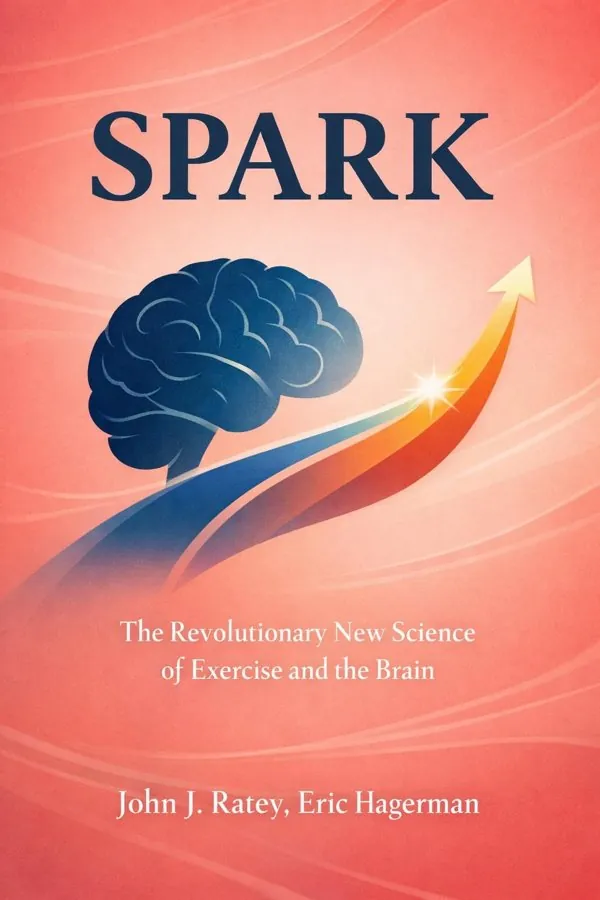
Spark: The Revolutionary New Science of Exercise and the Brain: Summary & Key Insights
by John J. Ratey, Eric Hagerman
 10 min8 chaptersAudio available
What Is Spark: The Revolutionary New Science of Exercise and the Brain About?
Spark: The Revolutionary New Science of Exercise and the Brain by John J. Ratey, Eric Hagerman is a neuroscience book spanning 8 pages. In this groundbreaking work, psychiatrist John J. Ratey explores the powerful connection between physical exercise and brain performance. Drawing on cutting-edge neuroscience, he demonstrates how aerobic activity can improve learning, memory, mood, and mental health, and even protect against neurodegenerative diseases. The book presents compelling evidence that exercise is not only vital for the body but also essential for optimal brain function.
This FizzRead summary covers all 8 key chapters of Spark: The Revolutionary New Science of Exercise and the Brain in approximately 10 minutes, distilling the most important ideas, arguments, and takeaways from John J. Ratey, Eric Hagerman's work. Also available as an audio summary and Key Quotes Podcast.
Spark: The Revolutionary New Science of Exercise and the Brain
In this groundbreaking work, psychiatrist John J. Ratey explores the powerful connection between physical exercise and brain performance. Drawing on cutting-edge neuroscience, he demonstrates how aerobic activity can improve learning, memory, mood, and mental health, and even protect against neurodegenerative diseases. The book presents compelling evidence that exercise is not only vital for the body but also essential for optimal brain function.
Who Should Read Spark: The Revolutionary New Science of Exercise and the Brain?
This book is perfect for anyone interested in neuroscience and looking to gain actionable insights in a short read. Whether you're a student, professional, or lifelong learner, the key ideas from Spark: The Revolutionary New Science of Exercise and the Brain by John J. Ratey, Eric Hagerman will help you think differently.
- ✓Readers who enjoy neuroscience and want practical takeaways
- ✓Professionals looking to apply new ideas to their work and life
- ✓Anyone who wants the core insights of Spark: The Revolutionary New Science of Exercise and the Brain in just 10 minutes
Want the full summary?
Get instant access to this book summary and 100K+ more with Fizz Moment.
Get Free SummaryAvailable on App Store • Free to download
Key Chapters
When I first learned about the Naperville school district, I was simply looking for a practical example of physical fitness done right. What I didn’t expect was that their approach would become one of the most compelling demonstrations of how movement transforms intellect. In the 1990s, a high school physical education teacher named Phil Lawler decided that gym class should be about more than dodgeball or team sports. He introduced a curriculum centered on cardiovascular fitness, where students wore heart-rate monitors and aimed for sustained levels of aerobic activity.
Soon, Naperville’s students were among the fittest in the nation. But the real marvel came when educators noticed something extraordinary: their academic performance soared. On international comparisons, particularly in science and mathematics, these students—mostly middle-class kids from suburban Illinois—ranked among the highest in the world. The correlation was clear: their fitness revolution had sparked a cognitive revolution.
When researchers examined what was happening, they realized that aerobic exercise was increasing levels of brain-derived neurotrophic factor (BDNF), a molecule often described as “Miracle-Gro for the brain.” BDNF encourages brain cells to grow, connect, and communicate more effectively. In Naperville, the students who began their day with sustained aerobic movement entered class primed to learn. Their brains were chemically, electrically, and emotionally optimized for intellectual engagement.
This was more than a success story—it was a glimpse into a new model of education, one that integrates body and mind rather than separating them. Naperville’s results confirmed a powerful truth: movement doesn’t distract from learning; it enables it. It is the spark that activates curiosity, focus, and self-belief.
At the heart of learning lies neuroplasticity—the brain’s ability to reorganize itself by forming new neural connections throughout life. Exercise, I tell my readers, is one of the most potent promoters of neuroplasticity that we know. When you engage in sustained aerobic activity, your body floods the brain with a cocktail of beneficial chemicals: BDNF, growth factors, and neurotransmitters such as dopamine and serotonin. These molecules enhance the ability of neurons to communicate and adapt.
Through imaging studies and molecular research, scientists have observed that active individuals have greater hippocampal volume—the region responsible for memory and spatial learning. In essence, exercise primes the hippocampus to absorb and retain new information. It also enhances executive function in the prefrontal cortex, improving planning, focus, and impulse control. When you move, you are stimulating the brain’s most evolutionarily advanced regions.
The implications for education are profound. Imagine a classroom that integrates physical movement strategically throughout the day—not as a break from learning but as part of it. The Naperville model shows that sustained moderate-to-vigorous exercise before cognitive tasks can dramatically improve memory retention and creativity. In both young students and adult learners, aerobic movement creates an optimal neurochemical environment for learning.
From a biological perspective, every step on the treadmill is a message to your brain: grow, connect, and adapt. And the more you challenge your body, the stronger this message becomes. It is not about running marathons or pushing limits but about consistency—moving often enough for your brain to thrive.
+ 6 more chapters — available in the FizzRead app
All Chapters in Spark: The Revolutionary New Science of Exercise and the Brain
About the Authors
John J. Ratey, M.D., is an associate clinical professor of psychiatry at Harvard Medical School and an internationally recognized expert in neuropsychiatry. Eric Hagerman is a science and health writer who has contributed to publications such as Popular Science and Outside.
Get This Summary in Your Preferred Format
Read or listen to the Spark: The Revolutionary New Science of Exercise and the Brain summary by John J. Ratey, Eric Hagerman anytime, anywhere. FizzRead offers multiple formats so you can learn on your terms — all free.
Available formats: App · Audio · PDF · EPUB — All included free with FizzRead
Download Spark: The Revolutionary New Science of Exercise and the Brain PDF and EPUB Summary
Key Quotes from Spark: The Revolutionary New Science of Exercise and the Brain
“When I first learned about the Naperville school district, I was simply looking for a practical example of physical fitness done right.”
“At the heart of learning lies neuroplasticity—the brain’s ability to reorganize itself by forming new neural connections throughout life.”
Frequently Asked Questions about Spark: The Revolutionary New Science of Exercise and the Brain
Spark: The Revolutionary New Science of Exercise and the Brain by John J. Ratey, Eric Hagerman is a neuroscience book that explores key ideas across 8 chapters. In this groundbreaking work, psychiatrist John J. Ratey explores the powerful connection between physical exercise and brain performance. Drawing on cutting-edge neuroscience, he demonstrates how aerobic activity can improve learning, memory, mood, and mental health, and even protect against neurodegenerative diseases. The book presents compelling evidence that exercise is not only vital for the body but also essential for optimal brain function.
You Might Also Like
Anxious
Joseph LeDoux
10 min
Hallucinations
Oliver Sacks
10 min
The Biological Mind: How Brain, Body, and Environment Collaborate to Make Us Who We Are
Alan Jasanoff
10 min
The Feeling of Life Itself: Why Consciousness Is Widespread but Can't Be Computed
Christof Koch
10 min
The No-Nonsense Meditation Book
Steven Laureys
10 min
A General Theory of Love
Thomas Lewis, Fari Amini, Richard Lannon
10 minBrowse by Category
Ready to read Spark: The Revolutionary New Science of Exercise and the Brain?
Get the full summary and 100K+ more books with Fizz Moment.