
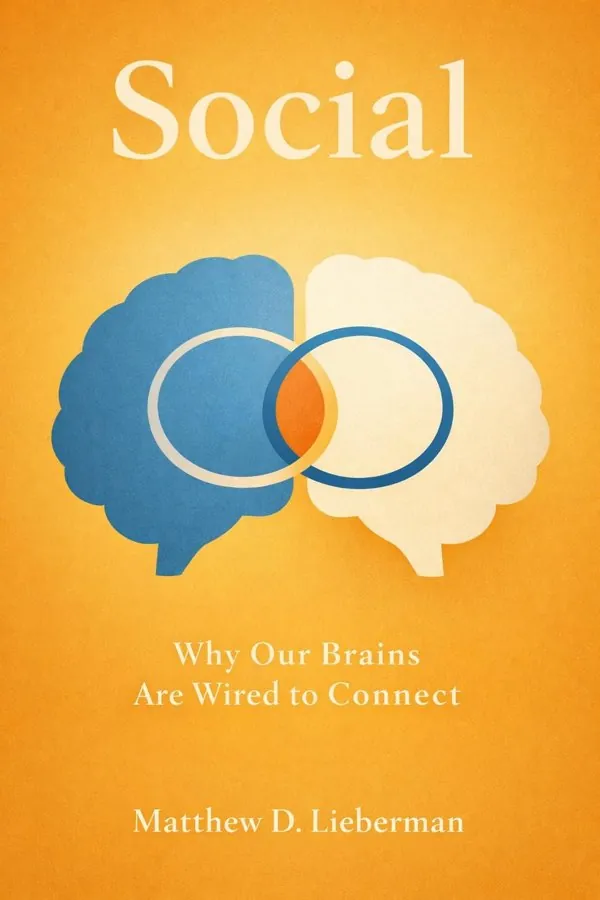
Social: Why Our Brains Are Wired to Connect: Summary & Key Insights
 10 min12 chaptersAudio available
What Is Social: Why Our Brains Are Wired to Connect About?
Social: Why Our Brains Are Wired to Connect by Matthew D. Lieberman is a neuroscience book spanning 12 pages. In this groundbreaking work, social neuroscientist Matthew D. Lieberman explores how the human brain is fundamentally designed for social connection. Drawing on decades of research, he reveals that our need to connect with others is as essential as our need for food and shelter. The book explains how social pain and pleasure are processed in the brain, how social thinking shapes our decisions, and why understanding our social nature can transform education, business, and personal relationships.
This FizzRead summary covers all 12 key chapters of Social: Why Our Brains Are Wired to Connect in approximately 10 minutes, distilling the most important ideas, arguments, and takeaways from Matthew D. Lieberman's work. Also available as an audio summary and Key Quotes Podcast.
Social: Why Our Brains Are Wired to Connect
In this groundbreaking work, social neuroscientist Matthew D. Lieberman explores how the human brain is fundamentally designed for social connection. Drawing on decades of research, he reveals that our need to connect with others is as essential as our need for food and shelter. The book explains how social pain and pleasure are processed in the brain, how social thinking shapes our decisions, and why understanding our social nature can transform education, business, and personal relationships.
Who Should Read Social: Why Our Brains Are Wired to Connect?
This book is perfect for anyone interested in neuroscience and looking to gain actionable insights in a short read. Whether you're a student, professional, or lifelong learner, the key ideas from Social: Why Our Brains Are Wired to Connect by Matthew D. Lieberman will help you think differently.
- ✓Readers who enjoy neuroscience and want practical takeaways
- ✓Professionals looking to apply new ideas to their work and life
- ✓Anyone who wants the core insights of Social: Why Our Brains Are Wired to Connect in just 10 minutes
Want the full summary?
Get instant access to this book summary and 100K+ more with Fizz Moment.
Get Free SummaryAvailable on App Store • Free to download
Key Chapters
+ 10 more chapters — available in the FizzRead app
All Chapters in Social: Why Our Brains Are Wired to Connect
About the Author
Matthew D. Lieberman is a professor of psychology, psychiatry, and biobehavioral sciences at the University of California, Los Angeles (UCLA). He is a founding father of social cognitive neuroscience and has published extensively on the neural basis of social behavior and emotion.
Get This Summary in Your Preferred Format
Read or listen to the Social: Why Our Brains Are Wired to Connect summary by Matthew D. Lieberman anytime, anywhere. FizzRead offers multiple formats so you can learn on your terms — all free.
Available formats: App · Audio · PDF · EPUB — All included free with FizzRead
Download Social: Why Our Brains Are Wired to Connect PDF and EPUB Summary
Key Quotes from Social: Why Our Brains Are Wired to Connect
“Evolution gave us big brains not to solve abstract puzzles, but to solve each other.”
“Perhaps the most startling discovery in my research came when we found that social pain—the sting of rejection—shares its neural home with physical pain.”
Frequently Asked Questions about Social: Why Our Brains Are Wired to Connect
Social: Why Our Brains Are Wired to Connect by Matthew D. Lieberman is a neuroscience book that explores key ideas across 12 chapters. In this groundbreaking work, social neuroscientist Matthew D. Lieberman explores how the human brain is fundamentally designed for social connection. Drawing on decades of research, he reveals that our need to connect with others is as essential as our need for food and shelter. The book explains how social pain and pleasure are processed in the brain, how social thinking shapes our decisions, and why understanding our social nature can transform education, business, and personal relationships.
You Might Also Like

Anxious
Joseph LeDoux
10 min
Hallucinations
Oliver Sacks
10 min
The Biological Mind: How Brain, Body, and Environment Collaborate to Make Us Who We Are
Alan Jasanoff
10 min
The Feeling of Life Itself: Why Consciousness Is Widespread but Can't Be Computed
Christof Koch
10 min
The No-Nonsense Meditation Book
Steven Laureys
10 min
A General Theory of Love
Thomas Lewis, Fari Amini, Richard Lannon
10 minBrowse by Category
Ready to read Social: Why Our Brains Are Wired to Connect?
Get the full summary and 100K+ more books with Fizz Moment.