
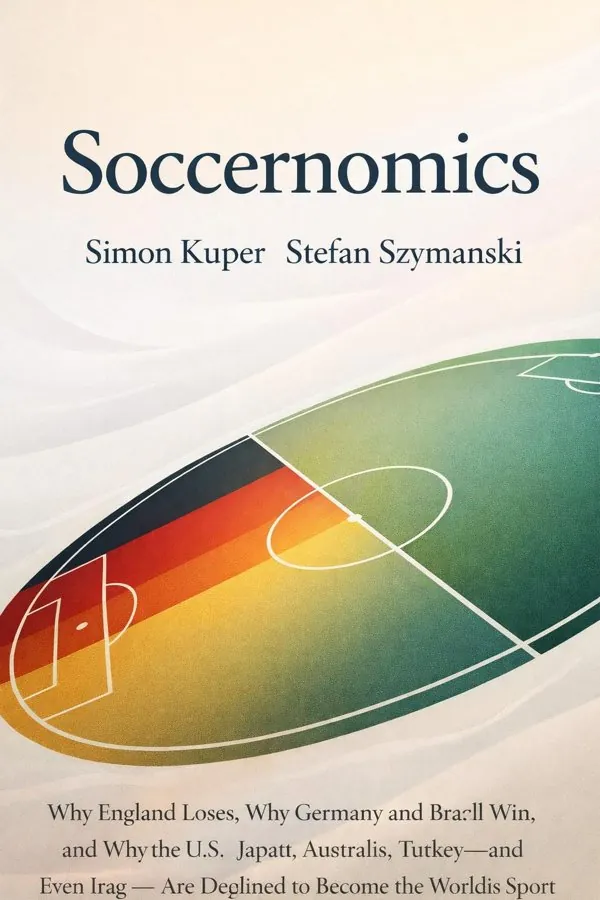
Soccernomics: Why England Loses, Why Germany and Brazil Win, and Why the U.S., Japan, Australia, Turkey—and Even Iraq—Are Destined to Become the Kings of the World’s Most Popular Sport: Summary & Key Insights
by Simon Kuper, Stefan Szymanski
 10 min10 chaptersAudio available
What Is Soccernomics: Why England Loses, Why Germany and Brazil Win, and Why the U.S., Japan, Australia, Turkey—and Even Iraq—Are Destined to Become the Kings of the World’s Most Popular Sport About?
Soccernomics: Why England Loses, Why Germany and Brazil Win, and Why the U.S., Japan, Australia, Turkey—and Even Iraq—Are Destined to Become the Kings of the World’s Most Popular Sport by Simon Kuper, Stefan Szymanski is a economics book spanning 10 pages. Soccernomics is a groundbreaking exploration of the world’s most popular sport through the lens of economics and data analysis. Simon Kuper and Stefan Szymanski use statistics, behavioral economics, and historical insight to challenge conventional wisdom about soccer. They explain why certain nations succeed or fail, how clubs can make smarter transfer decisions, and what the sport reveals about globalization and human behavior.
This FizzRead summary covers all 10 key chapters of Soccernomics: Why England Loses, Why Germany and Brazil Win, and Why the U.S., Japan, Australia, Turkey—and Even Iraq—Are Destined to Become the Kings of the World’s Most Popular Sport in approximately 10 minutes, distilling the most important ideas, arguments, and takeaways from Simon Kuper, Stefan Szymanski's work. Also available as an audio summary and Key Quotes Podcast.
Soccernomics: Why England Loses, Why Germany and Brazil Win, and Why the U.S., Japan, Australia, Turkey—and Even Iraq—Are Destined to Become the Kings of the World’s Most Popular Sport
Soccernomics is a groundbreaking exploration of the world’s most popular sport through the lens of economics and data analysis. Simon Kuper and Stefan Szymanski use statistics, behavioral economics, and historical insight to challenge conventional wisdom about soccer. They explain why certain nations succeed or fail, how clubs can make smarter transfer decisions, and what the sport reveals about globalization and human behavior.
Who Should Read Soccernomics: Why England Loses, Why Germany and Brazil Win, and Why the U.S., Japan, Australia, Turkey—and Even Iraq—Are Destined to Become the Kings of the World’s Most Popular Sport?
This book is perfect for anyone interested in economics and looking to gain actionable insights in a short read. Whether you're a student, professional, or lifelong learner, the key ideas from Soccernomics: Why England Loses, Why Germany and Brazil Win, and Why the U.S., Japan, Australia, Turkey—and Even Iraq—Are Destined to Become the Kings of the World’s Most Popular Sport by Simon Kuper, Stefan Szymanski will help you think differently.
- ✓Readers who enjoy economics and want practical takeaways
- ✓Professionals looking to apply new ideas to their work and life
- ✓Anyone who wants the core insights of Soccernomics: Why England Loses, Why Germany and Brazil Win, and Why the U.S., Japan, Australia, Turkey—and Even Iraq—Are Destined to Become the Kings of the World’s Most Popular Sport in just 10 minutes
Want the full summary?
Get instant access to this book summary and 100K+ more with Fizz Moment.
Get Free SummaryAvailable on App Store • Free to download
Key Chapters
In the beginning, soccer was just a game played in muddy fields across northern England, a pastime with local rules and no sense of empire. Then came industrialization, railways, and newspapers—the veins and nerves of modern society—and soccer spread from town to town, then from continent to continent. What fascinates us as economists is how this simple game mirrored globalization itself. Soccer was the first truly international cultural product, carrying British industrial patterns far beyond its birthplace.
When we examined the history, we found that national identities became entangled with soccer’s evolution. Argentina and Brazil didn’t just adopt British football—they transformed it. The improvisational style that we now call ‘Brazilian flair’ was as much a cultural adaptation as a tactical one. Nations began to see their footballing styles as reflections of their character: Brazil’s creativity, Germany’s precision, England’s stubborn pride. These identities shaped not only sport but diplomacy. Victories became symbols of emerging national strength, losses occasions for cultural introspection.
By recognizing that history, we see why national football remains so emotionally charged. But beneath the flags lies a set of economic mechanisms: investment in youth systems, organization, access to infrastructure. A country’s success seldom stems from its emotional character—it arises from predictably measurable conditions: wealth, education, stability, and openness. Soccer’s globalization thus follows the same curve as trade and migration. This realization underpins every argument in *Soccernomics*: the game is not separate from the world—it *is* the world.
Our story of England’s persistent footballing disappointment is as much cultural as analytical. The numbers, quite simply, do not lie: England has the population, wealth, and infrastructure to succeed, yet its returns are chronically below expectation. The reason, we argue, is psychological and institutional. English football still glories in the myth of the heroic amateur, the player who ‘gives his all’ rather than the one whose game intelligence is superior. This distrust of cleverness—of theory, of data, of foreign innovation—keeps English football emotionally rich but strategically impoverished.
For decades, English clubs invested heavily in short-term passion rather than structured planning. Managers were chosen for charisma, not for analytical discipline. The national team, meanwhile, carried an invisible burden of expectation unmatched by any other. The result? A systematic overperformance of emotion and underperformance of reason.
When Stefan analyzed the data on match results, salaries, transfer expenditures, and youth development, one pattern emerged clearly: England was wasting resources because it refused to learn. By contrast, nations like Germany rebuilt themselves after failure by studying systems—adopting academy models, investing in research, and training technically adept players rather than merely spirited ones. The 2006 German turnaround was a case study in applied economics within sport. England could have done the same—but culture resisted statistics.
As we guide readers through this analysis, the message becomes both humbling and hopeful: success in soccer begins when pride yields to learning. The England story teaches that tradition without introspection leads to stagnation; numbers, when embraced rather than feared, can resurrect a fallen giant.
+ 8 more chapters — available in the FizzRead app
All Chapters in Soccernomics: Why England Loses, Why Germany and Brazil Win, and Why the U.S., Japan, Australia, Turkey—and Even Iraq—Are Destined to Become the Kings of the World’s Most Popular Sport
About the Authors
Simon Kuper is a British journalist and author known for his work on sports and culture, writing for the Financial Times. Stefan Szymanski is a British economist and professor specializing in sports economics at the University of Michigan. Together, they bring analytical rigor and wit to the study of soccer’s global dynamics.
Get This Summary in Your Preferred Format
Read or listen to the Soccernomics: Why England Loses, Why Germany and Brazil Win, and Why the U.S., Japan, Australia, Turkey—and Even Iraq—Are Destined to Become the Kings of the World’s Most Popular Sport summary by Simon Kuper, Stefan Szymanski anytime, anywhere. FizzRead offers multiple formats so you can learn on your terms — all free.
Available formats: App · Audio · PDF · EPUB — All included free with FizzRead
Download Soccernomics: Why England Loses, Why Germany and Brazil Win, and Why the U.S., Japan, Australia, Turkey—and Even Iraq—Are Destined to Become the Kings of the World’s Most Popular Sport PDF and EPUB Summary
Key Quotes from Soccernomics: Why England Loses, Why Germany and Brazil Win, and Why the U.S., Japan, Australia, Turkey—and Even Iraq—Are Destined to Become the Kings of the World’s Most Popular Sport
“In the beginning, soccer was just a game played in muddy fields across northern England, a pastime with local rules and no sense of empire.”
“Our story of England’s persistent footballing disappointment is as much cultural as analytical.”
Frequently Asked Questions about Soccernomics: Why England Loses, Why Germany and Brazil Win, and Why the U.S., Japan, Australia, Turkey—and Even Iraq—Are Destined to Become the Kings of the World’s Most Popular Sport
Soccernomics: Why England Loses, Why Germany and Brazil Win, and Why the U.S., Japan, Australia, Turkey—and Even Iraq—Are Destined to Become the Kings of the World’s Most Popular Sport by Simon Kuper, Stefan Szymanski is a economics book that explores key ideas across 10 chapters. Soccernomics is a groundbreaking exploration of the world’s most popular sport through the lens of economics and data analysis. Simon Kuper and Stefan Szymanski use statistics, behavioral economics, and historical insight to challenge conventional wisdom about soccer. They explain why certain nations succeed or fail, how clubs can make smarter transfer decisions, and what the sport reveals about globalization and human behavior.
You Might Also Like

Business Adventures
John Brooks
10 min
Nudge
Richard H. Thaler, Cass R. Sunstein
10 min
The Hitchhiker"s Guide to the Galaxy
Douglas Adams
10 minThe Muqaddimah
Ibn Khaldun
10 minThe Outsiders
William N. Thorndike
10 min
A Little History of Economics
Niall Kishtainy
10 minBrowse by Category
Ready to read Soccernomics: Why England Loses, Why Germany and Brazil Win, and Why the U.S., Japan, Australia, Turkey—and Even Iraq—Are Destined to Become the Kings of the World’s Most Popular Sport?
Get the full summary and 100K+ more books with Fizz Moment.