
Smile: Summary & Key Insights
 10 min9 chaptersAudio available
Key Takeaways from Smile
One of the most unsettling truths of growing up is that ordinary life can break open in a moment.
Physical pain is often easiest to describe, but emotional pain is usually what lingers.
Few things matter more to adolescents than the fear of looking wrong.
Growing up often means discovering that not every friendship deserves to grow with you.
Independence may be a teenage goal, but survival often depends on support.
What Is Smile About?
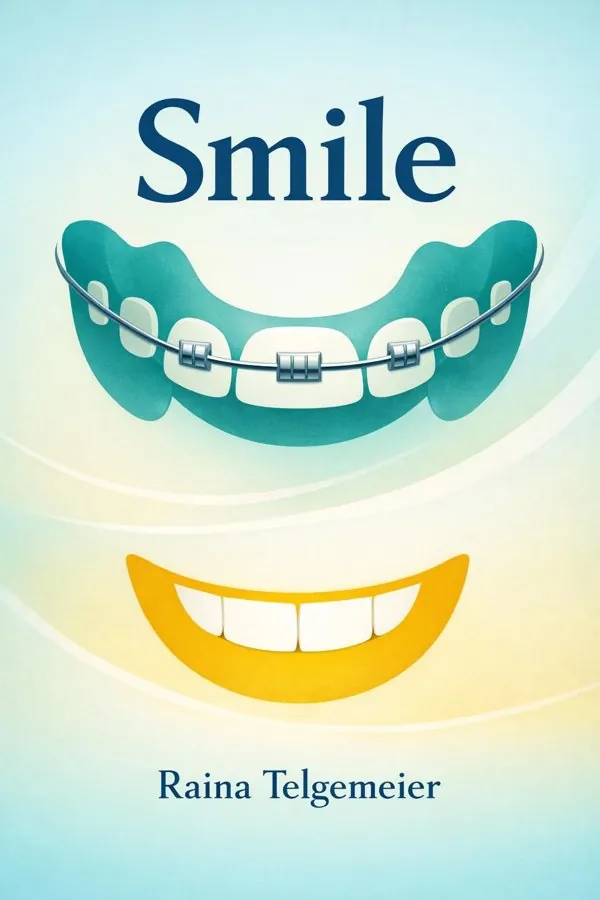
Smile by Raina Telgemeier is a bestsellers book spanning 15 pages. What looks like a simple story about dental drama quickly becomes something far deeper in Smile, Raina Telgemeier’s bestselling graphic memoir about pain, identity, and growing up under pressure. The book begins with a childhood accident that badly injures Raina’s front teeth, but the real story unfolds over the years that follow: surgeries, braces, headgear, embarrassing school days, fragile friendships, family tensions, crushes, and the slow work of learning to feel comfortable in her own skin. Telgemeier turns an intensely personal experience into a universal coming-of-age story, showing how physical setbacks often expose emotional ones that were already there. What makes Smile matter is not just its honesty, but its accessibility. Through expressive artwork, humor, and emotional clarity, Telgemeier captures the awkwardness of adolescence with unusual precision. She writes with the authority of lived experience and the craft of a master cartoonist, creating a memoir that resonates with middle-grade readers, teens, and adults alike. Smile is ultimately about more than fixing teeth; it is about rebuilding confidence, recognizing unhealthy relationships, and discovering that self-worth cannot depend on appearance alone.
This FizzRead summary covers all 9 key chapters of Smile in approximately 10 minutes, distilling the most important ideas, arguments, and takeaways from Raina Telgemeier's work. Also available as an audio summary and Key Quotes Podcast.
Smile
What looks like a simple story about dental drama quickly becomes something far deeper in Smile, Raina Telgemeier’s bestselling graphic memoir about pain, identity, and growing up under pressure. The book begins with a childhood accident that badly injures Raina’s front teeth, but the real story unfolds over the years that follow: surgeries, braces, headgear, embarrassing school days, fragile friendships, family tensions, crushes, and the slow work of learning to feel comfortable in her own skin. Telgemeier turns an intensely personal experience into a universal coming-of-age story, showing how physical setbacks often expose emotional ones that were already there. What makes Smile matter is not just its honesty, but its accessibility. Through expressive artwork, humor, and emotional clarity, Telgemeier captures the awkwardness of adolescence with unusual precision. She writes with the authority of lived experience and the craft of a master cartoonist, creating a memoir that resonates with middle-grade readers, teens, and adults alike. Smile is ultimately about more than fixing teeth; it is about rebuilding confidence, recognizing unhealthy relationships, and discovering that self-worth cannot depend on appearance alone.
Who Should Read Smile?
This book is perfect for anyone interested in bestsellers and looking to gain actionable insights in a short read. Whether you're a student, professional, or lifelong learner, the key ideas from Smile by Raina Telgemeier will help you think differently.
- ✓Readers who enjoy bestsellers and want practical takeaways
- ✓Professionals looking to apply new ideas to their work and life
- ✓Anyone who wants the core insights of Smile in just 10 minutes
Want the full summary?
Get instant access to this book summary and 100K+ more with Fizz Moment.
Get Free SummaryAvailable on App Store • Free to download
Key Chapters
One of the most unsettling truths of growing up is that ordinary life can break open in a moment. At the beginning of Smile, Raina is a fairly typical middle schooler: she worries about friends, wants to fit in, and lives in the familiar in-between space of late childhood and early adolescence. Nothing about her life seems especially dramatic, and that normality matters because it creates the contrast that powers the entire memoir. Then one night, a fall on the sidewalk severely damages her two front teeth, and everything changes.
The accident is not just a physical event. It becomes the trigger for years of appointments, surgeries, orthodontic devices, embarrassment, and emotional uncertainty. Telgemeier shows how a single unexpected moment can reshape how a young person sees her body, her future, and her place among peers. The power of the story lies in how recognizable that feeling is. Even if readers have never experienced a dental injury, they understand what it means to have life suddenly feel different from everyone else’s.
This idea has practical relevance beyond the book. Many people go through an abrupt change in childhood or adolescence: an injury, a move, a family crisis, a health issue, or a social rupture. What Smile demonstrates is that disruption does not erase identity, but it does force growth. The challenge is learning to adapt without letting the event define your entire sense of self.
Actionable takeaway: When life changes suddenly, resist the urge to measure yourself against who you were before. Focus instead on what support, habits, and perspectives will help you move forward from where you are now.
Physical pain is often easiest to describe, but emotional pain is usually what lingers. After Raina’s accident, the obvious problem is her damaged teeth. She needs emergency care, dental reconstruction, and years of follow-up treatment. But Smile makes clear that the harder part is not always the procedures themselves. It is the shame, anxiety, and constant self-consciousness that surround them. Her mouth becomes something she must think about every day, and that ongoing awareness changes how she speaks, smiles, and interacts with others.
Telgemeier captures how a medical issue can expand into an identity issue. Braces, retainers, surgery, and headgear are not just tools for treatment; in middle school, they become social markers. Raina worries about how she looks, how others interpret her appearance, and whether she can still be seen as normal or attractive. This is especially painful because adolescence is already a time when many young people feel watched and judged.
The memoir also reminds readers that emotional distress does not need to look dramatic to be real. Embarrassment, insecurity, dread before an appointment, or the exhaustion of explaining your situation over and over can wear a person down. For parents, teachers, and friends, Smile is a useful reminder that when someone is dealing with a visible health challenge, the invisible impact may be just as significant.
In daily life, this applies to anyone carrying a burden others can partially see but not fully understand. Support often begins with empathy rather than advice.
Actionable takeaway: When facing a physical struggle, pay attention to the emotional story growing around it. Naming fear, shame, or frustration can be the first step toward not letting those feelings control you.
Few things matter more to adolescents than the fear of looking wrong. Smile explores this with unusual honesty through Raina’s long battle with self-image. Her dental procedures make her feel exposed at exactly the stage of life when she most wants to blend in. She is not simply dealing with braces; she is dealing with the social meaning attached to every visible difference. A changed smile becomes, in her mind, a changed self.
What makes this idea powerful is that Telgemeier does not dismiss appearance as trivial. She acknowledges that how we look affects how we feel, especially when peers are quick to judge. That honesty gives the memoir emotional credibility. At the same time, the book gradually shows that confidence built only on appearance is unstable. Raina’s emotional healing does not happen the moment her teeth improve. It happens as she becomes more aware of her values, her boundaries, and the kind of people she wants around her.
This is a helpful distinction for readers of any age. There is nothing shallow about wanting to feel comfortable in your body. But trouble starts when self-worth becomes dependent on external perfection or social approval. Many readers will recognize this pattern in their own lives: obsessing over a hairstyle, skin issue, weight fluctuation, clothing choice, or other visible feature, while overlooking the deeper question of how they are treating themselves.
A practical application is to separate care from judgment. Taking care of your appearance can be healthy; equating appearance with value is not. Smile gently encourages that separation.
Actionable takeaway: Notice when concern about appearance turns into a verdict about your worth. Replace “How do I look to others?” with “How do I want to feel and show up in the world?”
Growing up often means discovering that not every friendship deserves to grow with you. In Smile, Raina’s social world is as important as her dental journey. As she moves through middle school, she becomes increasingly aware that some of her friendships are not supportive at all. Her friend group includes teasing, cruelty, insecurity, and pressure to conform. These dynamics are easy to excuse at first because they are familiar, but familiarity does not make them healthy.
Telgemeier shows how toxic friendships often operate subtly. No single moment may seem serious enough to justify leaving, yet the cumulative effect is draining. Raina is mocked, made to feel small, and pushed to accept behavior that does not align with who she is. Her growth begins when she starts trusting her discomfort instead of dismissing it. That is an important lesson for young readers, who are often taught to preserve friendships at all costs.
The book also highlights a crucial developmental truth: friendships are not just companions to growth; they actively shape it. The people around us influence how confident we feel, how safe we feel expressing ourselves, and how much we compromise to stay included. This is especially relevant in adolescence, but it remains true in adulthood, in workplaces, social circles, and online communities.
Practically, Smile encourages readers to ask better questions about their relationships. Do your friends celebrate you or tolerate you? Can you be honest with them? Do you leave interactions feeling energized or diminished? These are simple but revealing tests.
Actionable takeaway: Treat persistent discomfort in a friendship as useful information. If a relationship regularly undermines your confidence or values, give yourself permission to step back and make room for healthier connections.
Independence may be a teenage goal, but survival often depends on support. Throughout Smile, Raina’s parents and siblings provide a crucial emotional backdrop to her ordeal. They drive her to appointments, react to setbacks, witness her frustration, and help normalize a situation that might otherwise feel isolating. Family life is not portrayed as flawless or sentimental; there are tensions, annoyances, and ordinary conflicts. That realism is part of the book’s strength. Support does not have to be perfect to be meaningful.
Telgemeier illustrates that practical care and emotional care often work together. A parent scheduling yet another orthodontist appointment may not seem like a dramatic act of love, but over time these repeated efforts become evidence of steadiness. In moments when Raina feels embarrassed, discouraged, or angry, her family’s presence gives structure to the chaos. They cannot eliminate the pain, but they help carry it.
This idea applies broadly because many forms of resilience are relational. Whether the support comes from family, mentors, friends, or caregivers, people cope better when they do not have to face ongoing stress alone. For young readers, Smile can also be a quiet reminder to notice the care that often operates in the background. For adults, it is a reminder that consistency matters more than grand speeches. Showing up repeatedly is powerful.
A practical lesson here is that support should be specific. General sympathy helps, but concrete actions help more: rides, check-ins, listening without minimizing, remembering dates, or simply sitting with someone before a difficult event.
Actionable takeaway: If someone you care about is going through a prolonged challenge, offer steady, practical support rather than waiting for a dramatic moment. Small acts repeated over time can become a lifeline.
Sometimes the clearest way to process life is to turn it into art. Although Smile centers on dental trauma and adolescence, it also quietly traces Raina’s growing relationship with creativity, especially drawing. Her artistic interest is not presented as a grand solution that fixes everything. Instead, it functions as a tool for observation, self-expression, and meaning-making. In a life filled with awkwardness, discomfort, and uncertainty, creativity gives her a space where she can shape experience instead of just endure it.
This matters because adolescence is often emotionally crowded but verbally limited. Young people may feel intense confusion without having the language to explain it. Art, journaling, music, comics, and other creative outlets can bridge that gap. Telgemeier’s memoir itself is proof of this process: by illustrating her younger self, she transforms painful memories into a story that is funny, compassionate, and widely relatable.
The practical lesson is not that everyone needs to become an artist, but that expression creates perspective. When people externalize experience, they often see patterns more clearly. A sketch of a stressful day, a page in a journal after an argument, or a playlist made during a difficult period can reveal emotions that were previously tangled. Creativity can also restore agency. When life feels like something happening to you, making something from it reminds you that you still have a voice.
Readers can apply this idea in simple ways. A middle schooler dealing with social stress might draw comic strips about school. An adult revisiting painful memories might write short reflections or record voice notes. The point is not polish; it is clarity.
Actionable takeaway: Use a creative practice to process one difficult experience this week. Draw it, write it, map it, or narrate it. Expression may not erase pain, but it can help turn confusion into understanding.
We often imagine recovery as a straight line: treatment begins, improvement follows, life returns to normal. Smile rejects that fantasy. Raina’s dental journey unfolds over years, with setbacks, delays, discomfort, and periods of uncertainty. Procedures that seem like they should solve the problem often lead to new complications or more waiting. This uneven rhythm is one of the memoir’s most realistic features. Real healing, whether physical or emotional, is rarely tidy.
The book’s structure reinforces this idea. Raina does not become stronger all at once. Her confidence rises and falls. Some days she seems adaptable and hopeful; on others, she is overwhelmed or deeply self-conscious. That fluctuation does not mean she is failing. It means she is human. Telgemeier normalizes the fact that progress can include frustration, regression, and exhaustion.
This is especially valuable for readers living through long-term change. Someone recovering from illness, grief, burnout, bullying, or family disruption may wrongly assume that bad days cancel out all the good work already done. Smile offers a gentler framework: improvement can be real even when it is incomplete. Endurance is not always dramatic. Sometimes it looks like returning to the orthodontist again, going back to school again, and trying once more to trust that things will eventually feel easier.
A practical application is to measure progress more honestly. Instead of asking, “Am I done healing?” ask, “What can I handle now that I could not handle before?” That question acknowledges growth without demanding perfection.
Actionable takeaway: When your progress feels slow, document small signs of change. Notice increased patience, stronger boundaries, reduced fear, or greater self-awareness. Recovery becomes easier to trust when you learn to recognize subtle gains.
A major turning point in Smile comes when Raina stops trying so hard to earn acceptance from people who do not treat her well. This shift is not loud or dramatic, but it is transformative. She begins distancing herself from negative influences and becomes more willing to choose authenticity over approval. In narrative terms, this is where the memoir moves from endurance to agency.
The deeper lesson is that maturity often begins with boundaries. As children, many of us are taught to prioritize harmony, stay agreeable, and avoid exclusion. But without boundaries, those instincts can lead us into relationships where we accept disrespect simply to stay connected. Raina’s experience shows that saying no, stepping back, or emotionally disengaging from harmful dynamics is not selfish; it is healthy.
The book also links boundaries to identity. Once Raina loosens her attachment to the wrong social circle, she becomes more available to people who genuinely appreciate her. Her transition into high school symbolizes more than a new setting. It represents the possibility of a social world where she does not have to shrink herself. This is encouraging for readers who fear that their current environment defines their future.
In practical terms, boundaries can look simple: declining to join mean behavior, limiting time with draining people, refusing to laugh at cruelty, or seeking out communities where kindness is normal. For younger readers, this may be one of the most important takeaways in the book. For adults, it is a reminder that healthy belonging never requires self-betrayal.
Actionable takeaway: Identify one relationship or group dynamic where you regularly silence yourself to fit in. Decide on one clear boundary you can set, even if it is small, and practice holding it.
By the end of Smile, the restoration of Raina’s teeth matters, but it is not the whole victory. The final dental procedures parallel emotional healing, yet the memoir’s deeper resolution lies in self-acceptance. Raina has changed not only because her smile is improved, but because she has learned to see herself differently. She is more confident, more discerning about friendships, and less dependent on external validation. The repaired smile becomes symbolic: not proof of perfection, but evidence of resilience.
This distinction is central to the book’s main message. Confidence is often imagined as a feeling that appears after all visible flaws are fixed. Telgemeier suggests something wiser. Real confidence emerges when a person stops treating imperfection as disqualifying. Raina’s story is not about becoming flawless enough to belong. It is about recognizing that belonging should never have required flawlessness in the first place.
That message is useful for anyone navigating adolescence, recovery, or self-doubt. Many people postpone self-acceptance until after some imagined future improvement: when they look better, perform better, earn more, or become more impressive. Smile gently argues that this postponement keeps people trapped. External changes can help, but they cannot substitute for an internal decision to live with greater honesty and compassion.
Practically, self-acceptance can start with language. Instead of narrating yourself through deficiency, describe yourself through growth. Instead of “I’m a mess,” try “I’m in process.” Instead of “I’m behind,” try “I’m learning.” These are not clichés; they are more accurate and less cruel.
Actionable takeaway: Choose one insecurity that has shaped how you see yourself and rewrite the story around it. Ask not how to hide it, but what it has taught you about resilience, empathy, or strength.
All Chapters in Smile
About the Author
Raina Telgemeier is an American cartoonist, graphic novelist, and one of the most influential creators in contemporary children’s literature. She is best known for autobiographical and emotionally resonant works such as Smile, Sisters, and Guts, as well as acclaimed titles like Drama and Ghosts. Telgemeier also helped introduce many young readers to graphic storytelling through her adaptations of The Baby-Sitters Club. Her work is celebrated for its expressive art, humor, and remarkable ability to capture the emotional realities of childhood and adolescence. Drawing frequently from personal experience, she creates stories that feel intimate, honest, and widely relatable. Telgemeier has received multiple Eisner Awards and has played a major role in bringing graphic novels into classrooms, libraries, and mainstream literary culture.
Get This Summary in Your Preferred Format
Read or listen to the Smile summary by Raina Telgemeier anytime, anywhere. FizzRead offers multiple formats so you can learn on your terms — all free.
Available formats: App · Audio · PDF · EPUB — All included free with FizzRead
Download Smile PDF and EPUB Summary
Key Quotes from Smile
“One of the most unsettling truths of growing up is that ordinary life can break open in a moment.”
“Physical pain is often easiest to describe, but emotional pain is usually what lingers.”
“Few things matter more to adolescents than the fear of looking wrong.”
“Growing up often means discovering that not every friendship deserves to grow with you.”
“Independence may be a teenage goal, but survival often depends on support.”
Frequently Asked Questions about Smile
Smile by Raina Telgemeier is a bestsellers book that explores key ideas across 9 chapters. What looks like a simple story about dental drama quickly becomes something far deeper in Smile, Raina Telgemeier’s bestselling graphic memoir about pain, identity, and growing up under pressure. The book begins with a childhood accident that badly injures Raina’s front teeth, but the real story unfolds over the years that follow: surgeries, braces, headgear, embarrassing school days, fragile friendships, family tensions, crushes, and the slow work of learning to feel comfortable in her own skin. Telgemeier turns an intensely personal experience into a universal coming-of-age story, showing how physical setbacks often expose emotional ones that were already there. What makes Smile matter is not just its honesty, but its accessibility. Through expressive artwork, humor, and emotional clarity, Telgemeier captures the awkwardness of adolescence with unusual precision. She writes with the authority of lived experience and the craft of a master cartoonist, creating a memoir that resonates with middle-grade readers, teens, and adults alike. Smile is ultimately about more than fixing teeth; it is about rebuilding confidence, recognizing unhealthy relationships, and discovering that self-worth cannot depend on appearance alone.
You Might Also Like

The Godfather
Mario Puzo
10 min
The Handmaid's Tale
Margaret Atwood
10 min
The Hunger Games
Suzanne Collins
10 min
The Nightingale
Kristin Hannah
10 min
The Seven Husbands of Evelyn Hugo
Taylor Jenkins Reid
10 min
Backwater Justice
Fern Michaels
10 minBrowse by Category
Ready to read Smile?
Get the full summary and 100K+ more books with Fizz Moment.